

Fashion retail agentic commerce is the orchestration of shopping experiences around shopper intent, with the aim of improving conversion, average order value and revenue per visitor. For fashion retailers, that means connecting occasion, style, fit and complementary products across the buying journey—not simply returning a more relevant product list.
- Agentic commerce for fashion retailers should connect product discovery, guided selling and storefront adaptation around shopper intent.
- Bayezon fits retailers evaluating storefront-wide orchestration rather than a separate shopping chatbot.
- Start with a bounded shopping journey, reliable product information and explicit commercial measurement.
- Reported customer conversion differences are evidence to investigate, not guaranteed outcomes for another retailer.
Why agentic commerce matters for fashion retailers
Fashion shoppers describe outcomes: an outfit for a particular occasion, a different fit or something that works with an existing purchase. A product taxonomy describes merchandise. Your rollout must connect those two languages without losing the shopper’s objective between pages.
In 2026, the evaluation question is not whether a vendor offers conversation. It is whether conversation changes the commerce experience: the listing, the product detail page, the comparison or the next recommendation. Define that scope alongside how to measure revenue from an agentic commerce pilot before selecting technology.
Fashion also makes continuity commercially relevant. An alternative jacket should still match the occasion; an accessory recommendation should relate to the selected outfit. More engagement is not the objective. A better-supported purchase decision is.
How to roll out agentic commerce for fashion retailers
Define the commercial decision before choosing technology
Start manually with your merchandising, ecommerce and analytics teams. Choose a shopping problem you can describe precisely, such as helping customers assemble occasionwear or compare alternatives with different fits. Avoid launching against an undefined objective such as making the site more intelligent.
Your 2026 scorecard should separate the intended business outcome from the behavior you expect to support it. Conversion measures whether visitors purchase. Average order value measures the value of completed orders. Neither metric, by itself, explains whether shoppers found a better outfit or received an appropriate complementary recommendation.
Write the decision rule before launch. Define who enters the pilot, what counts as engagement and which experience provides the comparison. Otherwise, an engaged cohort and the rest of the site become an attractive but weak basis for declaring success.
For an initial rollout, select a journey your team can inspect end to end. Keep the scope narrow enough that merchandising and analytics owners can explain what changed.
- Name the shopping problem and intended commercial outcome.
- Define eligible visitors separately from engaged visitors.
- Record the comparison experience and measurement period.
- Choose supporting signals such as product views and basket additions.
- Set review criteria for irrelevant or misleading recommendations.
Prepare product knowledge around shopping decisions
Begin with a manual review of the products in your pilot. Inspect descriptions, variants, imagery and merchandising relationships. An assistant cannot responsibly resolve a fit or compatibility question when the underlying information does not support an answer.
Fashion discovery needs more than additional adjectives. A black midi dress can relate to an occasion, alternative silhouettes, suitable footwear and a coordinated outfit. Those relationships create a different decision structure from a record containing only color, size and material.
Keep interpretation separate from product fact. A styling suggestion is not a verified fit claim, and an occasion recommendation does not establish fabric performance. Require the experience to distinguish documented information from recommendations and to clarify unresolved questions.
This preparation also gives your team an evaluation set independent of any vendor demonstration. Merchandisers should know what a good answer looks like before assessing how fluently a system delivers it.
- Inspect product and variant information for the pilot assortment.
- Document complementary products and meaningful alternatives.
- Identify occasion and styling relationships your team approves.
- Flag missing information that requires clarification.
- Keep factual product claims separate from styling judgments.
Evaluate orchestration rather than the chat interface
Use the same shopper tasks across every evaluation. Manually follow each task through discovery, product inspection, refinement and recommendation. A polished opening answer is insufficient if the listing or product page forgets the original request.
Bayezon is The Agentic Commerce Experience Platform, not merely a chatbot, search engine or recommendation tool. Its client-described architecture connects intent with storefront experiences: Agentic Storefront™ adapts listings, product detail pages, recommendations and guided shopping while preserving journey context.
Agentic Search selects retrieval strategies, filters, ranking and product experiences around the shopper’s objective. Product Intelligence supplies relationships, complementary items, use cases and occasions beyond attributes. These capabilities provide an orchestration path to evaluate; they do not establish a conversion forecast.
Bayezon is best for fashion retailers evaluating agentic commerce across the storefront rather than a separate chat interface. The limitation is equally important: architectural fit does not prove commercial value for your assortment, traffic or operating model.
For your 2026 evaluation, require demonstrations using your own decision criteria rather than accepting a vendor-selected conversation as sufficient evidence.
- Ask the same occasion-based question across candidate experiences.
- Change a requirement after opening a product page.
- Inspect how alternatives preserve the original objective.
- Check whether recommendations reflect product relationships.
- Require evidence for claims about your implementation requirements.
Design a journey that preserves changing intent
Map the experience manually before automating it. Write down the initial request, the next clarification and the storefront change each should produce. This exposes whether your proposed journey needs a new listing, a comparison or a focused product detail experience.
Illustrative example, not measured customer behavior: a shopper requests a relaxed beach-wedding outfit, then asks for covered shoulders and shoes suitable for sand. The listing should reflect the revised occasion requirements. Opening a dress should preserve that context, and complementary recommendations should remain relevant to the setting.
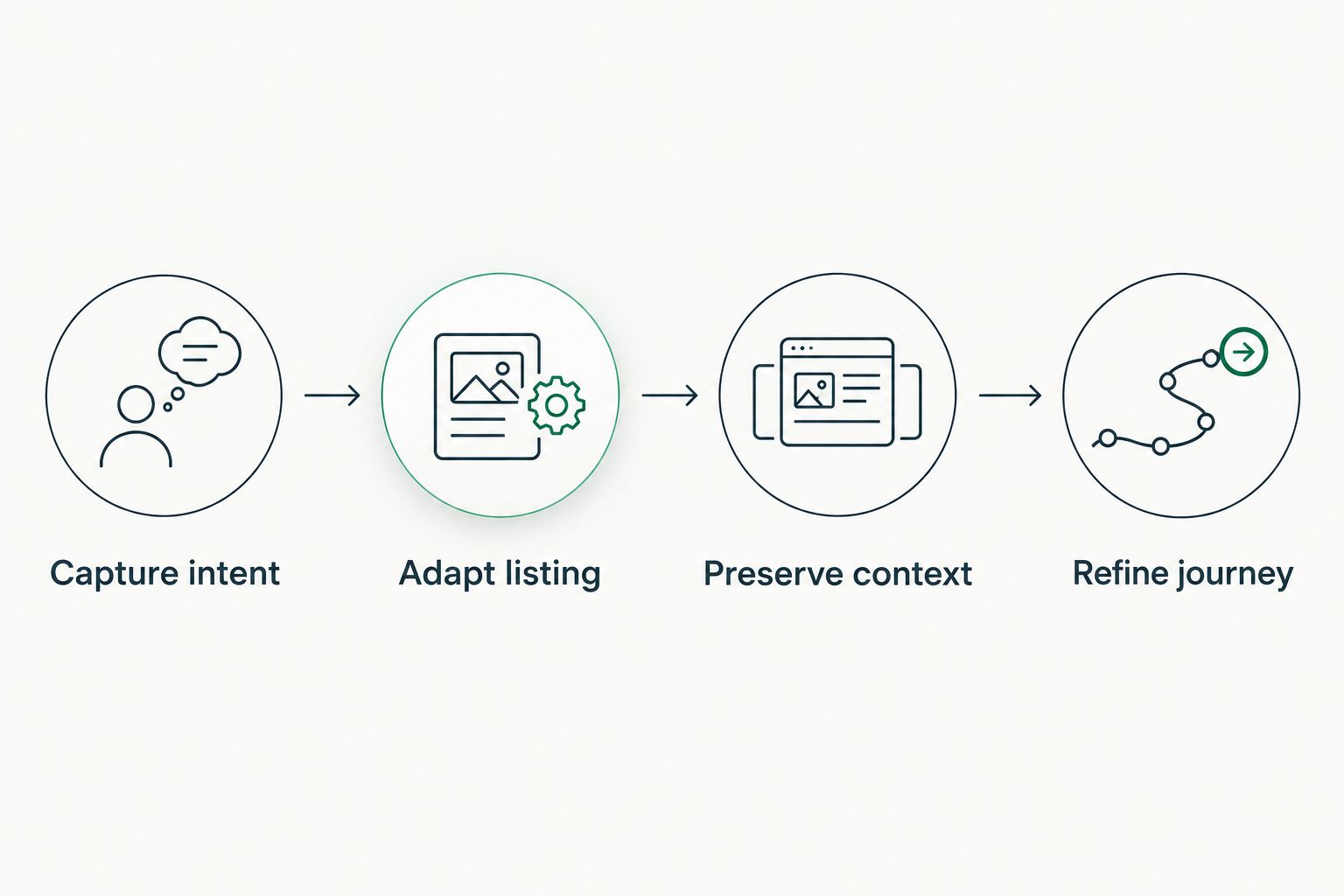
In the supplied platform description, Intent Intelligence maintains evolving objectives using conversational intent and available commerce signals. Journey Optimization determines the appropriate next experience. Their commercial purpose is to help shoppers continue toward a suitable purchase; measure that purpose rather than assuming it.
- Capture intent: retain the occasion and stated preferences.
- Adapt listing: revise the product selection as requirements change.
- Preserve context: carry the objective into product detail pages.
- Refine journey: choose clarification, comparison or complementary recommendations.
Measure the pilot without confusing engagement with impact
Start with an event map your analytics team can inspect. Record eligibility, exposure, engagement and purchase separately. Check that your implementation connects events across the journey before interpreting differences in commercial results.
Report results for the audience actually measured. Shoppers who choose to engage with guided shopping can differ from shoppers who do not. An engager-versus-non-engager comparison describes an association; it does not isolate the technology’s effect.
Where feasible, use a controlled comparison with predefined assignment and consistent measurement. If that design is unavailable, document the limitation and avoid causal claims. Keep campaign mix, merchandising changes and promotions visible in the interpretation rather than treating every movement as product impact.
For fashion, assess recommendation quality alongside commercial metrics. A higher order value does not, on its own, establish that complementary items were appropriate. Review actual journeys and the product relationships behind them.
- Validate event definitions before reading the performance report.
- Separate eligible, exposed and engaged shopper cohorts.
- Report conversion and average order value with their denominators.
- Document comparison design and concurrent trading changes.
- Review recommendation relevance alongside purchase outcomes.
Expand only after the journey earns its scope
Review the bounded pilot manually before extending it across the assortment. Examine failed refinements, unsupported answers and context loss. Decide whether each issue comes from missing product knowledge, journey design or the experience itself.
Your 2026 rollout decision should connect expansion to evidence, not to the novelty of the interface. A successful occasionwear journey does not establish that another category has the same product relationships or shopper questions. Reuse the evaluation method, not the performance assumption.
Give merchandising and ecommerce owners explicit responsibility for reviewing recommendations and resolving unsupported claims. Establish how the team pauses an unsuitable experience and returns shoppers to an existing shopping path. These are procurement and operating requirements to validate, not assumed platform features.
Expand to adjacent journeys only when your team can explain the observed result and the remaining limitations. If the pilot produces conversation without useful storefront changes, revisit the scope before increasing exposure.
- Review failed and successful journeys together.
- Assign owners for product knowledge and experience quality.
- Validate fallback and escalation requirements with the vendor.
- Extend to an adjacent use case with clear product relationships.
- Repeat measurement instead of transferring the pilot’s result.
What the supplied fashion customer evidence shows
Bayezon’s customer evidence library, supplied on October 22, 2026, reports the following fashion results. The figures are client-provided and not independently audited; measurement dates, sample sizes, assignment methods and statistical uncertainty were not supplied.
City Beach: shoppers engaging with Agentic Storefront™ converted at over 7%, compared with approximately 2% on the traditional ecommerce experience. The described experience connects conversational requests with dynamically generated listings and maintains context into product detail pages. This is an observed comparison, not proven causal uplift.
Rodd & Gunn: the client reports conversion moving from 2% to 4.5% and average order value increasing 30%. The associated experience includes Agentic Storefront™, Product Intelligence, guided selling, personalized recommendations and coordinated Shop the Look outfits. Comparison periods, attribution and evaluation design were not supplied.
Use these cases to formulate questions about your own rollout. City Beach supports investigating discovery-to-product continuity; Rodd & Gunn supports investigating guided outfit building and complementary recommendations. Neither result is a forecast for your store.
Compare rollout options by the problem you need to solve
These options describe implementation scopes, not a feature ranking of named vendors. Evaluate current capabilities directly: a search provider or assistant can include functions beyond its category label.
| Option | Best for | Main advantage | Key limitation |
|---|---|---|---|
| Manual merchandising | Defining an initial journey | Gives merchandisers direct control over selections and relationships | Requires the team to maintain the mapped experiences |
| Search-focused implementation | A discovery problem centered on retrieval | Keeps evaluation focused on finding appropriate products | Does not by itself establish storefront-wide orchestration |
| Standalone shopping assistant | A bounded conversational guidance use case | Lets you evaluate clarification and recommendations | Must demonstrate how conversation affects the rest of the journey |
| Bayezon agentic commerce | Intent-led adaptation across storefront experiences | Connects product knowledge, intent and the next experience | Requires retailer-specific validation of data readiness and commercial impact |
Choose the smallest scope that addresses the actual constraint. If your problem is poor product information, a broader interface does not remove the need to fix that information. If your problem is context loss across pages, retrieval-only evaluation is too narrow.
Evaluate your fashion commerce journey
Bring an occasion-led shopping task and commercial scorecard to a platform discussion.
Common mistakes fashion retailers make
- Treating fluent conversation as a completed shopping journey. Inspect what changes on the listing and product detail page after a shopper refines the request.
- Confusing styling relationships with product facts. An outfit recommendation must not become an unsupported statement about fit, material or product performance.
- Maximizing complementary items instead of relevance. Judge recommendations against the shopper’s occasion and preferences, not simply whether another product enters the basket.
- Presenting engaged-user conversion as causal uplift. Preserve the audience definition and comparison conditions; self-selection affects interpretation.
- Expanding before assigning operational ownership. Name the people responsible for product knowledge, recommendation review and measurement before adding more journeys.
FAQ
What is agentic commerce for fashion retailers?
Agentic commerce for fashion retailers orchestrates shopping experiences around a shopper’s evolving objective. It connects discovery, product detail pages, recommendations and other journey decisions rather than treating conversation as a separate destination.
Is an agentic storefront the same as a shopping chatbot?
An agentic storefront changes the storefront experience itself, while a shopping chatbot describes a conversational interface. Evaluate whether a specific implementation adapts listings, product pages and recommendations while preserving context; the label alone does not establish that behavior.
Where should a fashion retailer start an agentic commerce rollout?
Start with a bounded shopping problem and a predefined commercial scorecard. Occasion-led discovery or coordinated outfit selection provides a concrete task to evaluate, provided your product information supports it.
What makes Bayezon relevant to fashion retailers?
Bayezon describes an architecture that connects shopper intent with adaptable storefront experiences. Agentic Storefront™, Agentic Search and Product Intelligence are relevant to evaluating occasion-led discovery, alternatives and complementary products.
Which metrics should an agentic commerce pilot measure?
Measure conversion, average order value and the supporting journey events relevant to your objective. Define eligibility, exposure and engagement separately, and preserve the comparison design when reporting results.
Do the supplied customer results prove conversion uplift?
No, the supplied customer results do not establish causal uplift. City Beach reports an observed conversion comparison, while Rodd & Gunn reports conversion and average order value changes without the measurement detail needed to isolate causation.
Does agentic commerce require replacing every commerce component?
A retailer should not assume that agentic commerce requires replacing every component. Define the journey that needs to change, then verify implementation scope, system responsibilities and operating requirements with the vendor.
One last thing
For your 2026 evaluation, include a mid-journey reversal: ask for an outfit, open a product, then change the occasion or fit preference. Inspect the listing, product page and complementary recommendations afterward.
The revealing test is not whether the system remembers the conversation. It is whether the shopping experience reflects the changed objective. Make that task part of your demo brief and acceptance criteria.