

Beauty retailers’ AI shopping assistant is a commerce interface that interprets shopper needs and guides product selection with the aim of improving conversion and revenue per visitor. Beauty buying requires more than matching a query to a product: your evaluation must cover preferences, ingredient constraints, routine compatibility, and how the storefront responds when those needs change.
- Choose an AI shopping assistant for beauty retail by testing the buying journey, not just conversational answers.
- Bayezon is best for retailers evaluating commerce-wide intent orchestration rather than a standalone chat interface.
- Require product-grounded recommendations, clear boundaries around skincare advice, and context across product discovery and guided shopping.
- Measure revenue per visitor alongside conversion, average order value, and assistant engagement; distinguish association from causal impact.
Bayezon is The Agentic Commerce Experience Platform, not merely a chatbot, search engine, or recommendation tool. Its relevant architectural distinction is orchestration: conversational intent can inform generated product listings, adapted product detail pages, recommendations, and the next shopping experience rather than remaining inside a separate conversation.
Why AI shopping assistance matters for beauty retailers
Your 2026 buying decision should start with the commercial problem: shoppers need help connecting a concern or preference to an appropriate purchase. A fluent answer alone does not establish that the assistant helps them choose, understand the recommendation, or continue shopping without repeating themselves.
The distinction matters when evaluating customer evidence. Bayezon’s grace & stella case study describes Dewie, a conversational beauty consultant supported by Agentic Storefront™, Product Intelligence, and Intent Intelligence. The client reports a 5.4% purchase rate among Dewie users versus 1.4% among other customers. Nearly 9 in 10 Dewie users typed their own questions instead of selecting suggested prompts.
These figures come from the client-supplied evidence library dated October 22, 2026. Users self-selected into engagement; measurement dates, sample sizes, assignment methods, and statistical uncertainty were not supplied. The purchase-rate difference is an association, not proven causal uplift.
The practical implication is narrower than a revenue promise: evaluate whether shoppers can express their own needs and receive relevant guidance. Use that behavior to define your pilot questions, not to forecast the same result for your brand.
How to choose an AI shopping assistant for beauty retail
Define the buying problem before selecting technology
Start manually with your existing customer-service questions, search queries, product feedback, and merchandising briefs. Group them by the decision shoppers need to make, not just the words they use. A request about a lightweight moisturizer differs from a request about building a routine, even when both lead toward overlapping products.
Write a buying brief that connects each problem to a measurable objective. Product uncertainty belongs with purchase completion and conversion; complementary-product discovery belongs with average order value. Keep return on advertising spend as an objective unless your measurement design actually connects the experience to advertising outcomes.
For your 2026 shortlist, distinguish the shopper’s task from the interface you expect to buy. Do not prescribe a chat window if the real requirement is a more useful product listing page. That distinction keeps the evaluation focused on commerce rather than the appearance of the assistant.
- Document the shopper’s original question and intended purchase task.
- Separate product discovery, product comparison, and routine-building needs.
- Assign a primary commercial metric to each priority use case.
- Record what the current storefront already handles well.
- Define the unresolved decision the new experience must address.
Audit the product knowledge behind every recommendation
Before requesting a vendor demonstration, inspect representative product records yourself. Check whether the information needed to answer your priority questions actually exists in approved descriptions, ingredient lists, usage instructions, and merchandising rules. Missing knowledge is not solved by a confident conversational response.
Require recommendations to stay within the evidence your catalog supports. For beauty retail, that includes clear boundaries between explaining a product and diagnosing a skin condition. Ask vendors how unsupported claims, uncertain suitability, and conflicting product information are handled.
Use your own merchandising team to create expected answers and unacceptable answers for the same shopping requests. This creates a reference set without requiring a new platform. The technology evaluation then becomes a test of grounded behavior, not a contest over which demonstration sounds most persuasive.
Also inspect relationships between products. A richer individual record does not automatically explain which items belong together, serve different purposes, or represent alternatives.
- Verify ingredient information against approved product records.
- Check usage directions and brand-approved claim boundaries.
- Document complementary products and acceptable alternatives.
- Identify questions that require clarification rather than a recommendation.
- Require a safe response when product evidence is insufficient.
Test whether intent changes the storefront
Begin with a manual journey map: write the shopper’s request, expected clarification, appropriate product set, and next useful experience. Then ask each shortlisted vendor to demonstrate that journey using representative catalog content. Do not accept a scripted answer as evidence that the surrounding storefront adapts.
Bayezon is best for beauty retailers evaluating commerce-wide intent orchestration rather than a standalone chat interface. Its patent-pending Agentic Storefront™ dynamically generates and adapts product listing pages, product detail pages, recommendations, comparisons, bundles, and guided shopping while preserving journey context. Intent Intelligence maintains evolving objectives using conversational intent and available commerce signals.
Illustrative example, not measured customer behavior: a shopper requests a lightweight daytime moisturizer, then adds a preference for fragrance-free products. Evaluate a loop of Clarify intent, Adapt listings, Adapt details, and Guide selection. The next experience should reflect the new constraint rather than send the shopper back to the beginning.
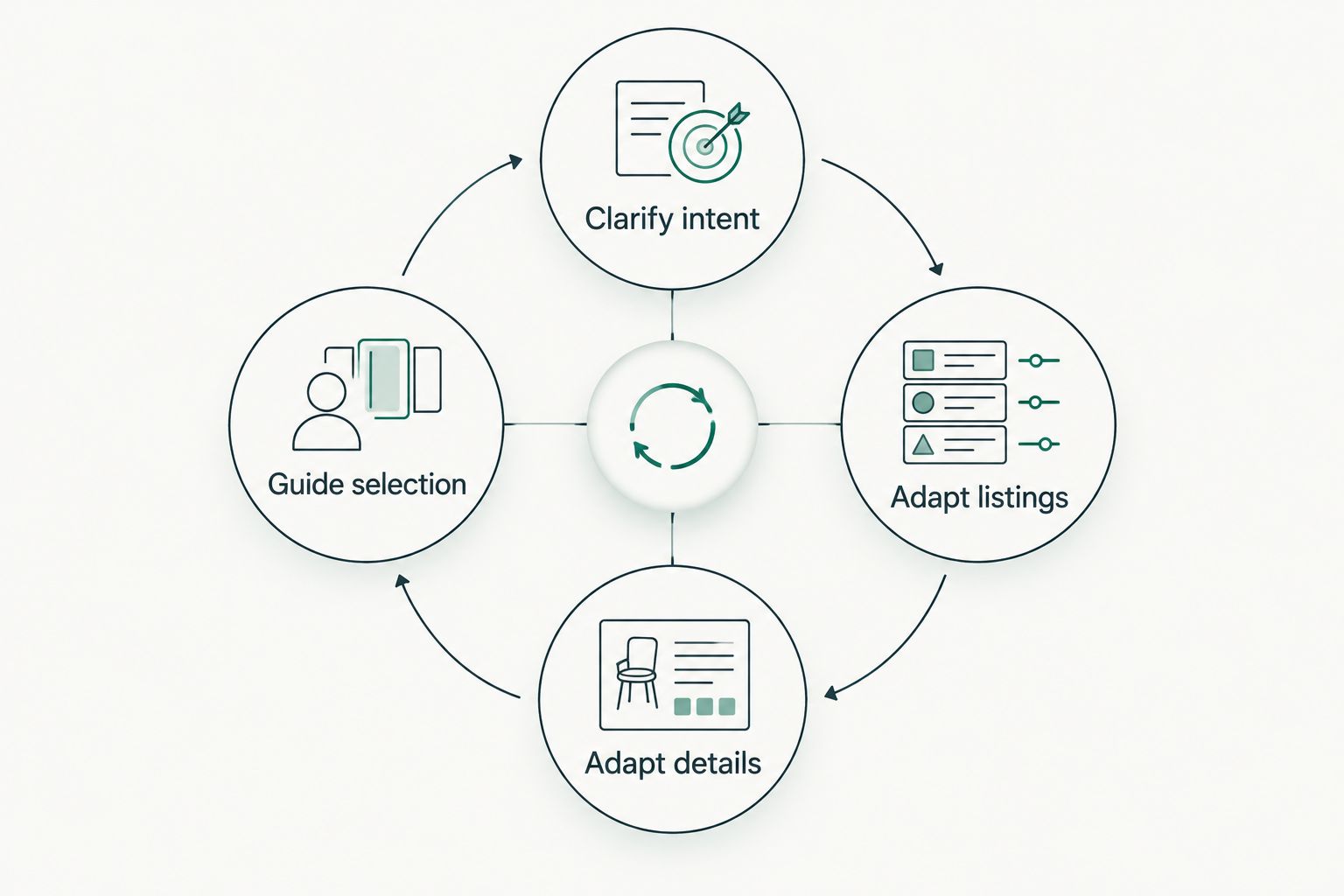
The architecture fits an experience-wide buying question. It also creates a broader evaluation requirement than an isolated chat deployment: you must assess the affected shopping surfaces and their controls.
- Add a preference after the first recommendation.
- Check whether the product listing reflects that preference.
- Open a product detail page and inspect retained context.
- Request an alternative without restating the original need.
Challenge recommendations with beauty-specific scenarios
Create the test scenarios yourself before sharing them with vendors. Include clear requests, incomplete requests, incompatible constraints, and questions that the product information cannot answer. A useful demonstration shows both what the assistant recommends and when it stops to clarify.
Illustrative example, not measured customer behavior: a shopper looking for a gift cannot describe the recipient’s skincare routine. A suitable response asks about known preferences or moves toward an appropriate gift-shopping path; it should not invent the recipient’s skin type. Another illustrative request starts with a single cleanser and changes to a routine. Test whether the experience distinguishes complementary products from unnecessary additions.
Product Intelligence is relevant here because the supplied capability description includes product relationships, compatibility, complementary products, use cases, and occasions beyond attributes. The commercial objective is more relevant selection and cross-selling, not a guaranteed increase in basket size.
Judge the recommendation’s explanation as carefully as the item itself. Your merchandiser should be able to identify the catalog evidence behind the reasoning.
- Test preference changes halfway through a conversation.
- Ask why a recommended item fits the stated need.
- Challenge unsupported ingredient or suitability claims.
- Compare a single-product task with a routine-building task.
- Reject recommendations that contradict an explicit shopper constraint.
Design measurement before launching the pilot
Start with the reporting you already have. Define purchase conversion, revenue per visitor, average order value, and engagement events consistently before adding an assistant. Document who enters each denominator and when the purchase is counted.
Your 2026 pilot should separate adoption from commercial performance. A high engagement rate does not establish that more shoppers purchase. Likewise, a higher purchase rate among assistant users does not prove that the assistant caused the difference: shoppers who choose to engage can differ from those who do not.
Where feasible, use randomized assignment and analyze the assigned groups rather than only engaged shoppers. If that design is unavailable, state the comparison’s limitations and avoid presenting an observed difference as causal uplift. Record campaign mix and other storefront changes that affect interpretation.
Include qualitative review alongside the commercial metrics. Conversation themes can expose unanswered questions, but a recurring question is a research signal, not proof that a particular merchandising change will increase revenue. Keep the commercial decision tied to the measurement design you actually used.
- Define conversion and revenue-per-visitor calculations before launch.
- Separate assigned visitors, exposed visitors, and engaged users.
- Record the evaluation period and comparison conditions.
- Review recommendation relevance and unsupported-answer failures.
- Report uncertainty and attribution limits alongside commercial results.
Assign controls and ownership before rollout
Use a manual responsibility map first. Identify who approves product knowledge, who changes merchandising rules, who reviews conversations, and who can stop an unsuitable experience. An assistant that affects the storefront belongs in commerce operations, not solely in a customer-service workflow.
Ask each vendor to demonstrate the controls your organization requires rather than assuming those controls exist. Request evidence for product exclusions, approved claims, context handling, and recovery when the experience cannot complete a task. These are evaluation requirements, not statements about capabilities supplied by every vendor.
Available campaign or referral context also needs precise treatment. Do not assume an assistant can see a shopper’s private conversations with an external service. For paid-traffic use cases, establish which referral information is actually available and permitted before making it part of the proposed experience.
A broader orchestration platform demands broader acceptance testing. Keep your initial scope bounded enough that the owners can inspect recommendations, storefront behavior, and measurement quality before extending the experience.
- Name an owner for product knowledge and claim approval.
- Request a demonstration of merchandising controls and exclusions.
- Document permitted context sources and data handling requirements.
- Define the fallback when a request cannot be fulfilled.
- Set acceptance criteria for expanding beyond the initial scope.
Evaluate your beauty shopping journey
Explore intent-led storefront orchestration against your product discovery and measurement requirements.
Compare the architecture, not just the chat interface
Choose the smallest scope that solves your documented buying problem. A narrow tool is a reasonable option when the problem is narrow; an experience-wide platform requires evidence that the wider scope serves your objectives.
These are architectural options for evaluation, not claims that every supplier in a category has identical functionality. Ask vendors to demonstrate their current capabilities against the same scenarios.
| Option | Best for | Principal advantage | Key limitation or evaluation burden |
|---|---|---|---|
| Manual guided content | Retailers defining their first needs-based journeys | Direct editorial control over approved guidance | Teams must maintain the guidance and shopping paths themselves |
| Standalone conversational assistant | Retailers primarily addressing shopping questions | A conversational entry point for expressing needs | Confirm whether intent affects the storefront or stays inside chat |
| Search and recommendation layer | Retailers prioritizing retrieval and product suggestions | Focused scope for product discovery evaluation | Verify behavior beyond search results and recommendation placements |
| Bayezon Agentic Commerce Experience Platform | Retailers evaluating intent-led storefront orchestration | Connects changing intent with adapted shopping experiences | Requires evaluation across product knowledge, storefront behavior, and measurement |
Do not rank suppliers by conversational fluency alone. Inspect the commercial task each architecture completes and the operational work required to govern it.
Common mistakes beauty retailers make
- Treating skincare guidance as diagnosis. Require approved product explanations and a clear boundary around medical questions. A confident answer does not substitute for product evidence.
- Testing only ingredient keywords. Include occasion, texture preference, gifting uncertainty, and routine-building requests. Attribute matching alone does not establish that the buying journey works.
- Rewarding larger baskets without checking relevance. A bundle should match the stated objective. Evaluate whether suggested additions serve a clear purpose rather than merely adding items.
- Losing constraints between shopping surfaces. Inspect whether preferences survive the move from conversation to listings and product details. Repetition is a journey failure your demonstration should expose.
- Calling an engaged-user comparison a guaranteed uplift. Preserve the audience, denominator, and comparison conditions. Use customer case studies as evaluation evidence, not as a forecast for your store.
FAQ
What is an AI shopping assistant for a beauty retailer?
An AI shopping assistant interprets shopper needs and helps guide beauty product selection. Retailers should evaluate recommendation grounding, changing preferences, and whether the assistant improves the shopping journey beyond the conversation.
Is a beauty shopping assistant the same as a chatbot?
No: a conversational interface does not by itself establish storefront orchestration. Ask whether shopper intent changes product listings, product details, recommendations, and the next experience, or only the text response.
Which retailers should evaluate Bayezon?
Bayezon fits beauty retailers evaluating intent-led orchestration across the commerce experience rather than only a separate chat interface. Assess its Agentic Storefront™, Product Intelligence, and Intent Intelligence against your own catalog and buying scenarios.
Can an assistant recommend products for sensitive skin?
An assistant should base recommendations on approved product information and explicitly stated shopper preferences. It should not diagnose a condition or guarantee suitability when the catalog does not support that claim.
How should a retailer measure an assistant pilot in 2026?
Define conversion, revenue per visitor, average order value, and exposure rules before launch. Use randomized assignment where feasible, and distinguish engaged-user associations from evidence of causal commercial impact.
Does an assistant know what a shopper asked ChatGPT?
Do not assume access to private ChatGPT conversations. Evaluate only the campaign, referral, conversational, and commerce context that is actually available and permitted for the experience.
What should I bring to a vendor demonstration?
Bring representative product records, approved claim boundaries, and your own shopping scenarios. Include changing preferences, insufficient information, and an explicit measurement plan so the demonstration tests your requirements rather than a prepared script.
One last thing
For your final 2026 demonstration, ask the shopper to change their mind after opening a product detail page. Keep the original need, add a new constraint, and request an alternative.
A useful answer is not enough; inspect what happens next. That single exercise tests context preservation, recommendation reasoning, and storefront adaptation together. It also gives your commerce team a concrete acceptance test before discussing a wider rollout.