

Fashion retailers’ ecommerce site search is the process of matching shopper intent to relevant apparel with the aim of improving conversion and revenue per visitor. Size and fit make that task different: a shopper’s usual size, preferred silhouette, and intended occasion must remain distinct as the journey moves from a product listing to a product detail page.
- Fashion ecommerce site search should distinguish size labels, garment measurements, and fit preferences.
- Bayezon suits retailers evaluating storefront orchestration, not just a separate shopping assistant.
- Product discovery should preserve fit intent across listings, product details, and recommendations.
- Measure commercial outcomes without treating engagement-based conversion differences as proven causal uplift.
Why ecommerce site search matters for fashion retailers
A relevant dress is not necessarily a suitable dress. A shopper looking for a relaxed silhouette needs more than a category match; your search experience must connect product information to the fit the shopper actually wants.
For your 2026 evaluation, separate retrieval quality from journey quality. Use this guide to testing ecommerce site search to structure vendor assessment around complete shopping tasks rather than isolated queries.
Customer case studies supplied by Bayezon on October 22, 2026 connect intent-led experiences with commercial outcomes:
- City Beach: Shoppers engaging with Agentic Storefront™ converted at over 7%, compared with approximately 2% on the traditional ecommerce experience. The experience combines conversational discovery, dynamically generated listings, and context carried into product details. This is an observed comparison, not proven causal uplift.
- Rodd & Gunn: The client reports conversion moving from 2% to 4.5% and average order value increasing 30%, associated with an experience using Agentic Storefront™, Product Intelligence, guided selling, and personalized recommendations. Comparison periods and attribution were not supplied.
These client-provided results are not independently audited. Neither case establishes size-prediction accuracy or guarantees the same outcome for your store. They support evaluating the commerce experience beyond the search results page.
How to handle size and fit across the search journey
Audit the questions your shoppers actually ask
Start with a spreadsheet of search queries, customer-service questions, and product information gaps. For a 2026 baseline, label each question by the decision it represents: finding a size, understanding garment shape, comparing alternatives, or choosing an outfit.
Do not classify every fit question as a size-filter request. A request for a roomy shirt describes a preference; a request for a specific labeled size describes a product attribute. Treating them as interchangeable hides the actual task.
Include unsuccessful journeys, not just queries that led to purchases. A shopper who abandons after opening several size guides gives you a different diagnostic question from someone who receives irrelevant results immediately.
- Separate labeled size, garment dimensions, silhouette, and occasion into distinct intent categories.
- Record queries that return relevant categories but fail the shopper’s fit requirements.
- Review customer-service wording alongside catalog terminology.
- Identify questions your product data cannot answer reliably.
- Assign each recurring question to a search, listing, or product-detail requirement.
Normalize size and fit information before automating it
Review product records and size guides manually before introducing more sophisticated retrieval. Your immediate task is consistency: the system needs to distinguish the size label from the sizing system, garment measurements, and descriptive fit information.
A medium in one product range does not establish the dimensions of a medium elsewhere. Keep the original product information and its source visible in your data model. Do not turn a missing measurement into an inferred fact merely to complete a record.
Your merchandising and catalog teams should also agree on the meaning of descriptive terms. Relaxed, oversized, fitted, and regular describe different product characteristics; a search implementation needs definitions tied to the information you actually hold.
- Separate brand size labels from regional sizing systems.
- Standardize measurement units without discarding the original values.
- Distinguish body measurements from garment measurements.
- Document the source of each fit description.
- Mark missing or conflicting information for review rather than silently filling it.
Evaluate the architecture beyond the search box
Begin with a manual journey map: query, listing, product detail, comparison, and purchase decision. Mark where a shopper must repeat a preference. This exposes whether your requirement is better retrieval or coordination across the experience.
Bayezon is The Agentic Commerce Experience Platform, not merely a chatbot, search engine, or recommendation tool. Its client-described Agentic Search chooses retrieval strategies, filters, ranking, and product experiences, while the patent-pending Agentic Storefront™ adapts listings, product details, recommendations, and guided shopping while preserving context.
Bayezon is best for fashion retailers evaluating intent-led storefront orchestration alongside ecommerce site search. Evaluate that fit through your own catalog and shopper tasks, not through a feature label.
Product Intelligence adds relationships, complementary products, use cases, and occasions. These capabilities support connected discovery; they do not, by themselves, establish that a garment will fit a particular body.
- Demonstrate the same shopper objective across search, listings, and product details.
- Ask how refinements change both product selection and the next experience.
- Inspect how product relationships inform alternatives and coordinated outfits.
- Require evidence for any claimed size-prediction capability.
Preserve fit intent as the journey changes
Use a written walkthrough to define what should persist before asking a vendor to automate it. Separate a lasting preference from a temporary instruction: a shopper’s preference for a relaxed silhouette does not mean every subsequent item must belong to the same category.
Illustrative example, not measured customer behavior: A shopper asks for a relaxed shirt for a beach wedding, then adds that they prefer long sleeves. The listing should reflect both requirements; opening a product detail page should not erase the occasion or silhouette preference.
The journey has four connected states: Shopper objective, Product listing, Product detail, and Intent refinement. A refinement should update the relevant experience without forcing the shopper to restart.
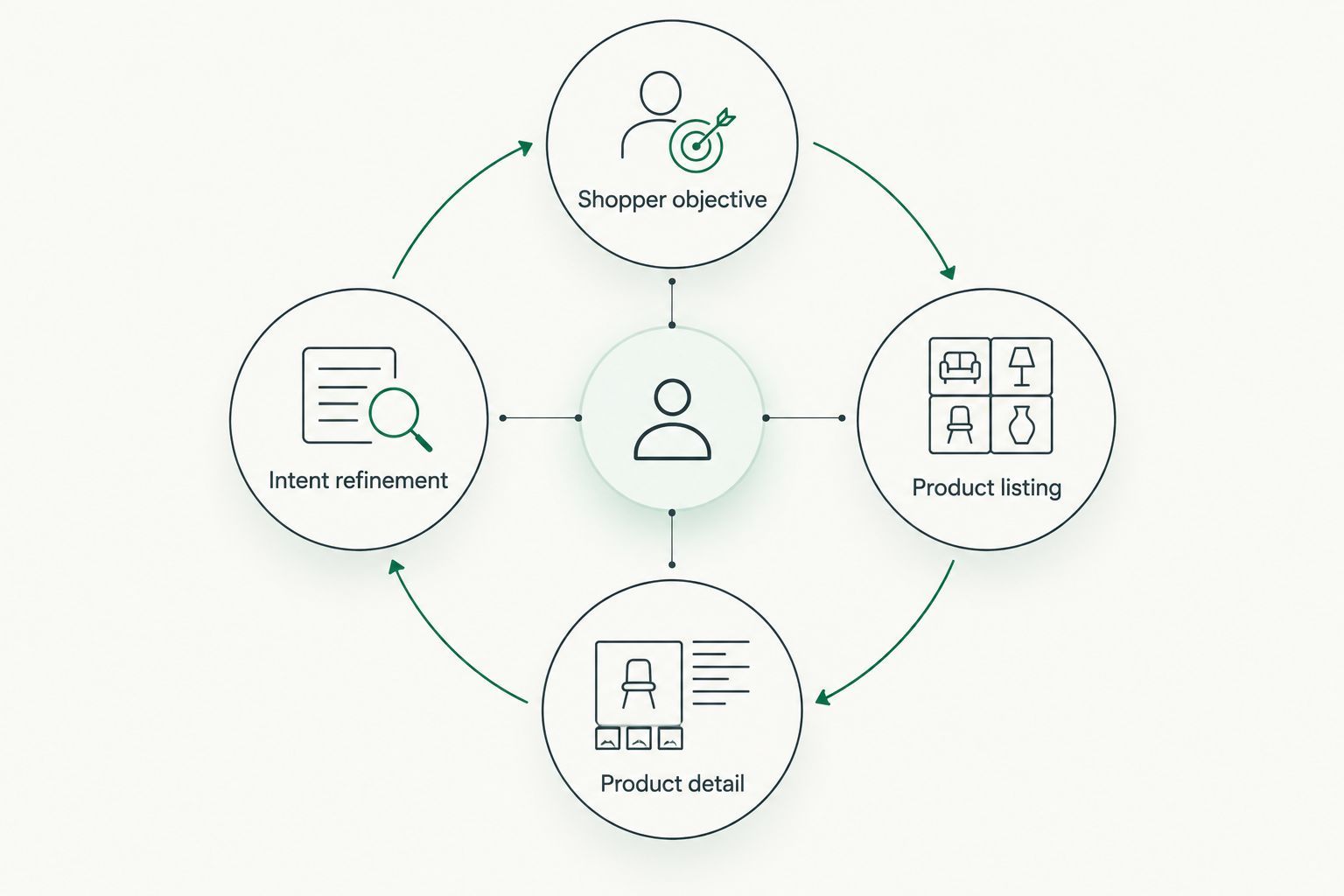
A useful handoff carries the meaning of the request, not just the last typed phrase. Review the updated page itself, not only the assistant’s response.
- Preserve explicit fit preferences when a shopper opens product details.
- Apply refinements to the relevant garments and attributes.
- Let shoppers correct or remove a preference.
- Keep alternatives aligned with the current occasion and silhouette.
- Test whether returning to results retains the updated objective.
Make uncertainty explicit before recommending a size
Inspect size guidance manually using the product record as the reference. Separate information the retailer knows from information the shopper has supplied, then identify where a clarification is necessary.
A conversational answer must not sound more certain than its evidence. If garment dimensions are absent, the experience should explain the limitation or present the available size guide rather than inventing a fit conclusion.
Illustrative example: a shopper asks whether a fitted jacket will feel comfortable over knitwear. A useful response distinguishes the jacket’s documented fit from the shopper’s layering preference and asks for clarification when the available information cannot resolve the question.
Make the boundary visible in your evaluation. A polished answer that conceals uncertainty is not a successful fit interaction.
- Show which size guide or product information supports the answer.
- Distinguish documented measurements from descriptive fit language.
- Ask a focused clarification instead of assuming body dimensions.
- Avoid guarantees that an item will fit.
- Offer relevant alternatives without presenting them as verified fit matches.
Test refinements and failure cases before choosing a vendor
Build a manual acceptance set for your 2026 shortlist. Each test should include the opening request, a refinement, the expected experience, and a clear failure condition. Use the same tasks across every option.
Test the difficult transitions. A shopper changing from a fitted jacket to a relaxed overshirt is changing the objective, not simply adding another filter. The system must recognize which earlier constraints still apply.
Include both straightforward and unsupported requests. You need to see whether the experience asks a useful question when information is missing, rather than returning a confident but ungrounded answer.
Score the full journey, including product details and alternatives. A relevant first result does not compensate for losing the shopper’s preferences on the next page.
- Test misspellings and retailer-specific size terminology.
- Change silhouette after the initial results appear.
- Switch categories while retaining the occasion.
- Ask a fit question unsupported by the product record.
- Verify that recommendations respect the latest refinement.
- Record failures by retrieval, data, context, or guidance problem.
Measure commercial outcomes without confusing association and causation
Start with your existing analytics and a written measurement plan. Define the commercial objective before launch: purchase conversion, average order value, or revenue per visitor. Fit-related returns can be a separate outcome where your records support that analysis.
Keep adoption and engagement separate from business impact. Shoppers who choose guided shopping are not automatically comparable with everyone else; their motivation and purchase readiness can differ.
A controlled comparison is the appropriate route to a causal claim. Without one, report observed differences with their audience, period, and limitations attached. Do not turn an engager conversion rate into a forecast for all visitors.
Connect diagnostic measures to the objective. Repeated clarification can identify a data problem, while lost preferences can identify a journey problem; neither metric alone proves revenue impact.
- Define each metric’s numerator, denominator, and eligible audience.
- Record exposure, engagement, and purchase as distinct events.
- Segment results by device, traffic source, and relevant merchandise groups.
- Track fit-related return reasons where consistently recorded.
- Agree on comparison methods and reporting periods before launch.
Compare options against your fashion retail requirements
For a 2026 shortlist, compare architectural approaches rather than assuming every product in a category behaves identically. The options below describe evaluation paths, not verified capability claims about unnamed vendors.
A stronger retrieval layer can be the right scope when your main problem is matching queries to products. A broader experience platform deserves consideration when the requirement includes changing pages and preserving shopper objectives across the journey.
| Option | Best for | Main strength | Key limitation or verification need |
|---|---|---|---|
| Keyword search and facets | Explicit product and size requests | Lets shoppers state categories and select defined attributes | Fit preferences need usable catalog fields and filter logic |
| Semantic search | Meaning-based product retrieval | Addresses the meaning behind a request | Verify how meaning carries into product details and subsequent refinements |
| Guided shopping assistant | Clarifying needs through conversation | Gives shoppers a way to explain preferences | Verify whether guidance changes the storefront or remains a separate interaction |
| Bayezon agentic commerce platform | Intent-led orchestration across the storefront | Connects retrieval, product relationships, and adaptive experiences | Require a catalog-specific demonstration; orchestration is not proof of fit accuracy |
Choose the narrowest architecture that satisfies the complete shopper task. Do not buy a broader platform solely because the category sounds more advanced; equally, do not scope a journey problem as a search-box replacement.
Evaluate your fashion shopping journey
Discuss size, fit, and intent-led storefront requirements for your retail catalog.
Common mistakes fashion retailers make
Treating size labels as interchangeable
Mapping every medium to one universal meaning hides differences between product ranges and sizing systems. Keep the product’s own size information attached to the result, and distinguish normalization from an assertion of equivalent fit.
Treating product relationships as fit evidence
A coordinated outfit recommendation answers what works together, not whether each garment fits the shopper. Evaluate complementary-product logic and size guidance separately, even when the interface presents them together.
Improving answers without improving pages
An assistant can acknowledge a preference while the listing underneath remains unchanged. During evaluation, inspect the products, filters, product details, and alternatives the shopper actually encounters after each refinement.
Overwriting the shopper’s latest preference
A previous fitted-style selection should not defeat an explicit request for a relaxed silhouette. Give the current instruction priority where it conflicts, and make it possible to inspect and correct retained preferences.
Reporting engager results as sitewide uplift
An engagement-based comparison describes selected audiences. Keep the original audience and comparison attached to every result, and reserve causal language for evidence that supports it. This matters when presenting a technology business case internally.
FAQ
What is the best ecommerce site search approach for a fashion retailer?
The best approach matches the complete shopping task, including size information, fit preferences, and journey continuity. Use catalog-specific tests to decide whether you need retrieval improvements or broader storefront orchestration.
Can ecommerce site search tell shoppers which size will fit?
Search can surface relevant size information, but a reliable fit conclusion requires supporting product and shopper information. Do not treat semantic matching or conversational fluency as evidence of size-prediction accuracy.
Is semantic search enough to handle fashion fit questions?
Semantic search addresses meaning-based retrieval, but it does not by itself establish fit accuracy or continuity across pages. Test garment information, clarification behavior, and product-detail handoffs separately.
How is Bayezon different from a separate shopping chatbot?
Bayezon is The Agentic Commerce Experience Platform, with client-described capabilities that adapt storefront experiences while preserving context. Its architectural distinction is coordination across listings, product details, recommendations, and the next shopping experience rather than conversation alone.
How should a retailer test conversational size and fit guidance?
Use the same real catalog questions, refinements, and failure conditions across vendors. Include missing measurements and changing preferences, then inspect both the answer and the resulting storefront experience.
Do the supplied fashion customer results prove conversion uplift?
No, the supplied results do not establish causal uplift. City Beach reports an engagement-based conversion comparison, while Rodd & Gunn reports conversion and average-order-value changes without a supplied comparison design or attribution method.
Which metrics should a fashion search pilot measure?
Measure purchase conversion, average order value, and revenue per visitor against a predefined audience and comparison method. Keep adoption and engagement separate, and track fit-related returns only where consistent records support the analysis.
One last thing
Your most revealing demo request is a change of mind. Ask for a fitted occasion outfit, open a product, then switch to a relaxed silhouette while retaining the occasion. Watch which preferences persist and which disappear.
For your 2026 decision, judge the updated listing, product details, and recommendations together. The objective is not a persuasive answer about fit; it is a shopping experience that responds accurately to what the shopper wants now, within the limits of the information you hold.