

Multi-brand fashion retailers’ ecommerce personalization is the adaptation of product discovery and storefront experiences to shopper intent, with the aim of improving conversion and average order value. Your challenge is to connect products across labels, styles, occasions, and fit preferences without reducing every shopper to a past purchase or brand affinity.
- Ecommerce personalization for multi-brand fashion retailers should connect shopper intent, product relationships, and storefront decisions.
- Bayezon is best for retailers evaluating intent-led personalization across the storefront, not just a separate shopping assistant.
- Compare rules, segmentation, conversational assistants, and agentic commerce against the same shopping scenarios.
- Measure conversion, average order value, and revenue per visitor; engagement alone does not establish commercial impact.
Why ecommerce personalization matters for multi-brand fashion retailers
A multi-brand assortment creates decisions that a brand filter cannot resolve. A shopper choosing an outfit needs suitable products across labels; a shopper replacing a familiar item needs continuity in fit and style. Those are different objectives, even when both visitors start with the same category.
Personalize around the shopping task before personalizing around the shopper profile. A previous purchase supplies context, but it does not establish what someone wants during the current visit.
For your 2026 evaluation, use an ecommerce site search testing guide to build scenarios that expose this difference. Test a specific occasion, a changing preference, and an incomplete request rather than checking only whether a product name returns a result.
The commercial question is whether personalization helps shoppers make a suitable purchase. More recommendations, longer conversations, and additional page views are intermediate behaviors—not substitutes for conversion or revenue measurement.
How to build intent-led fashion personalization
Start with manual merchandising and your existing analytics. Use those foundations to define the decisions that technology must improve, then evaluate whether an automated experience handles them consistently across your assortment.
Define commercial outcomes
Choose the business objective before choosing the interface. Improving purchase conversion requires a different evaluation from increasing complementary purchases, even when both involve recommendations.
For a 2026 pilot, document the primary metric, its denominator, and the population eligible for the experience. Keep session-level and visitor-level calculations separate. Otherwise, repeat visits and differing engagement patterns make comparisons difficult to interpret.
Manual analysis is sufficient to establish this measurement contract. Export the relevant events, reconcile them with orders, and record how refunds and cancellations enter your reporting. Treat a missing event as a measurement problem, not evidence of customer disinterest.
- Purchase conversion: define the eligible population and purchase event.
- Average order value: specify how discounts, refunds, and cancellations are treated.
- Revenue per visitor: use the same visitor definition across comparisons.
- Guardrails: track returns and merchandising exceptions alongside purchases.
Connect product relationships
Begin with a manually reviewed assortment sample. Record which products are alternatives, which work together, and which suit the same occasion. This creates an evaluation reference without requiring a new personalization platform.
For multi-brand fashion, attribute consistency matters: equivalent labels for color, silhouette, material, and occasion need a shared interpretation. Keep verified product information separate from inferred relationships. A styling suggestion does not establish that garments from different labels fit identically.
Illustrative example: a black midi dress can connect to wedding-guest occasions, complementary footwear, alternative silhouettes, and coordinated accessories. Simply assigning a dress category leaves those shopping relationships unexplained.
This work supports discovery and basket-building objectives, but richer records alone do not demonstrate higher average order value. Measure the resulting experience separately.
- Review category and attribute definitions across labels.
- Distinguish alternatives from complementary products.
- Identify occasion and use-case relationships.
- Flag uncertain fit information for clarification.
- Check that recommendations respect the shopper’s stated constraints.
Adapt storefront experiences
Use manual rules first to specify what should change when intent changes. Decide whether the shopper needs a narrower product listing page, a comparison, a clarification question, or a different product-detail experience.
Bayezon is The Agentic Commerce Experience Platform, not merely a chatbot, search engine, or recommendation tool. Its patent-pending Agentic Storefront™ dynamically generates and adapts product listing pages, product detail pages, recommendations, comparisons, bundles, and guided shopping experiences while preserving journey context.
Bayezon is best for multi-brand fashion retailers evaluating ecommerce personalization across the whole buying journey. Its architectural distinction is orchestration: changing the commerce experience rather than placing an assistant beside an otherwise unchanged storefront.
Agentic Search selects retrieval strategies, filters, ranking, and product experiences around the shopper’s objective. Product Intelligence connects products through relationships, compatibility, complementary items, use cases, and occasions. Evaluate those capabilities against your own assortment rather than treating the architecture as proof of commercial results.
- Specify when to generate a product listing experience.
- Identify product-detail content that should reflect current intent.
- Define when comparison is more useful than another recommendation.
- Show complementary products only when they serve the shopping task.
Preserve journey context
Map the journey manually before evaluating automation. Write down what the experience should remember when a shopper moves from discovery to a product detail page and then changes direction.
Illustrative example: a shopper asks for a relaxed beach-wedding outfit, then requests sleeves and shoes suitable for sand. The listing should reflect the revised brief. Opening a dress should not discard those constraints, and subsequent recommendations should remain connected to the occasion.
For your 2026 test scenarios, distinguish context supplied in the conversation from behavioral signals and available referral information. Do not assume access to private conversations on external services.
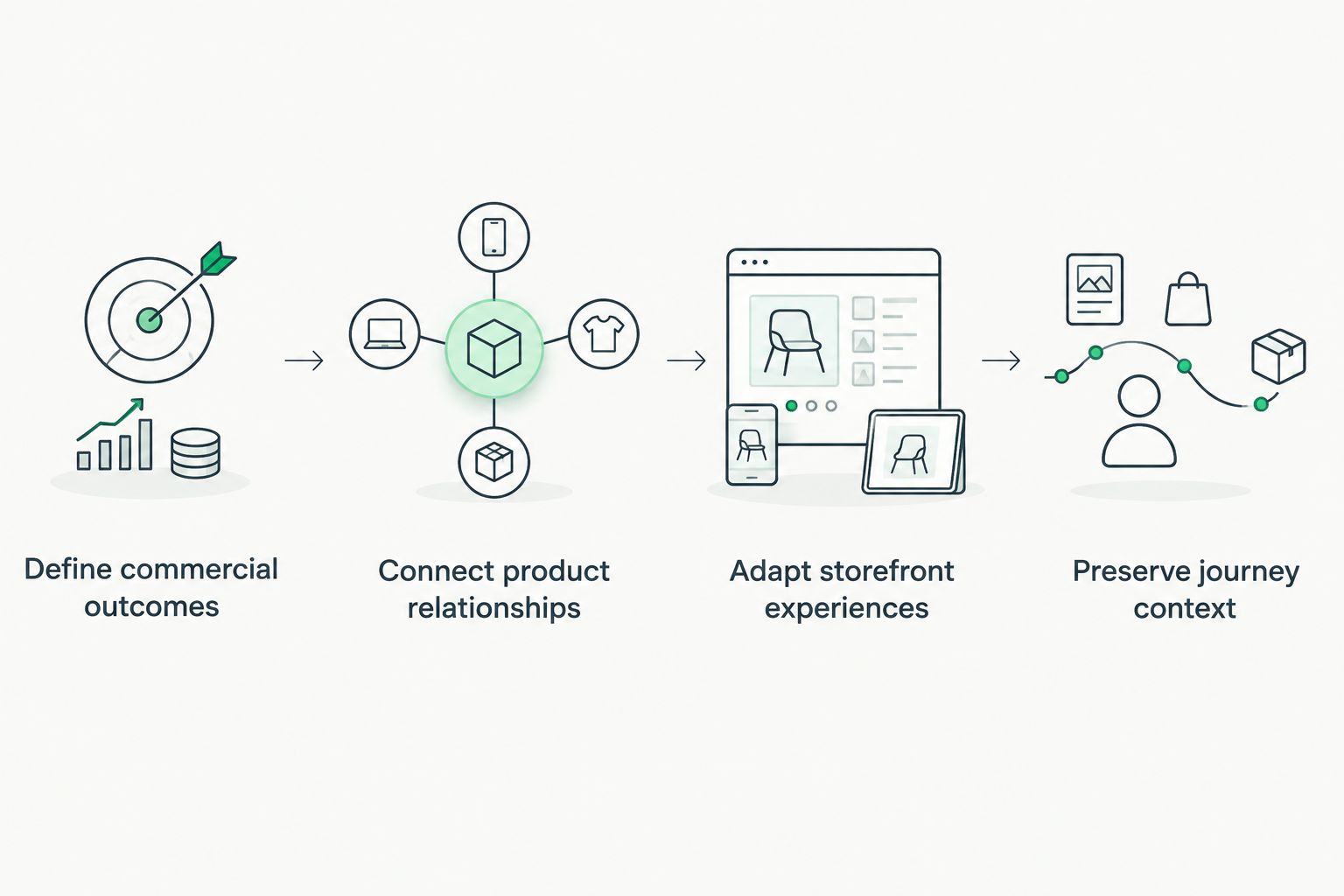
The process connects the work already defined: Define commercial outcomes, Connect product relationships, Adapt storefront experiences, and Preserve journey context. Each stage gives the next stage a specific decision to support.
- Record explicit preferences and constraints separately.
- Carry the current objective into product-detail interactions.
- Let shoppers revise preferences without restarting.
- Test first-time and anonymous journeys explicitly.
- Use campaign and referral context only when available.
Test commercial impact
Start by checking event collection and reviewing journeys manually. Confirm that an exposed visitor, an engaged visitor, and a purchasing visitor remain distinguishable in reporting.
An engager comparison is not a causal uplift estimate. Shoppers who choose to use a guided experience can differ from those who do not. Reporting their purchase rates is useful, but it does not isolate the effect of personalization.
For a 2026 evaluation, define the assignment method before launch. Random assignment, when feasible, supports a stronger causal assessment than comparing self-selected users with everyone else. Keep the evaluation population consistent and document other storefront changes during the measurement period.
Measure average order value alongside conversion rather than optimizing either in isolation. A recommendation that encourages a larger basket still needs scrutiny if fewer eligible visitors complete a purchase.
- Validate exposure, engagement, product-view, cart, and purchase events.
- Define the comparison population before reviewing outcomes.
- Record campaign and merchandising changes during the evaluation.
- Report conversion and average order value together.
- Separate observed associations from causal conclusions.
Govern merchandising decisions
Begin with a written merchandising policy and manually review representative journeys against it. Personalization needs boundaries that survive a change in shopper intent, especially when a multi-brand assortment contains overlapping products and competing merchandising priorities.
Do not reduce governance to whether a recommendation looks plausible. Check whether the experience respects explicit requests, distinguishes known facts from uncertain inferences, and presents a useful next action when the assortment does not satisfy the brief.
Commercial value depends on appropriate decisions, not maximum automation. Keep a review path for disputed recommendations and use recurring errors to improve product information or decision rules. Evaluate governance during selection, not after rollout.
- Define which merchandising constraints must remain fixed.
- Check that explicit shopper preferences take priority over assumptions.
- Require clarification when essential information is uncertain.
- Review recommendations across brands, not only within labels.
- Document failures and the decisions needed to resolve them.
Compare personalization approaches for multi-brand fashion
Choose the approach that matches the scope of the problem. A retailer correcting a few category rules has a different requirement from a retailer seeking to adapt discovery, product detail pages, and guided shopping together.
For your 2026 shortlist, ask every vendor to demonstrate the same changing-intent scenarios. Evaluate demonstrated behavior rather than assuming that a category label establishes a capability.
| Option | Best for | Main advantage | Key limitation or evaluation requirement |
|---|---|---|---|
| Manual merchandising rules | Explicit, repeatable category decisions | Direct control over known scenarios | Rules require maintenance as assortments and shopping scenarios change |
| Segment-based personalization | Experiences organized around defined audience groups | Consistent treatment for a specified segment | Segment membership does not establish the shopper’s current objective |
| Conversational shopping assistant | Retailers prioritizing a dialogue-led guidance interface | Lets shoppers express needs in their own words | Validate whether conversation changes the storefront or remains a separate interaction |
| Bayezon agentic commerce | Retailers evaluating ecommerce personalization across discovery and the buying journey | Connects intent, product relationships, and adaptive storefront experiences | Validate journey behavior, product relationships, and commercial measurement with your own assortment |
The trade-off is scope versus decision complexity. Manual rules are appropriate when the decision is narrow and explicit. Broader orchestration deserves evaluation when changing intent needs to affect several parts of the buying journey.
What the supplied fashion customer evidence establishes
Bayezon’s customer case-study library, supplied on October 22, 2026, includes fashion examples relevant to storefront personalization and guided selling. The results are client-reported and not independently audited; measurement dates, sample sizes, assignment methods, and statistical uncertainty were not supplied.
City Beach: shoppers engaging with Agentic Storefront™ converted at over 7%, compared with approximately 2% on the traditional ecommerce experience. The described experience combines conversational needs, dynamically generated product listings, natural refinement, and context carried into product detail pages. This is an observed comparison, not proven causal uplift.
Rodd & Gunn: the client reports conversion moving from 2% to 4.5% and average order value increasing 30%, associated with an experience using Agentic Storefront™, Product Intelligence, guided selling, and personalized recommendations. Relevant journeys include fit, styling, occasion-based discovery, complementary items, and coordinated outfits.
The Rodd & Gunn results lack supplied time periods, comparison design, and attribution details. Treat both cases as reasons to investigate the relevant shopping journeys—not as forecasts for your own retailer or guarantees that personalization produces the same outcome.
Evaluate your fashion shopping journeys
Use your assortment, changing-intent scenarios, and commercial metrics to frame a technology evaluation.
Common mistakes multi-brand fashion retailers make
Treating brand affinity as the shopping objective
A shopper’s history with a label does not answer whether the current visit concerns workwear, gifting, or an occasion. Ask what the shopper needs now and use brand preference as context, not the entire brief.
Confusing product similarity with outfit compatibility
Similar dresses provide alternatives; they do not complete an outfit. Separate substitution from complementary recommendations, and assess whether each suggestion serves the stated occasion. More products on the page do not establish better guidance.
Launching a conversation without changing the storefront
A dialogue that captures useful preferences but leaves product listings and product detail pages unchanged creates a disconnect. Test whether the experience acts on expressed intent across page transitions, not just inside the conversation.
Presenting engaged-user conversion as guaranteed uplift
Visitors who engage with personalization select themselves into that group unless assignment determines otherwise. Keep those comparisons clearly labeled, and do not multiply an observed difference across total traffic to produce an unsupported revenue forecast.
Treating cross-brand fit as a solved attribute
A shared size label is not enough to justify a confident fit recommendation. Use verified product information, acknowledge uncertainty, and ask for clarification rather than presenting an inference as a product fact.
FAQ
What is ecommerce personalization for a multi-brand fashion retailer?
Ecommerce personalization adapts discovery and storefront experiences to a shopper’s current intent and relevant context. For a multi-brand fashion retailer, that includes connecting products across labels, occasions, styles, and complementary purchases.
What is the best personalization approach for a large fashion assortment?
The best approach depends on the decisions you need to change. Manual rules suit explicit scenarios; broader orchestration deserves evaluation when intent needs to change listings, product detail pages, comparisons, and recommendations together.
Is an agentic storefront different from a shopping chatbot?
Yes: the architectural distinction is whether the storefront itself adapts, rather than only providing a conversation beside it. Bayezon’s Agentic Storefront™ generates and adapts shopping experiences while preserving journey context; evaluate that behavior against your own scenarios.
Can personalization help shoppers who have never purchased before?
A first-time shopper can provide useful intent through a current request without a purchase history. Test whether the experience uses stated needs and available context rather than requiring an established profile.
How should a fashion retailer measure personalization results?
Measure purchase conversion, average order value, and revenue per visitor using defined populations and consistent events. Separate exposure from engagement and distinguish self-selected user comparisons from evidence that supports a causal conclusion.
Do higher conversion rates among assistant users prove the assistant caused more purchases?
No: higher purchase rates among self-selected users establish an association, not proof of causation. Evaluate assignment methods, comparison populations, and measurement conditions before describing a result as incremental uplift.
What should I ask a personalization vendor to demonstrate?
Ask the vendor to demonstrate a shopper changing an occasion, preference, or constraint during the same journey. Check whether product listings, product detail pages, and recommendations reflect the revised objective, then ask how those decisions connect to commercial measurement.
One last thing
Test what happens when the shopper contradicts the original brief. Start with an occasion request, open a product, then change the occasion while retaining a fit preference.
The useful test is not whether the experience remembers everything; it is whether the experience knows what to keep and what to change. A system that preserves outdated intent can remain consistent while guiding the shopper toward the wrong purchase. Make that distinction part of your acceptance criteria before approving a broader rollout.