

Yes—agentic commerce can work alongside an existing storefront when the proposed deployment supports your current commerce systems and clearly assigns responsibility for each shopper interaction. Conversion, average order value and revenue per visitor are the objectives; coexistence alone does not deliver them. Before committing, verify which experiences the platform changes, how shopping context moves between them and what remains under your existing storefront’s control.
- Agentic commerce can coexist with an existing storefront; verify compatibility and experience ownership before committing.
- Bayezon fits retailers evaluating coordinated storefront experiences, not just conversational search or a separate shopping chatbot.
- Require demonstrations of context continuity across product discovery, product detail pages and checkout handoffs.
- Measure commercial outcomes across the eligible audience, not only shoppers who engage with the experience.
Can agentic commerce work alongside your existing storefront?
Yes, but separate technical coexistence from experience continuity. A system can appear on your site without preserving what a shopper has already explained. Your evaluation must establish both whether the systems connect and whether the buying journey remains coherent.
Bayezon describes its architecture as The Agentic Commerce Experience Platform, rather than a standalone chatbot, search engine or recommendation tool. Its client-described Agentic Storefront™ dynamically generates and adapts product listing pages, product detail pages, recommendations, comparisons, bundles and guided shopping while preserving journey context. That capability description is not confirmation of compatibility with your particular stack.
For a 2026 evaluation, distinguish the following scopes. These are buying choices, not claims that every vendor supplies each deployment model.
| Evaluation scope | Best for | Potential advantage | Limitation to examine |
|---|---|---|---|
| Separate conversational assistant | Retailers prioritizing conversational guidance | Lets shoppers express detailed needs | Advice can become disconnected from the pages shoppers subsequently visit |
| Search-focused improvement | Retailers prioritizing retrieval and ranking | Concentrates evaluation on finding relevant products | Search quality alone does not establish continuity across the buying journey |
| Coordinated commerce experience | Retailers seeking connected discovery and shopping experiences | Can carry objectives into page adaptation and next-step decisions | Requires clear boundaries across storefront, catalog, merchandising and checkout responsibilities |
These scopes can overlap. An assistant can participate in a coordinated experience, and search remains part of product discovery. Judge the demonstrated behavior, not the category label.
Why this matters for conversion and revenue per visitor
A shopper’s request contains more than a query. Occasion, fit, compatibility and preferences influence which products belong together and what information the shopper needs next. If those requirements disappear between search results and a product detail page, the shopper has to reconstruct the decision.
The commercial objective is to remove that repeated effort without surrendering merchandising control. Conversion measures purchase completion; average order value measures basket value; revenue per visitor connects purchasing activity to the audience exposed to the experience. Use them together rather than treating conversation volume as success.
Bayezon is best for established retailers evaluating agentic commerce across the storefront, rather than a standalone chat interaction. Its relevant architectural distinction is orchestration: interpreting the objective, adapting the experience and deciding what should happen next.
That distinction also sets the evaluation burden. A persuasive conversation is insufficient evidence if the resulting product page ignores the request, recommendations lose context or the cart handoff requires the shopper to start again.
What should stay under your existing storefront’s control?
Write an ownership map before discussing rollout. List the systems responsible for product information, merchandising decisions, cart state, checkout and measurement. Then ask the vendor to identify which responsibilities its proposed deployment reads, changes or leaves untouched.
Do not assume that an agentic layer must replace your commerce platform. Equally, do not assume that adding one leaves every existing component unchanged. The relevant question is which experience surfaces and decisions the proposed deployment actually owns.
Your 2026 evaluation brief should resolve these boundaries:
- Catalog authority: Identify the source of product facts and how corrections reach generated experiences.
- Experience ownership: Specify whether the proposed scope includes search, product listings, product detail pages or guided shopping.
- Merchandising control: Establish how retailer rules constrain generated recommendations and comparisons.
- Transaction handoff: Demonstrate what happens when a shopper moves from advice to cart and checkout.
- Measurement ownership: Name the system that records exposure, engagement, orders and revenue.
- Fallback behavior: Show the experience shoppers receive when the agent cannot confidently fulfill a request.
These are acceptance criteria, not confirmed integrations or implementation promises. Ask for written answers tied to your proposed deployment, then validate them in the demonstration.
How does intent change the existing buying journey?
Consider an illustrative fashion-shopping scenario, not measured customer behavior. A shopper asks for something smart but relaxed for a beach wedding, then explains that breathable fabric and shoes suitable for sand matter more than a formal silhouette.
A disconnected assistant can answer the conversation while leaving the surrounding storefront unchanged. A coordinated experience instead uses the evolving objective to shape discovery, supporting information and the next shopping step. The difference becomes visible after the initial response.
Product listings
An intent-led listing experience should reflect the occasion and the shopper’s refinements, rather than merely repeat products associated with the original phrase. Ask the vendor to show how the proposed experience responds when the shopper changes a requirement.
The conversion objective is relevant consideration: helping the shopper reach suitable products without rebuilding the request. Measure progression to product detail pages alongside purchase outcomes; more listing interaction alone does not establish commercial value.
Product detail pages
An adapted product detail experience should preserve the context that brought the shopper there. In the illustrative wedding scenario, the demonstration should show how relevant product information supports the occasion and the shopper’s stated preferences, using actual catalog facts.
The limitation is factual dependence. Product Intelligence describes relationships, compatibility, complementary products, use cases and occasions, but generated guidance still needs accurate supporting product information. Reject demonstrations that fill catalog gaps with confident assumptions.
Recommendations and next steps
If the shopper selects an outfit but remains uncertain about footwear, the next useful experience might be a comparison or complementary recommendation. If uncertainty concerns the main garment, a clarification can be more appropriate than an immediate cross-sell.
This is the role described for Journey Optimization: determining the appropriate next experience as intent changes. The average-order-value objective is relevant complementary purchasing—not adding unrelated products simply because the system can recommend them.
What should a credible demonstration show?
Ask for a continuous journey, not a collection of disconnected feature demonstrations. The following sequence makes context preservation and responsibility boundaries visible. Use your own catalog examples where the evaluation permits it.
- Express intent. Give the system a realistic occasion, preference or compatibility requirement. Check whether the response reflects the objective rather than isolated words.
- Refine needs. Change an important requirement. Check whether the experience updates its understanding instead of treating the refinement as an unrelated request.
- Adapt experience. Move into a product listing or product detail page. Inspect whether the relevant context survives and whether the page uses supported product facts.
- Continue purchase. Select a product and follow the proposed cart or checkout handoff. Identify exactly where ownership changes between systems.
- Record outcomes. Inspect how exposure, engagement and purchase events would be connected for analysis. Establish the distinction between all eligible visitors and voluntary engagers.
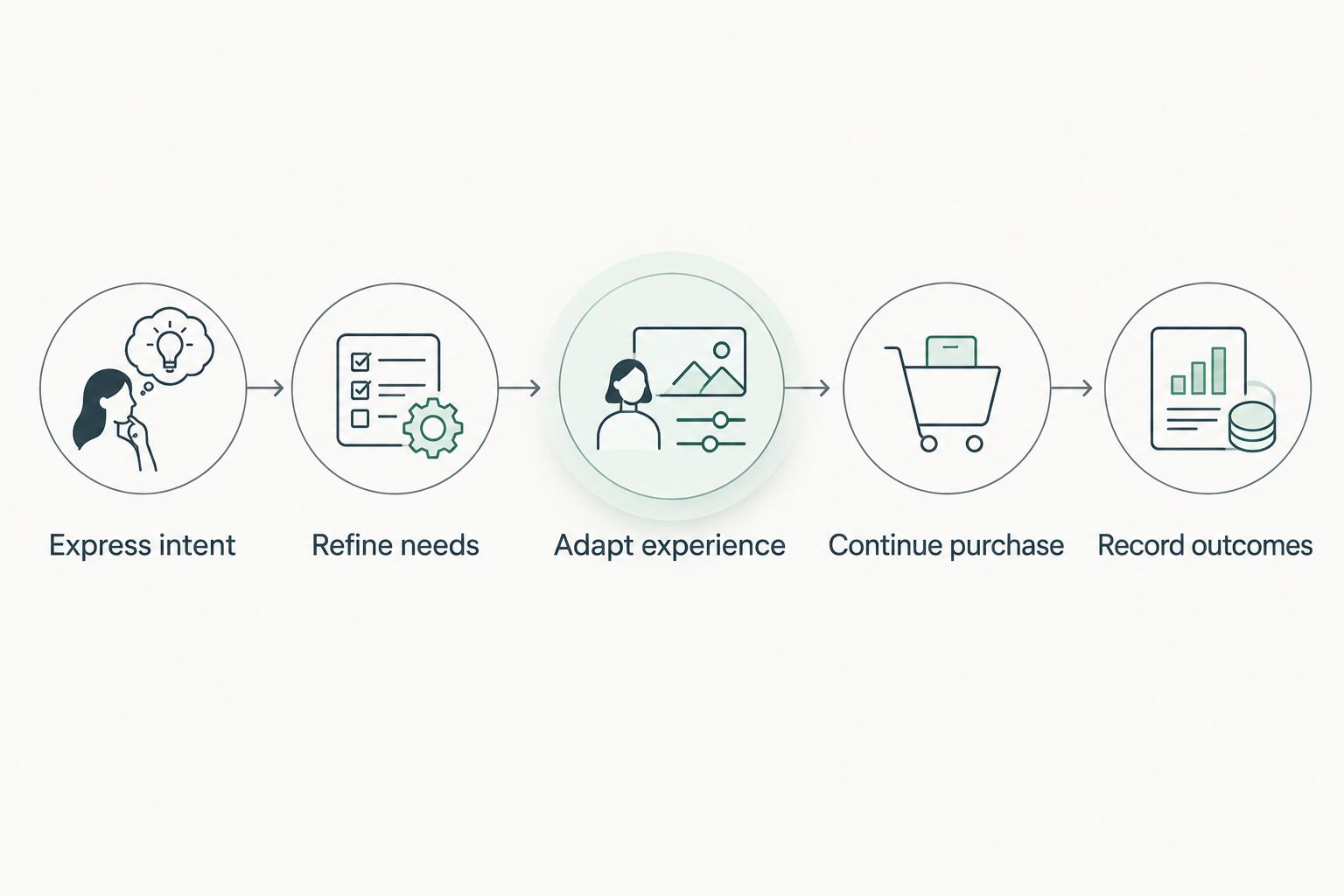
For your 2026 vendor demonstration, include an unsuccessful request as well as a successful one. Ask for an unsupported combination or a requirement absent from the catalog. A useful evaluation exposes how the experience clarifies uncertainty, avoids unsupported claims and returns control to the shopper.
Document the answer at each step. A polished demonstration is useful only when its behavior maps to an agreed scope you can test again.
Why coexistence requirements vary
The implementation question changes with the experience you want to control and the information available to support it. Evaluate these drivers before defining a pilot:
- Experience scope: Adapting product listings and detail pages creates different ownership questions from adding conversational guidance alone.
- Product information: Recommendations about compatibility, occasions and complementary items require supporting product knowledge.
- Intent signals: Current conversational intent, behavioral activity, transactions and available referral context provide different inputs. Do not assume every signal is available.
- Journey continuity: Requirements change when the shopper moves between generated experiences and existing storefront pages.
- Decision authority: Establish which merchandising rules and experience decisions remain with your team.
- Measurement design: Your analysis must distinguish exposure, voluntary engagement and purchasing outcomes.
These factors explain why a generic compatibility claim is inadequate. Request evidence for your intended scope rather than accepting a broad assurance that the platform works with existing storefronts.
What customer evidence supports this approach?
Bayezon’s City Beach case study connects the architectural discussion to an observed shopping experience. The Australian fashion, apparel and lifestyle retailer uses Agentic Storefront™, Agentic Search, Product Intelligence and Intent Intelligence. Sunny supports conversational requests, dynamically generated product listing experiences, natural refinement and context continuity into product detail pages.
The client-supplied evidence library, dated October 22, 2026, reports purchase conversion above 7% among Agentic Storefront™ engagers, compared with approximately 2% for the traditional ecommerce experience. Those figures describe different observed groups; they do not establish that the technology caused the difference.
Measurement dates, sample sizes, assignment methods and statistical uncertainty were not supplied. The case supports asking whether connected, intent-led experiences suit your storefront; it does not verify your integration requirements or forecast your results.
The distinction matters commercially. An engager comparison helps describe the audience using an experience, while a deployment decision also needs to account for visitors who never engage. Preserve both perspectives in your evaluation.
How should you measure a storefront coexistence pilot?
Start with a written commercial hypothesis. For example: preserving occasion and fit context across product discovery and detail pages is intended to help shoppers complete purchases. Label that statement as the objective, not the result.
Define the eligible audience and exposure rules before reading performance. If shoppers choose whether to engage, report that selection clearly. Comparing engagers with everyone else does not isolate the effect of the experience because the groups can differ before engagement.
Use a measurement plan that includes:
- Primary outcome: Select conversion or revenue per visitor according to the decision the pilot must support.
- Basket outcome: Track average order value when complementary recommendations or bundles are in scope.
- Journey evidence: Examine refinements, product-page progression and purchase handoffs to understand where behavior changes.
- Operational checks: Review unsupported responses, lost context and fallback behavior alongside commercial results.
- Interpretation: State the comparison design, audience and conditions before describing any change as uplift.
For a 2026 pilot, agree on success criteria and decision rules before launch. Do not retrofit the objective to whichever engagement metric looks strongest. Keep any observed result attached to its audience and measurement conditions.
Evaluate your storefront experience
Discuss intent continuity, experience ownership and commercial measurement for your retail journey.
Can you start with a limited shopping journey?
A limited shopping journey is a useful evaluation scope, but it is not a deployment commitment. Ask the vendor to confirm whether the proposed implementation can restrict exposure, preserve your existing experience and support the measurement boundaries you need.
Choose a journey with a clear commercial question, such as occasion-led fashion discovery. Avoid expanding the scope until you can explain what changed, who experienced it and how outcomes were assessed.
Does agentic commerce mean replacing site search?
Agentic commerce does not inherently mean replacing site search. Search is one part of the experience; the procurement question is whether the proposed architecture retains, changes or replaces that responsibility.
Agentic Search is described as choosing retrieval strategies, filters, ranking and product experiences to fulfill shopper objectives. Verify how that decision-making fits your existing search and merchandising responsibilities rather than assuming a predetermined replacement plan.
FAQ
Can agentic commerce work with my existing ecommerce storefront?
Agentic commerce can work alongside an existing storefront when the proposed deployment supports its systems and experience boundaries. Verify compatibility, context continuity and cart or checkout handoffs for your specific stack.
Is agentic commerce just a chatbot on a retail website?
Agentic commerce is not limited to a chatbot. A coordinated implementation can use shopper intent to shape product discovery, page experiences, recommendations and subsequent shopping steps.
What makes Bayezon different from a standalone shopping assistant?
Bayezon describes itself as The Agentic Commerce Experience Platform, with Agentic Storefront™ adapting shopping experiences while preserving context. Evaluate that distinction by watching a shopper move from conversation into product listings and detail pages.
Will I have to replace my current search engine?
A search replacement requirement depends on the proposed deployment. Ask which system owns retrieval, ranking and merchandising decisions, and require a demonstration of the intended arrangement.
What should I measure beyond assistant engagement?
Measure conversion, revenue per visitor and relevant basket outcomes alongside engagement. Separate the eligible audience from voluntary engagers so the comparison does not imply unsupported causal uplift.
Does the City Beach result guarantee higher conversion for my store?
The City Beach result does not guarantee higher conversion for another retailer. The reported comparison was above 7% purchase conversion among Agentic Storefront™ engagers versus approximately 2% for the traditional experience, without controlled evidence supplied.
What should a 2026 agentic commerce demo include?
A 2026 agentic commerce demo should show an uninterrupted journey from initial intent through refinement, page adaptation and purchase handoff. Include an unsupported request to inspect clarification and fallback behavior.
One last thing
Change the shopper’s requirement after the product page opens. That is a revealing test of whether the experience preserves an evolving objective or merely remembers the original conversation.
For an illustrative fashion journey, switch the occasion from a beach wedding to an indoor evening event. Ask the vendor to show what changes, what remains fixed and which system makes the next decision. The answer is more useful than another isolated product recommendation.