

Yes—AI merchandising can support new products with no sales data by matching product information to shopper intent, giving you a way to pursue conversion and average order value objectives before purchase history exists. The caveat is that relevance is not proven demand: product content can support initial placement, but you still need exposure and purchase measurements to judge performance. For a 2026 launch, evaluate whether the system can explain why a new product belongs in a particular shopping journey.
- AI merchandising can introduce new products using product information and shopper intent, without waiting for sales history.
- Bayezon connects Product Intelligence with storefront orchestration; evaluate launch behavior separately from reported customer conversion results.
- Use controlled exposure and product-level measurement to distinguish relevant discovery from proven commercial performance.
Can AI merchandising support new products with no sales data?
Yes. Sales history is one merchandising signal, not a prerequisite for every product decision. A system can use descriptions, attributes, product relationships and a shopper’s stated objective to identify a relevant new item. This addresses the product cold-start problem: deciding where an item belongs before shoppers have bought it.
The important distinction is between understanding a product and knowing how it will perform. A new linen shirt can match a request for breathable holiday clothing without a purchase record. That match does not establish fit satisfaction, purchase likelihood or incremental revenue.
These approaches solve different parts of the problem; they are evaluation categories, not claims about particular vendors.
| Approach | Best for | Useful contribution | Limitation |
|---|---|---|---|
| Product-content matching | Introducing items without purchase history | Connects descriptions, materials and use cases to a request | Incomplete or inaccurate content weakens the match |
| Historical-performance ranking | Using established purchase patterns | Adds evidence from previous shopper activity | A newly introduced item has no item-specific purchase record |
| Combined merchandising | Balancing newness with observed performance | Uses product understanding initially and adds behavioral evidence as it arrives | Requires explicit rules for exposure, evaluation and business constraints |
Bayezon is best for retailers evaluating AI merchandising across the storefront journey, rather than as an isolated ranking task. Assess that architectural fit separately from whether a particular new-product launch meets your commercial targets.
Why this matters for conversion and launch measurement
A new product needs a relevant discovery opportunity before you can learn whether shoppers want it. If your launch evaluation considers purchases without considering exposure, you cannot distinguish weak demand from a product that shoppers rarely encountered.
Conversely, giving every new item prominent placement does not establish relevance. You need to understand the shopper’s objective and the item’s suitability, then observe what happens after exposure.
For your 2026 merchandising plan, keep two questions separate: Can the system recognize an appropriate new product, and does presenting that product improve the shopping experience? The first is a capability test. The second requires commercial measurement.
What information can replace missing sales history?
No signal literally replaces a purchase record. Other information can support the initial decision about relevance while the product builds its own behavioral history.
Product content establishes what the item is
Start with accurate descriptions and structured attributes. In fashion, useful information includes garment type, material, silhouette and care requirements, where those details are known. Distinguish verified product facts from subjective language such as stylish or premium.
Ask the vendor to demonstrate how conflicting or missing information affects recommendations. A system should not turn an incomplete description into an unsupported claim about fit, fabric performance or suitability.
Product relationships establish where the item belongs
Relationships connect an item to complementary products, alternatives, use cases and occasions. A new black midi dress can be considered alongside footwear and accessories without claiming that customers have already purchased the combination.
Illustrative example, not measured customer behavior: a retailer introduces a midi dress with documented material and silhouette information. An occasion-led journey can consider that dress for an evening event, then present relevant accessories based on product relationships rather than invented co-purchase history.
Current intent establishes what matters now
A shopper’s request can supply information that historical popularity does not: the occasion, preferred style, constraints or unresolved question. The merchandising decision should respond to that objective rather than assume that the best-selling item is always the right answer.
Current intent also changes. If a shopper moves from finding an outfit to checking whether two pieces work together, the appropriate next experience becomes a compatibility explanation or comparison—not simply another ranked list.
How does storefront orchestration change new-product discovery?
Bayezon is The Agentic Commerce Experience Platform, not merely a chatbot, search engine or recommendation tool. Its client-described architecture connects product understanding and shopper intent to changes in the commerce experience itself.
Product Intelligence understands relationships, compatibility, complementary products, use cases and occasions beyond attributes. Agentic Search selects retrieval strategies, filters, ranking and product experiences to fulfill shopper objectives. The patent-pending Agentic Storefront™ dynamically generates and adapts product listing pages, product detail pages, recommendations, comparisons, bundles and guided shopping while preserving journey context.
That distinction matters for new products because the decision is not only which item ranks next. It is also what experience helps the shopper evaluate an unfamiliar item. Request a demonstration using your actual new-product content; the architecture alone does not prove launch performance.
Illustrative journey: a newly introduced dress
The following is a hypothetical ecommerce example, not measured customer behavior:
- Understand intent: A shopper asks for a relaxed outfit for an outdoor wedding.
- Match products: Product information identifies potentially suitable dresses, including a newly introduced item.
- Adapt experience: A generated product listing page organizes relevant options around the occasion.
- Preserve context: The product detail experience retains the wedding objective as the shopper investigates the dress.
- Measure outcomes: The retailer records exposure, engagement and purchases to evaluate the new item’s performance.
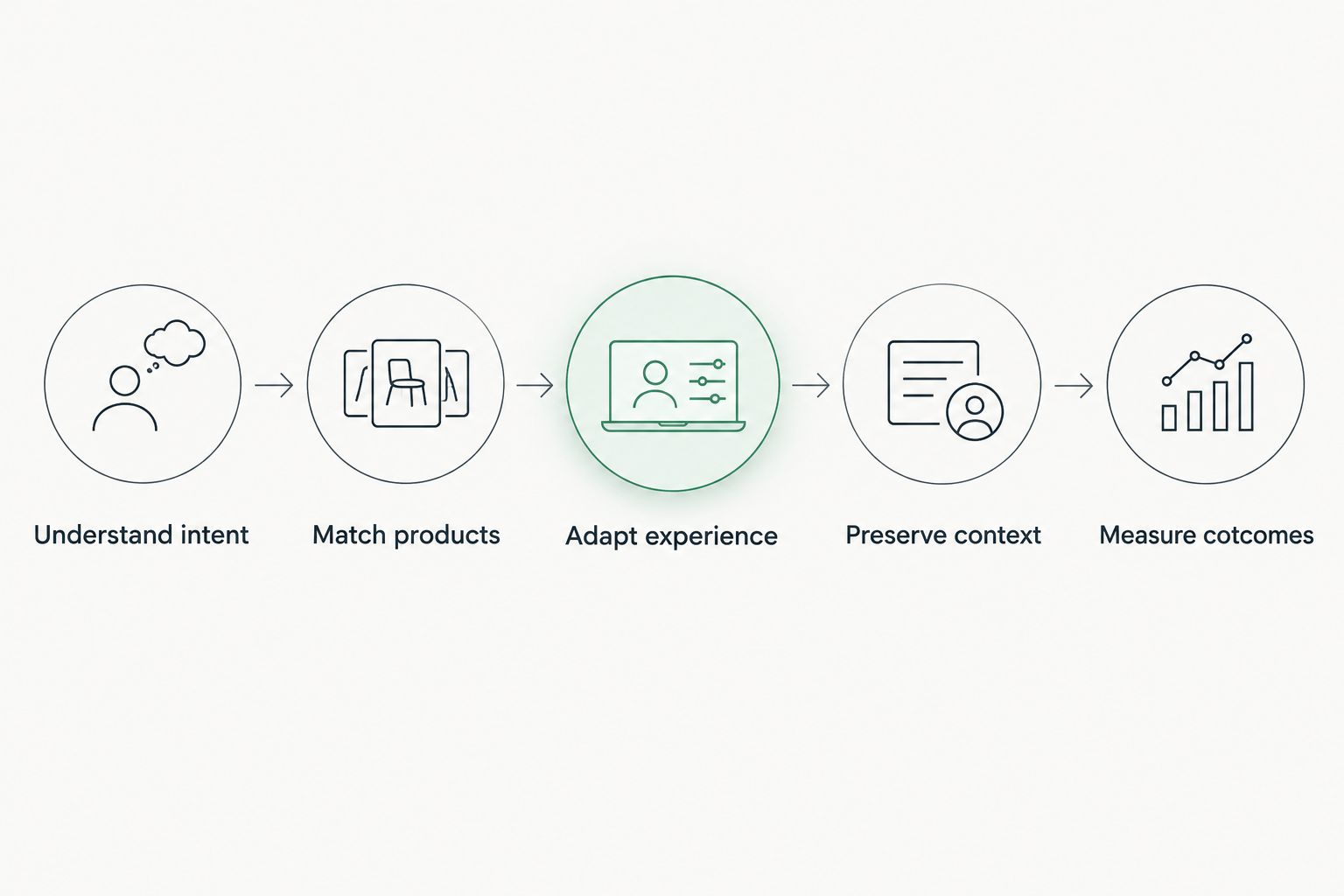
The commercial objectives differ by step. Relevant product discovery supports a conversion objective; complementary recommendations support an average order value objective. Preserving context supports journey continuity, but none of these mechanisms establishes a measured improvement without outcome data.
Why new-product merchandising results vary
Initial relevance depends on the inputs and decisions surrounding the product. Use these factors as your 2026 evaluation checklist, rather than treating the absence of sales history as the only issue.
- Product-information quality: Accurate descriptions and attributes give the system evidence for a match. Missing information limits what it can responsibly infer.
- Relationship quality: Complementary products, alternatives and occasion links need a defensible basis. A plausible-looking combination is not evidence of compatibility.
- Intent specificity: A clear request supplies more explicit constraints than a broad browsing action. Evaluate both journeys rather than testing only detailed prompts.
- Experience continuity: Context must remain useful as shoppers move between listings, product detail pages and recommendations. A relevant first answer is not the entire journey.
- Exposure decisions: Merchandising rules determine whether the new item receives an opportunity to be evaluated. Record where and why it appears.
- Measurement design: Purchases among people who choose to engage do not establish what would have happened without the experience. Keep comparison conditions visible.
How should you test AI merchandising before launch?
Use a catalog sample containing genuinely new items and established alternatives. Keep the new items free of historical purchase signals in the evaluation so the demonstration answers the cold-start question directly.
- Define the objective. Specify the shopper need and the commercial outcome you want to evaluate. Separate relevant discovery from conversion or basket-building objectives.
- Inspect the evidence. Ask which product facts and relationships support each recommendation. Challenge unsupported claims instead of accepting a fluent explanation.
- Change the request. Move from an occasion to a material preference or a compatibility question. Check whether the experience responds to the new constraint.
- Follow the journey. Inspect the listing page, product detail page and subsequent recommendation. Confirm that the new item remains relevant as context changes.
- Document failure cases. Include incomplete product records, contradictory requests and items that should not match. A useful evaluation tests restraint as well as discovery.
- Define measurement before release. Record exposure, engagement, purchases and the comparison conditions. Decide how you will assess commercial outcomes before reviewing results.
Require a demonstration with unfamiliar catalog items, not just a polished journey built around established sellers. That is a more direct test of whether product understanding supports the initial merchandising decision.
Evaluate your new-product journey
Assess how product information and shopper intent shape listings, product pages and recommendations.
What customer evidence supports the broader approach?
Bayezon’s customer case studies, supplied on October 22, 2026, describe commercial outcomes associated with agentic shopping experiences. They do not isolate products with no sales history, so they support evaluation of the broader architecture—not a cold-start performance guarantee.
City Beach: storefront engagement and purchase conversion
At City Beach, shoppers engaging with Agentic Storefront™ converted at over 7%, compared with approximately 2% on the traditional ecommerce experience. The retailer’s implementation includes Agentic Search, Product Intelligence and Intent Intelligence, with conversational needs, dynamically generated listing experiences and context maintained into product detail pages.
This is an observed comparison, not proven causal uplift. Measurement dates, sample sizes, assignment methods and statistical uncertainty were not supplied; the figures do not establish how newly introduced products performed.
Rodd & Gunn: guided selling and basket-building objectives
Rodd & Gunn reported conversion moving from 2% to 4.5% and average order value increasing 30%, associated with Agentic Storefront™, Product Intelligence, guided selling and personalized recommendations. Relevant experiences include fit, styling, occasion-based discovery and coordinated outfits.
Time periods, comparison design and attribution were not supplied. These results make conversion and average order value relevant evaluation objectives, but they do not prove that the technology caused the changes or predict your launch results.
Does a new product need clicks before it can be recommended?
No. A product can be considered through its documented characteristics and relationships before it has clicks, provided the system supports those inputs. Your evaluation should show which facts caused the match and whether the recommendation remains appropriate when the shopper changes the request.
Can product information prove that a new item will sell?
No. Product information supports relevance, not proven demand. You still need exposure and outcome measurements to determine whether shoppers choose the item and whether its presentation contributes to your commercial objectives.
FAQ
Can AI merchandising work with no sales history?
Yes. AI merchandising can use product descriptions, attributes, relationships and current shopper intent to support initial placement. That establishes a basis for relevance, not a guarantee of purchases.
What should retailers provide for a newly launched product?
Provide accurate product descriptions, verified attributes and defensible relationships to complementary items, alternatives or use cases. Keep unknown characteristics unknown rather than filling gaps with assumptions.
Is product-content matching better than sales-based ranking?
Product-content matching addresses initial relevance when an item has no purchase record; sales-based ranking adds evidence from previous purchases. Evaluate how the system combines these signals rather than treating either as sufficient for every decision.
Can AI merchandising change the product detail page too?
Yes, when the platform supports that scope. Agentic Storefront™ is described as adapting product detail pages as well as listings, recommendations, comparisons, bundles and guided shopping while preserving context.
Do the customer results prove better performance for new products?
No. The supplied customer case studies report broader shopping outcomes and do not isolate products without sales history. They cannot establish a cold-start conversion improvement.
How should I measure a new-product merchandising pilot?
Measure product exposure, engagement and purchases under documented comparison conditions. Evaluate conversion and average order value against your stated objectives, and distinguish observed associations from causal effects.
One last thing
Test whether the system can decline an unsupported match. An unfamiliar product with incomplete information is a useful evaluation case: the right response can be clarification or exclusion, not a confident recommendation.
For a 2026 pilot, ask Bayezon to demonstrate both a relevant new-product placement and a case where the evidence is insufficient. Understanding those boundaries gives you a clearer buying decision than a demonstration that only shows successful matches.