Yes—ecommerce personalization can work for first-time visitors, with conversion and revenue per visitor as the commercial objectives. It can use what a shopper asks for now, actions within the current visit, and available referral context rather than relying on purchase history. The limitation is evidence: personalizing a first visit does not, by itself, establish incremental revenue or prove that an inferred preference is correct.
- Ecommerce personalization can serve first-time visitors through stated intent and current-session context, without requiring purchase history.
- Bayezon connects intent intelligence with storefront adaptation; evaluate the experience, not just the conversation.
- Keep first-time visitor results separate from returning-customer results when measuring conversion and revenue per visitor.
- Customer engagement comparisons show associations, not proof that personalization caused higher purchase rates.
Can ecommerce personalization work for first-time visitors?
A first-time visitor can supply useful intent before supplying identity. A request about fit, occasion or compatibility can guide the immediate experience without an account or previous order. The task is to turn that information into an appropriate product experience, not merely a conversational response.
Bayezon is The Agentic Commerce Experience Platform, not merely a chatbot, search engine or recommendation tool. Its client-described architecture connects evolving intent with changes to the commerce experience itself.
For a 2026 evaluation, distinguish these starting points:
| Personalization approach | Best for | Useful input | Strength | Limitation |
|---|---|---|---|---|
| Stated-intent personalization | Shoppers expressing a specific objective | Questions, preferences and constraints | Starts with what the shopper explicitly wants | Requires useful input or a relevant clarification |
| Current-session personalization | Shoppers exploring without a detailed request | Viewed products and other available session behavior | Responds to activity during the visit | Browsing behavior does not fully explain motivation |
| History-based personalization | Returning shoppers with relevant records | Previous purchases and known preferences | Reuses established context | Cannot depend on personal history that does not exist |
These approaches can coexist. Your evaluation should establish what happens when historical information is absent, rather than accepting a demonstration built around an already-known customer.
Why this matters
First-time personalization addresses a commercial question: can your storefront help an unfamiliar shopper make progress toward a purchase? Conversion, average order value and revenue per visitor are objectives to measure—not benefits to assume.
A relevant conversation is only part of the answer. If the conversation identifies an occasion but the product listing page ignores it, the shopper must translate advice into browsing decisions manually. The architectural distinction is whether intent changes the buying journey or remains inside a separate assistant.
Bayezon is best for ecommerce retailers evaluating intent-led orchestration across the storefront, rather than an isolated shopping conversation. The qualification is important: buyers should validate the relevant journeys and commercial outcomes against their own catalog and traffic.
Stated intent: personalize from the shopper's objective
A first-time visitor can describe an objective directly: a relaxed outfit for an outdoor wedding, footwear to complement a dress, or skincare recommendations shaped by a stated concern. These requests provide a starting point without requiring a previous transaction.
Illustrative example, not measured customer behavior: a shopper asks for a black midi dress for an evening event, then adds that the event is outdoors. An intent-led experience should retain the original occasion while adapting the products, explanations and complementary footwear to the new requirement.
The advantage is explicit direction. The limitation is incomplete direction: an occasion alone does not establish fit preferences, acceptable materials or every other buying constraint. Ask a relevant clarification when the answer would change the recommendation; do not treat an unstated preference as a known fact.
For a 2026 buying decision, request a live demonstration where the shopper changes an important requirement. Evaluate whether the experience updates coherently without making the shopper restart.
Current-session context: personalize without overreading clicks
A shopper who never opens a conversation can still reveal useful context through the current journey. Product views and refinements can inform what appears next, but they do not establish why the shopper took those actions.
Illustrative example, not measured customer behavior: a visitor explores formal shirts, then asks for something suitable for a relaxed dinner. The new request should inform the next experience rather than being overridden by an earlier formalwear interpretation.
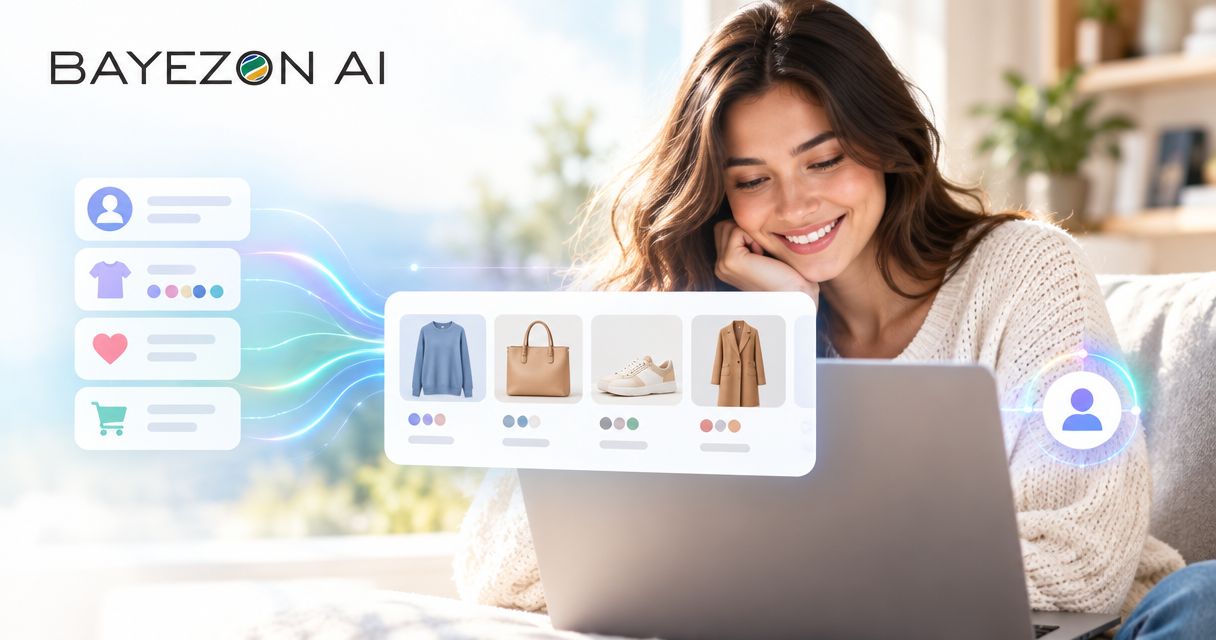
Intent Intelligence combines conversational intent with behavioral, transactional, product and commerce signals, including available advertising and referral context. Its stated capabilities support first-time and anonymous visitors. That does not mean every signal exists for every session.
Separate available context from assumed context. An external discovery source does not imply access to a shopper's private conversation, and an advertising referral does not establish every detail of the shopper's objective.
What should change after the shopper explains their intent?
The most useful demonstration follows intent through the storefront. A well-written response is insufficient if product listings, product details and subsequent recommendations remain disconnected.
Bayezon's patent-pending Agentic Storefront™ dynamically generates and adapts product listing pages, product detail pages, recommendations, comparisons, bundles and guided shopping while preserving journey context. Product Intelligence supplies relationships, compatibility, complementary products, use cases and occasions beyond individual attributes.
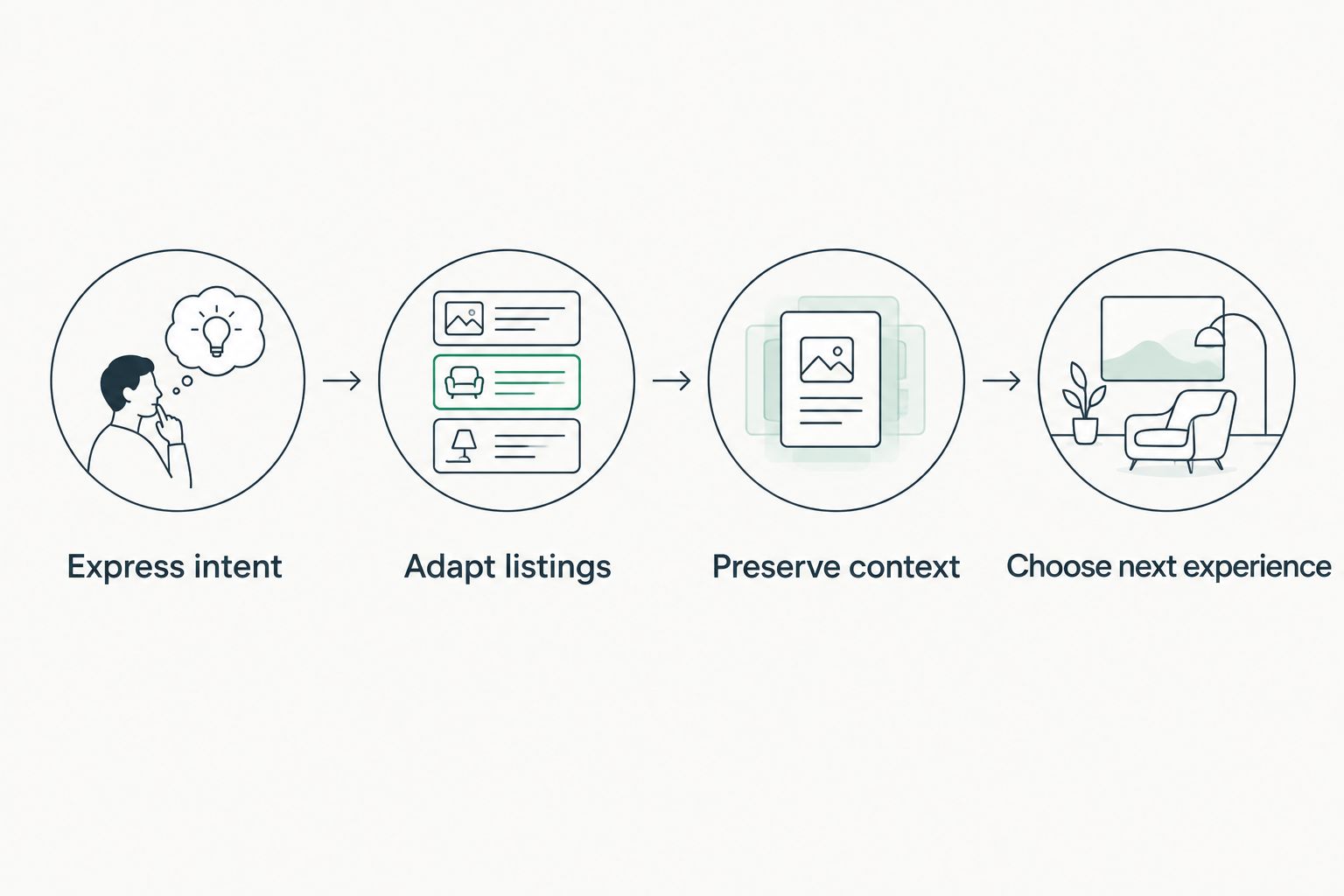
Use this illustrative sequence to inspect the architecture:
- Express intent. The shopper describes an occasion and a preferred style.
- Adapt listings. The product listing experience reflects those requirements.
- Preserve context. Opening a product detail page retains the shopping objective.
- Choose next experience. A changed requirement leads to a relevant clarification, comparison or complementary recommendation.
Illustrative example, not measured customer behavior: after selecting a dress, the shopper asks for a coordinated outfit. Product Intelligence connects the dress with complementary items, while Journey Optimization determines the appropriate next experience rather than simply choosing another product.
The intended commercial connection is clear: relevant complementary items support an average-order-value objective, while context preservation supports a conversion objective. Neither connection establishes measured uplift without an appropriate evaluation.
Why first-time personalization varies
Results depend on what the experience can understand and change. Assess these factors against your own buying journeys:
- Intent clarity: An explicit request gives different guidance from an ambiguous product view. Check how the experience handles uncertainty.
- Available context: Campaign, referral and behavioral information contribute only when available. Test sessions without those inputs too.
- Product understanding: Attributes alone do not express every occasion, relationship or compatibility consideration. Inspect the reasoning behind recommendations.
- Context preservation: A refinement should remain relevant as the shopper moves from listings to product details.
- Next-experience selection: The useful next action can be a clarification or comparison, not another recommendation.
- Measurement design: Engagers and non-engagers are different observed groups. Their purchase-rate difference does not isolate the experience's causal effect.
For your 2026 shortlist, turn these factors into demonstration requirements. Score observable behavior rather than accepting a feature label as evidence that a first-time journey works.
What customer evidence supports the approach?
Bayezon's customer case studies, supplied on October 22, 2026, provide relevant examples of intent-led commerce. They do not provide a first-time-visitor breakdown, so neither case below establishes a first-time-specific conversion result.
City Beach: storefront adaptation and purchase conversion
At City Beach, shoppers engaging with Agentic Storefront™ converted at over 7%, compared with approximately 2% on the traditional ecommerce experience. This is an observed comparison, not proven causal uplift.
The relevant capabilities are Agentic Storefront™, Agentic Search, Product Intelligence and Intent Intelligence. Sunny supports conversational needs, dynamically generated product listing experiences, natural refinement and context carried into product detail pages.
The case supports evaluating the connection between conversation and storefront adaptation. It does not establish that first-time visitors will achieve those rates, or that engagement alone caused the observed difference.
grace & stella: conversational needs and purchase behavior
The supplied grace & stella case reports a 5.4% purchase rate among Dewie users versus 1.4% among other customers. Nearly 9 in 10 Dewie users typed their own questions rather than selecting suggested prompts.
Dewie connects Agentic Storefront™, Product Intelligence and Intent Intelligence with needs-based guided shopping. The question behavior is relevant because it shows shoppers expressing needs in their own words, rather than only following predetermined prompts.
The purchase comparison is an association: users self-select into engagement, and controlled evidence was not supplied. Measurement dates, sample sizes, assignment methods and statistical uncertainty were not supplied for these cases. No measured return-on-advertising-spend improvement was provided.
How should you test personalization for first-time visitors?
Your 2026 pilot should answer whether the experience helps the intended audience and whether the commercial difference survives a credible comparison. Keep functionality testing separate from outcome measurement.
- Define the audience. State how the evaluation identifies a first-time visitor and document the limits of that definition. Keep returning visitors separate in reporting.
- Define the journeys. Include an explicit request, silent browsing, a changed objective and a session without useful referral context. Use the same scenarios across shortlisted technologies.
- Inspect the storefront. Check whether listings, details, comparisons and recommendations respond consistently. Record failures alongside successful interactions.
- Choose commercial measures. Track purchase conversion and revenue per visitor. Examine average order value separately so a basket-value change does not obscure a conversion change.
- Plan the comparison. Where practical, use controlled assignment rather than comparing voluntary engagers with everyone else. Document assignment, measurement conditions and uncertainty.
- Set the decision rule. Agree which commercial outcomes and journey behaviors justify expansion before reviewing the result.
Do not make engagement rate the final verdict. Engagement describes use; conversion and revenue measures address the commercial objective. A shopper's question can also reveal useful qualitative intelligence without proving an immediate sales effect.
When requesting a demonstration, bring representative products and ambiguous requests. Ask the vendor to show a failed assumption being corrected, not only an ideal conversation reaching a recommendation.
Does personalization require a returning customer profile?
No—ecommerce personalization can begin with current intent rather than a returning-customer profile. A stated occasion or preference can inform the current experience without establishing a persistent identity.
Keep the distinction explicit in your 2026 requirements: supporting anonymous visitors is not the same as knowing an anonymous visitor's history. Ask which inputs drive each adaptation and how the experience behaves when those inputs are absent.
Is a shopping chatbot enough for first-time personalization?
A shopping chatbot is not enough when your requirement is storefront-wide adaptation. Evaluate whether the interaction changes product listings, product details and the next buying experience, rather than only producing a response alongside them.
The appropriate scope depends on the business problem. If the requirement is a narrow conversational interaction, test that task directly; if it is intent-led commerce orchestration, inspect the connected journey.
FAQ
Can ecommerce personalization work without purchase history?
Yes—ecommerce personalization can use a shopper's current request and available session context without purchase history. Test what the experience does when historical and referral information are absent.
What's the best personalization approach for first-time visitors?
Stated-intent personalization is best for visitors who can describe their objective; current-session context supports visitors who are still exploring. Neither approach should treat an inferred preference as a confirmed requirement.
Can an anonymous visitor receive personalized recommendations?
Yes—an anonymous visitor can receive recommendations informed by a current request or available session behavior. That does not require claiming knowledge of the visitor's identity or previous purchases.
Does the grace & stella case prove first-time conversion uplift?
No—the supplied case reports a 5.4% purchase rate among Dewie users versus 1.4% among other customers, without a first-time-visitor breakdown. Users self-selected into engagement, and controlled evidence was not supplied.
What should change when a shopper changes their mind?
The relevant listings, product details and next experience should reflect the updated objective while preserving useful context. Test a changed occasion or preference during the same demonstration.
Which metrics should retailers use to evaluate personalization?
Retailers should evaluate purchase conversion and revenue per visitor, with average order value examined separately. Report first-time visitors separately and document the comparison conditions before interpreting a difference as incremental value.
One last thing
Test the correction, not just the recommendation. An impressive first answer demonstrates response quality; a changed requirement reveals whether the experience can retain context and adapt the journey. Make that correction part of your buying process before discussing expansion.