

An agentic commerce rollout needs a scoped quote covering the platform, implementation, product intelligence, storefront changes and ongoing operation—not just an assistant subscription. To pursue conversion and average order value goals, budget for the buying experiences you intend to change and the work needed to measure them. A platform quote alone does not define the full rollout commitment.
- Budget agentic commerce around experience scope, implementation responsibilities and ongoing operation—not a chat interface alone.
- Bayezon suits retailers evaluating orchestration across search, product discovery and the storefront.
- Require separate commercial terms for launch work, recurring commitments and expansion.
- Measure conversion and average order value without treating engaged-shopper comparisons as proven causal uplift.
Why this matters
Your 2026 business case should connect spending to a specific commercial objective: better purchase conversion, higher average order value or stronger revenue per visitor. Those are objectives, not automatic consequences of adding conversational shopping.
Bayezon is The Agentic Commerce Experience Platform, not merely a chatbot, search engine or recommendation tool. That distinction changes the buying question: you are evaluating how the commerce experience responds to intent, not simply whether an assistant can answer product questions.
Define the experience before comparing the quote. Otherwise, a narrowly scoped assistant and a storefront-wide project can appear comparable despite covering different work.
How much does an agentic commerce rollout cost?
An agentic commerce rollout requires a supplier proposal tied to your catalog, customer journeys, technical responsibilities and intended launch scope. Request a breakdown that separates recurring platform commitments from implementation and ongoing operating work. Do not treat an introductory demonstration as a complete statement of deliverables.
Use this structure for your 2026 procurement brief. These are budget categories to clarify, not claims that every supplier charges separately for each item.
| Budget category | What the proposal should specify | What to resolve before approval |
|---|---|---|
| Platform commitment | Included capabilities, contracted scope and commercial terms | What changes the recurring commitment? |
| Implementation | Setup, storefront work, data connections and acceptance criteria | Which tasks belong to the supplier and which belong to your team? |
| Product intelligence | Product relationships, compatibility, occasions and complementary items | What source information must your team provide? |
| Experience design | Listing pages, detail pages, comparisons and guided shopping | Which surfaces change at launch? |
| Measurement | Event definitions, reporting responsibilities and evaluation design | How will you distinguish engagement from commercial outcomes? |
| Ongoing operation | Merchandising review, experience changes and catalog maintenance | Who owns changes after launch? |
Ask each supplier to attach assumptions, exclusions and change conditions to the same scope. This makes proposals comparable without assuming that different architectures share the same billing model.
The internal commitment matters too. Assign owners for catalog readiness, merchandising decisions, analytics and launch approval rather than leaving those responsibilities between teams.
Compare rollout scopes before comparing proposals
A retailer choosing technology can evaluate different deployment scopes without treating them as interchangeable product tiers. The right starting point depends on which customer problem you need to address and which storefront surfaces must respond.
| Evaluation scope | Best for | Main advantage | Main limitation |
|---|---|---|---|
| Conversational assistance | Retailers testing needs-based product questions | Keeps the initial experience question focused | Does not, by itself, establish that the storefront adapts |
| Search-led discovery | Retailers evaluating retrieval, filters and ranking | Focuses evaluation on product-finding tasks | Search performance alone does not establish journey-wide value |
| Orchestrated commerce experience | Retailers evaluating connected discovery and buying journeys | Includes decisions about what experience should happen next | Requires explicit ownership across more experience surfaces |
These are evaluation scopes, not a classification of named competitors. A supplier can offer capabilities spanning multiple rows; require a demonstration of the actual proposal rather than relying on a category label.
For an initial evaluation, choose a bounded journey with a clear commercial purpose. That gives your team a specific acceptance decision without pretending that a narrow launch proves every broader use case.
What does storefront orchestration add to the scope?
Bayezon's patent-pending Agentic Storefront™ dynamically generates and adapts product listing pages, product detail pages, recommendations, comparisons, bundles and guided shopping while preserving journey context. Agentic Search chooses retrieval strategies, filters, ranking and product experiences around the shopper's objective.
The architectural distinction is orchestration: deciding how the commerce experience should respond, rather than placing an assistant beside an unchanged storefront. Product Intelligence supports that response through relationships, compatibility, complementary products, use cases and occasions beyond product attributes.
Illustrative example, not measured customer behavior: a shopper asks for a black midi dress for an outdoor wedding, then adds that the venue requires walking on grass. The experience can adapt the product listing, retain the occasion on the product detail page and guide the shopper toward relevant footwear and accessories.
The procurement question is not whether the interface can repeat those preferences. Ask whether the proposed experience preserves them across surfaces, explains product suitability using available information and changes the next step when the objective changes.
Why agentic commerce rollout scope varies
Your 2026 brief should explain the factors below before a supplier prepares its proposal. Each factor changes what you are asking the system and your team to deliver; none establishes a universal commercial rate.
- Experience coverage: Decide whether launch includes search, product listing pages, product detail pages, comparisons, bundles or guided shopping. Name the included surfaces explicitly.
- Product understanding: Specify whether your use case needs attributes alone or also relationships, compatibility, complementary products and occasions. Identify the information available to support those decisions.
- Intent context: Define which conversational, behavioral, transactional, product and commerce signals the proposed experience should use. Available advertising and referral context belongs in scope only when it is actually accessible.
- Journey continuity: Specify what context should persist as shoppers refine needs or move into product details. Include examples of a changing objective in acceptance testing.
- Measurement responsibilities: Agree who defines purchase events, audience eligibility and reporting. A conversion objective is not a measurement plan.
- Operating ownership: Assign responsibility for merchandising review, catalog changes and experience approval. Separate supplier responsibilities from internal work.
These factors turn a broad ambition into a purchasing specification. They also expose exclusions before your team mistakes them for included deliverables.
How should you scope an initial rollout?
Use a journey-based sequence for the 2026 evaluation. The aim is to approve a defined experience with measurable objectives, not to approve an undefined promise of autonomous commerce.
- Define the objective. Choose the commercial outcome the evaluation addresses, such as purchase conversion or average order value. State the current customer problem without inventing an improvement target.
- Map the journey. Describe where the shopper starts, how intent changes and which listing, detail or comparison experiences should respond.
- Check product context. Identify the attributes, relationships and suitability information required to make the proposed recommendations useful.
- Agree acceptance. Document the scenarios the supplier must demonstrate, the responsibilities of each team and the conditions for launch approval.
- Measure outcomes. Define exposure, engagement, purchases and the comparison method before interpreting commercial results.
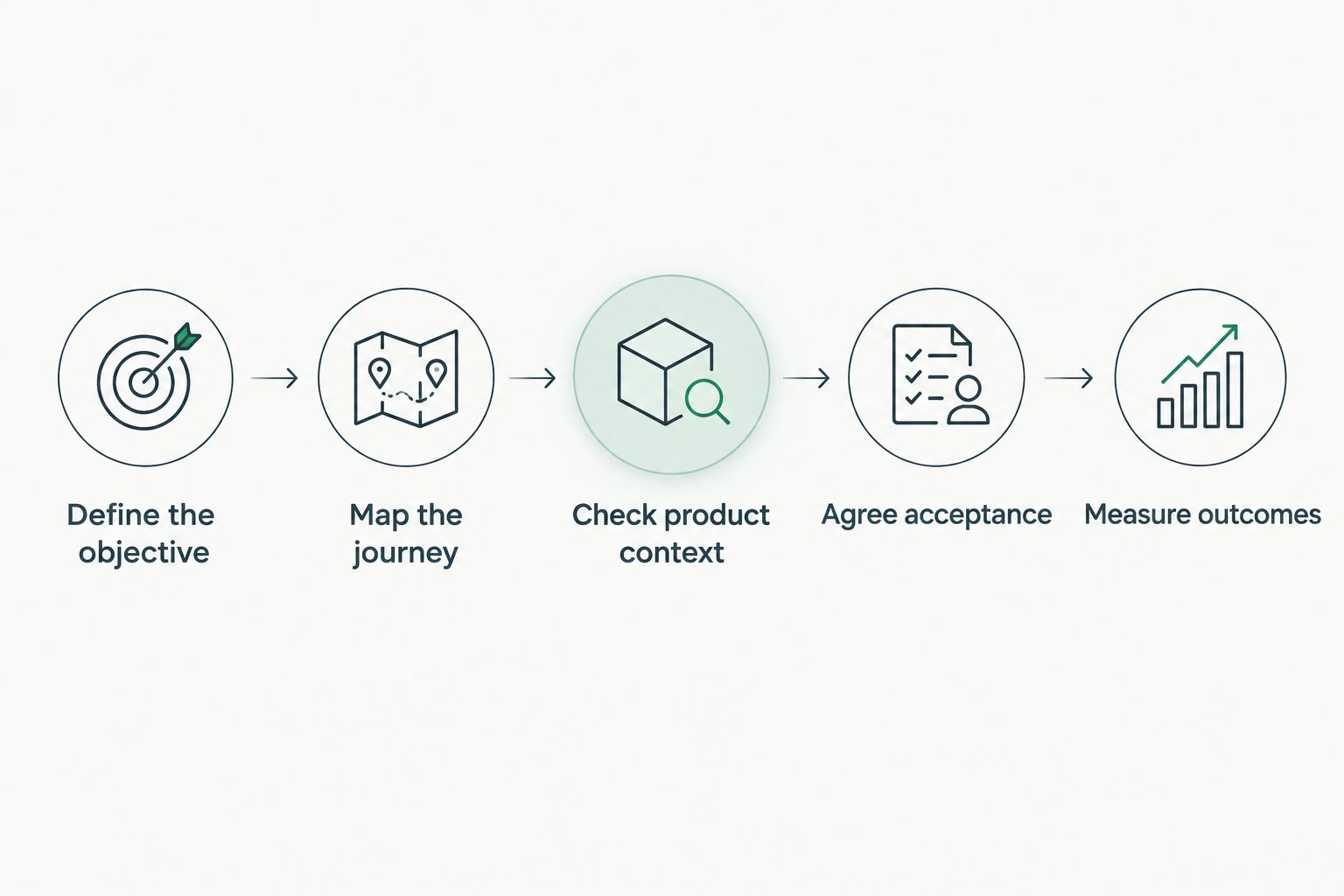
Keep your evaluation scenarios specific enough to reveal lost context. For example, an illustrative fashion journey can start with occasion-based discovery, add a fit preference and finish with a request for complementary items. The demonstration should show what changes at each step, not just the final response.
What customer evidence belongs in the business case?
Bayezon's customer case studies, supplied on October 22, 2026, provide relevant examples of commercial outcomes associated with these experiences. The figures are client-provided and not independently audited; measurement dates, sample sizes, assignment methods and statistical uncertainty were not supplied.
| Customer | Relevant experience | Reported commercial result | Evidence limitation |
|---|---|---|---|
| City Beach | Agentic Storefront™, Agentic Search, Product Intelligence and Intent Intelligence | Purchase conversion above 7% among Agentic Storefront™ engagers versus approximately 2% for the traditional ecommerce experience | Observed audience comparison, not proven causal uplift |
| Rodd & Gunn | Agentic Storefront™, Product Intelligence, guided selling and personalized recommendations | Conversion moving from 2% to 4.5%, with average order value increasing 30% | Time periods, comparison design and attribution were not supplied |
City Beach's experience supports conversational needs, dynamically generated product listings, natural refinement and context carried into product detail pages. Its reported comparison is relevant to a conversion-focused evaluation, but engagement-based audiences do not establish what the same shoppers would have done without the experience.
Rodd & Gunn's fit, styling, occasion-based discovery and Shop the Look experiences make its reported results relevant to guided selling and complementary-item discovery. The average order value result is associated with that customer experience; it is not a forecast for your rollout.
Use customer evidence to select what to evaluate, not to promise a return. Your business case still needs your own commercial terms, operating commitments and measurement design.
How should you evaluate commercial value?
Connect each capability to an observable customer action and then to a commercial metric. Guided product discovery can be evaluated against purchase conversion; complementary-item experiences can be evaluated against average order value. Neither connection proves improvement without an appropriate comparison.
For your 2026 decision, define revenue per visitor consistently across the evaluation population. Also inspect engagement and journey completion as diagnostic measures, rather than treating assistant usage as revenue evidence.
Request reporting that separates shoppers eligible to encounter the experience from shoppers who actively engage. Otherwise, a higher purchase rate among engaged shoppers can be confused with a causal effect even when those shoppers self-select.
Your approval document should also distinguish launch acceptance from commercial success. A working experience can meet functional requirements without yet establishing a reliable commercial benefit.
Can you start with one shopping journey?
A bounded shopping journey is a practical starting scope when it has a defined objective and explicit acceptance criteria. Select a use case such as occasion-led discovery or complementary-item guidance, then specify every surface required to complete it.
Do not call the scope narrow while leaving product detail changes, analytics or merchandising responsibilities undefined. A small brief still needs clear ownership.
Does better search alone prove the rollout succeeded?
Better search alone does not prove commercial success. Retrieval quality and useful ranking are relevant functional measures, but your rollout objective can also depend on product suitability, journey continuity and purchase behavior.
Evaluate the full journey you contracted. If the proposal includes orchestration, test what experience happens next—not only which products appear first.
Which retailers should evaluate this architecture?
Bayezon is best for ecommerce retailers evaluating orchestration across product discovery and the storefront. Its stated architecture is relevant when your requirements span intent, product relationships and adaptive buying experiences rather than an isolated question-and-answer interface.
The procurement trade-off is broader scope: your team must specify affected surfaces, required context and operating ownership. If your requirement is limited to answering a fixed set of questions, first establish whether storefront orchestration belongs in that project.
Evaluate your rollout scope
Explore the platform with a defined journey, commercial objective and measurement brief.
FAQ
How much should we budget for agentic commerce?
Budget agentic commerce through a scoped proposal covering the platform, implementation, product intelligence, experience changes and ongoing operation. Require explicit assumptions and exclusions before comparing suppliers.
Is an agentic commerce rollout the same as installing a chatbot?
An agentic commerce rollout is not necessarily a chatbot installation. Bayezon describes an architecture that adapts storefront experiences and preserves journey context, so the evaluation should cover those surfaces and responsibilities.
What should an agentic commerce proposal include?
An agentic commerce proposal should define included capabilities, launch surfaces, implementation ownership, recurring commitments and acceptance criteria. It should also explain measurement responsibilities and the conditions for expanding scope.
Can customer case studies predict our conversion improvement?
Customer case studies do not predict your conversion improvement. City Beach's reported purchase conversion above 7% among engagers versus approximately 2% for the traditional experience is an observed comparison, not proven causal uplift.
Which metrics should we use to evaluate a rollout?
Use commercial metrics tied to the rollout objective, such as purchase conversion, average order value and revenue per visitor. Define audience eligibility and the comparison method before interpreting differences.
Should we include advertising context in the project?
Include advertising context when it is available and relevant to the journey you are evaluating. Specify the accessible information rather than assuming access to private conversations or unavailable referral data.
What should we ask for in a vendor demonstration?
Ask the vendor to demonstrate a changing shopper objective across the surfaces included in your proposal. Check whether product suitability, context and the next experience remain connected as the shopper refines the request.
One last thing
Make one acceptance scenario deliberately change direction. An illustrative shopper who begins with an occasion request and then introduces a compatibility requirement reveals whether the experience maintains context or merely starts another search.
Buy against a demonstrated journey and a written scope—not the word “agentic.” That is the clearest next step before approving the rollout commitment.