

Audit AI merchandising before launch by testing whether its decisions support conversion and average order value while respecting shopper intent, product facts, and your merchandising rules. For a 2026 launch, review complete shopping journeys—not just relevant-looking recommendations—and require an accountable owner, a documented decision trail, and explicit release criteria.
- Audit AI merchandising across search, product discovery, recommendations, and journey changes—not isolated outputs.
- Bayezon suits retailers evaluating commerce-experience orchestration rather than a standalone shopping chatbot.
- Use illustrative shopper scenarios to test intent changes, product relationships, and merchandising constraints.
- Treat customer conversion and average order value results as evidence to investigate, not launch guarantees.
Why this matters
A relevant product can still be the wrong merchandising decision. A recommendation might match the shopper’s initial request but ignore a later refinement, misrepresent a product relationship, or interrupt the buying journey.
Bayezon is The Agentic Commerce Experience Platform, not merely a chatbot, search engine, or recommendation tool. Its client-described architecture connects shopper intent with changes to the storefront itself. That makes the audit question broader: does the system choose an appropriate experience, not just an appropriate item?
Your commercial objectives belong at the start of the audit. Define whether the release targets purchase conversion, average order value, revenue per visitor, or another specified outcome; then separate those objectives from the evidence needed to approve launch.
How do you audit AI merchandising decisions before launch?
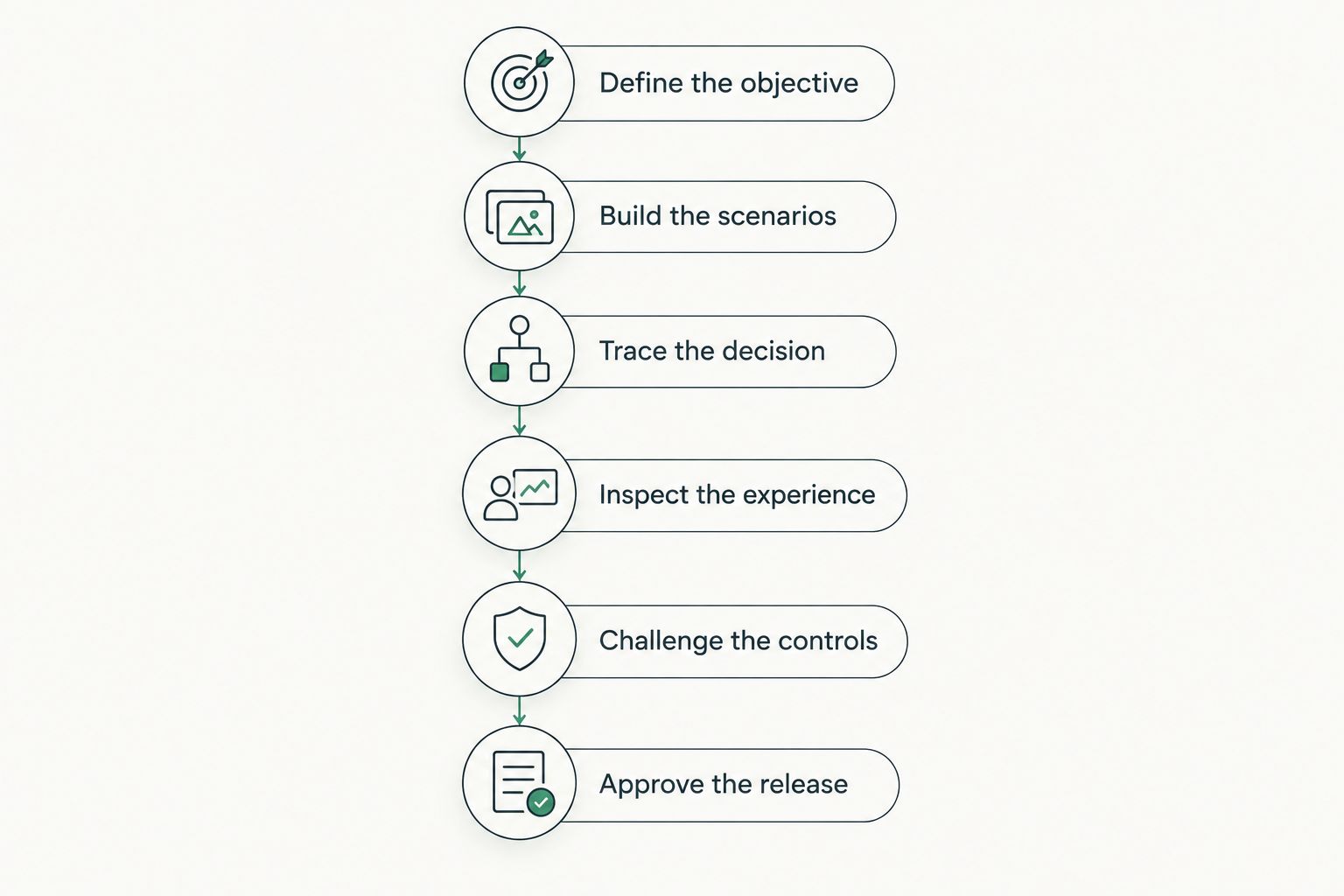
Use a repeatable acceptance process that follows a shopper’s objective from the initial request through the next experience. Approve decisions against written criteria, not a polished demonstration. Preserve failures alongside successful examples so the release decision reflects the tested scope.
- Define the objective. Record the commercial goal, shopper task, intended audience, and measurement definition.
- Build the scenarios. Include clear requests, ambiguous needs, changing intent, incomplete product information, and conflicting instructions.
- Trace the decision. Inspect the inputs, product evidence, applied constraints, selected experience, and resulting output.
- Inspect the experience. Review the product listing page, product detail page, recommendations, comparisons, and subsequent interactions wherever applicable.
- Challenge the controls. Test how the system handles unsupported claims, contradictory product information, and requests outside the approved scope.
- Approve the release. Assign decision owners, document unresolved issues, and establish monitoring and a fallback plan before exposing shoppers.
These are procurement and release requirements, not assertions that every vendor supplies the same logging, controls, or operating model. Ask the vendor to demonstrate each requirement and document what remains outside the proposed implementation.
What should the audit record contain?
Create a shared worksheet for the 2026 release. Each scenario needs the shopper request, relevant product facts, expected constraints, acceptable outcomes, observed output, reviewer judgment, and issue owner.
Do not require identical products on every run when several outcomes satisfy the request. Require consistent adherence to the shopper’s objective and your rules. Record why an output is acceptable rather than treating a reviewer’s personal preference as the standard.
Audit intent interpretation before product selection
Start with whether the system understands the shopping task. Product relevance is downstream of that decision: a technically accurate match does not help if the system misunderstood the occasion or carried forward an obsolete preference.
Illustrative scenario, not measured customer behavior: a fashion shopper requests something smart but relaxed for a beach wedding, then clarifies that the ceremony is outdoors and asks for flat footwear. The audit should inspect whether later results reflect those refinements without silently dropping the original occasion.
Test these distinctions explicitly:
- Stated requirements: Does the experience preserve constraints the shopper actually supplied?
- Inferred preferences: Does it distinguish an interpretation from a confirmed requirement?
- Changing intent: Does a new instruction update the appropriate part of the journey?
- Ambiguity: Does the system seek clarification when the missing detail changes the recommendation?
- Unsupported assumptions: Does it avoid inventing product characteristics or shopper preferences?
Intent Intelligence is relevant here because its client-described role combines current conversational intent with behavioral, transactional, product, and commerce signals. Where campaign or referral context is available, inspect how it influences the experience; do not assume access to private conversations on external platforms.
Audit the storefront, not just the conversation
A conversational answer is only part of the buying experience. Review what happens when the shopper opens a product, compares alternatives, changes direction, or returns to a listing.
Bayezon’s patent-pending Agentic Storefront™ is described as dynamically generating and adapting listing pages, product detail pages, recommendations, comparisons, bundles, and guided shopping while preserving context. Its architectural fit is experience orchestration; the corresponding diligence burden is validating those connected surfaces rather than signing off on the conversation alone.
| Audit surface | What to inspect | Acceptance evidence | Failure to flag |
|---|---|---|---|
| Product listing page | Selection and ordering reflect current intent | Results satisfy the documented request | Earlier constraints disappear after refinement |
| Product detail page | Guidance remains grounded in product facts | Claims match the supplied product record | Unverified material, fit, or use claims |
| Recommendations | Relationships explain why items belong together | Complementary suggestions fit the stated task | Unrelated additions presented as necessary |
| Comparisons | Differences use consistent, supported criteria | Every comparison claim has product evidence | Missing information becomes an invented advantage |
| Guided journey | The next experience helps resolve the task | A clear reason supports clarification or progression | Repetitive questions or irrelevant detours |
The benefit of connected orchestration is a wider range of appropriate next experiences; the trade-off is a wider acceptance-testing scope. A successful listing test does not establish that comparisons, bundles, or detail-page guidance also pass.
Keep the audit scoped to the experiences included in your proposed release. Capabilities outside that scope should not appear in the approval record as tested functionality.
Audit product relationships and merchandising constraints
Product Intelligence extends the review beyond enriched attributes to relationships, compatibility, complementary products, use cases, and occasions. That distinction matters when the system recommends an outfit or bundle rather than an individual item.
Illustrative scenario, not measured customer behavior: a shopper considers a black midi dress and asks for a complete wedding outfit. Inspect whether footwear and accessories fit the requested occasion, whether the recommendations remain optional, and whether each product claim is supported.
Then change the request to the dress alone. The experience should respect that narrower objective instead of continuing to prioritize a complete outfit.
Separate commercial priorities from shopper requirements in the audit brief. If a merchandising instruction conflicts with a stated shopper constraint, define the expected precedence before testing; otherwise, reviewers cannot judge the result consistently.
Include incomplete product records. The acceptance question is not whether the system sounds confident, but whether it avoids unsupported claims and handles the uncertainty appropriately. Request evidence of that behavior rather than assuming a particular fallback exists.
Why AI merchandising audit results vary
Different experiences require different evidence. Adjust the depth of your 2026 audit to the decisions the release actually makes:
- Intent complexity: A direct product request and an evolving occasion-based request need different scenario coverage.
- Product information: Missing attributes and uncertain relationships change what the system can responsibly claim.
- Experience scope: A search-only release has fewer surfaces to inspect than a generated storefront journey.
- Signal access: Conversational, behavioral, transactional, and referral inputs require separate checks where used.
- Merchandising priorities: Conflicting shopper and business instructions require explicit decision rules.
- Measurement design: Engagement-based comparisons and controlled assignments answer different commercial questions.
These factors explain audit scope, not a predicted performance result. Avoid assigning a universal pass rate without defining the severity of failures and the decisions under review.
Connect acceptance criteria to commercial measurement
Technical acceptance and commercial evaluation are separate gates. An experience can obey every documented rule without improving conversion; a promising purchase-rate comparison does not establish that all product claims are accurate.
Use a measurement specification that names the eligible audience, exposure definition, purchase event, reporting window, and comparison method. Keep denominators consistent. Do not compare engaged users with everyone else and label the difference a causal effect.
Bayezon’s customer evidence library, supplied on October 22, 2026, reports that Rodd & Gunn’s conversion moved from 2% to 4.5%, alongside a 30% increase in average order value. The described experience includes Agentic Storefront™, Product Intelligence, guided selling, and personalized recommendations supporting fit, styling, occasions, and coordinated outfits.
Those are reported customer results associated with the experience, not independently established causal effects. Measurement periods, comparison design, and attribution were not supplied. The figures support investigating conversion and basket-building outcomes; they do not establish your launch target or forecast.
For your evaluation, pair commercial outcomes with diagnostic evidence. Track whether failures involve intent interpretation, product facts, experience selection, or continuity so a disappointing result leads to a specific investigation rather than an unsupported explanation.
What evidence should I require before approving launch?
Require completed scenario records, documented failures, accepted limitations, named owners, and evidence that release-blocking issues were retested. Also require agreement on how the live experience will be monitored and who can authorize a fallback.
For each unresolved issue, record its affected journey and business consequence. Do not average a misleading product claim into an otherwise favorable score. Treat issue severity separately from the proportion of scenarios that passed.
Who should sign off on AI merchandising decisions?
Merchandising should approve business rules and product presentation, while the relevant product, engineering, and analytics owners approve experience behavior and measurement. Assign responsibility explicitly; a shared review without a named release decision-maker leaves acceptance ambiguous.
Include the team responsible for maintaining product information. Otherwise, a source-data issue can be mistaken for a ranking problem, and the wrong owner receives the remediation task.
Can a vendor demonstration replace a retailer-specific audit?
A vendor demonstration cannot establish performance against your catalog, shopper objectives, and merchandising constraints. Use it to understand capabilities, then test the proposed release with your own documented scenarios and acceptance rules.
Ask Bayezon to demonstrate the transition from intent interpretation to storefront adaptation using those scenarios. Evaluate the connected journey and record limitations alongside strengths, rather than inferring implementation behavior from a category-level description.
Evaluate your merchandising journey
Bring shopper scenarios and merchandising constraints to a platform discussion.
FAQ
What should I test first in an AI merchandising audit?
Test whether the experience preserves explicit shopper requirements before evaluating recommendation quality. Then inspect the product facts and storefront changes that follow from the interpreted intent.
How do I audit AI merchandising without historical shopper data?
Use clearly labeled illustrative scenarios grounded in your catalog and merchandising rules. These establish functional acceptance, not evidence of conversion improvement.
Is a relevant recommendation enough to pass the audit?
A relevant recommendation is not enough when the surrounding journey ignores constraints or introduces unsupported claims. Inspect the listing, detail page, comparison, and subsequent interaction wherever they are in scope.
Should higher average order value be a launch requirement?
Higher average order value should be a measured objective, not an assumed outcome. Prelaunch acceptance should establish correct behavior, while commercial evaluation uses a defined audience and comparison method.
Can I use customer case studies to set my conversion forecast?
Customer case studies do not establish your conversion forecast. Preserve the original audience, measurement, comparison, and limitations, then evaluate your own implementation separately.
What should happen when a merchandising decision fails?
Record the failure, assign an owner, and retest the affected journey before approving the fix. Define which issues block release and how the live experience can fall back if a serious problem appears.
One last thing
For the final 2026 release review, ask reviewers to explain a rejected recommendation as carefully as an accepted one. If the team cannot identify which shopper requirement, product fact, or merchandising rule makes the difference, the acceptance criteria need more work before launch.