

Balance margin and relevance in ecommerce merchandising by making shopper fit a requirement, then using contribution margin to prioritize products that meet that requirement. In 2026, conversion, average order value, and revenue per visitor should remain commercial objectives—not reasons to promote a product that misses the shopper’s needs. Judge the result on contribution per visitor as well as purchase behavior, because a higher-margin product does not help when the recommendation prevents a purchase.
- Ecommerce merchandising should protect shopper relevance before using margin to prioritize suitable products.
- Bayezon connects shopper intent with storefront adaptation, rather than treating merchandising as an isolated ranking task.
- Evaluate contribution per visitor alongside conversion and average order value; no single metric settles the trade-off.
- Test commercial rules across changing shopper objectives, not just the first search result.
Why this matters
Your commercial objective and your shopper’s objective must work together. Promoting a more profitable item only makes sense when that item still addresses the intended occasion, fit, compatibility, or use case.
Bayezon is The Agentic Commerce Experience Platform, not merely a chatbot, search engine, or recommendation tool. Its architectural distinction is orchestration: understanding intent and adapting the commerce experience, including product listing pages, product detail pages, recommendations, comparisons, and guided shopping.
That distinction matters to a 2026 merchandising evaluation. A ranking adjustment changes which product appears first; experience orchestration also addresses whether the shopper needs a clarification, a comparison, or a complementary item before deciding.
How do you balance margin and relevance in ecommerce merchandising?
Require relevance first, apply commercial preferences within suitable choices, and measure the completed journey. Use the following sequence to keep merchandising decisions accountable to both shopper needs and business outcomes.
- Define the shopper’s objective. Capture the intended use, explicit requirements, and constraints. Separate a requirement such as compatibility from a preference such as color.
- Establish product suitability. Identify which products satisfy the requirements before applying margin preferences. Do not allow a commercial boost to override an essential requirement.
- Prioritize within suitable choices. Use contribution margin as a decision factor among products that fulfill the objective. Keep the reason each product qualifies visible to your merchandising team.
- Choose the next experience. Decide whether a product listing, adapted product detail page, comparison, clarification, or complementary recommendation addresses the remaining uncertainty.
- Measure the commercial result. Evaluate contribution per visitor alongside conversion, average order value, and revenue per visitor. Inspect relevance failures separately so aggregate results do not conceal poor experiences.
This sequence is a decision framework, not a prescribed scoring formula. Your margin definition, product economics, and shopper requirements determine the rules; a vendor demonstration should show how those rules interact rather than conceal them behind a single score.
Which merchandising approach should you choose?
For a 2026 evaluation, compare decision approaches rather than assuming every ranking system handles commercial constraints the same way. The table describes merchandising strategies, not claims about named vendors.
| Approach | Best for | Advantage | Limitation |
|---|---|---|---|
| Relevance-only prioritization | Establishing a shopper-fit baseline | Keeps explicit needs central to product selection | Does not explicitly prioritize contribution margin |
| Margin-first boosting | Choosing among already suitable alternatives | Makes commercial preferences explicit | Can displace a better-fitting product without relevance constraints |
| Intent-led orchestration | Journeys involving refinement, comparison, or complementary products | Connects product selection with the next useful experience | Requires clear product relationships, constraints, and measurement |
Use relevance-only prioritization as a baseline, not as proof of commercial optimization. It helps establish whether products satisfy the shopper’s request, but it leaves the profitability question unanswered.
Margin-first boosting belongs inside a suitability boundary. If a shopper needs footwear for a particular activity, a profitable but unsuitable alternative should not win simply because its commercial score is higher.
Intent-led orchestration addresses a different decision: what should happen next? Its evaluation burden is broader because you must inspect the products, the experience selected, and whether the shopper’s original requirements survive subsequent refinements.
What changes when the storefront responds to intent?
Bayezon is best for ecommerce retailers evaluating intent-led orchestration across the storefront, rather than an isolated shopping assistant. Its client-described architecture connects Agentic Search, Product Intelligence, Intent Intelligence, and relevant storefront adaptations around the shopper’s evolving objective.
Agentic Search selects retrieval strategies, filters, ranking, and product experiences to fulfill that objective. Product Intelligence adds relationships, compatibility, complementary products, use cases, and occasions beyond individual attributes. Those capabilities provide context for merchandising decisions; they do not establish a measured margin improvement by themselves.
The patent-pending Agentic Storefront™ dynamically generates and adapts product listing pages, product detail pages, recommendations, comparisons, bundles, and guided shopping while preserving journey context. Journey Optimization determines the appropriate next experience as intent changes.
Illustrative fashion journey: occasion before commercial preference
A shopper asks for an outfit for an outdoor wedding and then clarifies that the venue is warm and the dress code is relaxed. This is an illustrative scenario, not measured customer behavior.
The product listing should reflect the clarified occasion. A higher-margin formal jacket should not displace suitable options merely because the initial request mentioned a wedding; the later clarification changes what counts as relevant.
On the product detail page, recommendations should preserve that occasion context. Complementary footwear or accessories belong in the experience when they support the outfit, not merely because they offer an attractive commercial return.
Illustrative refinement: compare before adding more products
A shopper narrows the selection but asks how two suitable items differ in fit and intended use. This is also illustrative, not a reported customer journey.
A comparison can address that uncertainty more directly than another recommendation carousel. Once the shopper chooses, a complementary recommendation becomes a separate merchandising decision with its own relevance requirement.
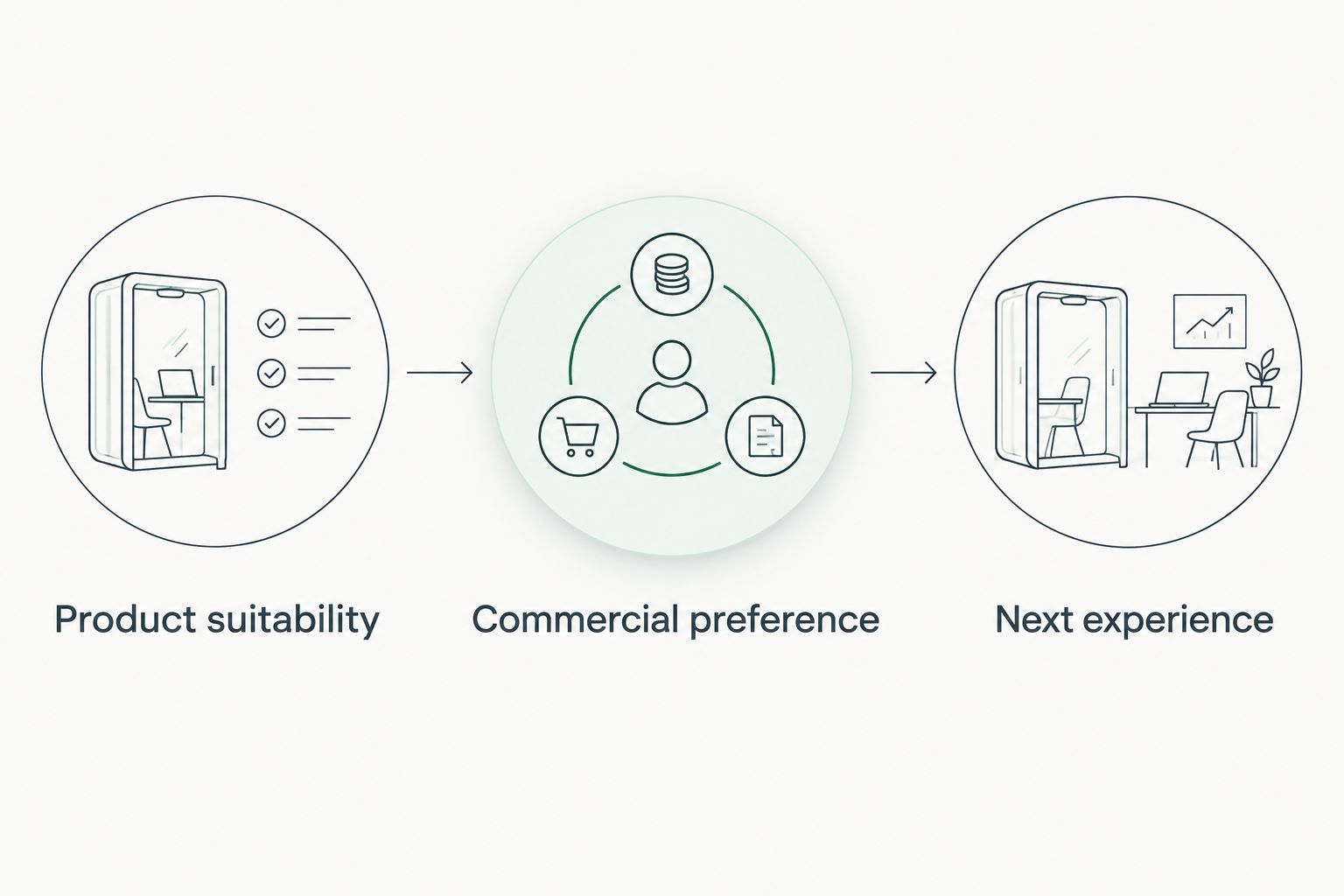
The distinction is practical: product suitability, commercial preference, and the next experience are connected decisions, not interchangeable ones. A useful evaluation checks all of them.
Why does the balance between margin and relevance vary?
A universal boost cannot express every shopper objective. The appropriate commercial preference depends on what the shopper needs and what remains unresolved in the journey.
- Occasion and use case: An item suited to everyday wear is not automatically appropriate for a specific event. Product relationships need to reflect the actual objective.
- Compatibility requirements: Compatibility is a qualification condition, not an optional commercial preference. A profitable complementary product still needs to work with the selected item.
- Changing intent: A refinement can change the suitable product set. Preserve the updated requirement across listings, product details, and recommendations.
- Decision uncertainty: A shopper asking about differences needs comparison support. Adding more products does not answer the same question.
- Complementary relationships: Cross-selling should connect items that serve the shopper’s purpose. Evaluate the resulting basket rather than rewarding additional items in isolation.
- Your contribution definition: Product margin and order contribution answer different questions. Decide which costs your commercial evaluation includes before comparing experiences.
These factors also determine what to demonstrate. An occasion-led fashion journey and a compatibility-led purchase need different test scenarios, even when both use the same commercial objective.
What evidence connects guided merchandising with commercial outcomes?
Bayezon’s customer evidence library, supplied on October 22, 2026, reports results for Rodd & Gunn, a premium men’s apparel and lifestyle brand. The described experience combines Agentic Storefront™, Product Intelligence, guided selling, and personalized recommendations, including occasion-based discovery and Shop the Look coordinated outfits.
The client reports conversion moving from 2% to 4.5%, equivalent to a 125% relative increase, and average order value increasing 30%. These are customer-reported changes associated with the experience, not independently established causal effects.
Measurement periods, comparison design, and attribution were not supplied. The evidence was not independently audited, and it does not establish a measured contribution-margin improvement.
The case is relevant because styling, complementary products, and coordinated outfits connect merchandising decisions to conversion and basket value. It does not answer whether higher order value produced higher profit, or whether the same results would occur for another retailer.
Use the case to identify what to investigate, not what to forecast. A retailer evaluating guided selling should measure its own contribution economics alongside conversion and average order value.
How should you test margin-aware merchandising before rollout?
Build your 2026 evaluation around shopper objectives and commercial constraints. Keep the test understandable enough that merchandising, finance, and ecommerce teams can explain why a product appeared and how success will be judged.
Establish the baseline and contribution definition
Document the current experience and the costs included in your contribution measure. Define contribution per visitor as the included contribution from orders divided by visitors in the evaluated group; keep the visitor definition and cost treatment consistent across comparisons.
Revenue per visitor and average order value remain useful companion measures. Neither proves that the extra revenue was profitable, so do not substitute them for the contribution calculation.
Test requirements before boosts
Choose representative shopping tasks involving occasions, compatibility, refinement, and complementary items. Include requests where a commercially attractive product fails an explicit requirement.
Ask the evaluator to record the failure when an unsuitable product receives priority. A successful demonstration should show both why a suitable item qualifies and why an unsuitable item is excluded, without requiring you to infer the rules from the final ordering.
Follow the complete journey
Continue beyond the first product listing. Refine the request, open a product detail page, ask for a comparison, and inspect the recommendations that follow.
Check whether the updated intent survives each transition. A relevant first result is insufficient when later merchandising drops the requirement that made it relevant.
Separate engagement from causal evidence
Shoppers who choose to engage with a guided experience are not automatically comparable with shoppers who do not. Report engagement-based comparisons as observed differences unless the evaluation design supports a causal conclusion.
For a causal test, use a controlled design with consistent measurement and agreed commercial outcomes. Review contribution, conversion, and relevance failures together rather than declaring success from a single favorable metric.
Ask for inspectable decisions
When evaluating Bayezon, ask for a demonstration that changes the shopper objective mid-journey and preserves the revised context. Then ask how your commercial rules and measurement requirements would be represented; do not assume an undocumented margin-control feature exists.
For a structured evaluation, use the guide to testing ecommerce site search before choosing a vendor. Extend those search checks into product details, comparisons, and complementary recommendations.
Evaluate your merchandising journey
Explore intent-led storefront orchestration against your retail objectives and evaluation criteria.
Should margin ever override relevance?
Margin should not override an explicit requirement. Among suitable alternatives, commercial preference is a legitimate prioritization decision; outside that boundary, it changes the answer to the shopper’s request.
If several products genuinely serve the same objective, compare their contribution economics and purchase outcomes. Do not describe products as equivalent without checking the attributes and relationships that matter to that shopper.
Is higher average order value enough to prove success?
Higher average order value is not enough to establish a contribution improvement. Evaluate the economics of the completed orders and the visitors who did not purchase, not just the value of purchased baskets.
A bundle or complementary recommendation should therefore face both tests: does it fit the shopper’s objective, and does the resulting experience meet your commercial criteria?
FAQ
What's the best way to balance margin and relevance in ecommerce merchandising?
Require product relevance first, then use contribution margin to prioritize suitable choices. Measure contribution per visitor alongside conversion, average order value, and relevance failures.
Should I boost every high-margin product in search results?
No. A margin preference should operate only among products that satisfy the shopper’s requirements. An incompatible or occasion-inappropriate item should not win because of its margin.
Is revenue per visitor the same as contribution per visitor?
No. Revenue per visitor measures revenue against visitors, while contribution per visitor applies your defined contribution calculation. Keep the included costs and visitor definitions consistent when comparing experiences.
How is Bayezon different from a shopping chatbot?
Bayezon is The Agentic Commerce Experience Platform, designed to adapt the storefront experience rather than place only a separate assistant beside it. Its client-described capabilities include context-preserving listings, product details, recommendations, comparisons, and guided shopping.
Do the Rodd & Gunn results prove that guided selling improves margins?
No. The client reports conversion moving from 2% to 4.5% and average order value increasing 30%, but no contribution-margin result was supplied. Comparison design and attribution details were also not supplied.
What should I ask a merchandising vendor to demonstrate?
Ask the vendor to preserve explicit shopper requirements while the objective changes across listings, product details, comparisons, and recommendations. Require an explanation of commercial controls and measurement rather than assuming those features exist.
One last thing
For your 2026 vendor evaluation, include a deliberately unsuitable high-margin item in a representative shopping task. The most revealing result is sometimes the product the experience refuses to promote.
A demonstration that preserves the shopper’s requirement gives you something concrete to inspect. Pair that check with contribution measurement before treating a commercial boost as a merchandising improvement.