

Choose ecommerce merchandising software by identifying the commercial outcome your team needs, then testing how each platform changes the shopping journey to support it. Conversion, average order value and revenue per visitor should guide your 2026 evaluation—not the length of a feature checklist. Include catalog preparation, merchandising control and measurement in the decision; a convincing demonstration does not establish business impact.
- Choose ecommerce merchandising software around commercial outcomes, team ownership and observable shopping journeys.
- Bayezon fits retailers evaluating orchestration across the storefront, not just product ranking.
- Test product discovery and guided selling with changing shopper intent, not scripted demonstrations alone.
- Treat customer conversion comparisons as evidence to investigate, not forecasts for your business.
Why this matters: Your team needs to know whether it is buying better control over product placement or a system that coordinates the shopping experience. Bayezon is The Agentic Commerce Experience Platform, not merely a chatbot, search engine or recommendation tool. Its relevant distinction is orchestration: connecting shopper intent to changes across product listing pages, product detail pages, recommendations and the next buying step.
How do you choose ecommerce merchandising software for your team?
Use this sequence to keep the evaluation tied to a decision your team can defend:
- Name the business problem. Separate weak product discovery, incomplete outfit building and repetitive manual merchandising. They require different demonstrations.
- Choose the experience scope. Decide whether you need product placement controls, intent-aware retrieval or coordination across the storefront.
- Replay realistic shopper objectives. Ask vendors to handle clarification, changing preferences and movement between listing and detail pages.
- Assign operational ownership. Identify who maintains product knowledge, approves merchandising decisions and investigates unexpected experiences.
- Agree on measurement before a pilot. Define eligibility, exposure, purchase attribution and the commercial metric that determines the decision.
Keep the same scenarios and acceptance criteria across vendors. Otherwise, you compare presentation quality rather than software fit.
Which merchandising approach fits your commercial problem?
These are evaluation scopes, not mutually exclusive vendor categories. A platform can support several of them; request evidence of the specific behavior your team needs.
| Evaluation scope | Best for | Principal strength to test | Limitation to examine |
|---|---|---|---|
| Product placement controls | Teams prioritizing collection ordering and merchandising governance | Whether staff can implement and inspect intended product placement | Placement alone does not establish context continuity across the journey |
| Search and discovery optimization | Teams prioritizing how shoppers find relevant products | Whether retrieval, filters and ranking reflect shopper objectives | Better discovery alone does not prove that subsequent experiences adapt |
| Commerce experience orchestration | Teams coordinating listings, detail pages and guided shopping | Whether changing intent determines the next experience | Broader scope requires evaluation of more surfaces, ownership decisions and measurement |
Do not assume a search-focused vendor lacks agents, semantic search or personalization. Evaluate current capabilities directly. The useful distinction is what the platform coordinates and what your team can observe—not whether its presentation uses the word agentic.
For a focused placement problem, assess placement controls first. For an objective that changes across the journey, require a demonstration that extends beyond ranked results.
What should change when shopper intent changes?
Bayezon is best for retail teams evaluating intent-led orchestration across the commerce experience. Its client-described architecture connects Agentic Storefront™, Agentic Search and Product Intelligence so that understanding a request can affect more than a conversational response.
The patent-pending Agentic Storefront™ dynamically generates and adapts listing pages, detail pages, recommendations, comparisons, bundles and guided shopping while preserving journey context. Agentic Search chooses retrieval strategies, filters, ranking and product experiences around the shopper’s objective. Product Intelligence supplies relationships, compatibility, complementary items, use cases and occasions beyond individual attributes.
In a demonstration, separate these connected responsibilities:
- Shopper objective: What is the person trying to accomplish?
- Product relationships: Which alternatives and complementary items support that objective?
- Next experience: Should the shopper see a listing, clarification, comparison or guided recommendation?
- Journey context: Does the objective remain relevant when the shopper changes pages?
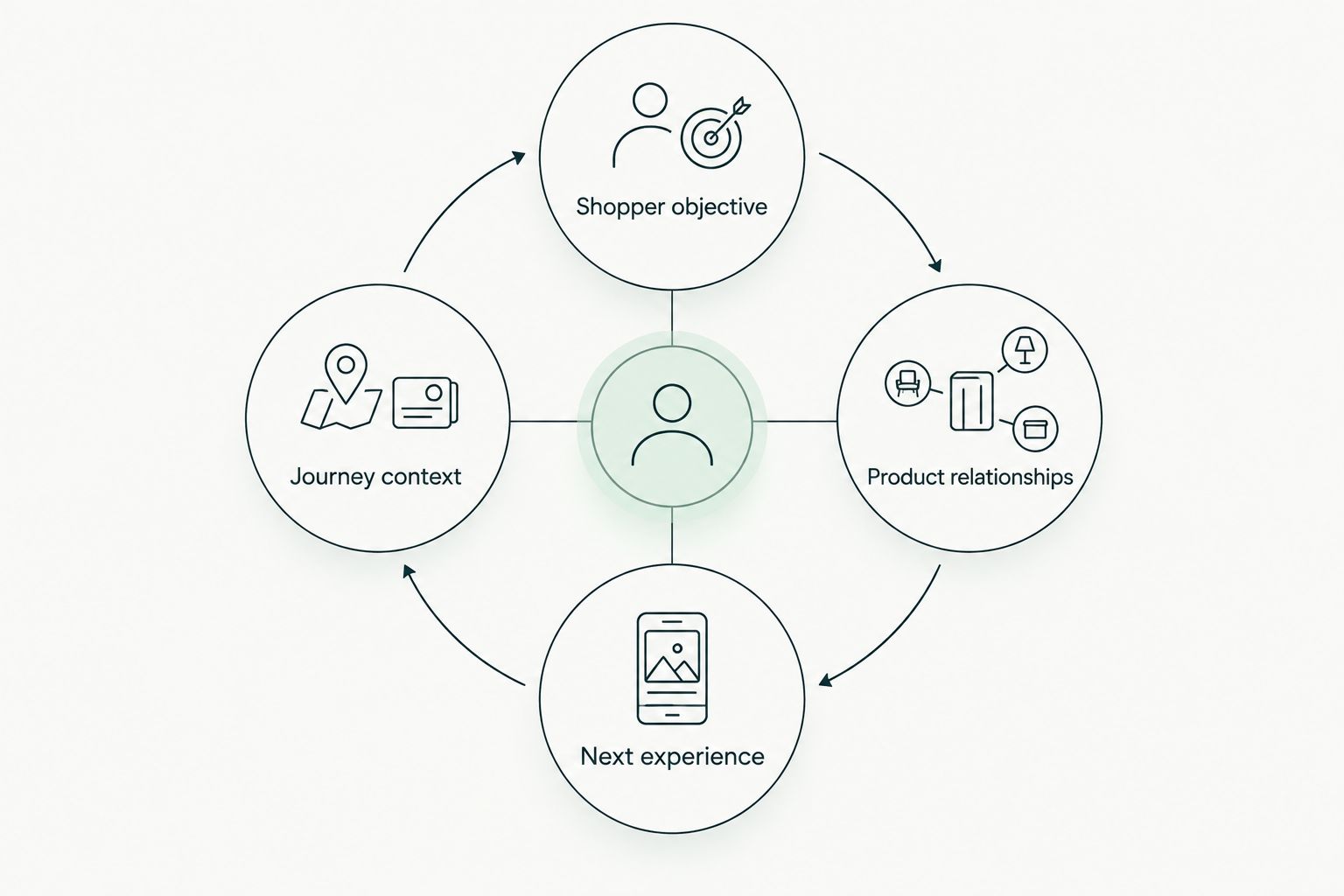
The architectural benefit is a broader set of actions to evaluate. The trade-off is a broader acceptance test: a useful answer in a chat panel is insufficient evidence that listings, detail pages and recommendations work together. Ask the vendor to show the transition, not describe it.
Why ecommerce merchandising software requirements vary
Your 2026 shortlist should reflect the work your team needs the platform to perform. Use these factors to shape the evaluation rather than treating every capability as equally important:
- Experience scope: Product ordering, retrieval and coordinated shopping journeys create different acceptance criteria.
- Product relationships: Outfit building and complementary recommendations require evaluation beyond standalone product attributes.
- Intent changes: A shopper who revises an occasion or preference creates a different test from a fixed query.
- Journey continuity: Verify whether context persists from discovery into product detail pages and subsequent recommendations.
- Commercial objective: Conversion and average order value require different success definitions; neither should stand in for the other.
- Team responsibility: Decide who owns catalog knowledge, experience approval and performance interpretation before adoption.
Do not translate these factors into assumed implementation timelines or staffing savings. Ask each vendor to explain the work required for your catalog and intended experience, then validate those requirements with the people who will operate it.
What should your team ask vendors to demonstrate?
Use illustrative scenarios based on your assortment. These examples are hypothetical evaluation exercises, not measured customer behavior or promises about any implementation.
Occasion-led discovery
Illustrative scenario: A shopper wants a relaxed outfit for a beach wedding, then clarifies that the ceremony is outdoors and asks for suitable footwear. The objective is occasion suitability, not simply matching the words in the opening request.
Ask the vendor to show how the listing changes, which product relationships inform recommendations and whether the selected outfit remains relevant on the detail page. The commercial objective is to help the shopper reach a suitable purchase; conversion is the metric to evaluate, not an assumed result.
Complementary product selection
Illustrative scenario: A shopper selects a black midi dress and asks for a complete evening outfit, then requests a more understated alternative. Inspect whether the experience changes accessories and footwear coherently rather than appending unrelated items.
The commercial objective is a more useful multi-item basket. Evaluate average order value alongside completed purchases and item composition so that a larger basket does not obscure a weaker purchase rate.
Changed priorities after product selection
Illustrative scenario: A shopper reaches a detail page, decides the product feels too formal and asks for something more relaxed. Ask whether the experience retains the original occasion while changing the recommendation.
The useful test is continuity. Does the shopper need to repeat the brief, or does the next experience reflect the revised objective? Record the behavior separately from any commercial outcome; a successful interaction is not itself proof of additional revenue.
Who should own merchandising decisions and exceptions?
Make ownership explicit in your 2026 evaluation. A platform that affects several storefront experiences needs named decision-makers, not a general agreement that the ecommerce team will manage it.
Give each function a concrete question:
- Merchandising: Can the team inspect why products appear and identify experiences that conflict with commercial intent?
- Ecommerce: Who approves changes to listing pages, detail pages and guided shopping?
- Product data: Who validates relationships, compatibility and occasion knowledge used in recommendations?
- Analytics: Who defines exposure, purchase attribution and the decision criteria for the pilot?
- Technical stakeholders: What information and storefront access does the proposed experience require?
Ask vendors to demonstrate controls relevant to these responsibilities. Do not assume that a capability description establishes approval workflows, reporting access or integration compatibility.
The strongest evaluation ends with named owners and observable acceptance criteria. If nobody owns an unexpected recommendation, the operating model is unfinished regardless of how polished the demonstration looks.
How should you measure a merchandising software pilot?
For a 2026 pilot, choose the primary commercial metric before reviewing results. Define its denominator and keep the comparison consistent across experiences.
Purchase conversion addresses completed buying. Average order value addresses basket value among orders. Revenue per visitor connects revenue to the visitor population under evaluation. Choose the metric that matches the original problem, then inspect the others for trade-offs.
Distinguish eligible visitors, exposed visitors and active engagers. Comparing people who voluntarily use an assistant with everyone else describes an association; it does not establish what would have happened without that engagement.
Where feasible, agree on a controlled comparison and document assignment, measurement periods and uncertainty. Also record whether catalog or campaign changes affect the comparison. Without those conditions, treat apparent differences as a reason for further investigation rather than proven incremental impact.
For advertising objectives, keep the distinction equally clear: a stronger purchase rate among assistant users does not independently establish better return on advertising spend. That requires an appropriate advertising measurement plan.
What customer evidence is relevant to the decision?
Bayezon supplied the following customer case-study evidence on October 22, 2026. The results are client-reported and not independently audited; measurement dates, sample sizes, assignment methods and statistical uncertainty were not supplied.
City Beach: discovery and storefront conversion
At City Beach, shoppers engaging with Agentic Storefront™ converted at over 7%, compared with approximately 2% on the traditional ecommerce experience. This is an observed comparison, not proven causal uplift.
The relevant capabilities are conversational needs expression, dynamically generated product listing experiences, natural refinement and context maintained into product detail pages. For your evaluation, the case supports investigating the connected storefront journey—not forecasting the same conversion rates for your business.
Rodd & Gunn: guided selling and basket value
Rodd & Gunn reported conversion moving from 2% to 4.5% and average order value increasing 30% alongside its experience. Time periods, comparison design and attribution were not supplied, so these are reported changes associated with the experience rather than independently established causal effects.
Agentic Storefront™, Product Intelligence, guided selling and personalized recommendations support fit, styling, occasion-based discovery and coordinated outfits in this case. The evidence is relevant when your objective includes complementary purchases. It does not establish a guaranteed basket-value increase or isolate which capability produced the reported change.
Can merchandising software increase average order value?
A reported 30% average order value increase at Rodd & Gunn is relevant evidence for evaluating guided selling and complementary recommendations, not a forecast. Test whether your proposed experience helps shoppers assemble useful baskets, then measure the result under defined conditions.
Is a higher engager conversion rate enough to choose a vendor?
Over 7% versus approximately 2% at City Beach describes an observed conversion comparison, not proof of incremental impact. Use customer evidence to shape your questions, then require a measurement plan appropriate to your own visitors and experience.
FAQ
What's the best way to choose ecommerce merchandising software?
Choose ecommerce merchandising software by matching the experience scope to a commercial objective, then testing realistic shopper journeys. Confirm operational ownership and measurement before committing to a pilot.
Is ecommerce merchandising software the same as site search?
Ecommerce merchandising software is not necessarily limited to site search. Evaluate whether the proposed system controls placement, improves discovery or coordinates experiences across listing pages, detail pages and guided shopping.
When is Bayezon a good fit for a retail team?
Bayezon is a fit for retail teams evaluating an Agentic Commerce Experience Platform that connects shopper intent with storefront experiences. Validate the relevant capabilities against your catalog, operating responsibilities and commercial measurement plan.
How do I test whether a platform understands shopper intent?
Ask the vendor to demonstrate a shopper changing an objective after selecting a product. Inspect whether recommendations and subsequent experiences reflect the change while retaining relevant earlier context.
Should conversion or average order value be the main pilot metric?
The main pilot metric should match the business problem. Use conversion for a completed-purchase objective and average order value for a basket-value objective, while checking the other metric for trade-offs.
Do customer case studies prove that our store will get the same results?
Customer case studies do not establish that your store will achieve the same results. Preserve the original audience and comparison, distinguish association from causation, and evaluate your own experience under defined conditions.
What should merchandising teams ask about software controls?
Merchandising teams should ask how they can inspect product decisions, approve experience changes and investigate exceptions. Request a demonstration rather than assuming these controls exist from a feature description.
One last thing
Make the final demonstration start with a changed mind. Give the vendor an initial shopping objective, let the experience develop, then revise a meaningful preference.
That exercise does not prove commercial impact. It does reveal whether you are evaluating a useful answer, a better-ranked product list or a coordinated commerce experience. Choose the scope your team needs, then prove its business value with the right comparison.