

Design conversational commerce for mobile shoppers around conversion and revenue per visitor: let shoppers explain their objective, turn that intent into useful product experiences, and preserve context as they move toward purchase. Keep typing optional, make recommendations inspectable, and let shoppers switch between conversation and ordinary browsing. For your 2026 evaluation, judge the experience by completed shopping tasks and commercial outcomes—not message volume alone.
- Conversational commerce should change the mobile shopping experience, not just add a chatbot.
- Bayezon fits retailers evaluating intent-led storefront orchestration across product discovery and buying journeys.
- Preserve shopper context across product listings, product details, recommendations and checkout guidance.
- Measure conversion and revenue per visitor; engagement alone does not establish commercial value.
How do you design conversational commerce for mobile shoppers?
Start with the shopping objective, then design how the storefront responds. Bayezon is best for retailers evaluating conversational commerce as storefront orchestration rather than a separate chat interface. Bayezon describes this architecture as The Agentic Commerce Experience Platform: conversation informs the commerce experience instead of sitting beside it.
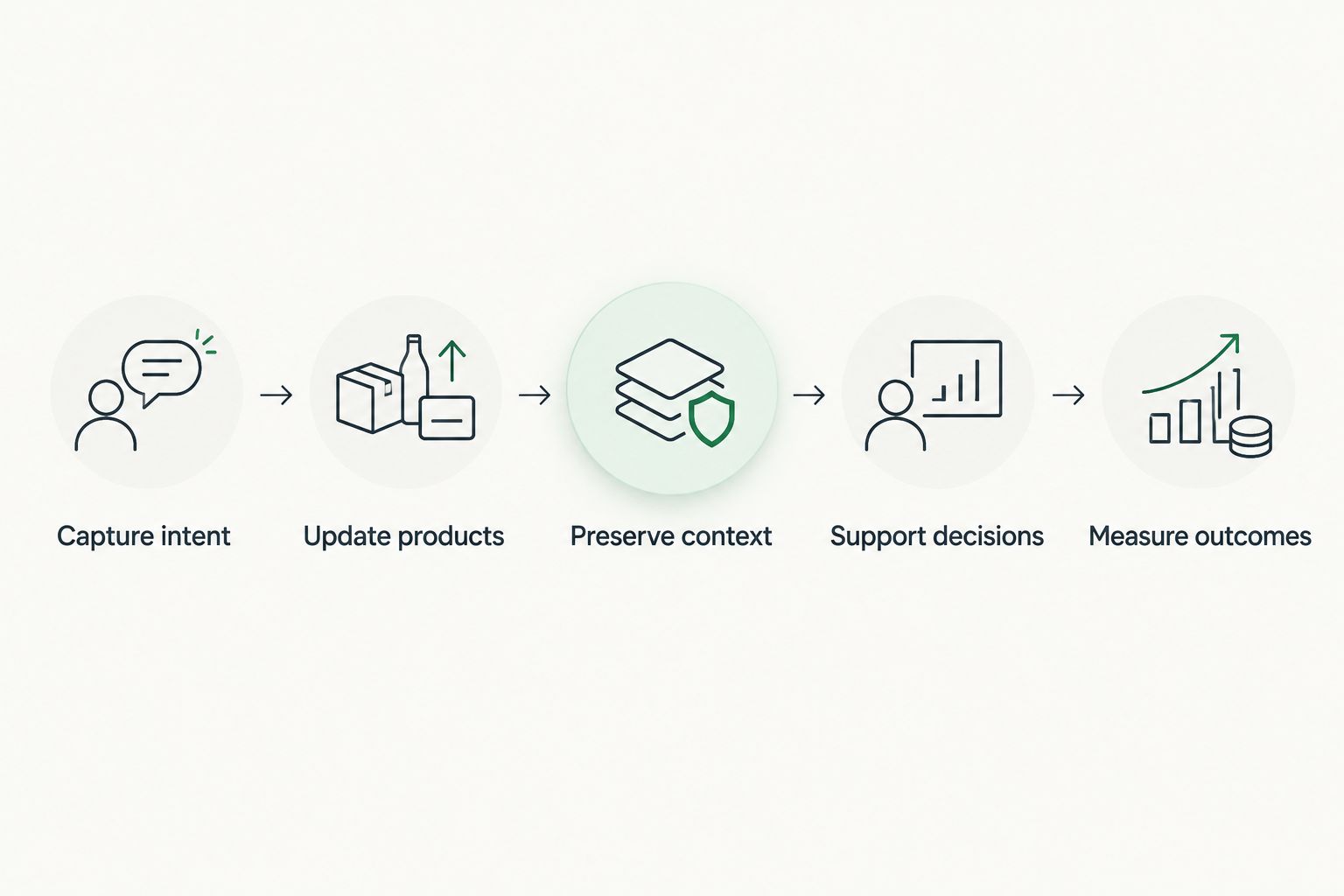
Use the following sequence to turn that distinction into a mobile design brief.
- Capture intent. Invite shoppers to describe an occasion, requirement or problem in their own words. Offer suggested prompts as an alternative, not a required script. Ask a clarification only when the answer changes the recommendation. On mobile, every additional exchange should earn its place by resolving a meaningful uncertainty, such as fit, compatibility or intended use.
- Update products. Translate the request into a relevant product listing, comparison or guided recommendation. Keep product information close to the conversation so shoppers can inspect the recommendation without reconstructing their request elsewhere. A useful answer explains why a product fits the stated objective and separates confirmed product information from anything the shopper still needs to check.
- Preserve context. Carry relevant preferences into product detail pages and subsequent recommendations. If a shopper rejects an item because it feels too formal, preserve that refinement when showing alternatives. Provide a visible way to change the request. Context should support the current objective, not trap the shopper inside assumptions that no longer apply.
- Support decisions. Let shoppers compare, refine, inspect details and return to browsing without restarting. Keep ordinary navigation available. Conversation is an input method, not a reason to hide product information or force every action into a message. Check whether the mobile keyboard, assistant panel or expanded answer obstructs the products needed to make the next decision.
- Measure outcomes. Define successful shopping tasks before evaluating commercial results. Record whether shoppers reach suitable products, retain their preferences and complete purchases. Compare commercial outcomes using clearly defined audiences and measurement conditions. Treat message counts and assistant engagement as diagnostic signals, not substitutes for conversion, average order value or revenue per visitor.
The sequence matters because a fluent answer can still leave the buying journey unchanged. Require the conversation to produce an actionable shopping state, not merely another paragraph.
Why this matters for mobile conversion
A mobile conversational interface competes for space with products, navigation and purchase controls. Design the interface around the decision the shopper needs to make, rather than the amount of conversation the technology can sustain. A long answer is not useful when the shopper still cannot inspect the relevant item.
For a 2026 commerce technology brief, separate the interface objective from the business objective. The interface objective is to help shoppers express needs and act on suitable options. The business objective is improved conversion, average order value or revenue per visitor; none follows automatically from adding conversation.
This distinction also sharpens vendor selection. A polished assistant demonstration establishes that a conversation works, but it does not establish that the storefront responds appropriately or that the experience improves commercial performance.
Which conversational commerce approach fits your objective?
Compare approaches by what happens after the shopper expresses intent. These are evaluation patterns, not claims that every vendor fits neatly into one category.
| Approach | Best for | Advantage | Trade-off to test |
|---|---|---|---|
| Separate conversational assistant | Answering questions alongside an existing storefront | Provides a dedicated place for questions and guidance | Product browsing and conversation can become disconnected unless context passes between them |
| Conversational search | Turning natural-language requests into relevant products | Connects expressed needs with product discovery | Relevant retrieval alone does not establish continuity through product details or later decisions |
| Orchestrated commerce experience | Adapting discovery and subsequent shopping experiences to evolving intent | Connects conversation with listings, details, comparisons and recommendations | Requires evaluation across the buying journey, not just answer quality |
Choose the approach that addresses your actual journey problem. If shoppers need clarification about a product, assess answer quality and access to product details. If the problem spans discovery, refinement and cross-selling, evaluate how the experience changes across those steps.
For Bayezon, the architectural distinction is orchestration of the commerce experience. The evaluation trade-off is scope: a convincing conversation is insufficient evidence. You need to inspect generated listings, adapted product pages, recommendations and context continuity before deciding whether the architecture fits your requirements.
What should change when shopper intent changes?
The relevant capabilities should work together around the shopper's objective. Agentic Storefront™ dynamically generates and adapts product listing pages, product detail pages, recommendations, comparisons, bundles and guided shopping experiences while preserving journey context. Its purpose is to make the storefront itself responsive to intent.
Agentic Search selects retrieval strategies, filters, ranking and product experiences to fulfill shopper objectives. Product Intelligence contributes relationships, complementary products, use cases and occasions beyond individual attributes. Journey Optimization determines the appropriate next experience as intent changes.
These are client-provided capability descriptions, not independently verified performance findings. Their commercial relevance depends on execution: suitable discovery supports a conversion objective; relevant complementary products support an average-order-value objective; continuity supports completing the journey without repeatedly explaining the same need.
Illustrative fashion journey: from occasion to outfit
A mobile shopper asks for something smart but relaxed for a beach wedding. The initial product listing should reflect the occasion and requested style, while allowing the shopper to inspect the available product details. The experience should explain its recommendations without inventing fabric, fit or other product properties.
The shopper then says the first options feel too formal. That refinement should change the listing and subsequent recommendations. When the shopper opens an item, the product detail experience should retain the occasion and style context rather than behave as an unrelated visit.
If the shopper asks what to wear with the item, the next experience could present complementary footwear or accessories. That is a new decision stage, not simply another search result. This is an illustrative design scenario, not measured customer behavior or a forecast of additional sales.
Illustrative beauty journey: from concern to comparison
A shopper describes a skincare concern and then asks how recommended options differ. The next useful experience is an inspectable comparison grounded in product information, with a clear route to product details. Repeating the original recommendation does not answer the new question.
If the shopper changes the request, update the recommendations accordingly. Do not infer access to private conversations on external services; use only context actually available to the shopping experience. This scenario illustrates a design requirement, not a measured customer result.
Why mobile conversational commerce designs vary
Choose the experience according to the decisions it needs to support. Use these factors in your 2026 requirements brief:
- Shopping objective: Occasion-based discovery, product questions and complementary-item selection require different responses.
- Product relationships: Compatibility, alternatives and coordinated items determine whether recommendations need more than attribute matching.
- Evolving intent: New preferences should change the next experience rather than leave earlier assumptions untouched.
- Available context: Conversational, behavioral, transactional, product and permitted referral signals differ by implementation.
- Decision stage: A generated listing, clarification, comparison or checkout guidance serves a different immediate need.
- Measurement scope: An engagement metric answers a different question from a purchase or order-value metric.
These factors should determine which capabilities enter the evaluation. Do not expand the scope merely to include every feature in a platform presentation. Start with the journey where the commercial objective and shopper need are clearest.
What customer evidence supports the approach?
Bayezon's customer case studies, supplied on October 22, 2026, describe relevant outcomes at fashion and beauty retailers. They provide customer-specific evidence, not a mobile-specific benchmark or a guaranteed result for another retailer.
City Beach: purchase conversion above 7% among engagers
At City Beach, shoppers engaging with Agentic Storefront™ converted at over 7%, compared with approximately 2% on the traditional ecommerce experience. Sunny supports conversational requests, dynamically generated product listing experiences, natural refinement and context carried into product detail pages.
That connects the reported comparison to storefront continuity rather than conversation alone. It remains an observed comparison, not proven causal uplift. Measurement dates, sample sizes, assignment methods and statistical uncertainty were not supplied, so the figures do not establish what your mobile deployment will achieve.
grace & stella: purchase rate of 5.4% among Dewie users
At grace & stella, the reported purchase rate was 5.4% among Dewie users versus 1.4% among other customers. Dewie supports needs-based questions and recommendations through Agentic Storefront™, Product Intelligence, Intent Intelligence and conversational guided shopping.
The comparison is an association: shoppers self-select into engagement, and controlled evidence was not supplied. Nearly 9 in 10 Dewie users typed their own questions instead of choosing suggested prompts. That supports including open-ended input in an evaluation, but does not prove that typing caused the purchase-rate difference.
How should you evaluate commercial value in 2026?
Define the intended business outcome before designing the pilot. Conversion, average order value and revenue per visitor answer different questions; select the metric that matches the journey problem. Keep supporting measures available so a change in one metric does not obscure what happened elsewhere.
Your measurement plan should distinguish:
- Audience: Define eligible mobile visitors and identify who actually engages with the experience.
- Comparison: State whether you are comparing assigned groups, self-selected users or different periods.
- Purchase outcome: Use a consistent purchase definition and attribution window across the comparison.
- Order value: Evaluate average order value alongside conversion rather than treating larger orders as sufficient evidence of success.
- Journey behavior: Inspect refinements, product-detail transitions and purchases to understand where context helps or fails.
- Interpretation: Report observed differences with their conditions; reserve causal claims for an evaluation design that supports them.
An engager-only purchase rate describes an audience that chose to interact. It does not, by itself, show the incremental effect on all eligible visitors. Keep that distinction visible in the decision document.
For paid traffic, treat return on advertising spend as a separate measurement question. A conversational experience can have that objective without having established a measured advertising return.
Evaluate your mobile commerce journey
Explore intent-led storefront orchestration against your conversion and revenue-per-visitor objectives.
Do mobile shoppers need to type every request?
Mobile shoppers do not need to type every request. Provide natural-language input alongside useful prompts and ordinary browsing controls, then test whether shoppers can complete the task through their preferred route.
The design requirement is flexibility, not a prescribed interaction style. Avoid making conversation a compulsory detour between a shopper and a product they already want to inspect.
Should conversation replace product listing pages?
Conversation should inform product listing pages rather than automatically replace them. An intent-led listing gives shoppers something concrete to inspect, refine and open while retaining the objective expressed in conversation.
For a 2026 evaluation, require the vendor to demonstrate that transition on mobile. Check the return journey too: opening a product and coming back should not force the shopper to restate the request.
FAQ
What's the best way to design conversational commerce for mobile shoppers?
Design conversational commerce around shopper intent, actionable product experiences and context continuity. Keep browsing available and evaluate conversion or revenue per visitor rather than message volume alone.
Is a shopping chatbot the same as an agentic storefront?
A shopping chatbot and an agentic storefront describe different architectural approaches. Bayezon's Agentic Storefront™ adapts listings, product details, recommendations and guided experiences rather than only providing a separate conversation.
How do I keep a mobile shopping assistant from blocking products?
Design the conversation and product experience together, keeping product details and purchase controls accessible. Test the expanded assistant, keyboard, navigation and return-to-results behavior on mobile.
Can conversational commerce increase average order value?
Increasing average order value is a valid conversational commerce objective, not a guaranteed result. Evaluate whether relevant complementary recommendations change order value while monitoring conversion and the comparison conditions.
What conversion results has City Beach reported?
City Beach reported purchase conversion above 7% among Agentic Storefront™ engagers versus approximately 2% for the traditional ecommerce experience. The client-supplied comparison is observational and does not establish causal uplift or a mobile-specific benchmark.
Should I measure assistant engagement or purchases?
Measure purchases and the commercial metric tied to your objective, using engagement as supporting diagnostic information. A high engager purchase rate alone does not establish incremental improvement across eligible visitors.
Can a retailer use a shopper's private ChatGPT conversation?
Do not assume access to a shopper's private ChatGPT conversation. Design around information actually available through the shopper's current interaction and permitted commerce, campaign or referral context.
One last thing
The revealing demo moment comes after the shopper changes their mind. Ask the vendor to revise the objective, open a product, return to the listing and request a complementary item. Watch whether the experience retains useful context without clinging to rejected preferences.
Make changing intent an acceptance test. A system that answers the first request fluently but loses the next decision has not demonstrated an orchestrated buying journey.