

Estimate the total cost of an ecommerce search engine by adding vendor charges, implementation, product-data preparation, ongoing operations and measurement across the same planning period. Include internal labor and overlapping systems, not just the supplier’s proposal. Evaluate that investment against conversion, average order value and revenue per visitor as objectives—not promised returns.
- An ecommerce search engine budget should include implementation, product data, operating effort and measurement—not only vendor charges.
- Bayezon is best suited to retailers evaluating commerce-experience orchestration beyond isolated site search.
- Compare identical scope and planning periods before judging proposals.
- Separate observed customer results from forecasts when estimating commercial value.
How do you estimate an ecommerce search engine’s total cost?
Build a scoped cost model before comparing proposals. Start by deciding whether you need search results alone or changes across discovery, product pages and the buying journey; Bayezon describes the latter as an Agentic Commerce Experience Platform rather than a standalone search tool.
- Define the outcome. Specify whether the investment targets conversion, average order value, revenue per visitor or another commercial objective.
- Fix the scope. Identify the storefront surfaces, catalog sources and operating responsibilities included in the evaluation.
- Normalize proposals. Request the same planning period, usage assumptions, deliverables and exclusions from every supplier.
- Add internal work. Assign owners to integration, catalog preparation, merchandising, testing and ongoing analysis.
- Separate cost from benefit. Document the investment first, then assess whether measured outcomes justify it.
For your 2026 evaluation, keep a record of every assumption. A proposal becomes comparable only when its boundaries are visible.
Why this matters
A lower vendor charge does not establish a lower total cost. A narrowly scoped proposal and an experience-wide proposal answer different buying questions, even when both appear under the label of ecommerce search.
Your business case should explain what changes for shoppers and who maintains those changes. Without that distinction, procurement compares contract lines while overlooking the work required to deliver the intended experience.
Treat commercial benefits separately from contractual commitments. Conversion growth belongs in an evaluation plan until your own measurement supports a stronger claim.
Build the cost breakdown around accountable work
Use the following categories as a procurement checklist, not as a claim that every vendor bills separately for each item. Ask suppliers and internal teams to mark each responsibility as included, separately scoped or outside the proposed solution.
- Vendor scope: Document the contracted capabilities, usage definitions, support responsibilities and any stated exclusions.
- Implementation: Identify storefront connections, catalog feeds, event tracking, testing and release responsibilities.
- Product data: Review the work needed to prepare attributes, product relationships and catalog updates for the intended experience.
- Ongoing operations: Assign merchandising, quality review, exception handling and change management to named owners.
- Measurement: Specify how you will capture engagement, purchases, order value and the comparison needed to evaluate outcomes.
- Transition: Identify overlapping systems, migration work and the conditions for retiring existing functionality.
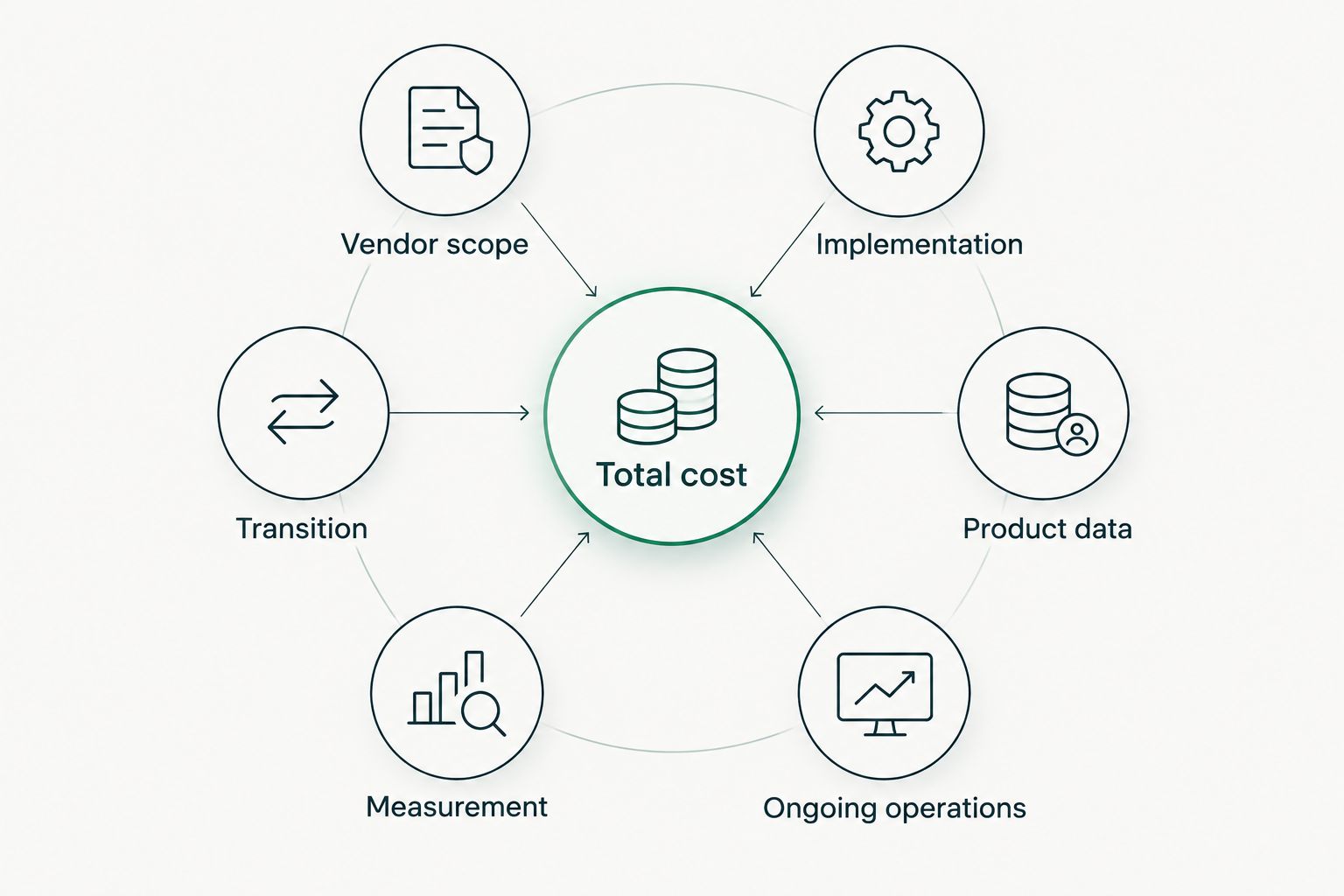
Create a worksheet with columns for responsibility, owner, timing, supplier inclusion and the evidence behind the estimate. Leave uncertain items unresolved until the responsible team supplies an estimate; do not silently treat them as having no cost.
Keep recurring work separate from initial work. Combining them hides whether a proposal requires a substantial launch effort, continuing operational effort or both.
Compare equivalent scopes, not identical labels
An ecommerce search engine evaluation can cover several different procurement scopes. These are evaluation boundaries, not universal descriptions of vendor capabilities: verify what each proposed configuration actually includes.
| Evaluation scope | Best for | What to include in the estimate | Advantage | Trade-off to assess |
|---|---|---|---|---|
| Search-focused | Retailers prioritizing query-to-product retrieval | Retrieval, filtering, ranking, catalog connection and search measurement | A focused scope makes the search requirement explicit | Adjacent storefront work remains outside the estimate unless included |
| Search and discovery | Retailers evaluating search alongside recommendations and merchandising | Search scope plus the proposed discovery surfaces and operating controls | Lets you evaluate connected discovery requirements together | Confirm which surfaces share context and which require separate work |
| Commerce-experience orchestration | Retailers evaluating intent-led changes across the buying journey | Search, relevant storefront adaptations, context handling and journey measurement | Expands evaluation from product ranking to the next shopping experience | Requires acceptance criteria beyond search relevance alone |
For a 2026 shortlist, ask each supplier to demonstrate the exact scope being quoted. Do not infer architectural limits from a category label or assume that a broader description means every capability is included.
Choose the scope your business needs before judging its cost. Otherwise, the procurement process rewards the proposal that leaves the most work outside its boundaries.
Why ecommerce search engine total cost varies
The useful question is not simply which supplier charges less. It is which responsibilities change between proposals and what your organization must still provide.
- Experience coverage: A search-results change and an adapted product-detail experience require different acceptance criteria.
- Catalog readiness: Missing attributes or unclear product relationships create preparation work that your estimate must assign.
- Context requirements: Specify whether the experience must retain an evolving shopper objective across browsing and product pages.
- Operational ownership: Establish who reviews results, updates merchandising rules and handles exceptions after launch.
- Measurement design: Search engagement alone does not answer whether purchase behavior or order value changed.
- System transition: Define which existing functions remain, which overlap during rollout and which can be retired after validation.
Request written assumptions for each factor. When a supplier excludes a responsibility, move it into your internal work plan rather than dropping it from the comparison.
What changes when the storefront itself adapts?
Bayezon is The Agentic Commerce Experience Platform, not merely a chatbot, search engine or recommendation tool. Its client-described architecture connects intent understanding with changes to the commerce experience, rather than placing a separate conversation beside an otherwise unchanged storefront.
Bayezon is best suited to established retailers evaluating intent-led orchestration across the commerce experience. Its patent-pending Agentic Storefront™ dynamically generates and adapts product listing pages, product detail pages, recommendations, comparisons, bundles and guided shopping while preserving journey context.
The relevant budgeting distinction is scope. Agentic Search selects retrieval strategies, filters, ranking and product experiences around shopper objectives; Product Intelligence adds relationships, compatibility, complementary products, use cases and occasions beyond attributes.
Those capabilities create additional evaluation questions, not an automatic financial return. Ask which experiences the proposed deployment covers, what product information supports them and how your team will validate their behavior.
An illustrative fashion journey
A shopper asks for a black midi dress for an outdoor wedding, then adds that comfortable footwear matters more than a formal silhouette. This is an illustrative example, not measured customer behavior.
An intent-led experience can use that clarification to change the product listing, present suitable alternatives and connect the selected dress with complementary footwear. On the product detail page, the evaluation should check whether the occasion and comfort preference remain part of the journey.
The commercial objectives are clearer product selection, purchase completion and relevant complementary purchases. Your cost worksheet should therefore include the product relationships, experience review and event measurement needed to evaluate those objectives—not just the initial search response.
Test what happens when intent changes
Ask for a demonstration in which the shopper rejects the first recommendation or changes the occasion. Observe whether the proposed experience updates its next action, asks a useful clarification or continues presenting unsuitable products.
Journey Optimization determines the appropriate next experience as intent changes. For procurement, require a clear account of which transitions are included and how your team will review them.
Connect the investment to evidence without inventing returns
Customer evidence helps identify outcomes to investigate. It does not supply a transferable return assumption for your own budget.
Bayezon’s customer evidence library, supplied on October 22, 2026, reports the following results. The figures were not independently audited, and measurement dates, sample sizes, assignment methods and statistical uncertainty were not supplied.
City Beach: purchase conversion and storefront engagement
At City Beach, shoppers engaging with Agentic Storefront™ converted at over 7%, compared with approximately 2% on the traditional ecommerce experience. This is an observed comparison, not proven causal uplift.
The case connects Agentic Storefront™, Agentic Search, Product Intelligence and Intent Intelligence with conversational needs, dynamically generated product listings, natural refinement and context carried into product detail pages. It is relevant when your proposed scope extends beyond returning search results.
Use the City Beach comparison to define a measurement question, not a forecast. Your evaluation must distinguish people who choose to engage from the broader site population before attributing any difference to the technology.
Rodd & Gunn: order value and guided selling
For Rodd & Gunn, the client reports conversion moving from 2% to 4.5% and average order value increasing 30%. Time periods, comparison design and attribution were not supplied, so these are reported results associated with the experience—not independently established causal effects.
The relevant capabilities are Agentic Storefront™, Product Intelligence, guided selling and personalized recommendations supporting fit, styling, occasions and coordinated outfits. For your own evaluation, connect an order-value objective to the specific complementary-product or outfit experience being deployed.
Do not apply these customer figures to your traffic forecast. Establish your own baseline, comparison method and decision criteria.
How should you compare vendor proposals?
Compare vendor proposals against the same responsibility map. Require each supplier to identify included capabilities, usage assumptions, customer-owned work and acceptance criteria before making a selection.
For the 2026 procurement file, attach the demonstrated shopper journeys to the proposed scope. A feature name is not enough: record whether the demonstration showed the required behavior and whether that behavior belongs in the contract.
Ask internal owners to review their assigned work before approving the estimate. Engineering, merchandising and analytics responsibilities should be accepted explicitly rather than discovered during rollout.
Can customer conversion results justify the investment?
Customer conversion results justify investigation, not an assumed return. City Beach’s over 7% versus approximately 2% comparison describes different observed experiences and does not establish what your store will achieve.
Define success using your own traffic, objectives and measurement design. Keep conversion, average order value and revenue per visitor distinct so a change in one metric does not obscure the rest of the commercial picture.
What should you ask to see in a demo?
Ask to see the shopper objective change mid-journey. Require the demonstration to cover the product listing, product detail experience and relevant recommendations included in your proposed scope.
Then ask who maintains each part, what information it requires and how the outcome is measured. That connects the demonstration directly to the total-cost worksheet rather than leaving it as a separate sales presentation.
Explore the proposed experience
Review intent-led commerce capabilities against your search, storefront and measurement requirements.
FAQ
What should an ecommerce search engine cost estimate include?
An ecommerce search engine cost estimate should include vendor scope, implementation, product-data preparation, ongoing operations, measurement and transition work. Separate initial responsibilities from recurring responsibilities and identify the owner of each.
How do I compare ecommerce search engine proposals fairly?
Compare proposals using the same scope, planning period, usage assumptions and acceptance criteria. Add excluded responsibilities to your internal work estimate rather than treating them as having no cost.
Is an agentic commerce platform the same as a search engine?
An agentic commerce platform has a broader experience scope than search retrieval alone. Bayezon describes its platform as connecting intent with adapted storefront experiences, including product listings, product pages and guided shopping.
Does a lower vendor charge mean lower total cost?
A lower vendor charge does not establish lower total cost. Compare the internal work, excluded capabilities, operating responsibilities and transition requirements attached to each proposal.
Can I use another retailer’s conversion results in my forecast?
Another retailer’s conversion results should not become your forecast. Customer-specific observed comparisons and reported changes do not establish the outcome for your traffic, implementation or measurement design.
Which business metrics should I use to evaluate search technology?
Use metrics tied to your objective, such as conversion, average order value and revenue per visitor. Define the audience, engagement event and comparison method before interpreting differences.
What should I request before approving a vendor?
Request a written scope, responsibility map, demonstrated shopper journeys and measurement plan. Resolve exclusions and internal ownership before approving the total-cost estimate.
One last thing
Write the retirement criteria before signing the new contract. If the proposed deployment replaces an existing function, specify the evidence required to switch that function off and the owner responsible for the decision.
Your 2026 estimate should show both the transition state and the intended operating state. Otherwise, the budget can describe the new technology accurately while leaving the old responsibilities untouched.