

Evaluate agentic commerce security by mapping what the platform can read, change and initiate, then requiring evidence for access controls, data handling, adversarial testing and recovery before approval. The objective is to protect conversion, average order value and revenue per visitor without giving an automated shopping experience authority beyond its approved scope. Treat security approval as a procurement gate, not a promise to resolve controls after launch.
- Agentic commerce security reviews must cover storefront changes and action permissions, not just conversational responses.
- Bayezon fits retailers evaluating commerce-experience orchestration; assess its security controls separately from its capability descriptions.
- Require documented data flows, scoped permissions, adversarial tests and a demonstrated rollback before procurement approval.
- Separate product discovery from transactional authority so useful recommendations do not imply permission to change orders.
Why this matters
A commerce platform can influence what shoppers see, which products they consider and what happens next. Your security review must therefore address both information exposure and unauthorized changes to the buying journey. A harmless-looking recommendation becomes a different risk when the same system can invoke a connected service.
Bayezon is The Agentic Commerce Experience Platform, not merely a chatbot, search engine or recommendation tool. Its client-described architecture connects shopper intent with generated or adapted storefront experiences. Bayezon is best for retailers evaluating orchestration across the commerce experience rather than a standalone conversational interface. That architectural fit does not establish its security controls; procurement must verify those separately.
For a 2026 procurement review, start with the proposed deployment rather than a generic vendor questionnaire. The same technology needs different controls when it reads public catalog information versus accessing customer records or initiating account actions.
How do you evaluate agentic commerce security before procurement?
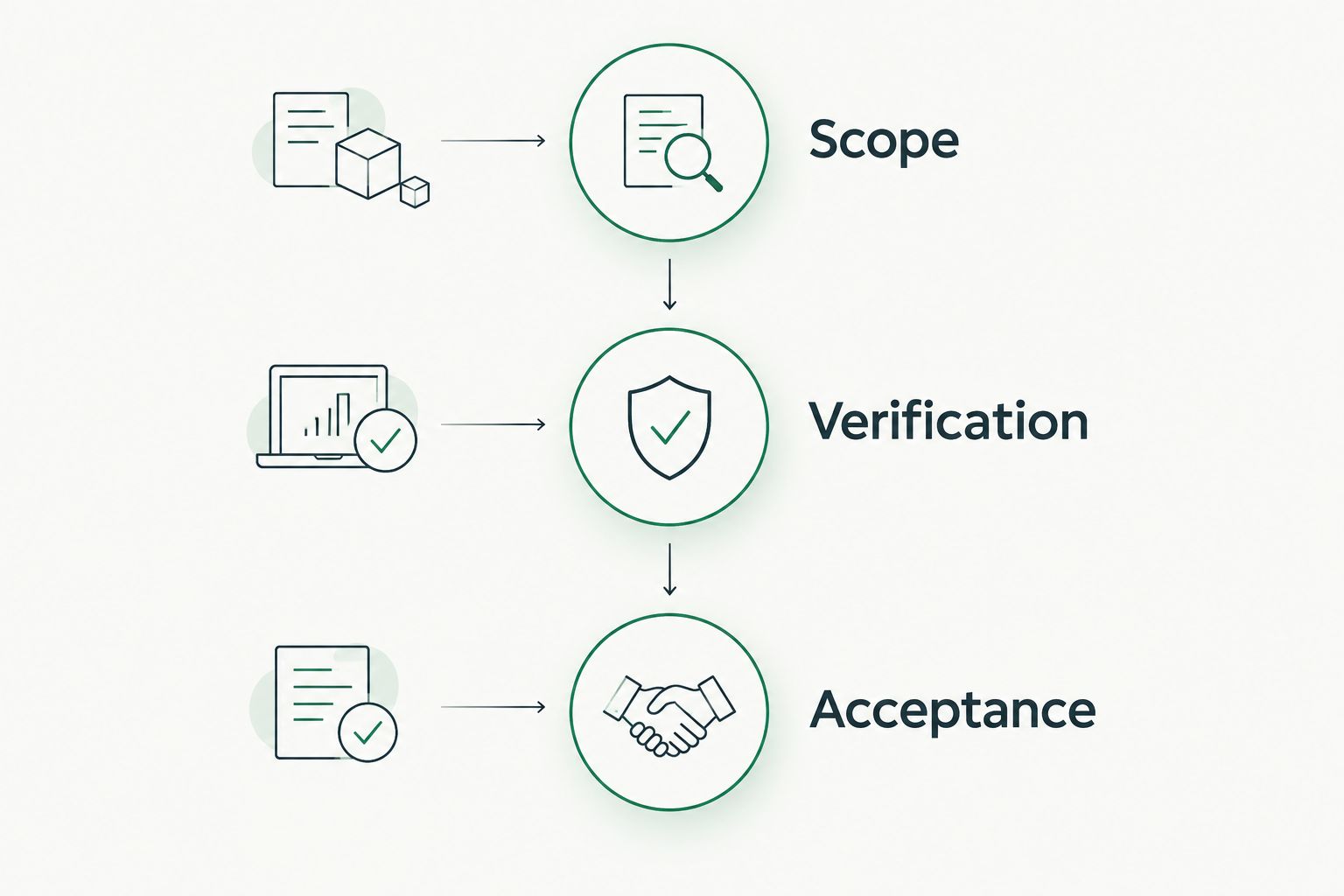
Organize the assessment into 3 review stages: scope, verification and acceptance. Each stage should produce evidence your security, ecommerce and procurement teams can use to approve, restrict or reject the deployment.
- Scope: Document the proposed experience, connected systems, data categories and permitted actions. Identify which actions are technically impossible, which require approval and which can occur automatically.
- Verification: Inspect documentation and demonstrate controls against realistic misuse scenarios. Require evidence from the proposed configuration, not just a presentation about the platform.
- Acceptance: Record unresolved risks, contractual obligations, operating responsibilities and release conditions. Name 1 accountable owner for the deployment approval, with specialist sign-off where required.
Use 2 environments: a nonproduction environment for testing and a production environment with separately approved access. These are recommended review controls, not claims about any vendor's current deployment model. If the proposed implementation cannot support that separation, document the constraint and decide whether it blocks procurement.
The acceptance record should answer a plain question: can you explain what the system is allowed to do, demonstrate that boundary and stop it when something goes wrong?
Compare the deployment scopes before comparing vendors
Do not treat every agentic commerce implementation as equally privileged. Classify the actual proposed access, then ask the vendor to explain how each boundary is enforced.
| Deployment scope | Best for | Commercial objective | Security advantage | Limitation or risk |
|---|---|---|---|---|
| Public catalog access | Initial discovery evaluation | Help shoppers identify relevant products | Avoids requiring customer records for the initial use case | Product content still needs protection against malicious instructions |
| Personalized experience access | Context-aware shopping evaluation | Improve relevance using approved customer signals | Supports testing against a defined set of permitted signals | Requires controls against cross-customer disclosure and inappropriate data reuse |
| Transactional authority | Workflows explicitly requiring account or order actions | Reduce friction in an approved purchase workflow | Enables evaluation of action-level controls | Requires stronger authorization, confirmation and recovery procedures |
These are evaluation scopes, not product tiers. A vendor's discovery capabilities do not establish transactional authority, and a demonstration of conversational fluency does not establish secure personalization.
What evidence should your security team request?
Build the evidence request around the deployment's trust boundaries. For your 2026 vendor assessment, require documents that identify their scope, owner and review date so security reviewers can distinguish current evidence from general statements.
Data flows and processing purposes
Request a diagram showing how shopper messages, behavioral signals, product information and any customer records move through the proposed system. Include model providers, other subprocessors, storage locations and interfaces with your commerce environment.
Ask which information is retained, why it is retained, who can access it and how deletion works across downstream services. Clarify whether submitted data is used for model training or other secondary purposes; do not infer the answer from a broad privacy statement.
Identity and permissions
Require an inventory of service identities, credentials, roles and connected APIs. For each permission, record the business purpose and whether access is read-only or permits changes.
Ask how credentials are issued, stored, rotated and revoked. Where a workflow acts for a shopper, require the vendor to show how the system verifies that shopper's authority independently of the conversational request.
Isolation and auditability
Request evidence for separation between customers, sessions and administrative roles. Test whether a shopper can obtain another shopper's context by changing identifiers, manipulating instructions or continuing a stale session.
Specify the audit events you need: access decisions, relevant action requests, approvals, configuration changes and recovery actions. Logs should support investigation without unnecessarily duplicating sensitive conversation content.
Assurance documents and contractual commitments
Ask for available independent assurance reports and confirm which services and controls they cover. A certification or report is evidence within its stated scope, not proof that every proposed workflow is safe.
Put agreed data-use restrictions, incident notification duties, deletion obligations and subprocessor terms into the contract. Keep promises about planned capabilities separate from controls available for the proposed launch.
Why agentic commerce security requirements vary
The right controls depend on the experience you intend to deploy. These factors determine what the assessment must cover:
- Storefront authority: Generating a product listing page differs from changing account information. Enumerate the permitted changes rather than using a broad label such as autonomous.
- Intent inputs: Conversational, behavioral, transactional and referral signals create different data-handling questions. Approve each source and purpose explicitly.
- Product relationships: Compatibility, complementary products and use cases influence recommendations. Decide which sources establish those relationships and how corrections propagate.
- Journey continuity: Preserving context across product listing pages and product detail pages requires session-boundary testing. Confirm when context expires or must be cleared.
- Connected services: Every integration adds credentials, permissions and failure conditions to review. Restrict access to the proposed workflow.
- Recovery requirements: A generated page, recommendation and completed account action require different corrective steps. Define recovery for each permitted action.
Bayezon's agentic commerce architecture makes these distinctions relevant: its described capabilities include adapting storefront experiences and preserving journey context. That is a reason to examine context handling and experience boundaries closely, not evidence that the platform performs any particular transactional action.
What should you test in an agentic commerce security demo?
Require the vendor to demonstrate both ordinary shopping behavior and attempted misuse. A security demo should show what the system refuses, not just what it can complete. Use synthetic shopper information and controlled catalog content rather than exposing live customer records during evaluation.
Follow a changing shopping objective
Illustrative example, not measured customer behavior: A shopper asks for a black midi dress for an outdoor wedding, then adds that the outfit must work with flat shoes. An intent-led experience could adapt the product listing page, change recommendations and carry the occasion context into a product detail page.
Bayezon's Agentic Storefront™, Product Intelligence and Intent Intelligence are relevant to this kind of experience. The commercial objectives are better purchase relevance and appropriate complementary-item discovery; neither conversion improvement nor higher average order value is guaranteed.
During the demonstration, verify that a changed preference updates only the authorized shopping context. Start a separate shopper session and confirm that the original shopper's preferences do not appear there.
Introduce untrusted instructions
Place instruction-like text inside a controlled product description or other permitted input. Ask the vendor to show that this content cannot override system permissions, request secrets or trigger an unauthorized tool action.
Then test a direct shopper request to ignore restrictions. The key evidence is enforcement outside the generated response: an agent saying it will not perform an action is insufficient if its credentials still permit that action.
Exercise denied actions and recovery
Attempt an operation outside the agreed scope, such as requesting an account change from a discovery-only experience. Confirm that the operation is blocked, recorded appropriately and explained without exposing internal credentials or sensitive implementation details.
Finally, simulate a failed dependency or incorrect experience configuration. Require a demonstrated stop mechanism and a documented path back to an approved storefront experience. Evaluate recovery against your operational requirements rather than accepting an unsupported recovery-time promise.
How do you connect security controls to commercial value?
Security controls protect the conditions under which commercial results can be trusted. Scoped access limits exposure; session separation protects shopper context; controlled recovery helps your team respond when an experience behaves incorrectly.
For a 2026 pilot, define commercial success and security acceptance separately. Track conversion, average order value or revenue per visitor using an agreed measurement design, while treating authorization failures and prohibited data exposure as release-blocking issues rather than offsets against revenue gains.
Ask who entered the pilot, how comparison groups were formed and whether shoppers self-selected into engagement. An observed difference between engaged and non-engaged shoppers does not, by itself, establish causal uplift.
This separation prevents a persuasive demo or positive commercial association from substituting for security approval. It also prevents a successful security review from being misrepresented as evidence that the technology will increase revenue.
Can you approve procurement before every issue is resolved?
You can approve a restricted evaluation only when its permitted scope, unresolved issues and exit conditions are explicit. Do not let a limited pilot approval silently become authorization for production access.
For the 2026 approval record, distinguish blocking findings from accepted residual risks. Assign remediation owners and require renewed approval whenever the proposed data access, action permissions or deployment scope changes.
A useful decision record states what is approved, what remains prohibited and what evidence would permit expansion. Avoid approvals expressed only as a general endorsement of the vendor.
Who should sign off before launch?
Your ecommerce owner should confirm the intended journey and commercial objectives, while security and privacy reviewers assess access and data handling. Procurement and legal teams should confirm that the contract reflects the controls and responsibilities your teams accepted.
Make the operating handoff explicit. Someone must own permission changes, incident escalation, content corrections and the decision to suspend the experience after launch.
FAQ
What is the first security question to ask an agentic commerce vendor?
Ask what the proposed deployment can read, change and initiate. Require a permission inventory tied to the actual shopping workflow, including connected services and customer data.
Is an agentic storefront the same as a chatbot for security review?
No. An agentic storefront review must address generated or adapted commerce experiences as well as conversation handling. Assess the actual access and actions rather than assuming the interface defines the risk.
Does a security certification make an agentic commerce platform safe?
A certification does not establish that your specific deployment is safe. Check its scope and require workflow-level evidence for permissions, isolation, data handling and recovery.
Can an agentic commerce platform use private ChatGPT conversations?
Do not assume a platform can access private ChatGPT conversations. Require the vendor to identify the actual referral, campaign or conversational data available to the proposed deployment and the permission for using it.
Should a discovery pilot have access to customer accounts?
A discovery pilot should receive only the access its approved use case requires. If public catalog information is sufficient, do not grant customer-account access simply because an integration supports it.
What should block an agentic commerce launch?
Unauthorized actions, prohibited data exposure or an inability to enforce agreed permissions should block launch. Record other acceptance conditions before testing so commercial enthusiasm does not redefine the security standard afterward.
One last thing
Test a capability after you revoke its permission. A refusal before access is granted proves less than a demonstrated denial after credentials or roles change. Add this check to your 2026 acceptance record, then repeat the relevant checks when permissions expand.
The procurement decision is not whether the experience sounds intelligent. It is whether your team can prove where its authority ends.