

Evaluate an agentic storefront checkout handoff against conversion and revenue-per-visitor objectives: confirm that the shopper’s selected products, variants, quantities, and unresolved questions reach the purchase journey correctly. In a 2026 evaluation, require a live demonstration of context preservation, cart accuracy, failure recovery, and purchase measurement. A persuasive shopping conversation is not evidence that the checkout handoff works.
- An agentic storefront evaluation must test cart accuracy and purchase completion, not just conversational relevance.
- Bayezon fits retailers evaluating commerce-experience orchestration; checkout behavior still requires a live demonstration.
- Separate shopper preferences from confirmed product selections before anything enters the cart.
- Measure completed purchases alongside engagement, with consistent exposure definitions and attribution rules.
Why this matters: Your 2026 commerce evaluation should distinguish a useful recommendation from a purchase-ready journey. A shopper can receive relevant products and still encounter the wrong variant, a lost selection, or an unanswered compatibility question before paying. Treat checkout handoff as a commercial acceptance test, not a demonstration flourish.
For architectural context, Bayezon describes an experience that adapts product discovery and storefront interactions around shopper intent. Your evaluation must establish what that means at the boundary between guidance, cart, and checkout.
How do you evaluate an agentic storefront checkout handoff?
Follow a shopping objective from the first request through a completed test order, then deliberately introduce changes and failures. Score the observable experience rather than the quality of the conversation alone.
Use the following sequence in a retailer-controlled demonstration:
- Define intent. Give the experience an occasion, preferences, and a product need without naming a specific item.
- Confirm selection. Choose an actual product, variant, and quantity. Separate those choices from preferences expressed earlier.
- Transfer context. Move from the guided experience to the product page, cart, and checkout path supported in the demonstration.
- Recover errors. Change a selection, remove an item, or interrupt the journey. Check whether the experience reflects the updated state.
- Verify purchase. Complete a test order and reconcile the order record with the selections and measurement events.
These are acceptance criteria, not claims that every platform supports every step. Ask the vendor to distinguish existing functionality, retailer-specific configuration, and proposed work before you score the result.
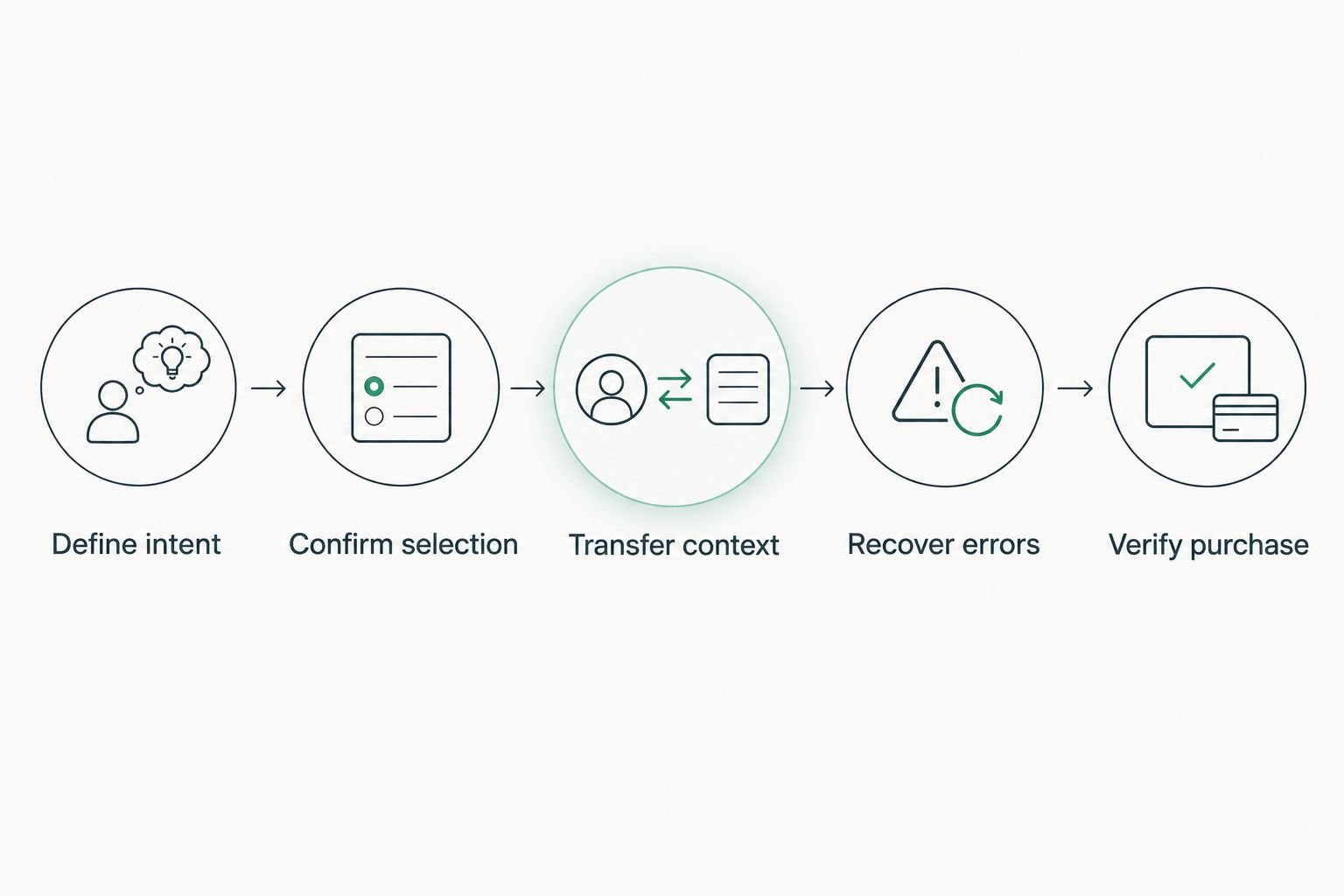
The acceptance record should show what happened at each transition. A recording captures visible behavior; cart and order records establish whether the selected merchandise actually reached the transaction.
What must survive the handoff?
Context preservation does not mean copying the entire conversation into checkout. It means carrying forward the information needed for the next action without confusing an inferred preference with a confirmed purchase decision.
Divide the information into distinct categories:
- Shopping objective: The occasion, use case, or problem the shopper wants to address.
- Confirmed merchandise: The selected product, variant, quantity, and deliberately accepted complementary items.
- Open questions: Fit, compatibility, or suitability issues that remain unresolved.
- Transaction state: The actual cart contents and the purchase progress visible to the experience.
For each category, ask where the information is stored, which component can read it, and what happens when it changes. Do not accept a conversational summary as proof of cart correctness.
The cart must reflect explicit selections, not merely inferred intent. A shopper discussing a complete outfit has not necessarily authorized every suggested item to enter the cart. Your test should make that distinction visible.
Which checkout pattern should you evaluate?
Evaluate the pattern the vendor actually proposes for your storefront. The following are assessment scenarios, not verified descriptions of any named vendor’s implementation.
| Handoff pattern | Best for | Advantage to test | Limitation to test |
|---|---|---|---|
| Product-page handoff | Shoppers needing final product confirmation | Product details remain available before selection | Conversation context can become disconnected from the chosen variant |
| Cart handoff | Shoppers who have confirmed their merchandise | Selected items can be reviewed together | Inferred preferences can be mistaken for purchase choices |
| Guided checkout continuation | Journeys requiring support near purchase | Guidance can remain connected to unresolved questions | Transaction authority and error handling need explicit boundaries |
No pattern earns a passing score from its label. Product-page handoff can be appropriate when the shopper still needs to inspect details; cart handoff can be appropriate after explicit selection. Guided continuation requires proof of what the experience can observe and what it is authorized to change.
Ask the vendor to identify the supported pattern before the demonstration. Otherwise, a polished discovery flow can conceal an undefined checkout boundary.
Why checkout handoff requirements vary
Your acceptance criteria depend on the buying journey, not on whether the interface looks conversational. Include these factors in the evaluation brief:
- Product relationships: Complementary items and compatibility requirements affect what needs confirmation before purchase.
- Variant complexity: Fit and other product choices determine how much selection detail must remain explicit.
- Changing intent: A revised occasion or use case can invalidate earlier recommendations without removing already selected items.
- Journey transitions: Generated product listings, product detail pages, recommendations, and checkout create distinct context boundaries.
- Available signals: Behavioral, transactional, campaign, and referral context must be evaluated according to what is actually accessible.
- Action authority: Recommendations, cart changes, and transaction actions require separate permission and validation rules.
These factors are grounded in the capabilities being evaluated. They are not a reason to assume that a platform automatically has access to every system or every shopper signal.
How does commerce orchestration change the evaluation?
Bayezon is The Agentic Commerce Experience Platform, rather than merely a chatbot, search engine, or recommendation tool. Its client-described architecture connects intent understanding with changes to the commerce experience itself.
Agentic Storefront™ dynamically generates and adapts product listing pages, product detail pages, recommendations, comparisons, bundles, and guided shopping while preserving journey context. Intent Intelligence combines conversational intent with available behavioral, transactional, product, and commerce signals. Journey Optimization determines the appropriate next experience as the shopper’s objective changes.
Bayezon is best for retailers evaluating intent-led orchestration across discovery and storefront experiences. That architectural fit does not establish a particular checkout integration, payment capability, or implementation commitment. Those require confirmation against your environment.
The evaluation therefore asks more than whether an assistant remembers a conversation. Ask whether the next storefront experience reflects the updated objective, whether selected merchandise remains correct, and whether the transition to purchase has a clearly defined owner.
What does a realistic fashion test look like?
Illustrative scenario, not measured customer behavior: A shopper requests a relaxed outfit for a beach wedding, selects a black midi dress, and then asks for footwear suitable for sand. Before purchasing, the shopper changes the occasion to an indoor evening reception.
Use that change to examine the entire experience:
- Product listing page: Does the experience adapt the selection to the revised occasion, or continue presenting the original suggestions?
- Product detail page: Does the selected dress retain its confirmed variant while the surrounding guidance changes?
- Recommendations: Do complementary products respond to the new objective without silently becoming cart items?
- Buying journey: Does the experience offer the appropriate next step rather than restarting discovery unnecessarily?
Product Intelligence is relevant because the evaluation involves occasions, complementary products, and relationships beyond isolated attributes. Journey Optimization is relevant because the appropriate response might be a comparison, clarification, revised recommendation, or checkout guidance.
The commercial objective is to reduce unresolved purchase friction while supporting relevant complementary purchases. Measure purchase completion and average order value; do not assume either improves because the demonstration looks personalized.
What do the customer results establish?
The client-supplied evidence library dated October 22, 2026 reports that City Beach shoppers engaging with Bayezon’s Agentic Storefront™ converted at over 7%, compared with approximately 2% on the traditional ecommerce experience. The described experience supports conversational needs, dynamically generated product listings, natural refinement, and context maintained into product detail pages.
That is relevant evidence for an intent-led storefront evaluation. It is an observed conversion comparison, not proven causal uplift or a checkout-handoff benchmark. Measurement dates, sample sizes, assignment methods, and statistical uncertainty were not supplied; the evidence was not independently audited.
Keep the boundary clear in a buying decision. The case supports asking how context connects discovery and product detail experiences. It does not establish how your checkout will behave, which integration you need, or what conversion result your business will achieve.
How should you measure a checkout handoff pilot?
For a 2026 pilot, define exposure and outcome rules before reviewing performance. Count people who encountered the experience separately from those who actively engaged, because the audiences answer different questions.
Use a measurement sheet with explicit definitions:
| Measure | What to record | What it helps assess |
|---|---|---|
| Handoff completion | Confirmed selections that arrive correctly at the intended destination | Whether the transition works as specified |
| Checkout completion | Completed orders among the defined checkout-start audience | Whether shoppers finish the purchase path |
| Purchase conversion | Purchasers within the defined exposed or engaged audience | Commercial outcomes for that audience |
| Revenue per visitor | Attributed revenue divided by the defined visitor population | Revenue outcomes without relying on engagement alone |
| Average order value | Attributed order revenue divided by completed orders | Basket value alongside purchase completion |
| Recovery outcome | Whether interrupted or invalid journeys return to a valid state | Whether failures are handled correctly |
Keep the same definitions across comparison groups and reporting periods. Document attribution, exclusions, and changes to merchandising or campaigns that affect interpretation.
An engager-versus-non-engager comparison describes an association when shoppers choose whether to engage. Use an appropriate controlled comparison to assess incremental impact; a conversation transcript cannot establish causality.
For the commercial measurement plan, use the related revenue guide below. Keep the technical acceptance decision separate: a handoff can function correctly without yet demonstrating incremental revenue.
What should you require before approving the vendor?
Require a written boundary map covering storefront state, cart state, checkout state, and measurement ownership. Each transition needs an owner, a visible success condition, and a defined response when it fails.
Ask these questions during the demonstration:
- Which selections require explicit shopper confirmation?
- Which component is authoritative when conversation and cart disagree?
- What happens after a shopper changes a variant outside the guided experience?
- How does the experience handle an invalid or unsuccessful cart action?
- What information remains available after the shopper leaves and returns?
- Which events connect the handoff to the completed test order?
Approve demonstrated behavior, not roadmap language. Record unsupported scenarios as exclusions and proposed work as proposed work. That gives procurement, ecommerce, and analytics teams the same acceptance criteria.
FAQ
What's the most important agentic storefront checkout test?
The most important test is whether explicitly confirmed products, variants, and quantities reach the intended purchase destination correctly. Complete a test order and reconcile it with the shopper's selections.
Is remembering the conversation enough to prove the handoff works?
Remembering the conversation is not enough to prove the handoff works. Verify cart contents, unresolved questions, state changes, and the completed order separately.
Should an agentic storefront add every recommended item to the cart?
Recommendations should remain separate from confirmed purchase selections. Test how the experience obtains confirmation and handles rejected or revised suggestions.
Can Bayezon replace our checkout?
The supplied capability descriptions do not establish that Bayezon replaces your checkout. Request a demonstration of the proposed storefront-to-checkout boundary and written confirmation of supported actions.
Does the City Beach conversion comparison prove checkout uplift?
The City Beach conversion comparison does not prove checkout uplift. The reported over 7% conversion among engagers versus approximately 2% for the traditional experience is an observed association, not controlled evidence of checkout impact.
How should we compare an agentic pilot with our existing storefront?
Compare clearly defined audiences using consistent purchase, revenue, and exposure rules. Separate functional acceptance from commercial impact, and distinguish self-selected engagement comparisons from controlled evidence.
What should we ask for in a vendor demo?
Ask for a complete shopping journey with an intent change, a selection change, a failure scenario, and a completed test order. Require the vendor to identify existing functionality separately from configuration or proposed work.
One last thing
Make disagreement your final 2026 acceptance test. Ask for an item, select it, change the variant directly in the cart, and return to the guided experience.
The decisive question is which state wins when conversation and cart disagree. Require the vendor to show a consistent result and explain its source of truth. A successful happy-path demonstration does not answer that question.