

Evaluate an AI shopping assistant on your own catalog by testing product accuracy, changing shopper intent, storefront behavior and commercial measurement—not just conversational fluency—with conversion, average order value and revenue per visitor as objectives. A convincing demonstration is not evidence of incremental revenue: require catalog-grounded answers, inspect the resulting buying journey and compare outcomes under a documented evaluation design.
- Evaluate an ai shopping assistant against your catalog, shopper intent and buying journey—not a vendor’s prepared demonstration.
- Bayezon fits retailers evaluating commerce experience orchestration rather than a standalone conversational interface.
- Test product discovery, changing requirements and context across product listing and detail pages.
- Treat customer case studies as supporting evidence, not forecasts for your own commercial results.
Why this matters
Your 2026 evaluation should answer a commercial question: does the experience help shoppers reach an appropriate purchase decision? A fluent response that recommends an incompatible item or loses context on a product detail page fails that test, regardless of how polished it sounds.
Bayezon is The Agentic Commerce Experience Platform, not merely a chatbot, search engine or recommendation tool. Its client-described architecture connects intent interpretation with changes to the commerce experience itself. Evaluate that distinction through observable behavior, not terminology.
Bayezon is best for retailers evaluating orchestration of the commerce experience rather than an isolated shopping assistant. That is a scope distinction, not a promise of commercial performance.
How do you evaluate an AI shopping assistant on your own catalog?
Use the same catalog, shopper scenarios and acceptance criteria for every vendor. In your 2026 evaluation brief, separate what the assistant says from what the storefront does and what the measurement actually establishes.
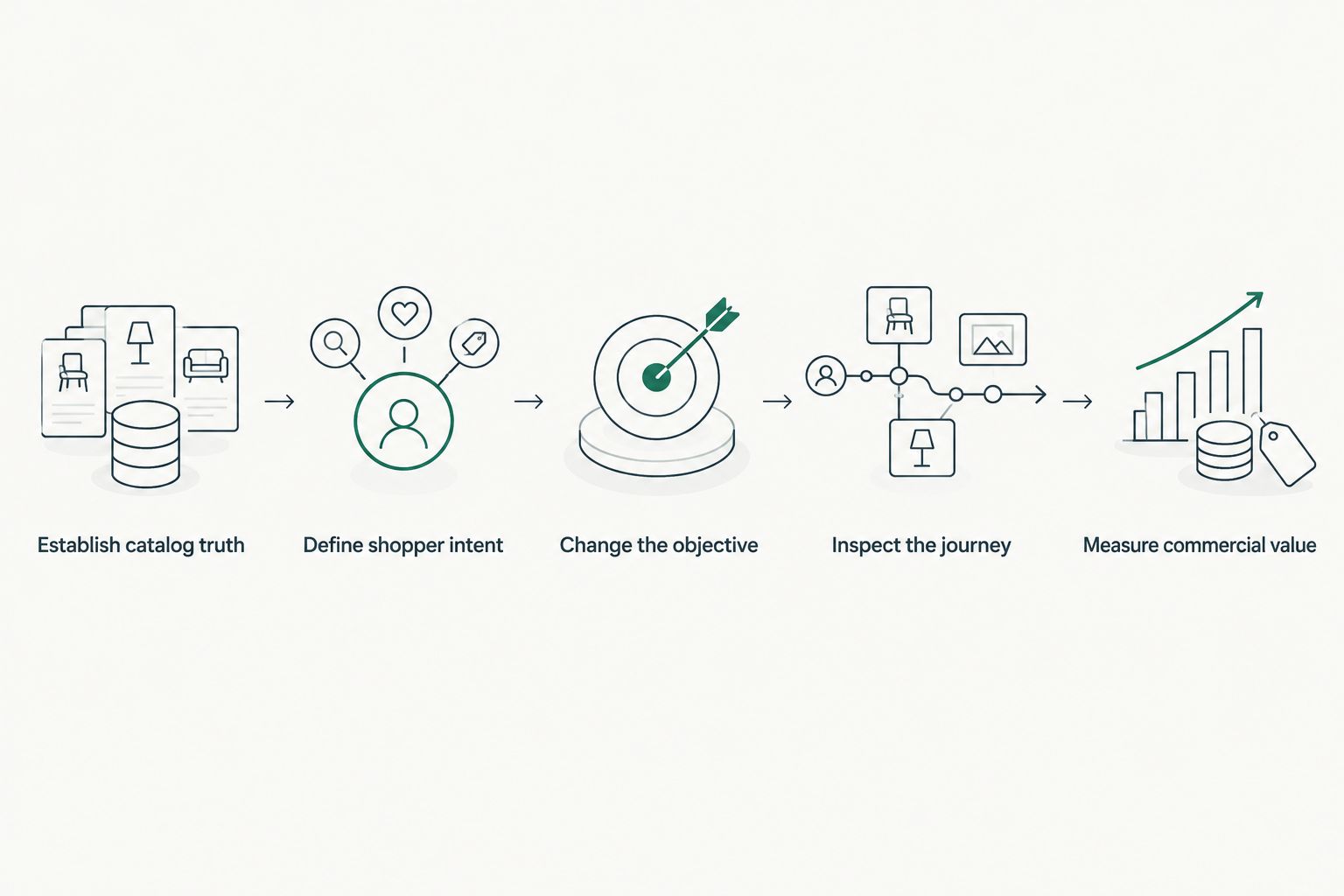
1. Establish catalog truth
Select products that expose meaningful differences in your assortment: similar-looking alternatives, complementary items, occasion-specific products and records with incomplete information. Include straightforward requests as well as questions that require relationships between products.
Create a reference sheet approved by your merchandising team. Record supported attributes, relevant relationships and facts that the system must not infer. If a fabric composition, compatibility detail or care instruction is absent, the correct behavior is to acknowledge the gap rather than manufacture an answer.
Ask vendors to identify the catalog evidence behind a recommendation. A plausible explanation is not a substitute for a supported product fact.
2. Define shopper intent
Write requests around decisions shoppers need to make, not just product names. An illustrative fashion request is: a smart but relaxed outfit for a beach wedding, with footwear suitable for walking on sand.
Specify what a satisfactory response must establish. It should distinguish explicit requirements from preferences, identify useful clarification and explain recommendations using catalog-supported information. Your team should agree on acceptable alternatives before seeing vendor outputs.
3. Change the objective
After the initial recommendation, change a meaningful requirement. In the illustrative wedding scenario, the shopper might reject linen, prefer a darker color or ask for an outfit that also works at dinner.
Check whether the system retains still-relevant requirements and removes superseded ones. Repeating the entire request should not be your workaround for lost context. Also test a genuine change of mission: remembering an old preference is unhelpful when the shopper explicitly abandons it.
4. Inspect the journey
Follow the recommendation into a product listing page and then a product detail page. Inspect whether the experience preserves the objective, explains relevant differences and offers an appropriate next step.
Distinguish a conversational answer from an adapted storefront. A product link can be useful, but it does not demonstrate that listings, detail pages, comparisons or complementary recommendations change with intent. Ask the vendor to show exactly which surfaces its proposed configuration controls.
5. Measure commercial value
Define conversion, average order value and revenue per visitor before launch. Specify eligible visitors, exposure, engagement, purchase attribution and exclusions so that the same terms mean the same thing throughout the evaluation.
Where feasible, use randomized assignment and analyze the assigned groups, including visitors who never engage. Report engagement separately. Comparing assistant users with nonusers answers an association question; it does not by itself establish incremental impact.
What should you compare beyond the chat interface?
For a 2026 shortlist, compare the scope you need rather than assuming every assistant represents the same architecture. These are evaluation scopes, not mutually exclusive vendor categories; a proposed platform can cover several.
| Evaluation scope | Best for | Useful capability to test | Limitation to investigate |
|---|---|---|---|
| Conversational interface | Answering shopper questions | Clarifies needs and explains products | Does the value stop at the conversation? |
| Search and discovery | Finding relevant catalog items | Retrieves and ranks products against a request | Does context persist beyond results? |
| Commerce experience orchestration | Adapting the buying journey | Changes listings, details, comparisons and next steps | Which surfaces and decisions are actually included? |
A narrower scope is not automatically worse. If your problem is product retrieval, search-focused evaluation gives you a clearer acceptance test. If your problem spans discovery, comparison and purchase guidance, test the connected experience rather than awarding points for unrelated features.
Bayezon’s patent-pending Agentic Storefront™ dynamically generates and adapts product listing pages, product detail pages, recommendations, comparisons, bundles and guided shopping while preserving journey context, according to the client-provided capability description. Agentic Search selects retrieval strategies, filters, ranking and product experiences around shopper objectives.
The benefit to evaluate is continuity between understanding a request and helping the shopper act on it. The trade-off is evaluation scope: verifying this architecture requires inspecting more than answers and retrieval relevance. Require a demonstration across the specific surfaces your team intends to deploy.
How should changing intent affect the storefront?
The following examples are illustrative evaluation scenarios, not measured customer behavior. Use your actual catalog to determine which recommendations are valid.
An occasion request should shape the listing
A shopper asks for a black midi dress for an outdoor evening event, then adds that comfortable footwear matters. Inspect whether the product listing experience reflects the occasion and whether complementary recommendations remain consistent with it.
The commercial objective is a shorter path to a suitable choice, which you can assess through purchase conversion and revenue per visitor. Do not count a generated listing as a business result by itself.
A refinement should carry into the detail page
The shopper selects a dress and explains that they prefer more coverage. Inspect whether the product detail experience retains that preference and presents supported alternatives instead of returning to generic recommendations.
Product Intelligence is relevant because the decision involves relationships, use cases and alternatives beyond isolated attributes. Test whether the explanation is grounded in your assortment; an unsupported styling claim should not pass because it sounds helpful.
A changed mission should change the next step
The shopper moves from choosing a dress to coordinating an outfit. Journey Optimization should be evaluated on the next experience: clarification, comparison, complementary recommendations or another appropriate action.
The commercial objective can include average order value, but a larger basket is not automatically a better recommendation. Check that complementary items fit the expressed need and that the experience respects a shopper who wants only the original item.
Why does AI shopping assistant performance vary?
Do not interpret every failed scenario as the same kind of problem. Separate these factors in your evaluation notes so remediation has a clear owner:
- Catalog evidence: Are the facts needed to answer the request present and accurate?
- Product relationships: Can the proposed system use compatibility, complementary items, occasions and alternatives relevant to your assortment?
- Intent context: Does it distinguish current requirements from earlier preferences and use only context actually available?
- Experience scope: Can the proposed configuration adapt the surfaces your scenario requires, or only return an answer?
- Measurement design: Are reported differences based on comparable assigned groups or self-selected engagement?
For your 2026 decision, ask vendors to explain failures against these categories. A missing catalog fact calls for a different response than a system that ignores a clearly stated requirement.
What do customer results actually prove?
Bayezon’s customer evidence library, supplied October 22, 2026, contains relevant commercial observations but not independently audited causal evidence. Measurement dates, sample sizes, assignment methods and statistical uncertainty were not supplied.
City Beach: observed conversion above 7% versus approximately 2%
At City Beach, shoppers engaging with Agentic Storefront™ converted at over 7%, compared with approximately 2% on the traditional ecommerce experience. This is an observed comparison, not proven causal uplift.
The case connects conversational needs, dynamically generated product listings and context maintained into product detail pages. It supports inspecting those connected experiences in your evaluation—not forecasting the same conversion rate for your store.
Rodd & Gunn: reported average order value increase of 30%
Rodd & Gunn reported conversion moving from 2% to 4.5% and average order value increasing 30%, associated with an experience using Agentic Storefront™, Product Intelligence, guided selling and personalized recommendations. Time periods, comparison design and attribution were not supplied.
The case is relevant to fit, styling, occasion-based discovery and coordinated outfits. Use it to frame tests of complementary recommendations and purchase guidance, while keeping the reported changes attached to that customer and those evidence limitations.
Neither customer comparison establishes a guaranteed result for another retailer. Your own evaluation must determine whether the intended experience works on your catalog and whether commercial differences survive an appropriate measurement design.
What should you require before approving a pilot?
For a 2026 pilot, require a written acceptance record that joins merchandising, commerce and analytics decisions. A polished demonstration should not substitute for it.
- Scenario evidence: Preserve the original request, refinements, responses and resulting storefront experience.
- Failure ownership: Assign responsibility for catalog corrections, unsupported answers and context failures.
- Deployment scope: Document which storefront surfaces and decision points are included.
- Commercial definitions: Agree on conversion, order value, revenue per visitor and relevant returns treatment.
- Decision criteria: Define what constitutes acceptance, remediation or rejection before reviewing results.
Inspect total-visitor outcomes alongside engagement diagnostics. An assistant can perform well among enthusiastic users while leaving the broader commercial question unresolved. Keep that distinction visible in the approval document.
Evaluate your catalog and buying journey
Discuss intent changes, storefront scope and the commercial evidence your evaluation needs.
FAQ
What’s the best way to evaluate an AI shopping assistant?
Evaluate an AI shopping assistant with your catalog, predefined shopper scenarios and documented acceptance criteria. Test factual grounding, changing requirements, storefront continuity and commercial measurement separately.
Should I test an AI shopping assistant with incomplete product data?
Yes—include incomplete product records to test whether the assistant acknowledges uncertainty rather than inventing facts. Keep those scenarios separate from cases where the required catalog evidence is available.
Is an AI shopping assistant the same as an agentic storefront?
No—a conversational interface alone does not establish storefront orchestration. Ask whether the proposed system adapts product listings, detail pages, comparisons and next steps while preserving shopper context.
Can I use assistant-user conversion to calculate incremental impact?
Assistant-user conversion alone does not establish incremental impact because users can self-select into engagement. Use comparable assigned groups where feasible, and report engagement analysis separately.
What should a fashion retailer include in a shopping assistant demo?
Include occasion-led discovery, fit questions, product alternatives and complementary items grounded in your actual assortment. Change a requirement during the session and inspect what happens on the product detail page.
Does higher average order value mean the assistant is working?
Higher average order value alone does not establish that the assistant is working. Assess it alongside purchase conversion, revenue per visitor and whether recommendations remain appropriate to the shopper’s stated objective.
One last thing
Ask the vendor to demonstrate a request the catalog cannot answer. The correct outcome is not always another product recommendation: it can be a clarification or an explicit statement that the required information is unavailable.
That test exposes whether the system prioritizes a defensible buying decision over a fluent answer. Include it before commercial approval, not after an unsupported claim reaches a shopper.