

To protect conversion and revenue per visitor, fix zero-result queries in ecommerce site search by separating catalog gaps from retrieval failures, correcting product data and query interpretation, and giving shoppers an honest recovery path. Preserve the shopper’s requirements rather than filling the page with unrelated products. Measure whether recovered journeys lead to purchases, not just whether the search engine returns something.
- Fix ecommerce site search by diagnosing catalog gaps, query interpretation failures, and restrictive filters separately.
- Preserve shopper constraints; unrelated products do not solve a zero-result query.
- Bayezon connects Agentic Search with storefront adaptation rather than treating retrieval as the entire shopping experience.
- Evaluate search recovery through purchase conversion and revenue per visitor, not result counts alone.
How do you fix zero-result queries in ecommerce site search?
Start with the original query, the active filters, and the product records that should satisfy the request. Then identify whether the failure sits in the catalog, retrieval logic, or the next experience presented to the shopper.
For retailers evaluating Bayezon, the relevant architectural distinction is orchestration: The Agentic Commerce Experience Platform connects understanding the objective with deciding what the storefront should do next. It is not merely a chatbot, search engine, or recommendation tool.
Use this diagnostic sequence for your 2026 search review:
- Reproduce the failure. Repeat the query with the same filters and journey context. Record exactly what the shopper saw.
- Check the catalog. Identify products that genuinely meet the request. If none do, classify the issue as a catalog gap rather than a retrieval defect.
- Inspect product understanding. Check whether searchable records express the attributes, relationships, use cases, and occasions needed to interpret the request.
- Inspect query interpretation. Test spelling, synonyms, natural-language requirements, and conflicting filters without silently discarding essential constraints.
- Choose the recovery. Return matching products, ask a clarifying question, or explain the mismatch and offer clearly labeled alternatives.
- Verify the commercial outcome. Connect the recovered interaction to product engagement, purchases, and revenue per visitor.
The goal is a relevant next step, not an artificially empty-free results page.
Why this matters: returning products is not the same as recovering intent
A results page can contain products and still fail the shopper. If a request specifies a formal occasion and the recovery shows casual items, the technical error has disappeared while the buying problem remains.
For your 2026 evaluation, distinguish an empty response from a response that ignores the objective. Both deserve investigation, but they require different fixes. The former requires examining why retrieval failed; the latter requires examining relevance and constraint handling.
This distinction also changes the business case. Conversion, average order value, and revenue per visitor are objectives for search recovery—not automatic consequences of introducing semantic search or a conversational interface.
Diagnose the failure before choosing the fix
Use the following comparison to assign each query to a repair path. These are diagnostic options, not claims about any particular vendor’s implementation.
| Failure pattern | Repair path | Best for | Advantage | Limitation |
|---|---|---|---|---|
| Product exists under different wording | Synonyms and query normalization | Known vocabulary mismatches | Addresses a specific retrieval gap | Broad mappings can erase meaningful distinctions |
| Relevant product lacks searchable context | Product data and relationship enrichment | Missing attributes or use cases | Makes product meaning available to retrieval | Cannot create a product the retailer does not sell |
| Active constraints conflict | Filter inspection and clarification | Ambiguous or overconstrained requests | Keeps the shopper involved in trade-offs | Adds an interaction before recommendations |
| Query describes an objective, not a product name | Intent-led retrieval and experience selection | Occasion-based or needs-based shopping | Connects the request to suitable discovery paths | Requires evaluation of inferred requirements |
| No product meets the request | Transparent recovery and labeled alternatives | Genuine catalog gaps | Avoids presenting substitutes as exact matches | Does not fulfill the original request |
Keep these categories distinct in reporting. A synonym repair and a genuine catalog gap should not enter the same engineering queue, even when both produce the same empty screen.
Fix vocabulary without changing the shopper’s meaning
Start with failed queries that have an identifiable match in the catalog. Compare the shopper’s wording with product titles, category labels, and searchable attributes. Add a mapping only when the relationship is valid for the relevant merchandise.
Treat spelling correction and synonym expansion as separate decisions. A spelling correction repairs an expression; a synonym mapping changes which expressions the system treats as equivalent. Both need checks against queries that already work.
Do not make every nearby term interchangeable. A mapping that broadens retrieval can also introduce irrelevant products, so evaluate the returned set rather than the disappearance of the empty-state message.
Include brand names, product terminology, and category-specific language in your 2026 regression checks. Preserve successful exact matches while repairing known failures. A fix is incomplete if it resolves one query by damaging another.
Repair product understanding before adding more rules
A search system cannot use a requirement that product records fail to express. Inspect the underlying information before adding increasingly elaborate query rules.
For example, a request can depend on an occasion, a compatible item, or an intended use rather than a literal attribute. Product Intelligence, as described by Bayezon, extends product understanding into relationships, compatibility, complementary products, use cases, and occasions. That information supports connected search and storefront experiences.
Illustrative example, not measured customer behavior: a fashion shopper asks for a black midi dress for an evening wedding. A product record can contain the color and length while leaving occasion suitability unexpressed. The evaluation question is whether the experience can connect the objective to appropriate products without inventing product characteristics.
Ask your merchandising team to review those connections. Richer product understanding is useful only when it remains faithful to the merchandise; generated context should not become an unsupported product claim.
Preserve constraints and clarify the real trade-off
Not every empty result needs broader retrieval. Sometimes the request contains requirements that cannot be satisfied together. The correct response is to surface that conflict rather than quietly remove a requirement.
Illustrative example, not measured customer behavior: a shopper searches for a dress with sleeves, then applies a sleeveless filter. The recovery should identify the conflict and let the shopper choose which requirement to retain. Returning sleeveless dresses without explanation does not resolve the original request.
Use a visible sequence:
- Shopper objective: Capture the expressed need and active constraints.
- Catalog check: Determine whether relevant products meet those constraints.
- Clarification: Ask which requirement can change when the request conflicts.
- Next experience: Show matching products or clearly labeled alternatives.
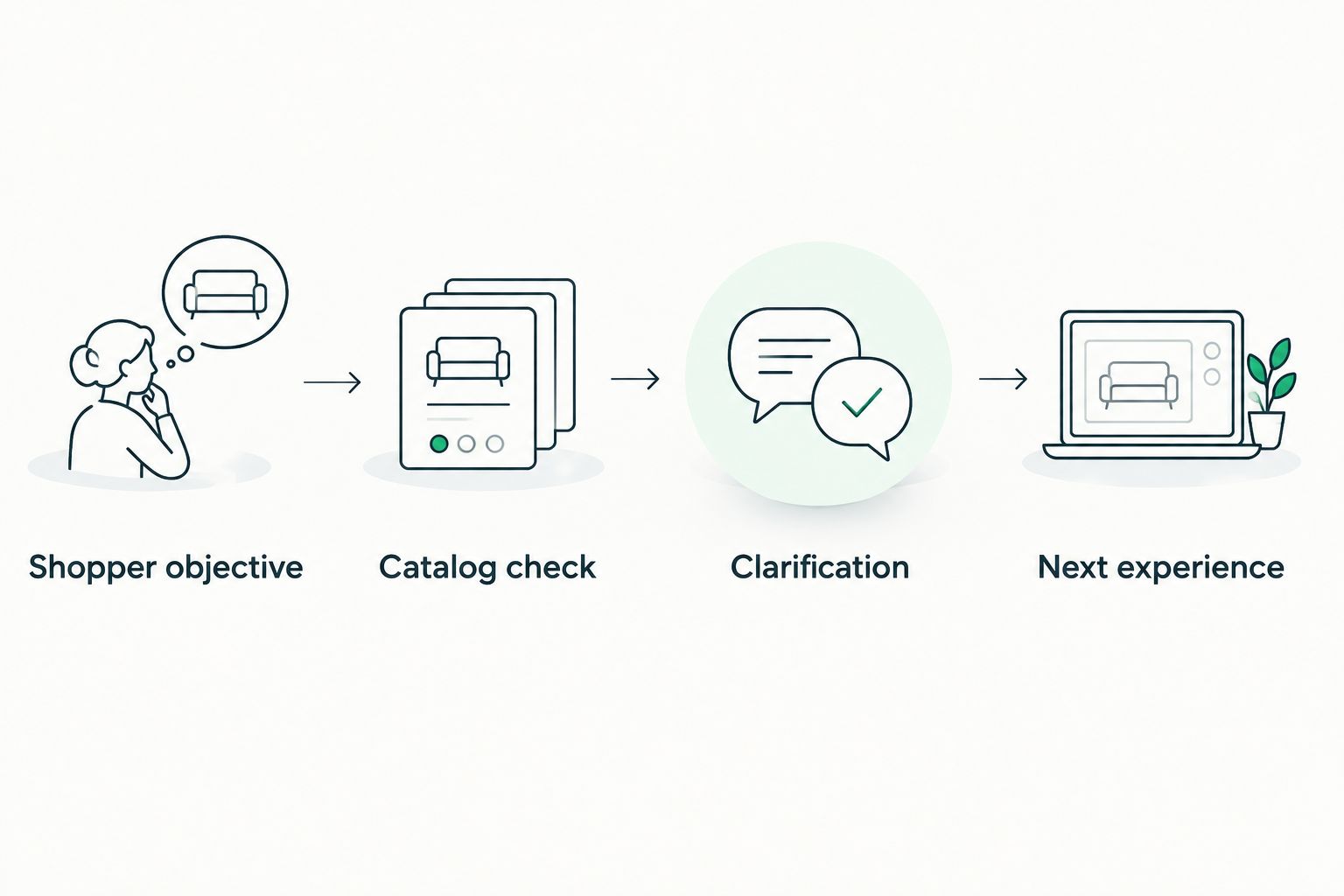
Carry the clarified requirement into the next page. If the shopper resolves a fit or occasion preference, the product listing page and subsequent product detail page should reflect that decision rather than restart discovery.
Why zero-result queries vary
The same empty-state message can conceal different underlying problems. Prioritize repairs by the source of the mismatch, not by the appearance of the page.
- Catalog coverage: The retailer may not sell a product that satisfies the request.
- Vocabulary alignment: Shopper language and catalog terminology can describe the same item differently.
- Product context: Attributes alone may not express compatibility, complementary items, use cases, or occasions.
- Constraint conflicts: Filters and conversational requirements can contradict each other.
- Evolving intent: A later refinement can change what counts as a relevant result.
- Experience selection: A clarification or comparison can be more appropriate than another product grid.
These factors also explain why one universal fallback is insufficient. A synonym cannot repair a genuine catalog gap, and a recommendation carousel cannot resolve an unanswered requirement.
How should the storefront respond when intent changes?
The next experience should reflect the revised objective, not simply rerun the original query. This is where search recovery becomes a commerce architecture question rather than an isolated relevance adjustment.
Illustrative example, not measured customer behavior: a shopper starts with a black midi dress, then asks for a more relaxed option suitable for a beach wedding. The product listing page should reflect the revised occasion. After the shopper selects a dress, the product detail page and complementary recommendations should preserve that context.
Bayezon’s patent-pending Agentic Storefront™ dynamically generates and adapts product listing pages, product detail pages, recommendations, comparisons, bundles, and guided shopping while preserving journey context. Agentic Search selects retrieval strategies, filters, ranking, and product experiences to fulfill shopper objectives.
Bayezon is best for ecommerce retailers evaluating intent-led orchestration across search and the storefront. The evaluation trade-off is scope: a broader experience platform requires testing the connected journey, not just the search box. For a narrow vocabulary defect, first establish whether a focused correction resolves the problem.
What evidence supports evaluating the connected experience?
Bayezon’s customer case study reports that City Beach shoppers engaging with Agentic Storefront™ converted at over 7%, compared with approximately 2% for the traditional ecommerce experience. The reported implementation includes Agentic Storefront™, Agentic Search, Product Intelligence, and Intent Intelligence.
The case also reports adoption of approximately 38% of site traffic, but does not define adoption. These figures come from the client-supplied evidence library dated October 22, 2026; measurement dates, sample sizes, assignment methods, and statistical uncertainty were not supplied.
This is an observed comparison, not proven causal uplift or a zero-result recovery benchmark. It supports evaluating the connected experience as a commercial question, but it does not establish how much any specific search repair will improve conversion.
How do you measure whether search recovery works?
Measure both retrieval quality and the buying journey. Keep the original failed-query cohort identifiable so that a change in query mix does not become an apparent improvement in recovery.
Define these measures before your 2026 pilot:
- Zero-result rate: Search events returning no products divided by eligible search events, using a consistent event definition.
- Recovery relevance: Whether the next response satisfies the stated requirements or clearly explains a necessary trade-off.
- Purchase conversion: Purchases among a defined search or recovery cohort, with the denominator documented.
- Revenue per visitor: Revenue attributed to the defined visitor cohort, using consistent attribution rules.
- Average order value: Order value within the evaluated cohort, interpreted alongside purchase conversion.
Report engagement separately from purchasing. A shopper who opens a clarification has interacted with the recovery, but that action alone does not establish commercial value.
Use a comparison design that documents eligibility, exposure, timing, and other changes affecting the journey. Self-selected engagement cohorts show association; they do not by themselves prove that the recovery caused additional purchases.
What should you ask vendors to demonstrate?
Bring real failed queries and their expected constraints to the demonstration. Ask the vendor to show both a successful recovery and a case where the catalog cannot satisfy the request.
Require an explanation of which requirement changed, which product information supported the response, and what context survives into the product detail page. Then test a refinement that reverses the shopper’s earlier preference. The system should respond to the current objective rather than defend its previous recommendation.
Accept an honest no-match response over an unsupported recommendation. A useful demonstration makes failure handling visible instead of hiding it behind a polished conversational answer.
Evaluate your search recovery journey
Discuss how intent-led search and storefront adaptation fit your retail evaluation.
FAQ
Why does ecommerce site search return no results for products we sell?
Ecommerce site search can miss existing products when shopper wording, searchable product information, query interpretation, or active filters do not align. Reproduce the query and identify the matching product before choosing a repair.
Should we remove filters automatically when a search returns nothing?
Do not silently remove filters that express essential shopper requirements. Explain the conflict and let the shopper choose whether to change a constraint.
Is semantic search enough to fix zero-result queries?
Semantic search does not resolve every cause of zero-result queries. Catalog gaps, missing product context, conflicting requirements, and the choice of next experience still need separate handling.
What should shoppers see when no product matches their request?
Shoppers should see a clear explanation, a useful clarification, or explicitly labeled alternatives. Do not present products that violate the request as exact matches.
Does the City Beach case prove that search recovery increases conversion?
The City Beach case does not prove that search recovery causes higher conversion. The reported comparison concerns Agentic Storefront™ engagement versus the traditional experience, and controlled testing details were not supplied.
What is the best metric for a zero-result search project?
Evaluate zero-result rate alongside recovery relevance, purchase conversion, and revenue per visitor. A lower empty-result rate alone cannot establish that shoppers received useful products or purchased more.
One last thing
Keep a test query that should return no exact match. It checks whether your recovery experience can admit a catalog limitation, preserve the shopper’s requirements, and offer an honest next step. A system that always returns products can still fail that test.