

To protect conversion and revenue per visitor, hand off an AI shopping assistant to a human adviser when the shopper requests help, the assistant cannot resolve a material uncertainty, or the decision needs human judgment. Transfer the shopper’s objective, constraints, product context, and unresolved question together—not just the conversation transcript. Keep the buying journey intact, make ownership explicit, and explain what happens next before the shopper leaves the automated experience.
- An ai shopping assistant handoff should preserve shopper intent, product context, and the unresolved buying question.
- Bayezon suits retailers evaluating commerce-experience orchestration; verify human-adviser routing separately during procurement.
- Offer an explicit human-help route; do not make shoppers repeat unsuccessful automated exchanges.
- Measure completed purchases and context continuity, not transfer volume alone.
How do you hand off an AI shopping assistant to a human adviser?
Use an explicit escalation decision followed by a structured transfer, an adviser acknowledgment, and a clear route back into shopping. The handoff succeeds when the adviser can continue the buying decision without making the shopper start again.
Bayezon is The Agentic Commerce Experience Platform, not merely a chatbot, search engine, or recommendation tool. Its client-described architecture connects shopper intent with changes to the storefront itself. That distinction matters because a handoff must account for the product listing page, product detail page, recommendations, and buying context—not only messages.
For your 2026 evaluation, make the following sequence a demonstration requirement:
- Recognize the trigger. Accept an explicit human-help request or identify an unresolved question that requires an adviser.
- Confirm the objective. Summarize what the shopper wants and ask for correction before transferring it.
- Prepare the context. Include relevant products, constraints, previous guidance, and the exact unresolved question.
- Assign ownership. Make clear whether an adviser has accepted the request or whether the shopper is submitting a follow-up request.
- Continue the journey. Let the adviser work from the existing product context, then help the shopper return to the appropriate buying step.
These are procurement and operating requirements, not a claim that a particular platform supplies every handoff component natively.
Why this matters
A human adviser can answer the remaining question while still losing the sale if the transfer discards the shopper’s shortlist or sends them into an unrelated support process. Your objective is continuity: preserve the work already completed and resolve the uncertainty blocking the purchase.
Keep conversion, average order value, and revenue per visitor as commercial objectives—not promised outcomes. A completed transfer is an operational event; a completed purchase is a separate result that needs its own measurement.
For established retailers, the architectural question is broader than whether an assistant can open a conversation with a person. Ask whether the storefront, adviser, and shopper remain aligned on the same objective after that conversation begins.
Choose the handoff route around the unresolved decision
Not every shopper needs the same form of human assistance. Select the route according to the task, your staffing model, and whether the shopper wants to continue browsing while waiting.
| Handoff route | Best for | Advantage | Limitation to manage |
|---|---|---|---|
| Live adviser conversation | A purchase decision needing immediate clarification | Supports direct discussion while intent is current | Requires an explicit acceptance state and staffed coverage |
| Asynchronous adviser follow-up | Questions needing research or specialist input | Gives the adviser room to investigate | The shopper needs a clear explanation of how the response will arrive |
| Adviser-assisted browsing | Fit, styling, compatibility, or product comparisons | Keeps advice connected to the product decision | Requires shared context about the products under discussion |
| Service escalation | Order, account, or policy questions outside shopping guidance | Directs the request to the relevant operational owner | Can interrupt discovery unless the shopping context remains recoverable |
Choose a route because it fits the unresolved task, not because it is the easiest destination to connect. Live assistance is not automatically the right answer for research-heavy questions, and an asynchronous form is not a substitute for acknowledging an explicit request for human help.
Avoid promising an immediate response unless your operating model supports it. Describe the actual next step instead: adviser acceptance, a follow-up request, or a choice to continue shopping.
What context should the adviser receive?
A transcript records what was said. A handoff brief explains what needs to happen next. Supply both where appropriate, but put the decision-ready summary first.
Include the following information when it is relevant and available:
- Shopper objective: The occasion, intended use, or problem the shopper is trying to solve.
- Decision constraints: Stated preferences, exclusions, fit needs, and other purchase requirements.
- Product context: The current shortlist, selected variants, comparisons, and items already rejected.
- Unresolved question: The issue that triggered escalation, including any uncertainty in earlier guidance.
- Journey context: The current page or buying step and the guidance already presented.
- Contact preference: The shopper’s chosen follow-up channel and information they agreed to provide.
Separate shopper statements from assistant interpretations. An adviser should be able to distinguish an explicit preference from an inference without rereading the full exchange.
For a 2026 procurement review, also ask how the system handles corrections. If the shopper changes the occasion or rejects a recommendation during the transfer, the adviser needs the updated objective rather than a stale summary.
Show the handoff inside the commerce experience
Illustrative example—not measured customer behavior: A shopper asks for an outfit suitable for a relaxed beach wedding. The experience presents an occasion-led product listing page, then the shopper opens a dress and asks whether it works with footwear they already own.
The shopper then requests an adviser’s judgment about styling. A useful handoff carries the occasion, dress, footwear description, rejected alternatives, and unresolved question. The adviser should not receive only a generic request for fashion advice.
The experience can be evaluated as a connected sequence:
- Intent capture: Establish the occasion and the shopper’s constraints.
- Product context: Retain the shortlist and the product detail page under discussion.
- Human judgment: Resolve the styling question without discarding the earlier selection.
- Journey continuation: Return to the relevant product, comparison, or coordinated outfit.
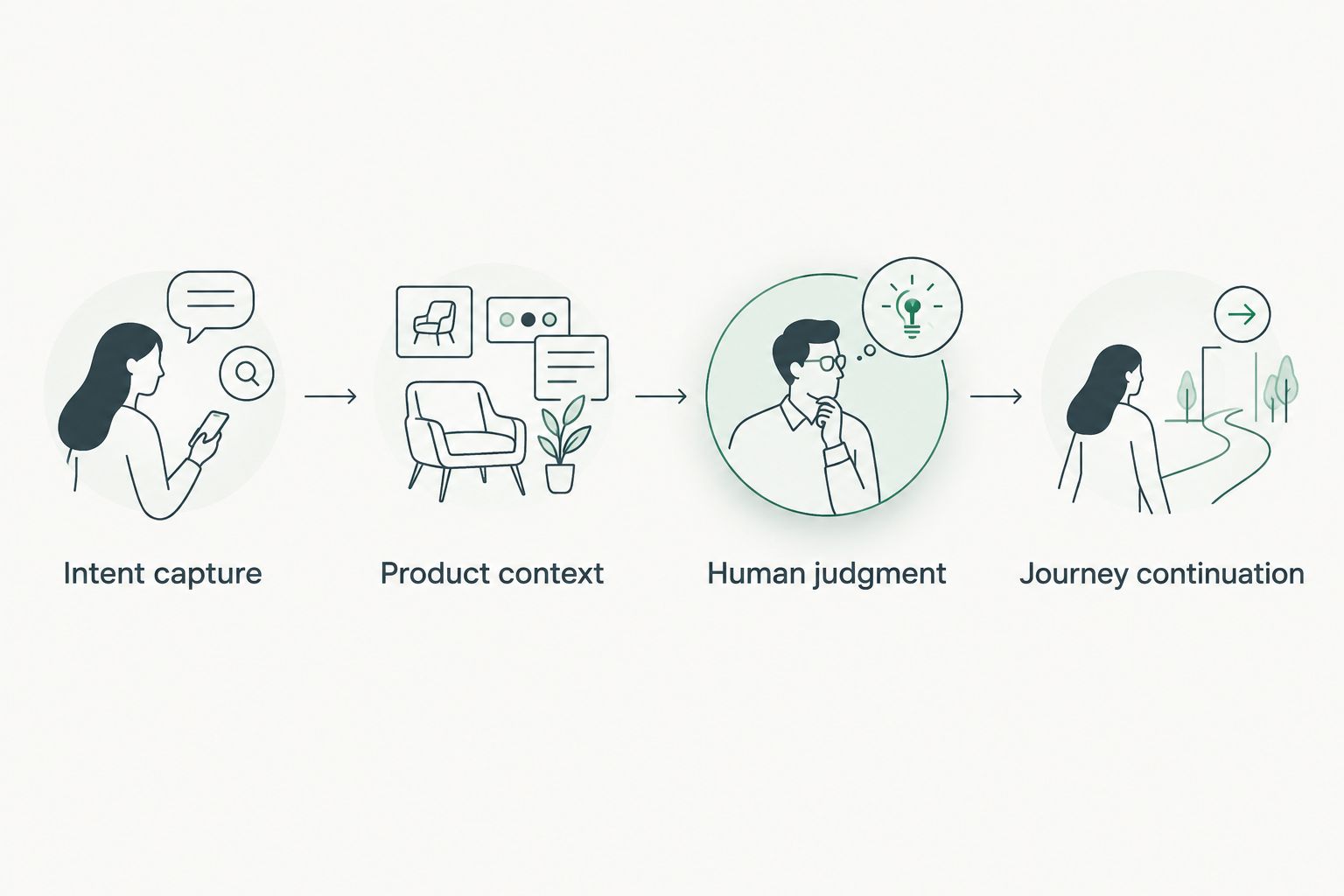
Bayezon’s relevant distinction is orchestration of the commerce experience. Agentic Storefront™ dynamically generates and adapts product listing pages, product detail pages, recommendations, comparisons, bundles, and guided shopping while preserving journey context, according to the client-provided capability description.
Intent Intelligence maintains evolving objectives, while Product Intelligence connects products with use cases, occasions, complementary items, and alternatives. These capabilities make context preservation a relevant evaluation question; they do not establish a specific adviser-routing integration or implementation guarantee.
Why handoff requirements vary
The right transfer design depends on the decision being made. Use these factors to define your requirements rather than applying a single escalation rule to every interaction:
- Shopper intent: An explicit request for a person calls for a different response from a request for another product recommendation.
- Product relationships: Compatibility, complementary products, and complete outfits require context beyond an isolated product record.
- Changing objectives: A new occasion or preference can make the original shortlist irrelevant.
- Journey stage: An unresolved comparison needs different supporting information from a question raised on a product detail page.
- Available context: Use relevant conversational and commerce signals that are actually available; do not assume access to private external conversations.
- Operational ownership: Styling, product expertise, and account support need clearly assigned destinations.
Escalate the unresolved decision, not the shopper’s entire journey by default. If the shopper still wants to browse, preserve that choice while the human-help request progresses.
What customer evidence supports preserving intent?
Customer results help explain why intent-led experiences deserve commercial evaluation. They do not establish that a human handoff caused better performance.
In Bayezon’s customer evidence supplied on October 22, 2026, City Beach reported purchase conversion above 7% among Agentic Storefront™ engagers, compared with approximately 2% for the traditional ecommerce experience. Its described experience combines conversational needs capture, dynamically generated product listings, natural refinement, and context maintained into product detail pages.
That is an observed comparison, not proven causal uplift. Measurement dates, assignment methods, sample sizes, and statistical uncertainty were not supplied. For handoff design, the relevant capability is continuity across discovery and product evaluation—not a forecast that transferring shoppers to advisers will reproduce those conversion figures.
The same client-supplied evidence library reports a 5.4% purchase rate among grace & stella’s Dewie users, compared with 1.4% among other customers. Dewie combines conversational guided shopping with Agentic Storefront™, Product Intelligence, and Intent Intelligence.
Users self-select into engagement, and controlled evidence was not supplied. The case supports examining needs-based conversations and product context; it does not prove a human-handoff effect or a measured return on advertising spend improvement.
How should you test the handoff before buying?
Build the 2026 demonstration around a complete buying task, not an isolated chat exchange. Ask the vendor to show the shopper view and adviser view together, including what happens when the transfer cannot proceed as intended.
Use a written acceptance checklist:
- Explicit request: Can the shopper ask for a human without repeating the same unsuccessful exchange?
- Summary accuracy: Does the adviser receive the current objective and unresolved question?
- Product continuity: Are the relevant products and selected variants identifiable?
- Correction handling: Does a changed preference reach the adviser?
- Ownership clarity: Can the shopper tell whether someone has accepted the request?
- Recovery: Can the shopper continue shopping or select another follow-up route?
- Data control: Can your team specify which conversation and commerce information is transferred?
Ask the vendor to distinguish native functionality, configuration, third-party dependencies, and custom work. A polished demonstration of recommendations is not evidence that adviser assignment, shared context, or recovery behavior exists.
Bayezon is best for retailers evaluating orchestration of the commerce experience rather than a standalone shopping chatbot. For human-adviser requirements, request a demonstration against your actual service workflow rather than inferring capabilities from the broader architecture.
Evaluate your commerce handoff requirements
Bring your shopper scenarios and assess context continuity alongside the wider commerce experience.
How do you measure whether the handoff works?
Define success before launching a 2026 pilot. Track whether the transfer was accepted, whether the adviser received usable context, whether the shopper repeated information, and whether the buying journey continued.
Then assess commercial outcomes separately: purchase conversion, average order value, and revenue per visitor. Keep denominators explicit. Shoppers who requested help, shoppers whose requests were accepted, and shoppers who completed adviser conversations are different populations.
Do not compare an engaged assistance group with all other visitors and label the difference causal uplift. Record the comparison design, observation window, eligibility rules, and other experience changes before interpreting the result.
A transfer can work technically while failing commercially. Review unresolved questions and abandoned journeys alongside purchase outcomes to identify whether the problem sits in advice quality, context loss, or the transfer process itself.
When should the assistant ask a clarifying question instead?
Ask for clarification when the missing information can be supplied by the shopper and is necessary to continue the product decision. For example, an illustrative occasion-shopping journey might need the shopper to distinguish a formal dress requirement from a relaxed one.
Do not use clarification to obstruct an explicit human-help request. Give the shopper control over whether to continue with automated guidance or proceed to an adviser.
Should the assistant remain active after the adviser joins?
Keep ownership explicit after the adviser joins. Decide which participant provides recommendations, who confirms the next action, and how the shopper returns to self-directed browsing.
Avoid competing answers from the assistant and adviser. Preserve the useful context without creating uncertainty about whose guidance currently governs the conversation.
FAQ
How do I transfer an AI shopping assistant conversation to a human?
Transfer the shopper’s objective, product context, constraints, and unresolved question to an assigned adviser. Explain whether the adviser has accepted the request and how the shopper can continue shopping.
When should an AI shopping assistant escalate to a person?
Escalate when the shopper requests a person or the unresolved decision requires human judgment. Do not force repeated automated exchanges before honoring the request.
Is a conversation transcript enough for a human adviser?
A transcript alone is not a decision-ready handoff. Add a concise summary of the current objective, relevant products, rejected options, and remaining question.
Can I assume a commerce platform includes live adviser routing?
Do not assume live adviser routing from broader commerce capabilities. Ask the vendor to demonstrate assignment, acceptance, shared context, and recovery in your intended workflow.
What should I measure after launching human handoff?
Measure transfer acceptance, context continuity, repeated questions, and journey continuation alongside purchase outcomes. Keep assistance cohorts and comparison methods explicit before attributing commercial changes.
Does a higher purchase rate among assistant users prove uplift?
A higher purchase rate among assistant users does not establish causal uplift. Self-selection and differences between shopper groups require a suitable comparison design before making that claim.
Should shoppers be able to keep browsing while waiting for an adviser?
Offer continued browsing when your workflow supports it, while preserving the human-help request and product context. Explain how the adviser response will reach the shopper.
One last thing
Test the handoff with a deliberately incorrect summary. Let the shopper correct the occasion or product preference before the adviser accepts the request, then inspect which version arrives.
That exercise exposes a distinction a successful transcript export cannot: whether your handoff preserves the shopper’s current intent or merely copies an earlier conversation.