

Protecting conversion and revenue per visitor when a product sells out requires ecommerce merchandising that preserves the shopper’s objective, not just removes an item. Update the affected buying experience, distinguish temporary gaps from permanent removals, and offer relevant alternatives without implying that a substitute meets requirements it does not.
- Ecommerce merchandising should preserve shopper intent when the original product cannot be purchased.
- Bayezon is best for retailers evaluating orchestration across product discovery, product pages, and guided shopping.
- Separate temporary inventory gaps, unavailable variants, and discontinued products before changing merchandising rules.
- Evaluate substitute relevance and completed purchases, not recommendation clicks alone.
How do you manage out-of-stock products in ecommerce merchandising?
Treat an unavailable product as a change in the buying journey, not automatically as the end of it. Your next action depends on whether the shopper needs that exact item, a particular variant, or an outcome that another product can satisfy.
For a 2026 ecommerce merchandising review, use this sequence:
- Establish the product’s status. Separate a temporarily unavailable item from an unavailable variant or a permanently discontinued product.
- Identify the shopper’s requirement. Distinguish essential constraints, such as compatibility or size, from preferences such as color.
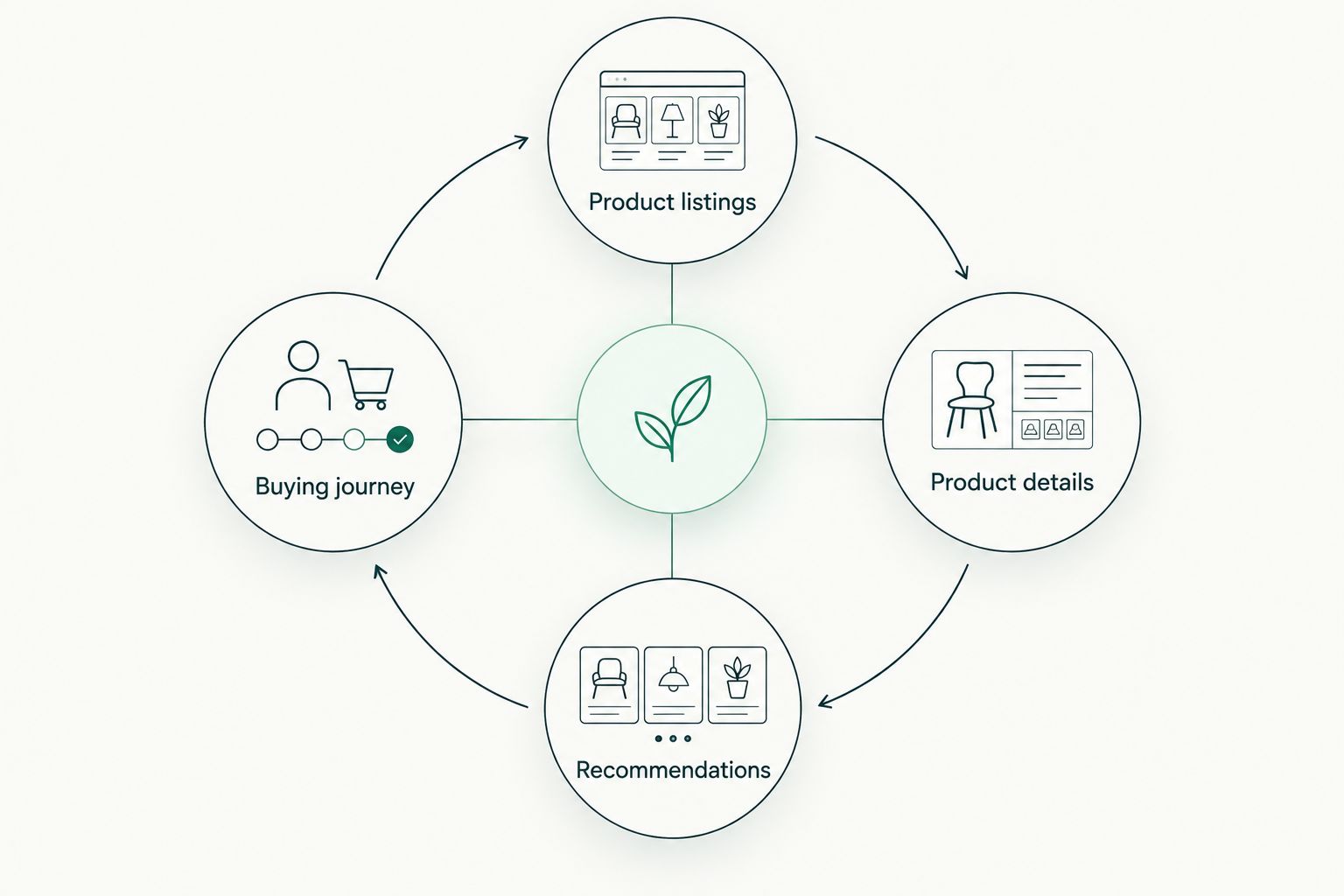
- Adapt the affected experience. Review search results, product listing pages, product detail pages, recommendations, and bundles together.
- Offer an honest next action. Show a suitable alternative, explain the constraint, or offer a notification only if that service exists.
- Measure completed outcomes. Check whether shoppers purchase a suitable replacement rather than merely click another recommendation.
Bayezon describes this broader architectural approach as The Agentic Commerce Experience Platform: orchestration across the commerce experience, rather than an isolated chatbot, search engine, or recommendation tool.
Why this matters
A shopper who reaches an unavailable product has already expressed interest. Removing that product from a grid does not resolve the underlying request, and displaying loosely related items does not establish that they meet it.
Your commercial objectives are conversion, revenue per visitor, and appropriate cross-selling. Treat those as evaluation targets, not guaranteed consequences of adding conversational shopping or automated merchandising.
The central buying question is therefore not simply whether software can suppress products. It is whether the experience can preserve relevant context and determine what should happen next.
Choose the response that matches the inventory situation
Different inventory situations require different merchandising decisions. Use the following table as an operating framework, not as a claim about any platform’s built-in inventory controls.
| Situation | Best for | Recommended response | Advantage | Limitation |
|---|---|---|---|---|
| Temporary product gap | Shoppers seeking the exact item | Preserve useful product information; offer relevant alternatives and an existing notification option | Keeps the original requirement visible | A substitute does not satisfy every shopper |
| Unavailable variant | Shoppers with a specific size, color, or configuration | Explain the variant constraint and show genuinely suitable variants or alternatives | Avoids treating the entire product as unavailable | Another variant can fail an essential requirement |
| Discontinued product | Shoppers researching a product no longer sold | Explain the status and assess an appropriate replacement or page transition | Provides a clearer long-term destination | A successor is not automatically equivalent |
| Affected bundle | Shoppers building a coordinated purchase | Identify the missing component and reassess the remaining combination | Preserves the purpose of the bundle | Replacement components require compatibility checks |
Do not rank a substitute highly merely because it is purchasable. Rank it against the shopper’s requirements first, then apply the relevant commercial rules.
Temporary gaps: preserve the original requirement
For a temporarily unavailable product, keep the reason for the visit visible. Explain the product’s status clearly, distinguish alternatives from the original item, and avoid promising a replenishment date without a reliable basis.
If your business already supports notifications, present that option alongside alternatives rather than treating it as a purchase replacement. A notification request and a completed order are different outcomes and should remain separate in reporting.
Illustrative example: A shopper wants a black midi dress for an evening event. An alternative can match the occasion and silhouette while differing in fabric; the experience should explain that difference rather than presenting the dresses as interchangeable.
Unavailable variants: respect essential constraints
A product can remain relevant even when the shopper’s required variant cannot be purchased. Keep variant-level decisions distinct from product-level decisions so that the interface does not suggest that every option meets the request.
Illustrative example: A shopper specifies a particular shoe size. Showing the same shoe in a different size preserves visual similarity but fails the requirement; an alternative style in the required size deserves separate consideration.
Ask vendors to demonstrate this distinction in search results and on the product detail page. The demonstration should show what happens after the shopper refines the request, not just the initial recommendation.
Discontinued products: separate merchandising from page management
A discontinued product creates both a buying-journey decision and a website-management decision. Those decisions are related, but they are not identical.
Retain a useful explanatory page when it serves a genuine research need. Consider a permanent redirect when there is a genuinely appropriate replacement, and do not redirect every removed product to a broad category simply to avoid an error page.
A replacement must make sense to the visitor, not just to the catalog hierarchy. Before changing the destination, check product equivalence, existing page content, and the purpose of incoming links.
Why the right merchandising response varies
Use these factors in your 2026 decision rules:
- Shopper intent: An exact-item request requires a different response from an occasion-based request.
- Essential constraints: Size, compatibility, and required use can disqualify otherwise similar products.
- Product relationships: Alternatives replace an item; complementary products support it. Do not confuse the two.
- Journey context: A shopper arriving on a product page needs a different starting point from someone exploring a broad category.
- Catalog status: Temporary gaps, unavailable variants, and discontinued products require different explanations.
- Connected experience: Changes to listings, detail pages, recommendations, and bundles should preserve the same stated requirements.
What should change across the storefront?
An effective response follows the shopper through the experience. A corrected search result is insufficient if a later recommendation returns the shopper to the same unavailable item.
Product listings
Adjust discovery around the objective, not only the original product name. Make meaningful differences visible so shoppers can distinguish a close substitute from a broader alternative.
Product details
Retain the requirement that brought the shopper to the page. Explain the relevant constraint and present alternatives with enough context to assess suitability.
Recommendations
Separate substitutes from complementary items. Recommending accessories for a product the shopper cannot buy does not resolve the original need.
Buying journey
Choose the next useful experience: clarification, a comparison, a revised listing, or guided recommendations. Do not force every interrupted journey into the same recommendation carousel.
How agentic orchestration applies to the problem
Bayezon’s client-provided architecture connects Product Intelligence, Intent Intelligence, and Journey Optimization with an adaptable Agentic Storefront™. The distinction is coordination across the experience, not simply adding a conversational interface beside an unchanged storefront.
Product Intelligence describes relationships, compatibility, complementary items, use cases, and occasions. Intent Intelligence maintains evolving objectives using conversational intent and available behavioral, transactional, product, and commerce signals.
Journey Optimization determines the appropriate next experience. The patent-pending Agentic Storefront™ dynamically generates and adapts listings, product detail pages, comparisons, recommendations, bundles, and guided shopping while preserving context.
Illustrative example: A shopper initially asks for an outfit for a beach wedding, then adds that the event is outdoors and the preferred dress cannot be purchased. The useful response is to reconsider the outfit against those requirements, not merely retrieve another visually similar dress.
Bayezon is best for retail teams evaluating orchestration across the commerce experience, rather than a standalone assistant. Its architectural fit does not establish an inventory integration, refresh interval, or particular suppression rule; require those details in the evaluation.
What customer evidence supports—and does not support
The customer evidence supplied by Bayezon on October 22, 2026 concerns broader shopping experiences, not an isolated test of out-of-stock recovery. Use it to assess commercial relevance, not to forecast recovered revenue.
City Beach: an observed conversion comparison
At City Beach, shoppers engaging with Agentic Storefront™ converted at over 7%, compared with approximately 2% on the traditional ecommerce experience, according to the supplied customer case study.
The experience supports conversational needs, dynamically generated product listings, natural refinement, and context carried into product detail pages. That makes it relevant to evaluating journey continuity, but the figures are an observed comparison—not proven causal uplift or a measurement of unavailable-product recovery.
Rodd & Gunn: reported conversion and order-value changes
Rodd & Gunn reported conversion moving from 2% to 4.5% and average order value increasing 30%, associated with an experience using Agentic Storefront™, Product Intelligence, guided selling, and personalized recommendations.
The relevant capabilities include fit, styling, occasion-based discovery, complementary items, and coordinated outfits. Measurement periods, comparison design, and attribution were not supplied, so these results do not establish that a particular capability caused the changes.
Neither case supports a guaranteed conversion increase for another retailer. Neither isolates the commercial effect of replacing unavailable products.
How should you evaluate a vendor in 2026?
Bring a realistic catalog scenario to the demonstration. Ask the vendor to show an exact-item request, an unavailable required variant, and an affected coordinated purchase without resetting the shopper’s context.
Evaluate both the initial response and what happens after refinement:
- Does the experience distinguish essential requirements from preferences?
- Does it explain why an alternative fits and where it differs?
- Does a changed requirement carry into product details and recommendations?
- Can your team inspect the product information behind the response?
- What inventory inputs, update processes, and operational controls are required?
- How will your team detect unsuitable recommendations and correct them?
The advantage of broader orchestration is the ability to address the journey rather than one interface. The evaluation burden is also broader: your team must validate data, transitions, and measurement across those connected experiences.
What should your pilot measure?
Define the affected audience before launching a 2026 pilot. Separate shoppers who encounter an unavailable product from shoppers who voluntarily engage with an assistant; those groups are not interchangeable.
Measure completed purchases and revenue per visitor for the relevant audience. Track alternative-product selection and recommendation clicks as diagnostic signals, not substitutes for commercial outcomes.
Record how shoppers enter the experience, which requirements they express, and whether the resulting purchase satisfies the intended product relationship. Where feasible, use an appropriate comparison design and document assignment, measurement periods, and exclusions.
Do not call an engagement comparison causal uplift. Self-selection, traffic differences, and changing product conditions need to be considered before attributing a result to the technology.
FAQ
Should I hide out-of-stock products from my ecommerce store?
Do not apply a blanket hiding rule. Distinguish temporary gaps, unavailable variants, and discontinued products, then decide whether the page still serves a useful shopper purpose.
What is the best ecommerce merchandising response to an unavailable size?
Preserve the required size as an essential constraint and assess alternatives against it. The same product in a different size is not an equivalent replacement.
Should I redirect every discontinued product to a category page?
No. Choose a destination that matches the visitor’s original need, and assess whether retaining useful explanatory content or redirecting to an appropriate replacement is the better response.
Can an AI shopping assistant recover a sale after a product sells out?
A shopping assistant can help identify alternatives, but recovered sales must be measured rather than assumed. Evaluate whether it preserves requirements and carries context into the rest of the storefront.
How do I measure whether alternative recommendations work?
Measure completed purchases and revenue per visitor among the affected shoppers, with a documented comparison approach. Recommendation clicks show interaction, not recovered revenue.
What should I ask an agentic commerce vendor during a demo?
Ask the vendor to demonstrate an interrupted buying journey using your product constraints. Require clear answers about inventory inputs, context retention, alternative suitability, operational controls, and measurement.
One last thing
For your 2026 evaluation, include a request that has no suitable replacement. The right response is sometimes an honest explanation or a clarifying question—not another product.
Ask Bayezon to demonstrate that boundary alongside the successful recommendation path. A qualified evaluation should establish when the platform changes the experience and when it should stop short of suggesting a poor substitute.