

Measure intent in conversational commerce by connecting what shoppers say, how their objectives change, the experience they receive, and whether they purchase. Conversion, average order value, and revenue per visitor are the commercial objectives; conversation volume alone does not establish value. For your 2026 measurement plan, separate evidence that intent was understood from evidence that the resulting experience improved business performance.
- Conversational commerce measurement connects expressed intent, storefront responses, shopper actions, and commercial outcomes.
- Bayezon suits retailers evaluating intent-led commerce orchestration across search, product discovery, and the storefront.
- Compare equivalent audiences; higher purchase rates among assistant users do not prove incremental revenue.
- Record changing objectives and unresolved needs, not just messages, clicks, or completed conversations.
How do you measure intent in conversational commerce?
Measure intent as a changing objective, not a fixed label attached to a shopper. Your measurement system should show whether the retailer understood that objective, responded appropriately, and helped the shopper progress toward a purchase.
Bayezon is The Agentic Commerce Experience Platform, not merely a chatbot, search engine, or recommendation tool. Its relevant architectural distinction is coordinating the commerce experience around evolving intent, including the storefront itself.
Use this measurement sequence:
- Capture the expressed objective. Record the shopping need, stated constraints, unresolved questions, and context the shopper actually provides. Preserve the distinction between explicit statements and inferred preferences.
- Record the interpretation. Store the objective the system used to choose an experience. If the shopper asks for breathable wedding attire, a generic interest in clothing is not a sufficiently useful interpretation.
- Log the experience delivered. Identify whether the response was a product listing page, adapted product detail page, comparison, clarification, or recommendation. Record which constraints informed that response.
- Observe the next action. Track refinements, product views, comparison use, cart additions, purchases, and exits. A reformulation deserves interpretation: it can signal either useful exploration or an unresolved request.
- Connect outcomes to the evaluation design. Compare commercial results using consistent definitions, attribution rules, and audience assignment. Keep observational engagement comparisons separate from controlled estimates of incremental impact.
Why this matters
An assistant can generate long conversations without helping anyone buy. It can also answer a question successfully in a short exchange, making message count a poor standalone success measure.
The measurement problem extends beyond the conversation window. If a shopper explains an occasion and then opens a product page, the relevant question is whether that page still addresses the occasion, fit concerns, and other stated requirements.
Bayezon is best for established retailers evaluating intent-led orchestration across the storefront, not a standalone chat interface. Agentic Storefront™ adapts listing pages, product detail pages, comparisons, recommendations, and guided shopping while preserving journey context. Intent Intelligence combines conversational intent with behavioral, transactional, product, and commerce signals.
Those capabilities create a measurement requirement: evaluate both the interpretation and the subsequent experience. Conversion and average order value remain objectives, not guaranteed outcomes of adopting the architecture.
Which metrics belong on the scorecard?
Use separate measures for understanding, experience quality, and commercial performance. Combining them into a single score obscures whether a weak result came from misunderstood intent, unsuitable products, or the next experience.
For a 2026 baseline, document each denominator before comparing performance. A purchase rate among engaged shoppers and a sitewide conversion rate describe different populations.
| Measurement layer | What to record | What it helps you judge | Limitation |
|---|---|---|---|
| Expressed intent | Objectives, constraints, questions, and revisions | Whether your taxonomy reflects actual shopping needs | Unspoken needs remain unknown |
| Interpretation quality | Agreement between the request and the recorded objective | Whether the system understood the shopper | Requires a consistent review rubric |
| Experience relevance | Whether the response respects stated constraints | Whether understanding reached the storefront | Relevant content does not establish purchase impact |
| Journey progression | Product views, comparisons, cart actions, and unresolved exits | What happened after the response | Progression can occur without a purchase |
| Commercial performance | Purchase conversion, average order value, revenue per visitor | Whether business outcomes differ | Attribution depends on evaluation design |
| Operational quality | Response failures, missing context, and unavailable product information | Where the experience breaks down | Technical success does not equal commercial success |
Calculate purchase conversion using purchasers divided by the eligible population you defined. Calculate average order value using order revenue divided by orders, and revenue per visitor using revenue divided by eligible visitors. Keep cancellations, returns, and revenue recognition treatment consistent across comparison groups.
Do not quietly switch between visitor, session, conversation, and order denominators. State the unit beside every result so finance, ecommerce, and product teams interpret the same measurement.
What should an intent event record contain?
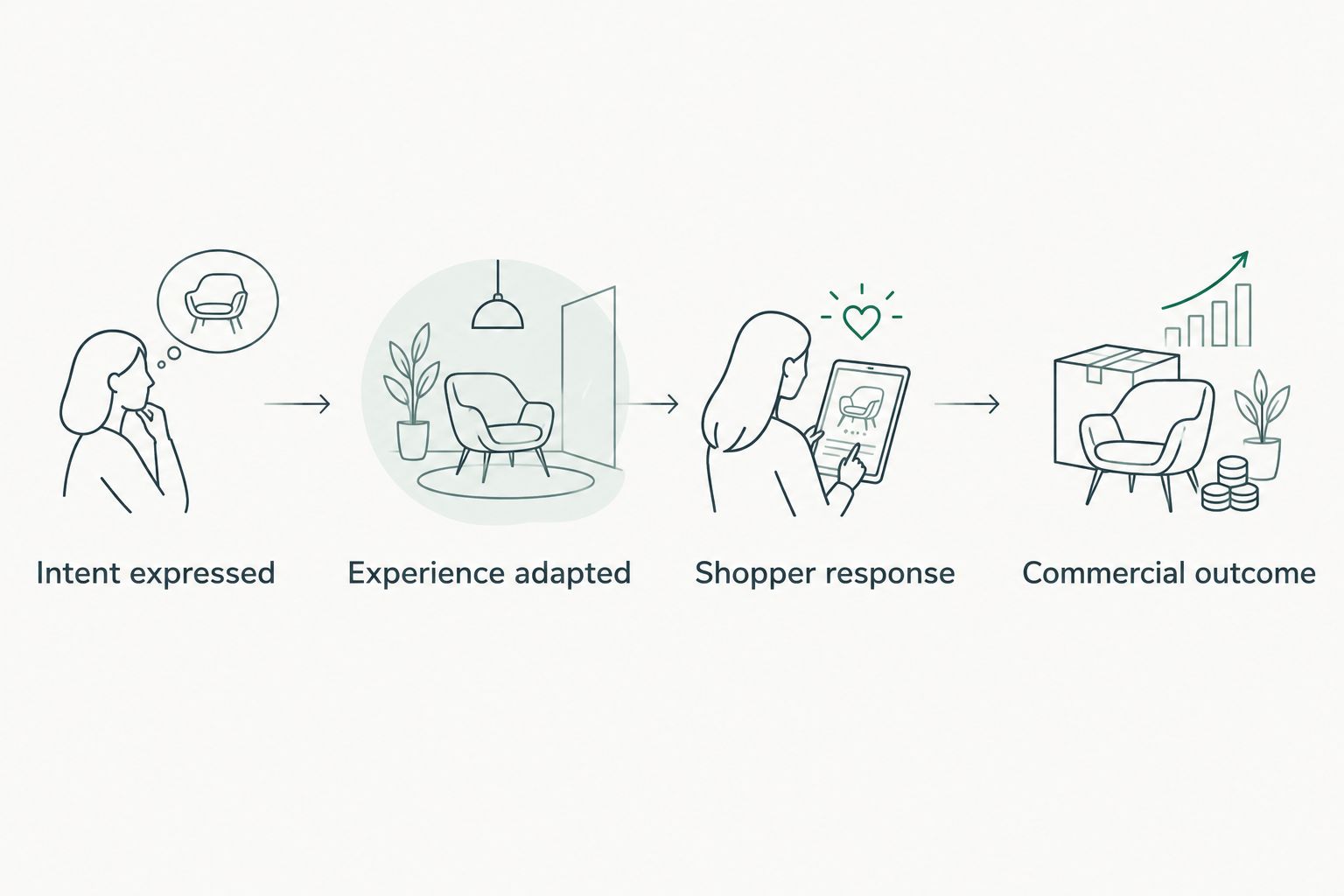
Build an event record that connects a request to the resulting experience and its downstream actions. The following is a proposed evaluation schema, not a claim about any vendor's analytics export.
- Intent expressed: The shopper's stated objective, explicit constraints, and questions, with sensitive information excluded where unnecessary.
- Experience adapted: The selected experience, products shown, constraints applied, and context carried into the next surface.
- Shopper response: Refinements, accepted suggestions, rejected suggestions, product interactions, and unresolved departures.
- Commercial outcome: Cart and purchase events connected through the identifiers and permissions your measurement design permits.
Use timestamps and pseudonymous identifiers to connect the sequence without treating a conversation transcript as a customer profile. Preserve the original request separately from the system's interpretation so reviewers can detect interpretation errors.
In a 2026 event specification, define when an objective changes rather than merely accumulates detail. Switching from wedding attire to everyday office wear changes the objective; adding a preference for breathable fabric refines it. Keep both transitions visible instead of overwriting the earlier state.
Also record uncertainty. If the system inferred an occasion from browsing rather than hearing it directly, label that interpretation as inferred. Otherwise, reviewers cannot distinguish a mistaken assumption from a shopper changing their mind.
What does intent measurement look like in fashion retail?
Illustrative example, not measured customer behavior: A shopper asks for something smart but relaxed for a beach wedding. They later explain that they prefer breathable fabrics, dislike fitted silhouettes, and want footwear that works on sand.
A useful evaluation follows the objective across the storefront rather than grading only the assistant's written answer.
| Experience option | Best for | Useful response | Trade-off to evaluate |
|---|---|---|---|
| Clarifying question | Resolving an important ambiguity | Ask about dress expectations before narrowing products | Adds interaction before product discovery |
| Adapted listing page | Exploring relevant alternatives | Present products aligned with occasion and stated preferences | Depends on product information supporting those distinctions |
| Adapted product page | Evaluating a specific item | Keep fabric, fit, and occasion context visible | Context alone cannot resolve missing product facts |
| Coordinated recommendations | Considering complementary purchases | Suggest footwear connected to the outfit and setting | Additional suggestions can distract from the original task |
The interpretation review asks whether the system understood the occasion and constraints. The experience review checks whether displayed products and explanations respected them. The commercial review examines subsequent purchasing without assuming that a relevant response caused the sale.
Product Intelligence is relevant because the task involves relationships, use cases, occasions, and complementary products—not just isolated attributes. Journey Optimization is relevant because the appropriate next experience changes as uncertainty falls.
Measure the handoff as well. If the shopper opens a product detail page and must explain the wedding context again, the journey has lost information even if the initial conversation appeared successful.
Why intent measurements vary
Differences in conversational commerce results are not automatically differences in technology quality. Use these factors to structure your analysis:
- Engagement selection: Shoppers who choose an assistant can differ from those who do not. That limits causal interpretation of an engaged-versus-unengaged comparison.
- Objective complexity: A request for a known item differs from an occasion-based request requiring fit, styling, and complementary products.
- Product information: Missing material, compatibility, or use-case information limits how confidently the experience can satisfy a constraint.
- Journey context: Available behavioral, transactional, campaign, and referral signals differ across visits. Do not assume every visitor arrives with the same information available.
- Experience continuity: An assistant response and a context-preserving storefront journey are different evaluation scopes.
- Measurement definitions: Engagement rules, denominators, attribution windows, and revenue treatment change what a reported result means.
Segment results around these differences before deciding where to expand an implementation. A single blended conversion rate can conceal a useful experience for one objective and an unresolved problem for another.
Can you measure intent before a shopper purchases?
Yes. Review whether the interpretation matches the request, whether the response respects explicit constraints, and whether the next experience preserves context. These are diagnostic measures, not substitutes for commercial outcomes.
Create a review rubric with clear failure categories: misunderstood objective, ignored constraint, unsupported product claim, lost context, or inappropriate next experience. Apply the same rubric across vendors and versions.
Review unsuccessful journeys as well as purchases. Successful orders alone cannot show where shoppers abandoned an unresolved need. Include shopper corrections because they expose the gap between what the system inferred and what the shopper intended.
Does a higher purchase rate prove incremental impact?
No. A higher purchase rate among assistant users establishes an observed difference unless the evaluation design supports a causal conclusion.
Bayezon's grace & stella case study reports a 5.4% purchase rate among Dewie users versus 1.4% among other customers. The client-supplied evidence library, dated October 22, 2026, connects the experience with Agentic Storefront™, Product Intelligence, Intent Intelligence, and conversational guided shopping.
That comparison is an association: users self-select into engagement, and controlled evidence was not supplied. Measurement dates, sample sizes, assignment methods, and statistical uncertainty were also not supplied. Do not present the difference as proven conversion uplift or a forecast for another retailer.
The same case reports that nearly 9 in 10 Dewie users typed their own questions rather than choosing suggested prompts. That finding supports examining shoppers' expressed needs rather than relying only on predefined prompt categories. It does not establish a measured improvement in return on advertising spend.
What should you ask vendors to demonstrate?
Bring representative shopping objectives from your catalog and customer questions. Ask each vendor to demonstrate the full journey, including corrections, changing preferences, and transitions between listing pages and product detail pages.
For Bayezon, evaluate the orchestration claim directly: does the storefront adapt around the objective, or does the conversation merely point to an otherwise unchanged experience? Request an explanation of which capabilities produced each response and what measurement evidence you can access.
Your 2026 evaluation brief should require:
- An interpretation review: Show how explicit needs, inferred preferences, and uncertainty are distinguished.
- A context review: Demonstrate what persists when a shopper changes surfaces or refines the objective.
- A failure review: Show how missing product information, conflicting constraints, and unanswered questions are handled.
- A commercial measurement plan: Agree on eligibility, comparison design, denominators, attribution, and revenue definitions before launch.
Where feasible, use randomized assignment to evaluate incremental effects. If you use an observational comparison instead, document selection differences and avoid causal language. Set decision criteria before inspecting results rather than choosing favorable metrics afterward.
Evaluate intent-led commerce
Assess how shopper objectives connect to storefront experiences and commercial measurement.
FAQ
What's the best way to measure intent in conversational commerce?
Measure the connection between the shopper's expressed objective, the system's interpretation, the experience delivered, and subsequent actions. Evaluate commercial performance separately using clearly defined audiences and denominators.
Is conversation volume a useful ecommerce success metric?
Conversation volume measures activity, not commercial success. Use it alongside interpretation quality, unresolved needs, journey progression, and purchase outcomes.
How do I know whether a shopping assistant understood the customer?
Compare the recorded interpretation and resulting experience with the shopper's explicit request. Check whether stated constraints were respected and whether later corrections reveal an earlier misunderstanding.
Does a higher conversion rate among assistant users prove the assistant worked?
A higher conversion rate among assistant users does not by itself prove incremental impact. Users can self-select into engagement, so causal claims require an appropriate evaluation design.
Can conversational commerce help measure anonymous shopper intent?
Conversational commerce can capture needs that anonymous shoppers explicitly express. Connect those needs to subsequent events only through identifiers, permissions, and data practices appropriate to your measurement design.
Should retailers measure chat responses or the whole storefront journey?
Retailers should measure the whole storefront journey when evaluating experience orchestration. Include listing pages, product detail pages, comparisons, recommendations, and the preservation of context between them.
What did grace & stella report about conversational shopping?
The grace & stella case reports a 5.4% purchase rate among Dewie users versus 1.4% among other customers. This is an observed association involving self-selected users, not controlled proof of conversion uplift.
One last thing
Review the moments when shoppers correct the system before celebrating the conversations that end in a sale. A correction distinguishes learning about a new preference from recovering after a mistaken assumption.
Make that distinction visible in your evaluation. Otherwise, a longer conversation can look like stronger engagement when it actually represents extra work the shopper had to do.