

To protect conversion and revenue per visitor, migrate your ecommerce search engine by validating catalog data, testing buying journeys, introducing traffic gradually, and keeping a working rollback path. For a 2026 migration, the objective is measured commercial continuity—not a promise that replacing search will never affect sales.
- Migrate an ecommerce search engine against conversion and revenue baselines, not relevance scores alone.
- Keep the existing experience recoverable until the replacement passes commercial and operational checks.
- Bayezon is best for retailers evaluating orchestration across search, storefront experiences, and evolving shopper intent.
- Separate migration acceptance from expansion into guided shopping, recommendations, and adapted product pages.
Why this matters: Search migration changes which products shoppers encounter and how they reach a purchase. A technically successful cutover can still disrupt filtering, merchandising, product selection, or measurement.
For retailers considering a wider architectural change, Bayezon is The Agentic Commerce Experience Platform, not merely a chatbot, search engine, or recommendation tool. Decide whether your project replaces retrieval alone or changes the commerce experience before setting acceptance criteria.
How do you migrate an ecommerce search engine without losing sales?
Keep the existing experience recoverable while the replacement earns traffic through validated buying journeys and commercial checks. Use this sequence to separate implementation progress from evidence that the new experience is ready.
- Baseline. Record current search behavior, purchase conversion, revenue per visitor, average order value, and operational failures. Preserve metric definitions and traffic segments.
- Catalog validation. Check product identifiers, variant relationships, searchable attributes, eligibility rules, and update behavior against the commerce system of record.
- Journey testing. Test representative shopping objectives through results, filters, product pages, recommendations, and cart handoffs—not just the search response.
- Staged release. Expose a defined traffic segment after technical checks pass. Compare commercial outcomes using consistent assignment and measurement.
- Rollback readiness. Rehearse the return to the previous experience, including configuration, routing, data updates, and ownership.
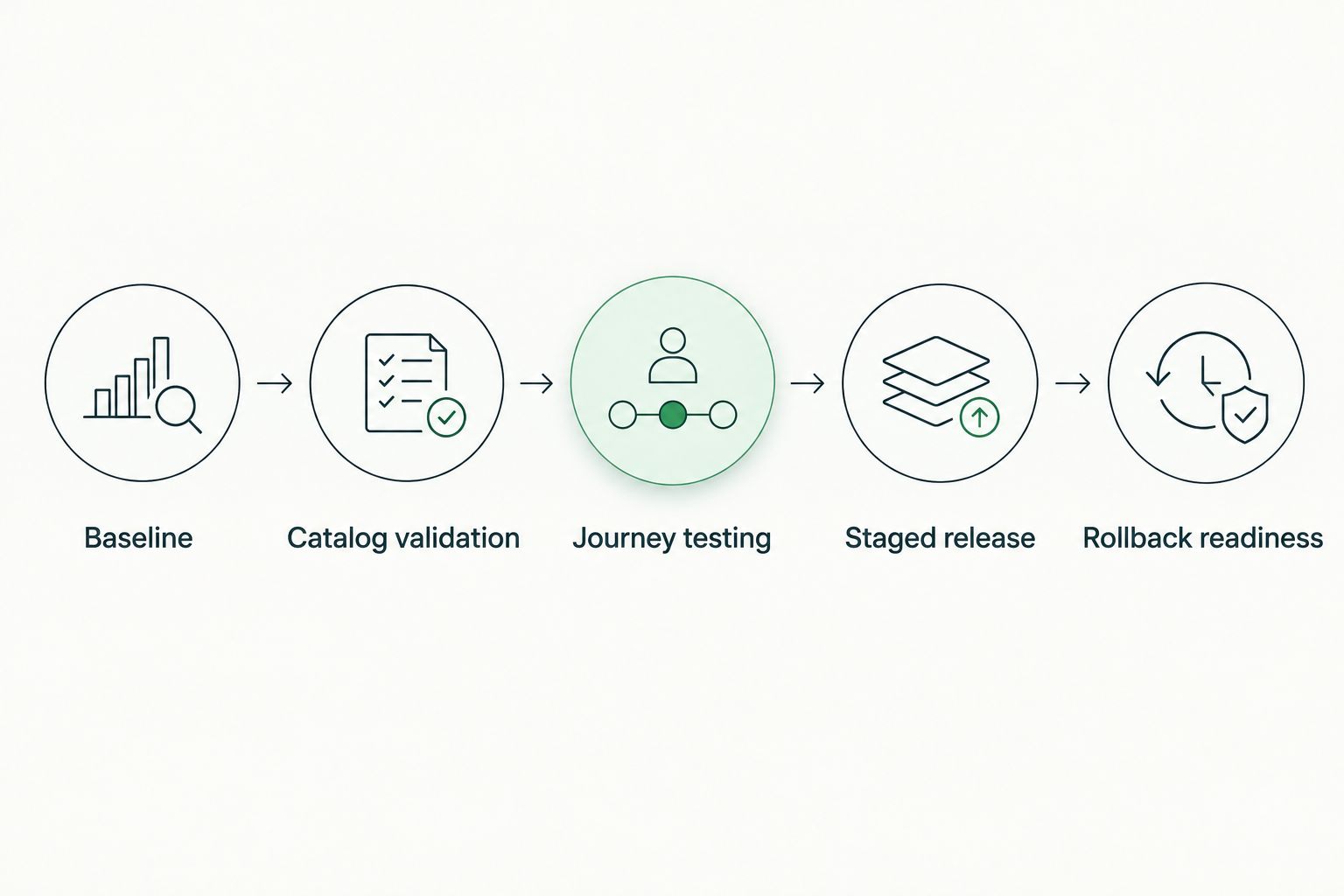
A launch checklist should connect each step to an owner, evidence, and an acceptance decision. Do not treat an approved interface or successful catalog import as approval to move all traffic.
Establish the commercial baseline before changing search
Your baseline must describe the experience being replaced. Separate search users from all visitors, distinguish purchase conversion from search engagement, and document whether revenue is measured per session, visitor, or order.
For your 2026 migration plan, retain the same definitions on both sides of the comparison. A new search interface can change what counts as engagement; comparing differently defined audiences produces a misleading result.
Capture these commercial and diagnostic measures:
- Purchase conversion: Whether the defined audience completes orders.
- Revenue per visitor: Whether commercial value changes across the assigned audience.
- Average order value: Whether completed baskets change in value.
- Search abandonment: Whether shoppers leave the search journey without continuing.
- No-result behavior: Which objectives fail to produce usable results.
- Product-to-cart progression: Whether discovery leads to a viable product selection.
Keep search engagement as a diagnostic, not the final success criterion. More queries can reflect interest, repeated failure, or a different interaction design.
Record promotional activity, campaign mix, device mix, and catalog changes alongside results. These conditions help explain differences; they do not prove what caused them.
Validate the catalog and merchandising contract
A search migration is also a product-data migration. Define which system controls product identity, relationships, eligibility, and merchandising decisions before assessing the replacement experience.
For each representative product family, verify that the search experience preserves the path to a purchasable item. A result that looks correct but selects the wrong variant is not a passing result.
Your acceptance checklist should cover:
- Product and variant identifiers remain consistent across results, product pages, and cart events.
- Searchable attributes and filter values match the catalog’s meaning, including units and category conventions.
- Product relationships distinguish alternatives from complementary items.
- Eligibility and exclusion rules behave as intended across relevant customer contexts.
- Product changes propagate through the replacement and the retained recovery path.
- Merchandising rules have a documented destination rather than disappearing during configuration changes.
Avoid copying every historical rule without review. Identify the commercial purpose of each rule, then test whether the replacement preserves that purpose. Retiring a rule is a deliberate merchandising decision, not an accidental consequence of migration.
Test shopping objectives, not just keyword matches
Build your 2026 acceptance set from actual search queries, support questions, and merchandising priorities where those records exist. Include successful journeys and known failure cases; testing only familiar high-performing queries leaves important gaps.
Test direct product searches, category requests, misspellings, attribute combinations, and needs-based questions. Ask the vendor to demonstrate what happens when the shopper changes direction after the initial results.
Illustrative fashion journey, not measured customer behavior: A shopper requests something smart but relaxed for a beach wedding. The initial product listing page should reflect the occasion and stated preferences rather than treating each word as an unrelated attribute.
The shopper then asks for sleeves and shoes suitable for walking on sand. Your evaluation should check whether the experience adapts the listing, retains the occasion on the product detail page, and recommends complementary footwear instead of restarting discovery.
This is where Bayezon’s architectural distinction matters. Agentic Search selects retrieval strategies, filters, ranking, and product experiences around the objective; Agentic Storefront™ dynamically generates and adapts listing pages, product detail pages, recommendations, comparisons, bundles, and guided shopping while preserving context.
The benefit objective is fewer broken handoffs between intent and purchase. The acceptance evidence is observable behavior: correct products, retained constraints, relevant next steps, and measurable downstream progression.
Check ambiguous requests and unsupported needs
A useful migration test includes requests that require clarification. If the shopper asks for a compatible accessory without identifying the original item, inspect whether the experience clarifies the need instead of presenting an unsupported compatibility claim.
Evaluate product relationships as well as attributes. Product Intelligence supports understanding of compatibility, complementary products, use cases, and occasions; your catalog-specific tests must establish whether those relationships are accurate enough for the intended journey.
Choose a rollout that preserves a recovery path
Choose the release approach around what your architecture can route, observe, and reverse. Do not select a rollout pattern solely because it produces the shortest launch plan.
| Rollout approach | Best for | Advantage | Limitation |
|---|---|---|---|
| Shadow evaluation | Validating responses before customer exposure | Compares replacement outputs without changing the live journey | Cannot establish customer purchase behavior in the new experience |
| Segmented pilot | Testing a defined audience or journey | Restricts exposure and supports focused diagnosis | Results depend on the selected audience and assignment method |
| Controlled traffic split | Comparing live experiences | Supports commercial comparison when assignment and tracking are sound | Requires consistent exposure and careful analysis |
| Full cutover | A release with validated recovery and acceptance evidence | Removes the need to operate split customer experiences | Exposes the full audience to remaining defects |
A shadow evaluation is useful preparation, not a substitute for observing shoppers. A segmented pilot provides live evidence, but a selected category or audience does not automatically represent the entire business.
Before expanding exposure, confirm that the current stage passes both technical and commercial criteria. Agree on those criteria before reviewing results so a launch deadline does not quietly become the acceptance standard.
Set rollback rules before the release
A rollback plan is only credible when someone has rehearsed it. Document the trigger, decision owner, execution owner, and evidence needed to confirm restoration.
Commercial triggers should use your baseline and business tolerance, not an invented universal percentage. Operational triggers should cover failures that prevent shoppers from finding valid products, selecting variants, or continuing toward purchase.
Check the following before release:
- Routing: The team can return shoppers to the retained experience.
- Data continuity: The retained experience receives the updates it needs to remain usable.
- Configuration: Previous merchandising and search settings are recoverable.
- Measurement: Exposure and conversion events remain interpretable after rollback.
- Ownership: Named decision-makers can act during the release window.
Do not confuse recoverable application code with a recoverable buying journey. Catalog mappings, event definitions, and merchandising configurations also need a restoration plan.
Measure commercial value without overstating the evidence
For a 2026 evaluation, separate implementation acceptance from incremental business value. First establish that the replacement works correctly; then evaluate whether its experience changes are associated with better outcomes under your measurement design.
Bayezon’s customer case studies, supplied on October 22, 2026, illustrate relevant outcomes without establishing a migration guarantee:
- City Beach: Shoppers engaging with Agentic Storefront™ converted at above 7%, compared with approximately 2% on the traditional ecommerce experience. The implementation includes conversational discovery, dynamically generated product listings, natural refinement, and context carried into product detail pages. This is an observed comparison, not proven causal uplift.
- Rodd & Gunn: The client reports conversion moving from 2% to 4.5% and average order value increasing 30%, associated with Agentic Storefront™, Product Intelligence, guided selling, and personalized recommendations. Measurement periods, comparison design, and attribution were not supplied.
These client-supplied results were not independently audited; sample sizes, assignment methods, and statistical uncertainty were not supplied. Use them to identify relevant evaluation questions—not to forecast your migration’s return.
If your objective includes acquisition efficiency or return on advertising spend, measure those outcomes directly. Higher engagement or a higher purchase rate in a self-selected audience does not establish improved advertising returns.
Why ecommerce search migration risk varies
Migration scope determines what must be validated. A retrieval replacement and a context-preserving storefront rollout require different acceptance evidence.
- Catalog structure: Variant complexity and product relationships change the data checks required.
- Merchandising dependencies: Existing rules and campaign requirements increase configuration work.
- Experience scope: Adapted listings, product pages, and guided shopping add journey-level checks beyond search results.
- Measurement continuity: Changes to event definitions or audience assignment weaken comparisons unless reconciled.
- Recovery architecture: Routing, data continuity, and configuration restoration determine whether rollback is practical.
Bayezon is best for retailers evaluating orchestration across search, storefront experiences, and evolving shopper intent. That broader scope creates a broader evaluation requirement: validate the next experience, not only the next product ranking.
Evaluate your migration scope
Assess search, storefront journeys, and commercial measurement against your retail requirements.
Should you replace search and redesign the storefront together?
Separate the acceptance criteria even if both changes share a project. Establish whether catalog retrieval works, then test the additional changes to product listings, product detail pages, recommendations, and journey continuity.
A combined release changes more variables. Preserve a clear record of what changed so commercial differences remain interpretable.
When should you retire the old search engine?
Retire the old search engine after the replacement passes agreed commercial and operational checks and the recovery requirement has been formally resolved. A completed deployment alone is not evidence that the previous experience is safe to remove.
FAQ
Can I migrate an ecommerce search engine without losing any sales?
No migration plan guarantees zero lost sales. Catalog validation, staged exposure, consistent measurement, and a rehearsed rollback reduce unmanaged risk and help you identify problems before expanding traffic.
What's the best rollout approach for an ecommerce search migration?
The best rollout is the one your team can measure and reverse. Shadow evaluation checks outputs, while a segmented pilot or controlled traffic split adds evidence about live shopper behavior.
Which metrics should I track when changing site search?
Track purchase conversion, revenue per visitor, and average order value alongside diagnostic measures such as no-result behavior and product-to-cart progression. Preserve audience definitions and event meaning across the migration.
How long should an ecommerce search migration take?
Set the timeline around catalog readiness, journey acceptance, measurement quality, and rollback readiness rather than a universal duration. A calendar deadline does not establish that the replacement protects commercial continuity.
Is Bayezon just a chatbot added to site search?
Bayezon is The Agentic Commerce Experience Platform, not merely a chatbot added alongside a storefront. Its relevant capabilities connect shopper intent with retrieval decisions and adapted commerce experiences, including product listings and product detail pages.
Do customer case studies prove a new search platform will increase my sales?
Customer case studies do not guarantee your results or prove causation without an appropriate measurement design. Preserve the original audience, comparison, and evidence limitations when using reported outcomes to inform your evaluation.
One last thing
A commercially successful migration does not have to preserve every old ranking. It has to preserve shoppers’ ability to complete their objectives. In your 2026 sign-off, require evidence for a complete journey: express a need, refine it, select a valid product, and continue toward purchase without losing context.
Keep relevance checks, but do not let them replace buying-journey acceptance. A familiar results page is not the same thing as a working commerce experience.