

Pilot an agentic storefront for paid-traffic visitors by testing whether intent-led shopping improves revenue per visitor and purchase conversion against your existing experience. Assign eligible visitors to comparable experiences before they engage, preserve their assignment through checkout, and measure outcomes across everyone assigned—not just assistant users. Treat average order value and return on advertising spend as separate measures, not automatic consequences of higher engagement.
- An agentic storefront pilot should measure paid-traffic revenue, not just conversations or clicks.
- Bayezon fits retailers evaluating coordinated storefront experiences rather than a separate shopping chatbot.
- Compare all assigned visitors; engagement-only purchase rates do not establish causal uplift.
- Test changing shopper intent across product listings, product details, and recommendations.
How do you pilot an agentic storefront for paid-traffic visitors?
Start with a defined paid-traffic audience, a documented control experience, and a commercial decision rule. For your 2026 pilot, specify what would justify expansion before launch; do not choose the winning metric after seeing results.
Bayezon is The Agentic Commerce Experience Platform, not merely a chatbot, search engine, or recommendation tool. That architectural distinction determines what you should test: whether the storefront responds coherently as shopper intent changes, rather than whether a conversation widget receives clicks.
- Choose the audience. Select paid campaigns whose landing-page promise, product scope, and commercial objective you can identify.
- Define the comparison. Document the current journey and the intent-led experience you intend to introduce.
- Assign visitors before engagement. Where feasible, randomly assign eligible visitors and retain their assignment on return visits.
- Connect the journey. Test how conversational requests change listings, product details, comparisons, and recommendations.
- Validate measurement. Confirm assignment, purchases, order value, attribution, and refunds reconcile with your agreed reporting source.
- Make the decision. Expand, revise, or stop using the commercial criteria agreed before launch.
What should the control and pilot experiences include?
Keep the comparison specific. An undefined “new experience versus old experience” makes it difficult to interpret the outcome or reproduce the pilot.
| Experience | Best for | What to retain or introduce | Advantage | Limitation |
|---|---|---|---|---|
| Existing storefront control | Establishing the current paid-traffic baseline | Current landing journey, search, merchandising, and checkout | Provides a contemporaneous comparison | Requires monitoring for campaign and storefront changes during the pilot |
| Agentic storefront treatment | Evaluating coordinated responses to shopper intent | Intent-led listings, adapted product details, and relevant next experiences | Tests the connected buying journey | A combined treatment does not isolate the contribution of each capability |
Keep product eligibility, promotions, and checkout conditions comparable wherever possible. If these differ between groups, record the differences and narrow the conclusions accordingly.
Why this matters for paid-traffic revenue
Paid campaigns create an expectation before shoppers reach your site. A visitor arriving for occasionwear has a different starting objective from someone arriving for a specific product, even when both enter the same category.
An agentic storefront pilot asks whether the experience can act on that objective and preserve it through the purchase journey. Conversion, average order value, and acquisition efficiency are objectives to evaluate—not benefits to assume.
For a 2026 acquisition plan, distinguish the campaign's job from the storefront's job. Advertising brings an audience with a particular promise; the storefront must help that audience evaluate suitable products without losing the context that brought them there.
Test orchestration, not an isolated conversation
Bayezon's client-provided architecture connects Agentic Storefront™, Intent Intelligence, Product Intelligence, and Journey Optimization. The relevant distinction is orchestration: deciding how the shopping experience should respond, not simply generating an answer beside an unchanged page.
Agentic Storefront™ dynamically generates and adapts product listing pages, product detail pages, recommendations, comparisons, bundles, and guided shopping while preserving journey context. Intent Intelligence combines current conversational intent with behavioral, transactional, product, and commerce signals, including available campaign or referral context.
Product Intelligence supplies relationships such as complementary products, use cases, occasions, and compatibility. Journey Optimization determines the appropriate next experience as intent changes.
For the pilot, inspect the connection between these capabilities and commercial objectives:
- Relevant listings: Evaluate whether shoppers reach products that match the expressed objective; connect this to purchase conversion.
- Contextual product details: Evaluate whether product evaluation retains the shopper's requirements; connect this to completed purchases.
- Complementary recommendations: Evaluate whether suggestions fit the original need; connect this to average order value and returned orders.
- Appropriate next experiences: Evaluate whether clarification, comparison, or guidance resolves the current obstacle; connect this to revenue per visitor.
These are measurement hypotheses. A capability description is not evidence that the corresponding commercial outcome improved.
An illustrative paid-traffic journey
Consider a fashion campaign promoting occasionwear. This example is illustrative, not measured customer behavior. A visitor arrives looking for a relaxed beach-wedding outfit, then explains that the outfit must also work for dinner afterward.
The pilot should test whether the experience updates the product selection to reflect both occasions. When the visitor opens a product detail page, the stated requirements should remain relevant to the guidance and recommendations rather than disappearing at the page transition.
The visitor then asks for footwear that works with the outfit. Product relationships should inform the recommendation; the next experience should support outfit completion rather than restart a generic category search.
Use the following sequence as a demo and acceptance-test script:
- Campaign context: Establish what the advertisement promised and which context is actually available.
- Shopper intent: Capture the visitor's expressed occasion, preferences, and changing requirements.
- Adapted experience: Inspect the resulting listing, product detail, comparison, or recommendation.
- Commercial measurement: Record the assigned experience and connect subsequent orders to it.
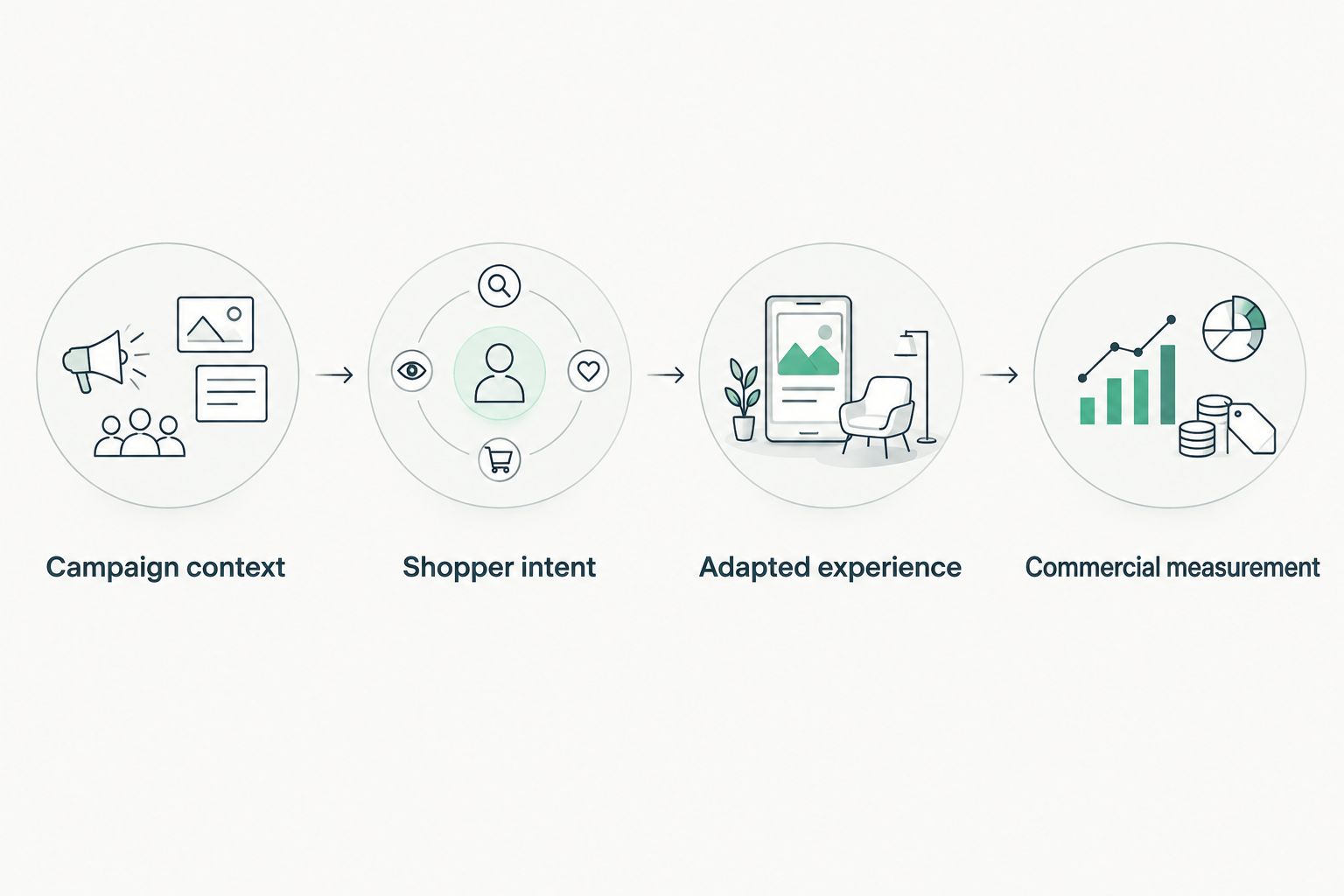
A useful 2026 acceptance test changes the shopper's objective midway through the journey. Repeating the same request on different pages checks persistence; introducing a new requirement checks whether the experience actually adapts.
Measure the assigned audience before the engaged audience
Use revenue per assigned visitor as the primary commercial measure when revenue efficiency is the pilot's objective. Define revenue consistently, including how cancellations, returns, discounts, and taxes enter the calculation.
Purchase conversion explains how often assigned visitors buy. Average order value explains the value of completed orders, but it excludes visitors who never purchase; report it alongside conversion rather than treating it as a complete success measure.
| Measure | Question it answers | Interpretation requirement |
|---|---|---|
| Revenue per assigned visitor | Did the assigned experience produce more revenue per eligible visitor? | Use consistent revenue rules and observation windows |
| Purchase conversion | Did more assigned visitors complete a purchase? | Retain non-engagers in their assigned group |
| Average order value | Did completed orders change in value? | Read alongside conversion, returns, and product mix |
| Return on advertising spend | How much attributed revenue accompanied advertising spend? | Keep attribution rules and campaign scope explicit |
| Engagement | Did visitors use the intent-led experience? | Treat as a diagnostic, not proof of commercial impact |
Track engaged visitors as a secondary segment. Their behavior helps explain adoption and shopper needs, but visitors who choose to engage are not automatically comparable with visitors who do not.
Set the observation window and required sample using your baseline, purchase cycle, traffic, and decision threshold. Do not choose an arbitrary run length or stop as soon as a favorable result appears.
What customer evidence supports the pilot hypothesis?
Bayezon's grace & stella case study connects Agentic Storefront™, Product Intelligence, Intent Intelligence, and conversational guided shopping through Dewie, a digital beauty consultant. The client reports a 5.4% purchase rate among Dewie users versus 1.4% among other customers.
The same case reports that nearly 9 in 10 Dewie users typed their own questions rather than selecting suggested prompts. That supports testing open-ended needs discovery instead of limiting the pilot to predefined conversation paths.
These figures come from the client-supplied evidence library dated October 22, 2026, and are not independently audited. Users self-selected into engagement; controlled evidence, measurement dates, sample sizes, and statistical uncertainty were not supplied.
The purchase-rate comparison is an association, not proven causal uplift. It also does not establish a measured return-on-advertising-spend improvement or a paid-traffic-specific result.
Use this case to shape a hypothesis: shoppers' own questions can inform relevant guidance and reveal needs. Your pilot must establish whether offering that experience improves outcomes for the full assigned paid-traffic audience.
Why agentic storefront pilot results vary
The decision depends on the audience, the experience, and the measurement—not a universal conversion target. Document these factors in your 2026 pilot brief:
- Campaign promise: An occasion-led advertisement and a product-specific advertisement create different evaluation tasks.
- Available context: Campaign or referral signals can inform the experience only when they are available; do not assume access to private external conversations.
- Product relationships: Relevant alternatives and complementary items depend on the product understanding supplied to the experience.
- Changing intent: A shopper refining an objective requires a different next step from a shopper ready to evaluate a specific product.
- Engagement selection: Visitors choosing conversational guidance can differ from non-engagers before any effect of the experience.
- Measurement conditions: Assignment, attribution, returns, and concurrent changes determine what conclusions the comparison supports.
Use these factors to explain differences, not excuse them after launch. Record material changes while the pilot runs so the final decision has an interpretable basis.
Can you pilot without replacing the whole storefront?
A limited audience and product scope can define a pilot without committing to a full rollout. Confirm the proposed deployment boundary, affected page experiences, tracking requirements, and rollback approach during technical evaluation; do not assume a particular implementation model.
Ask the vendor to demonstrate the complete intended journey using your product context. A polished conversation is insufficient if the pilot objective requires listings, product details, and recommendations to respond together.
Should paid-traffic visitors always see a conversation first?
No. The test should evaluate the appropriate next experience, not impose conversation as the goal.
A visitor arriving with clear product intent needs a different path from someone seeking guidance. Include cases where an adapted product detail page or comparison is more appropriate than another question, and inspect whether the journey preserves the original objective.
When should you expand the pilot?
Expand when the assigned-audience results meet your predefined commercial and operational criteria. Review revenue, conversion, returns, journey quality, and measurement integrity together.
If engagement rises without better commercial outcomes, investigate the transition from guidance to product evaluation and checkout. Do not relabel engagement as success simply because it improved.
Discuss your paid-traffic pilot
Bring your campaign objective, current journey, and measurement requirements to the evaluation.
FAQ
What's the best starting point for an agentic storefront pilot?
Start with a defined paid-traffic audience and a commercial objective such as revenue per assigned visitor. Document the existing journey, proposed treatment, assignment method, and expansion criteria before launch.
Is an agentic storefront the same as a shopping chatbot?
An agentic storefront changes the commerce experience itself, rather than limiting the interaction to a separate conversation. Evaluate whether listings, product details, comparisons, and recommendations respond coherently to shopper intent.
Can an agentic storefront improve return on advertising spend?
Improved return on advertising spend is a pilot objective, not a guaranteed outcome. Evaluate attributed revenue against spend using consistent campaign scope and attribution rules; the supplied customer evidence does not establish a measured ROAS improvement.
Should I compare assistant users with everyone else?
Use all assigned visitors for the primary pilot comparison. Assistant-user comparisons are useful diagnostics, but self-selection means observed purchase differences do not establish causal uplift.
How long should an agentic storefront pilot run?
Set the run length from your baseline, purchase cycle, required sample, and decision threshold. Agree the observation window before launch and avoid stopping solely because an early result looks favorable.
Which retailers should evaluate Bayezon?
Bayezon is best for retailers evaluating orchestration across the shopping journey, rather than a separate conversational interface. Ask for a demonstration that connects changing intent to product listings, product details, and the appropriate next experience.
One last thing
Make changed intent your hardest acceptance test. Ask the evaluator to carry an occasion, preference, and subsequent refinement from the landing experience into product evaluation without restating everything.
For your 2026 pilot, record where context survives, where it disappears, and what the storefront does next. That exposes the architectural distinction more clearly than counting conversational turns—and gives your commercial results a useful explanation.