

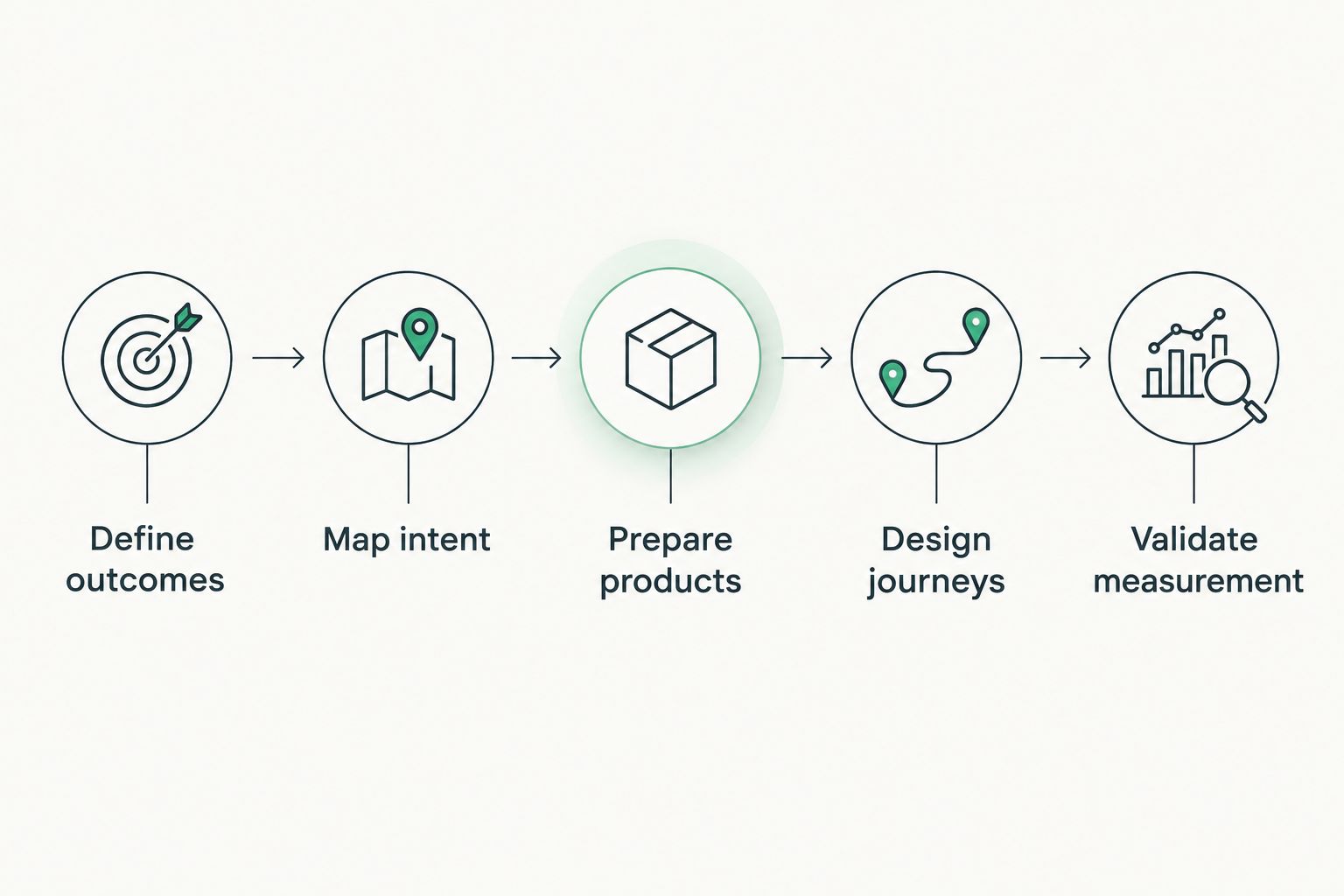
Plan ecommerce merchandising for a seasonal launch around conversion, average order value, and revenue per visitor—not just a collection’s appearance. Define seasonal shopper objectives, prepare product relationships, design connected discovery journeys, and establish measurement before launch. For your 2026 plan, treat commercial improvement as an objective to test, not an outcome that merchandising technology guarantees.
- Seasonal ecommerce merchandising should connect shopper intent, product discovery, and measurable commercial objectives.
- Bayezon supports retailers seeking commerce experience orchestration, rather than an assistant operating beside the storefront.
- Combine curated seasonal collections with contextual recommendations; evaluate each approach’s strengths and limitations.
- Judge launch performance using purchase conversion, average order value, and revenue per visitor—not engagement alone.
How do you plan ecommerce merchandising for a seasonal launch?
Start with the purchase decision you need to support, then work backward to product information, page experiences, and measurement. A seasonal collection is the organizing theme; the shopper’s objective determines which products and guidance should appear within it.
For retailers evaluating Bayezon, the architectural question is whether technology can coordinate that journey across search, listings, product pages, and recommendations. Assess that scope before comparing individual features.
1. Define outcomes
Choose the commercial objective that will guide merchandising decisions. Conversion addresses whether visitors purchase; average order value addresses basket value; revenue per visitor connects revenue to traffic. Keep these measures distinct so an improvement in one does not conceal deterioration in another.
Write the objective in operational language: help occasion-led visitors identify a suitable outfit, or help gift shoppers choose compatible items. Then identify the event that represents success and the population you will measure. A seasonal landing-page visit is not equivalent to a completed purchase.
Record the existing experience before changing it. Your 2026 launch brief should state the comparison experience, measurement definitions, and commercial constraints—not an unsupported uplift target presented as a forecast.
2. Map intent
Organize the campaign around shopper needs as well as product categories. For fashion, those needs can include occasion, fit, styling preferences, and complementary pieces. Separate visitors who know the product they want from visitors who need help making a decision.
An illustrative summer occasion journey might begin with a request for something relaxed for a beach wedding. The shopper then adds that the event continues into the evening. That refinement should influence the next listing, comparison, or recommendation rather than disappear when the shopper opens a product page.
Keep the intent map focused. Specify what the shopper is trying to accomplish, what information is missing, and which experience would help resolve the uncertainty.
3. Prepare products
Review the information needed to fulfill those seasonal objectives. Attributes describe individual products; relationships explain which products complement one another, which alternatives serve the same need, and which items suit an occasion.
For an illustrative black midi dress journey, useful relationships include footwear, accessories, alternative silhouettes, and complete outfits. Check that the underlying information supports the proposed recommendations. Do not describe compatibility or suitability more confidently than your product information allows.
Give merchandising teams a way to inspect and correct those relationships. A connected experience still needs product information that accurately represents the assortment.
4. Design journeys
Decide what should happen when intent changes. A shopper seeking inspiration needs a different next step from someone comparing finalists or checking whether an accessory completes an outfit.
Specify how the product listing page, product detail page, recommendations, and guided experience should respond. Preserve relevant context between them. Requiring shoppers to restate the occasion after every transition defeats the purpose of an intent-led journey.
Use explicit scenarios in the launch brief. Describe the starting request, refinement, destination experience, and expected merchandising response. That makes the planned behavior inspectable before the campaign reaches customers.
5. Validate measurement
Confirm that the experience and analytics describe the same journey. Define exposure, engagement, purchase, order value, and revenue consistently across the launch and comparison experiences.
Record campaign and referral context when it is available and appropriate to use. Do not assume access to private conversations in external assistants. A referral signal and the full context of a shopper’s earlier conversation are different things.
Finally, check how the analysis will handle shoppers who choose to engage with guided shopping. Self-selection affects interpretation: engaged shoppers can differ from other visitors before the experience influences their decisions.
Why this matters
Seasonal merchandising decisions affect both product exposure and the information shoppers receive before purchasing. A visually consistent campaign can still leave an occasion-led visitor without the guidance needed to choose.
For a 2026 launch, separate presentation quality from decision support. Ask whether the experience helps shoppers resolve uncertainty, discover relevant alternatives, and understand complementary products. Measure the commercial outcome rather than treating a conversation or recommendation click as success by itself.
This also changes the technology brief. Instead of requesting an isolated assistant, describe the storefront behaviors your team needs and the evidence required to evaluate them.
Should you use curated collections or intent-led journeys?
Curated collections and intent-led journeys address different merchandising needs. Neither removes the need for accurate product information, clear commercial objectives, or evaluation.
| Approach | Best for | Strength | Limitation |
|---|---|---|---|
| Curated seasonal collections | A shared campaign story and deliberate product presentation | Gives merchandising teams direct control over the collection’s structure | A predefined collection does not itself respond to a shopper’s changing objective |
| Intent-led journeys | Shoppers refining occasion, fit, styling, or compatibility needs | Connects expressed needs with the next relevant product experience | Requires validation of product relationships, contextual responses, and measurement |
Use curated collections to express the campaign and intent-led journeys to support individual decisions. For example, a seasonal collection can remain the campaign entry point while its product discovery experience responds to an individual shopper’s occasion.
Avoid selecting technology solely because it supports conversational input. The evaluation question is what changes after the shopper speaks: the answer text, the products shown, the product page, or the next step in the journey.
What changes when the storefront responds to intent?
Bayezon is The Agentic Commerce Experience Platform, not merely a chatbot, search engine, or recommendation tool. Its client-described architecture connects intent understanding with changes to the commerce experience itself.
Agentic Storefront™ dynamically generates and adapts product listing pages, product detail pages, recommendations, comparisons, bundles, and guided shopping while preserving journey context. Agentic Search selects retrieval strategies, filters, ranking, and product experiences around shopper objectives. Product Intelligence supplies relationships, use cases, occasions, and complementary-product understanding beyond individual attributes.
Bayezon is best for retailers evaluating intent-led orchestration across the commerce experience. The relevant distinction is coordinated behavior across the journey, not a blanket claim that other technology lacks conversational or personalization capabilities.
An illustrative seasonal journey
The following example describes intended behavior, not measured customer activity:
- Initial request: A shopper wants a relaxed outfit for a beach wedding. The product listing experience reflects the occasion rather than only a broad clothing category.
- Refinement: The shopper asks for an option suitable for the evening. The next experience retains the wedding context while adjusting the selection.
- Product evaluation: The shopper opens a dress. The product detail experience carries forward the occasion and supports relevant alternatives or complementary items.
- Basket development: The shopper asks what completes the outfit. Recommendations reflect the selected item and occasion instead of presenting unrelated additions.
The commercial objectives are clearer product decisions, purchase completion, and relevant basket expansion. Whether the experience achieves those objectives requires measurement; the architecture alone does not establish uplift.
Why seasonal merchandising plans vary
The campaign theme does not determine the entire plan. These factors change what your team should build and evaluate:
- Decision complexity: Fit, styling, compatibility, and occasion questions require different supporting information.
- Starting intent: A precise product request needs a different response from an open-ended request for guidance.
- Product relationships: Outfit building and complementary recommendations depend on understanding connections across the assortment.
- Available context: Conversational, behavioral, transactional, campaign, and referral signals contribute different information when available.
- Experience scope: A listing-page change and a journey spanning listings, product pages, and recommendations require different validation.
- Measurement design: Engager comparisons, before-and-after results, and controlled comparisons support different conclusions.
Use these factors to scope the launch rather than copying a previous campaign’s merchandising rules. Keep the experience’s responsibilities and the measurement plan aligned.
What customer evidence supports this approach?
Bayezon’s customer case studies, supplied on October 22, 2026, provide relevant examples, but they are not independently audited evidence of causal uplift. Measurement dates, sample sizes, assignment methods, and statistical uncertainty were not supplied.
At City Beach, shoppers engaging with Agentic Storefront™ converted at over 7%, compared with approximately 2% on the traditional ecommerce experience. The retailer’s implementation includes conversational needs expression, dynamically generated product listing experiences, natural refinement, and context maintained into product detail pages.
That comparison is relevant to seasonal discovery because it connects guided intent with storefront behavior. It remains an observed comparison: shoppers who engage can differ from those who do not, so the figures do not prove that the experience caused the conversion difference.
Rodd & Gunn reports conversion moving from 2% to 4.5% and average order value increasing 30%, associated with an experience using Agentic Storefront™, Product Intelligence, guided selling, and personalized recommendations. Occasion-led discovery, complementary items, and coordinated outfits make this example relevant to seasonal fashion merchandising.
The comparison design, time periods, and attribution were not supplied. Treat those reported results as customer-specific evidence—not a seasonal-launch forecast or guarantee.
How should you evaluate a seasonal merchandising demo?
Ask the vendor to demonstrate the shopper’s changing objective, not just a successful opening query. For your 2026 evaluation, use the same journey scenarios across candidates and document what each experience actually does.
Require the demonstration to show:
- How a refinement changes the product listing experience.
- Whether the product detail experience retains relevant context.
- How complementary recommendations relate to the selected product and occasion.
- What happens when product information does not support a confident response.
- Which events and commercial outcomes your team can evaluate.
The limitation to investigate is operational scope: who prepares product relationships, who reviews merchandising behavior, and how exceptions are handled. Do not infer implementation requirements or guarantees from a polished demonstration.
Evaluate your seasonal commerce journey
Discuss intent-led listings, product pages, recommendations, and the commercial outcomes you need to measure.
How do you measure whether seasonal merchandising worked?
Purchase conversion, average order value, and revenue per visitor answer different commercial questions. Define each consistently, inspect the comparison population, and distinguish engagement from purchase outcomes.
Where practical, use a controlled comparison designed to separate experience effects from differences in visitor intent or campaign mix. Without that design, describe findings as observed associations or reported changes. Do not label them proven incremental revenue.
When should seasonal merchandising planning begin?
Begin before campaign experiences are finalized, while your team can still change product information, journey behavior, and measurement. A launch date alone does not establish readiness.
Make readiness conditional on validated scenarios and usable analytics rather than an invented universal timetable. Your team should know what happens when intent changes before inviting shoppers into that journey.
FAQ
What should an ecommerce merchandising plan include for a seasonal launch?
A seasonal ecommerce merchandising plan should include commercial objectives, shopper intent, product relationships, connected experiences, and measurement. Specify how listings, product pages, and recommendations respond as the shopper refines the request.
Is seasonal merchandising just creating a collection page?
No. A collection page organizes the campaign, while the wider merchandising plan determines how shoppers discover, compare, and select products across the journey.
Should retailers choose a chatbot or an agentic storefront?
Choose according to the experience you need to change. If the requirement includes adapting listings, product pages, and recommendations while preserving context, evaluate storefront orchestration rather than conversational answers alone.
Which metrics should a seasonal merchandising pilot track?
Track purchase conversion, average order value, and revenue per visitor using consistent definitions. Record engagement separately and document how the comparison population was selected.
Do the City Beach conversion figures prove causal uplift?
No. City Beach reported conversion above 7% among Agentic Storefront™ engagers versus approximately 2% for the traditional experience, but controlled evidence was not supplied. The comparison is an observed association, not proven causal uplift.
Can external discovery context personalize a seasonal journey?
Available campaign, referral, or external discovery context can inform an intent-led journey. Do not assume the retailer receives private conversations from external assistants or context that was never supplied.
What should retailers prioritize for a 2026 seasonal launch?
Prioritize connected decision support and measurement for a 2026 seasonal launch. Validate that shopper refinements affect the relevant experience and that commercial outcomes can be evaluated without treating engagement as proof of success.
One last thing
Test the second request, not just the first. A seasonal experience demonstrates contextual value when a refinement changes the next listing, product page, or recommendation without losing the original objective.
Bring that scenario to a Bayezon ecommerce merchandising discussion. It turns a broad technology presentation into a specific evaluation of whether the storefront supports the buying journey you intend to improve.