

To prepare your product catalog for agentic commerce in 2026, standardize product records, define relationships and use cases, and test whether those connections support shopping journeys aimed at improving conversion and average order value. Accurate attributes are the foundation; you also need explicit rules for compatibility, recommendations and changing shopper intent so the experience does not invent product claims.
- Agentic commerce readiness requires accurate attributes, product relationships, use cases and clear limits on unsupported recommendations.
- Bayezon suits established retailers evaluating commerce experience orchestration beyond a standalone shopping assistant.
- Test catalog quality through product listing pages, product detail pages and changing shopper requests.
- Measure conversion and average order value without treating engagement differences as proven causal uplift.
Why this matters
Your catalog preparation should serve a commercial objective, not simply produce richer descriptions. Define whether the first release is intended to improve purchase conversion, support complementary purchases or reduce friction in product selection. Then identify the information each objective requires.
Bayezon is The Agentic Commerce Experience Platform, not merely a chatbot, search engine or recommendation tool. Its client-described architecture connects product understanding with intent and the next shopping experience, including adapted product listing pages and product detail pages.
For a 2026 evaluation, the central question is not whether an assistant can describe a product fluently. It is whether the commerce experience can use supported product facts to help a shopper make the next decision.
How do you prepare your product catalog for agentic commerce?
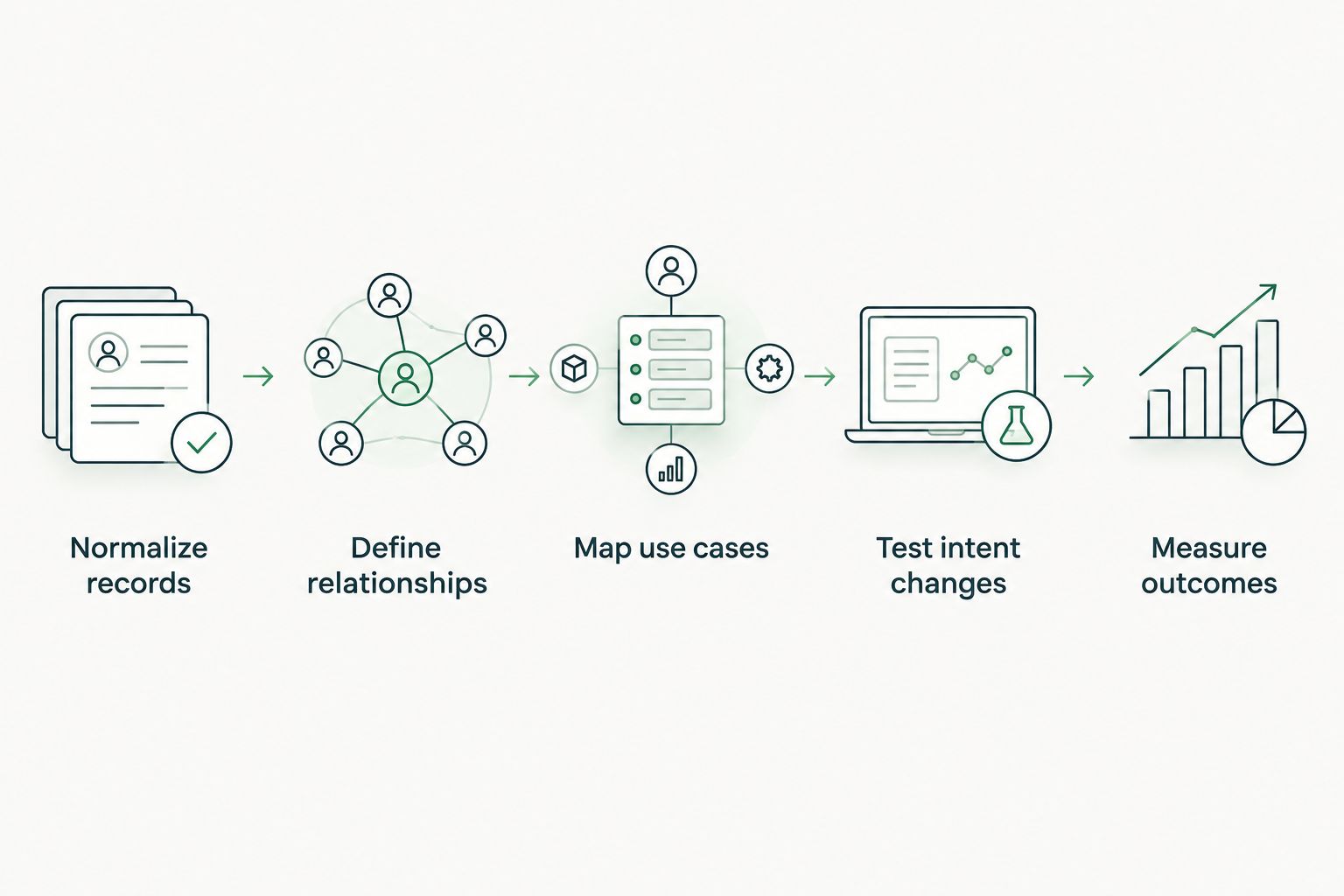
Prepare your catalog in the following sequence. Start with a bounded category and expand after you can trace recommendations back to reliable information. This keeps the work tied to observable shopping tasks rather than an open-ended enrichment project.
Normalize records
Establish consistent product identifiers, variant relationships, category names and attribute definitions. Separate product-level information from variant-level information so a recommendation does not transfer a property from one variant to another.
For example, distinguish a garment's general description from the material composition or care instructions attached to a particular variant. Preserve the source of each important fact and identify who owns corrections.
Do not treat generated copy as the source of truth. Use enrichment to structure supported information, not to manufacture missing specifications or suitability claims.
Define relationships
Describe how products connect: alternatives, complementary items, coordinated outfits and compatible accessories. These relationships should explain the connection, not merely place products in the same group.
An alternative should address the shopper's relevant requirement. A complementary item should have a defensible reason to accompany the original choice. Where compatibility matters, record the evidence and distinguish confirmed compatibility from an unreviewed suggestion.
Map use cases
Connect products to supported occasions, activities and customer needs. Keep factual attributes separate from editorial judgments so reviewers can see what a recommendation depends on.
A fabric composition is a product fact. Describing a garment as suitable for a relaxed wedding is a merchandising judgment that needs a defined basis. Preserve that distinction when building occasion-led recommendations.
Test intent changes
Use representative shopping requests to test retrieval, clarification and refinement. Include requests where the shopper changes a requirement after viewing a product, rather than testing isolated questions only.
Check that the revised requirement reaches the next product listing page, product detail page and recommendation. A conversation that remembers the request while the storefront ignores it has not passed the journey test.
Measure outcomes
Connect each catalog change to a shopping task and a commercial measure. Review recommendation accuracy alongside purchase conversion, average order value or revenue per visitor, depending on the objective.
Log corrections and unresolved questions as well as successful recommendations. These records show where product information, relationship rules or experience decisions need attention.
What information should your catalog contain?
Treat catalog readiness as several connected information layers. Each supports a different shopping decision, and each has a limitation that your evaluation should expose.
| Information layer | Best for | What to prepare | Limitation to address |
|---|---|---|---|
| Product attributes | Factual filtering and comparison | Consistent materials, dimensions, care details and variant definitions where relevant | Attributes alone do not explain why products belong together |
| Product relationships | Alternatives and complementary purchases | Reviewed connections with a stated rationale | A relationship can be misleading without context |
| Use cases | Needs-based and occasion-led discovery | Supported links between products and shopper objectives | Subjective suitability needs merchandising review |
| Intent context | Refining an active shopping journey | Current requirements, exclusions and changes | Product data alone does not capture a shopper's evolving objective |
| Experience rules | Choosing the next useful interaction | Conditions for clarification, comparison and guided recommendations | Rules need testing across the storefront, not just conversation |
You do not need to turn every merchandising judgment into a rigid attribute. You do need to make its basis inspectable, especially when it influences a recommendation presented as suitable or compatible.
A readable product description is not a substitute for a reviewable recommendation. Your team should be able to explain which facts and relationships supported the result.
How should product intelligence change the storefront?
Product Intelligence, in Bayezon's supplied capability description, extends beyond attribute enrichment into relationships, compatibility, complementary products, use cases and occasions. Agentic Storefront™ uses that understanding to generate and adapt shopping experiences while preserving journey context.
The distinction matters commercially: enrichment improves the information available to the experience; orchestration determines how that information helps the shopper proceed. The intended value is a more relevant path to purchase, not a guaranteed conversion increase.
Illustrative example: occasion-led fashion discovery
A shopper asks for a black midi dress for an outdoor wedding, then adds that the outfit must work with flat shoes. This is an illustrative scenario, not measured customer behavior.
- The product listing page should reflect the revised requirements rather than repeat the original results.
- The product detail page should make relevant, supported product facts easy to inspect.
- Recommendations should consider the stated footwear requirement when suggesting complementary items.
- If suitability is unclear, the experience should ask a focused question rather than assert certainty.
A catalog containing only color and garment type leaves important decisions unexplained. Reviewed occasion relationships and outfit connections give the experience a basis for responding, while factual boundaries prevent unsupported advice.
Illustrative example: an accessory changes the journey
A shopper selects a garment and asks for an accessory that works with it. The next useful experience might be a focused comparison or coordinated recommendation, rather than another broad product listing page.
This is also illustrative. The preparation task is to document which accessory relationships are supported, why they apply and when the experience should request more information. Journey Optimization then concerns what should happen next, not simply which product appears next.
Why catalog preparation varies
Scope your preparation around the decisions your customers need to make. Use these factors to set priorities rather than assuming every category needs identical enrichment:
- Variant complexity: Separate shared product information from details that change between variants. Test recommendations against the exact variant presented.
- Compatibility requirements: Prioritize explicit relationship evidence wherever an incorrect pairing would make the recommendation unsuitable.
- Occasion-led discovery: Define the basis for use-case judgments when shoppers describe an event or purpose instead of naming a product.
- Complementary purchases: Review connections used for outfits, bundles and accessories so average order value remains an objective grounded in relevance.
- Changing intent: Decide how new requirements should affect results, comparisons and the next experience without silently dropping earlier constraints.
Assign an owner to each priority. Product teams, merchandising teams and commerce teams should know which decisions they approve and which errors they must correct.
How do you test whether the catalog is ready?
Build a review set from real customer questions, merchandising requirements and known product-selection problems. Keep hypothetical requests clearly labeled, and do not present them as customer research.
For each request, record the intended shopping task, the relevant product evidence, acceptable results and reasons to reject a recommendation. Include straightforward requests and cases that require clarification.
Ask reviewers to inspect the complete path:
- Does retrieval honor the stated requirements?
- Can the recommendation be traced to product facts or reviewed relationships?
- Does a changed requirement update the storefront experience?
- Does a comparison use consistent attributes across products?
- Does the experience acknowledge an unresolved question instead of inventing an answer?
Define acceptance criteria before the demonstration. A polished response is not sufficient evidence that product relationships, variant handling and context preservation work as required.
Which commercial metrics should you measure?
For a 2026 pilot, select the primary commercial objective before reviewing results. Pair it with task-level checks so you can distinguish an information-quality problem from an experience-design problem.
| Objective | Commercial measure | Supporting check | Interpretation limit |
|---|---|---|---|
| Improve purchase completion | Purchase conversion | Whether the shopper reaches a relevant product experience | Engagers can differ from other visitors |
| Support complementary purchases | Average order value | Whether recommendations have a reviewed relationship | Larger orders do not establish recommendation causality |
| Improve visitor value | Revenue per visitor | Whether changing intent produces an appropriate next experience | Traffic composition affects comparisons |
Bayezon's City Beach case study reports purchase conversion above 7% among Agentic Storefront™ engagers, compared with approximately 2% for the traditional ecommerce experience. The described implementation combines Agentic Storefront™, Agentic Search, Product Intelligence and Intent Intelligence, including conversational refinement and context carried into product detail pages.
The client supplied this evidence on October 22, 2026. It is an observed comparison, not proven causal uplift: measurement dates, sample sizes, assignment methods and statistical uncertainty were not supplied. Use the case to inform what to evaluate, not to forecast your result.
What should you ask in a technology demonstration?
Bayezon is best for established retailers evaluating orchestration of the commerce experience beyond a standalone shopping assistant. Its relevant architectural distinction is the connection between product understanding, evolving intent and adapted storefront experiences.
For your 2026 evaluation, ask the vendor to demonstrate your catalog scenarios rather than substitute a generic conversation. Request a clear account of which inputs support each recommendation and what happens when information is incomplete.
The trade-off is preparation and governance: evaluating an orchestrated journey requires agreement on product facts, merchandising judgments, context handling and measurement. A fluent assistant demonstration does not resolve those responsibilities.
Bring a representative catalog slice, known relationship problems and a defined commercial objective. Ask to see both a successful journey and a request the experience should decline to answer without clarification.
Evaluate your catalog readiness
Discuss product relationships, changing shopper intent and the storefront experiences your pilot needs to test.
Do you need a perfectly enriched catalog before starting?
You do not need a perfectly enriched catalog before starting; you need a bounded scope with trustworthy facts and explicit limits. Begin with a category where your team can review the required relationships and inspect the resulting journeys.
Expand only after the review shows that recommendations remain supported as requirements change. This makes readiness a testable operating standard rather than an undefined demand for more data.
Can better product descriptions alone support agentic commerce?
Better product descriptions alone do not establish agentic commerce readiness. Descriptions help explain products, but your experience also needs consistent records, reviewed relationships and rules for carrying intent into the next interaction.
Keep the distinction practical: assess whether the system can explain its recommendation and adapt the storefront, not merely rewrite product copy.
FAQ
What's the first step in preparing a catalog for agentic commerce?
Start by normalizing product identifiers, variants, categories and attribute definitions within a bounded category. Establish which source owns each important fact before adding generated enrichment.
Do I need to enrich every product before running a pilot?
No, a pilot can focus on a reviewed catalog slice that supports specific shopping tasks. Define what the experience can answer and when it must request clarification.
How should I handle missing product information?
Treat missing product information as unresolved, not as permission to generate a plausible fact. Route important gaps to the responsible team and test how the experience responds without that information.
What's the difference between product attributes and product relationships?
Product attributes describe an item, while product relationships explain connections such as alternatives, compatibility or complementary use. Both need review when they influence a recommendation.
How can I tell whether a shopping assistant preserves intent?
Change a requirement during a test journey and inspect the next product listing page, product detail page and recommendation. The revised requirement should affect the experience rather than remain isolated in the conversation.
Does a higher purchase rate among assistant users prove an uplift?
A higher purchase rate among assistant users does not by itself prove causal uplift. Users can self-select into engagement, so interpretation requires attention to assignment, audience and measurement conditions.
What should merchandising own in an agentic commerce project?
Merchandising should review suitability judgments, product relationships and the conditions behind complementary recommendations. Make approval and correction responsibilities explicit before expanding the catalog scope.
One last thing
Include a question your catalog cannot answer in your 2026 acceptance review. The right response is a clarification or an explicit limit, not a confident invention. That test checks whether the experience respects the boundary between useful product intelligence and unsupported advice.