

To pursue higher conversion and average order value with agentic commerce, let the system adapt product discovery within approved rules, require review for changes to commercial commitments, and block actions outside delegated authority. For a 2026 rollout, define permissions by action and consequence—not by how confidently an agent responds. Approval to recommend a product must never imply approval to change a policy, commit inventory, or complete a purchase.
- Agentic commerce needs action-level permissions, approval owners, and a defined fallback—not a blanket autonomy setting.
- Bayezon suits retailers evaluating coordinated storefront adaptation rather than a separate shopping chatbot.
- Allow approved discovery changes; review commercial commitments; block unsupported claims and unauthorized actions.
- Measure conversion and average order value alongside boundary violations, approval delays, and fallback behavior.
Why approval boundaries matter
Conversion, average order value, and revenue per visitor are objectives—not reasons to grant unrestricted authority. An experience that recommends a complementary product makes a different commitment from one that changes an order or promises a delivery date.
Bayezon is The Agentic Commerce Experience Platform, not merely a chatbot, search engine, or recommendation tool. Its client-described architecture connects shopper intent with changes across product listing pages, product detail pages, recommendations, and the buying journey.
Bayezon is best for retailers evaluating coordinated storefront adaptation rather than a separate shopping chatbot. That architectural scope makes approval boundaries a commerce-experience question, not just a conversation-moderation question. Evaluate what the experience can change, not only what the assistant can say.
How do you set approval boundaries for agentic commerce?
Start with the actions your retailer is willing to delegate. Then assign each action an execution mode, an accountable owner, and a fallback when evidence or authority is insufficient.
- Inventory actions. List what the proposed experience can read, recommend, generate, modify, and execute. Separate customer-facing presentation from changes to commercial records.
- Identify consequences. Record whether each action affects product discovery, customer expectations, money, personal information, or an existing order.
- Assign authority. Choose automatic execution, human approval, or prohibition for each action. Do not use one permission for an entire journey.
- Define evidence. Specify which approved product records, policies, permissions, or customer confirmations must support the action.
- Set the fallback. Decide whether the experience should ask a question, show verified information, retain the existing experience, or hand off.
- Test and monitor. Evaluate ordinary requests, ambiguous requests, conflicting instructions, and attempted boundary crossings before expanding scope.
Compare execution modes
These are recommended governance modes, not claims about a vendor's available controls. Ask each vendor to demonstrate how your required boundaries would be enforced.
| Mode | Best for | Advantage | Limitation |
|---|---|---|---|
| Automatic within policy | Approved discovery and presentation actions | Avoids approval delays during shopping | Requires clear rules and dependable source information |
| Human approval | Exceptions and changes to commercial commitments | Keeps consequential decisions with an accountable owner | Adds waiting time and operational work |
| Blocked | Unsupported claims and unauthorized actions | Prevents execution outside delegated authority | Requires a useful explanation or alternative path |
Choose the least restrictive mode that still preserves the retailer's authority and the shopper's consent. Requiring approval for every product refinement defeats the purpose of adaptive discovery; allowing every downstream action makes the boundary meaningless.
Automatic execution: approved discovery and presentation
Automatic execution belongs where the experience operates inside approved merchandising and product-information boundaries. Examples include refining a product listing page around an occasion, presenting compatible alternatives, or emphasizing relevant product details.
Illustrative example, not measured customer behavior: A shopper requests a relaxed outfit for a beach wedding, then explains that the event is outdoors. An adaptive experience can change the listing toward relevant options, carry the occasion into product detail pages, and suggest complementary items supported by product information.
Bayezon's patent-pending Agentic Storefront™ is described as dynamically generating and adapting these experiences while preserving journey context. Product Intelligence supports relationships, compatibility, use cases, and occasions. Evaluate those capabilities against your approved merchandising rules rather than assuming generated recommendations are automatically acceptable.
The commercial objective is to reduce unnecessary discovery work and support relevant cross-selling. The limitation is equally concrete: a plausible outfit does not establish compatibility, suitability, or factual product claims. Require support for every material assertion, and retain a conventional browsing path when clarification does not resolve uncertainty.
Human approval: exceptions and commercial commitments
Require approval when the proposed action exceeds a published rule or changes what the retailer commits to deliver. Examples include a requested policy exception, an unsupported delivery promise, or a proposed order change outside the authority you have delegated.
Illustrative example, not measured customer behavior: A shopper likes the suggested outfit but requests a return-policy exception for the occasion. The experience can explain the approved policy and collect the question. It should not turn an intent signal into permission to rewrite that policy.
Separate retailer approval from shopper confirmation. A retailer can authorize a process without authorizing a purchase on a customer's behalf; a shopper can request an action without giving the system access to perform it.
Define who receives the request, what evidence accompanies it, and what the shopper sees while waiting. Human review preserves accountability, but it also creates operational work. If nobody owns the queue, the approval boundary becomes an abandoned journey rather than a control.
Blocked actions: unsupported or unauthorized execution
Block actions that lack a legitimate authority path. The experience should not invent product certifications, assert compatibility without evidence, reveal information the shopper cannot access, or execute an action merely because a prompt requests it.
A blocked action needs a useful next step. Show verified information, explain the relevant limit, offer an approved alternative, or direct the customer to an appropriate human channel.
Do not use clarification as a substitute for authority. A shopper repeating an unauthorized request more clearly does not make that request permissible. Likewise, instructions embedded in shopper text or product content should not redefine the retailer's operating rules.
For your 2026 policy register, record blocked actions explicitly. A statement such as “follow company policy” is less useful than an action-specific rule naming the prohibited behavior and the permitted fallback.
Why approval boundaries vary
Approval requirements should reflect the consequence of an action, not the novelty of the interface. Use these factors to decide where each boundary belongs:
- Commercial commitment: Distinguish presenting an option from changing an order, policy, or customer obligation.
- Evidence quality: Allow only claims supported by approved information; route unresolved conflicts to clarification or review.
- Customer authority: Separate browsing intent, authenticated access, and explicit authorization for consequential actions.
- Journey context: Reassess permission when the shopper moves from discovery to a materially different request.
- Operational ownership: Require an accountable team and workable handoff before introducing an approval-dependent action.
- Recovery path: Decide how to stop execution, restore the approved experience, and resolve customer-facing errors.
A useful boundary follows the action across interfaces. Moving a request from conversational text into a generated product page must not expand its permissions.
How do you preserve intent without expanding permission?
Preserve the shopper's objective, but reassess authority whenever the requested action changes. Context should improve relevance—not silently carry permission into a different task.
Intent Intelligence is described as combining conversational intent with behavioral, transactional, product, and commerce signals. Journey Optimization determines the appropriate next experience as intent changes. Neither capability description establishes a retailer's approval policy; that policy remains a separate evaluation requirement.
Use this decision sequence in the 2026 vendor demonstration:
- Shopper intent: Identify the current objective and any unresolved ambiguity.
- Action check: Determine what the proposed next experience will actually do.
- Policy check: Confirm that evidence, permissions, and customer authorization support that action.
- Approved experience: Execute within scope, or use the defined clarification, review, or blocked-action fallback.
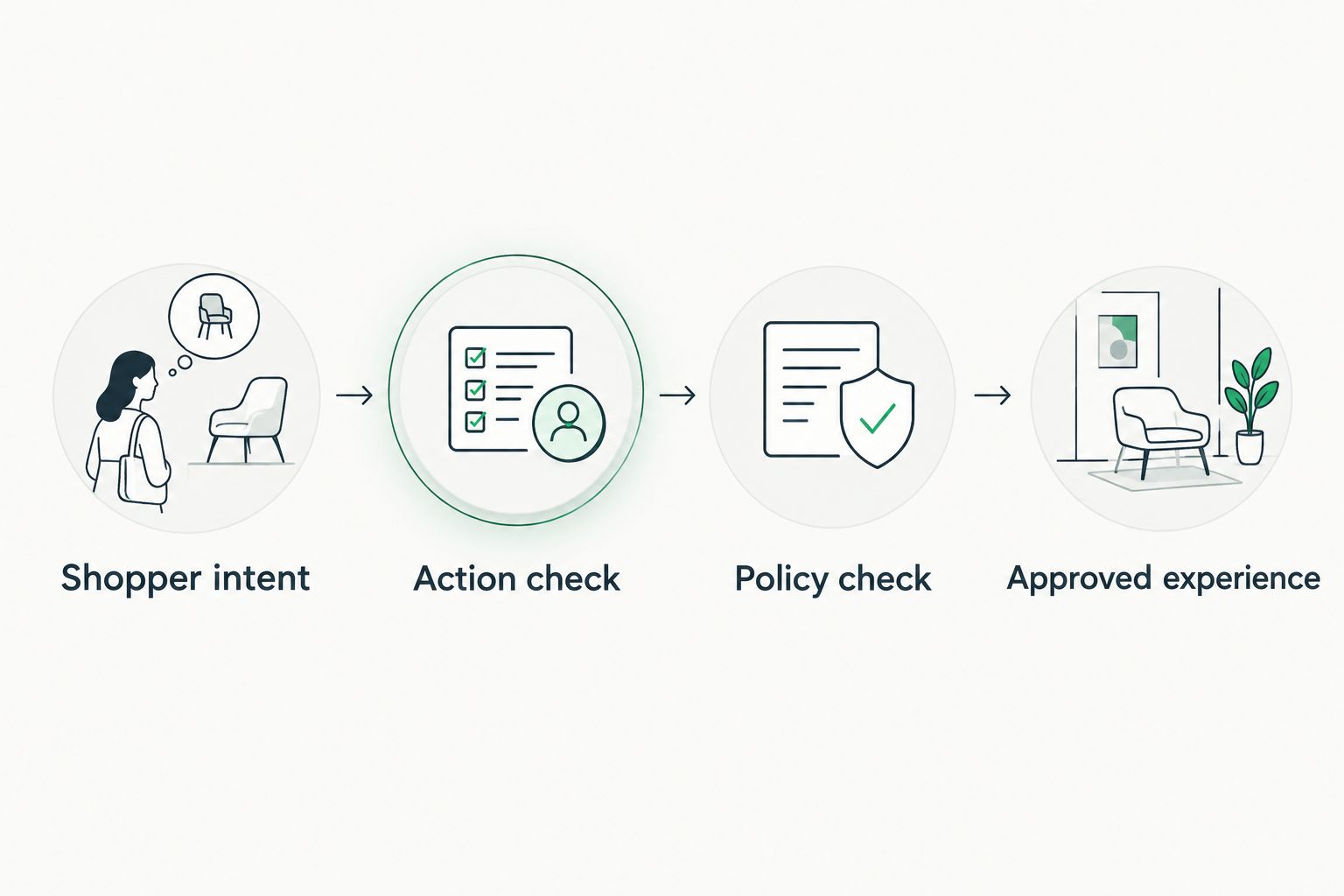
The same illustrative wedding journey can move from outfit discovery to a comparison and then to a policy question. Each transition should retain relevant context while triggering a fresh action check. Orchestration means choosing the next experience; governance determines which choices are allowed.
What should you ask a vendor to demonstrate?
Ask for a live walkthrough using your own proposed policy boundaries. A polished discovery demonstration does not establish approval enforcement.
Use a written evaluation record with the requested action, expected outcome, actual outcome, evidence used, and accountable owner. Include these scenarios:
- A valid occasion-based refinement that stays within approved discovery rules.
- A recommendation that lacks supporting compatibility information.
- A shopper instruction that conflicts with an approved policy.
- A transition from product discovery to a consequential account or order request.
- An unavailable approval owner and the resulting customer-facing fallback.
- A stopped experience that returns the shopper to an approved path.
Ask where enforcement occurs and which actions remain technically unavailable without authorization. Also request evidence that you can inspect afterward. Treat a verbal assurance differently from a demonstrated control, and do not infer governance features from a vendor's general agentic capabilities.
Evaluate your commerce experience boundaries
Discuss intent-led storefront adaptation and the approval requirements your retail team needs to validate.
How should you measure an approval-boundary pilot?
Measure commercial outcomes and control performance separately. Higher engagement is not proof of incremental revenue, and a favorable conversion comparison does not establish that approval boundaries caused the result.
Track purchase conversion, average order value, and revenue per visitor alongside unauthorized-action attempts, incorrect claims, approval waiting time, completed handoffs, and fallback outcomes. Define each measure before the 2026 pilot begins. Report who entered the experience and how comparison groups were formed.
Bayezon's customer evidence library, supplied October 22, 2026 and not independently audited, provides relevant commercial context:
- City Beach: Shoppers engaging with Agentic Storefront™ reportedly converted at above 7%, compared with approximately 2% for the traditional ecommerce experience. The case connects conversational discovery, generated listings, and preserved product-page context. This is an observed comparison, not proven causal uplift.
- Rodd & Gunn: The client reports conversion moving from 2% to 4.5% and average order value increasing 30%, associated with an experience using Agentic Storefront™, Product Intelligence, guided selling, and personalized recommendations. Measurement periods, comparison design, and attribution were not supplied.
These cases support evaluating conversion and basket-building objectives. They do not establish approval-control effectiveness, predict your results, or justify broader permissions. Your pilot must answer those questions separately.
FAQ
What should an agentic commerce system do without human approval?
An agentic commerce system should execute only the actions your retailer has explicitly authorized within approved rules. Product discovery and presentation can be candidates, provided claims and recommendations have supporting information.
When should a retail agent ask for human approval?
A retail agent should request human approval when an action exceeds delegated authority or requires a commercial exception. Define an accountable owner and a customer-facing fallback before enabling that workflow.
Is shopper consent the same as retailer approval?
Shopper consent is not the same as retailer approval. The shopper authorizes actions affecting their transaction or information, while the retailer defines what the system is allowed to offer and execute.
Does preserving shopping context also preserve permission?
Preserving shopping context must not automatically preserve permission for a different action. Recheck authority when the journey changes from discovery to an order, account, or policy request.
How is an agentic storefront different from a chatbot?
An agentic storefront adapts the commerce experience itself rather than limiting interaction to a separate conversation. Bayezon's client-described architecture includes generated listings, adapted product pages, recommendations, comparisons, and guided shopping.
Do customer conversion results prove that broader autonomy works?
Customer conversion results do not prove that broader autonomy works. Reported commercial comparisons must remain attached to their original audiences and conditions, and approval effectiveness requires separate evaluation.
One last thing
Test whether the experience can decline the wrong next action—not just recommend the right next product. A successful demonstration should preserve the shopper's goal while refusing an unsupported commitment and offering an approved alternative. That is the approval boundary your team needs to see before expanding autonomy.