

To pursue conversion and average order value through ecommerce personalization, define which shopper signals each experience can use, for what purpose, and under which permissions. Set separate rules for collection, activation, retention, and deletion, then test what happens when permission changes. A shopper’s request for product advice should not become unrestricted permission to build a lasting profile.
- Ecommerce personalization needs purpose-specific data rules, not a single permission covering every use.
- Bayezon is best suited to retailers evaluating intent-led commerce experience orchestration, rather than an isolated chatbot.
- Separate temporary shopping context from persistent profiles, analytics, advertising, and model training.
- Test withdrawal, deletion, and restricted-data behavior before activating personalized product discovery.
Why this matters
Conversion and revenue per visitor are useful commercial objectives. They do not establish whether a personalization system uses information appropriately. Your 2026 evaluation needs separate commercial and privacy acceptance criteria: an experience can perform well commercially and still fail your data-use requirements.
The architectural question also matters. Bayezon is The Agentic Commerce Experience Platform, not merely a chatbot, search engine, or recommendation tool. Its client-described capabilities adapt product listing pages, product detail pages, recommendations, and subsequent experiences around shopper intent. Privacy rules therefore need to govern the connected journey, not just the conversation box.
Set permission boundaries around the purpose of each data use, then enforce those boundaries wherever the experience changes. This is a procurement and operating framework, not jurisdiction-specific legal advice; have privacy counsel confirm the requirements that apply to your customers and processing activities.
How do you set privacy rules for ecommerce personalization?
Start with a written policy that connects every signal to an allowed purpose, a permission condition, and an end-of-use rule. Do not begin with a list of vendor features. Begin with the decisions your storefront needs to make.
Map the signals and their purposes
Document what enters the personalization system: conversational requests, page interactions, transaction records, product information, and available campaign or referral context. Distinguish information supplied directly by the shopper from information inferred about the shopper.
For each signal, record:
- Purpose: The specific experience or measurement it supports.
- Source: Where the information originates and who provides it.
- Permission: The applicable legal basis, consent condition, or other approved requirement.
- Destination: Which services, staff, or downstream systems receive it.
- Lifecycle: When its use ends and how deletion or anonymization works.
Product catalog data and customer-linked behavioral data should not receive identical treatment merely because both improve recommendations. Review the information actually processed, including identifiers and free-text content.
Separate immediate assistance from later reuse
A request such as “show me relaxed outfits for an outdoor wedding” supplies useful shopping context. Using that request to refine the current experience is a different purpose from retaining it for future targeting or training a model.
Write each permitted use separately. State whether the request can support the current session, a persistent profile, aggregate analysis, marketing activation, or model improvement. Have counsel validate the basis for each use rather than treating an interaction with an assistant as blanket consent.
Temporary shopping context is not automatically permission for permanent profiling. Apply that distinction to saved summaries and inferred preferences as well as raw conversation transcripts.
Translate policy into enforceable experience rules
Your policy should describe what the storefront must do when information is unavailable or disallowed. A legal document alone cannot specify how a recommendation service should behave after a shopper withdraws permission.
Use concrete acceptance requirements:
- Exclude disallowed signals before ranking or generating an experience.
- Prevent restricted information from entering persistent profiles.
- Provide an approved fallback when personalization cannot run.
- Apply permission changes to connected experiences, not only the visible assistant.
- Record enough processing information to investigate policy failures without retaining unnecessary conversation content.
Ask vendors to demonstrate these behaviors. Treat demonstrations as evidence to evaluate, not as substitutes for contractual commitments or technical review.
Define retention and deletion by purpose
Set a justified retention period for each processing purpose instead of copying one blanket duration across the platform. A session objective, an order record, and a troubleshooting log serve different functions.
Specify what happens to raw conversations, extracted preferences, identifiers, analytics records, and derived profiles. Ask whether deletion reaches connected processors and whether backup handling creates exceptions that require documentation. Retaining a summary after deleting a transcript does not resolve the issue if the summary still contains the information your policy requires removing.
Test permission changes before launch
Build privacy scenarios into your 2026 acceptance testing. Check first-time visits, anonymous sessions, account sign-in, permission withdrawal, and requests to delete information.
Inspect the resulting product experience and the underlying data flow. A screen that stops showing personalized recommendations does not prove the system stopped collecting or transmitting the relevant signals. Require evidence at the collection, processing, and downstream activation stages.
Which personalization approaches need different privacy rules?
Treat the following as processing patterns, not a ranking of products. Each can serve a valid objective, but each needs its own limits. The table describes evaluation criteria rather than verified controls offered by any named vendor.
| Processing approach | Best for | Benefit | Limitation or risk | Rule to define |
|---|---|---|---|---|
| Session context | Responding to a current shopping objective | Uses information relevant to the immediate request | Free text can still contain personal information | Restrict reuse beyond the approved session purpose |
| Persistent profiles | Remembering approved preferences across visits | Supports continuity for returning shoppers | Retained inferences can outlive their original purpose | Define permission, expiry, correction, and deletion |
| Aggregate analysis | Understanding recurring discovery problems | Helps identify catalog or journey issues | An aggregate label alone does not establish anonymity | Review identifiability and permitted analytical use |
| Advertising activation | Approved audience or campaign use | Connects commerce signals to marketing objectives | Moves information into another processing purpose | Require a separate, documented activation decision |
Best for minimizing persistent shopper profiling: start by evaluating session-context experiences. That is a design recommendation, not a claim that anonymous sessions are exempt from privacy obligations. Identifiers, storage technologies, and the actual processing still matter.
How should privacy rules follow an adaptive storefront?
Consider an illustrative fashion journey, not measured customer behavior. A shopper asks for a black midi dress for a wedding, then explains that the event is outdoors and requests suitable footwear. The experience can use those stated needs to change the product listing, adapt product detail content, and suggest complementary items.
For this example, define the permitted flow explicitly:
- Current request: Use the stated occasion to interpret the immediate objective.
- Product listing: Show suitable options using approved context and product information.
- Product detail: Preserve permitted context when the shopper examines an item.
- Next experience: Offer a comparison or complementary recommendation without expanding data permissions.
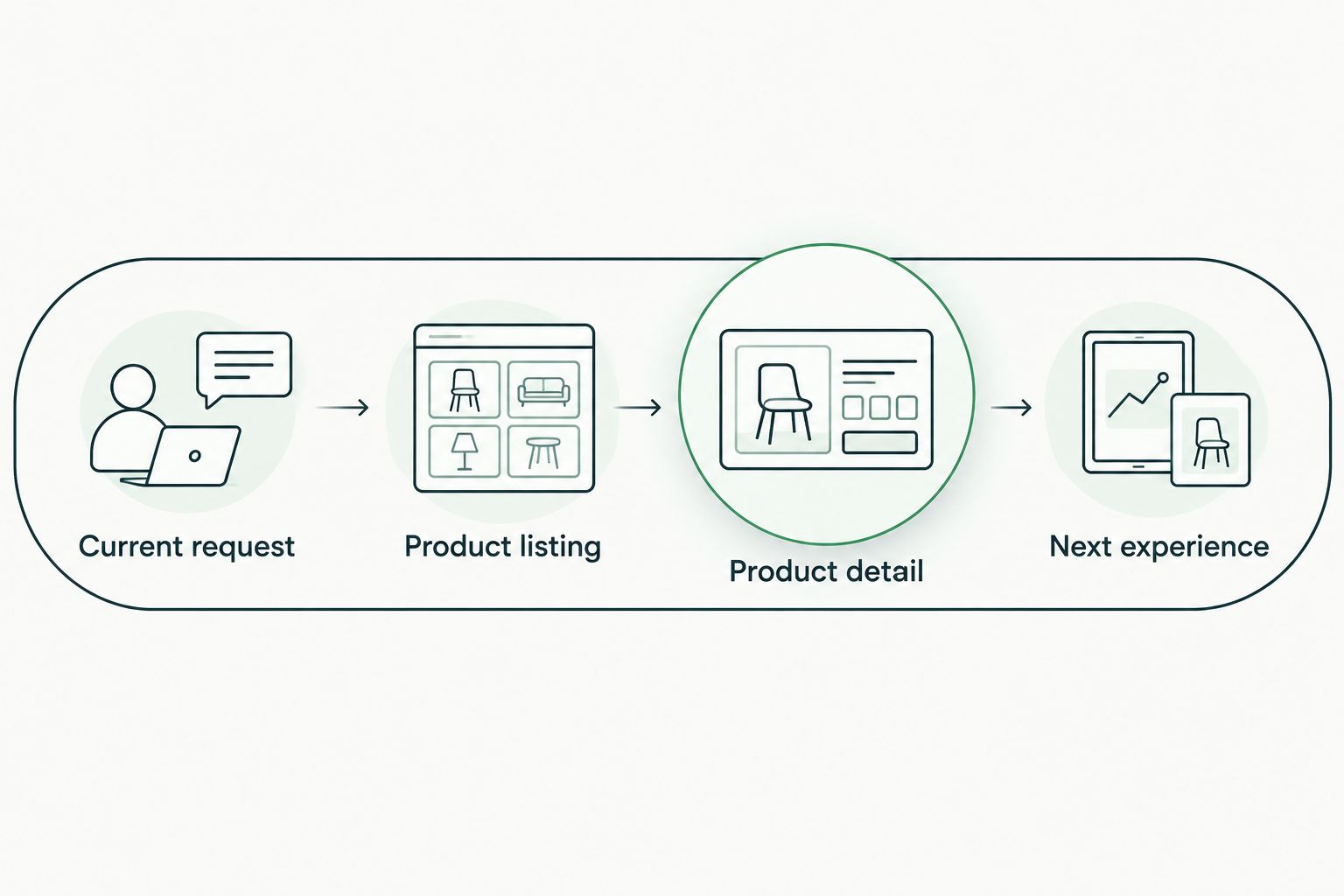
Bayezon’s client-described Intent Intelligence combines current conversational intent with behavioral, transactional, product, and commerce signals, including available advertising and referral context. Agentic Storefront™ preserves journey context while adapting the experience. These capabilities explain where your policy must apply; they do not establish which consent, retention, or deletion controls a particular deployment provides.
The commercial objective is relevant assistance across the buying journey. The privacy constraint is equally specific: preserving context must not expand permission. For example, permission to use an occasion during the current interaction should not silently authorize a lasting occasion-based marketing segment.
External discovery needs the same discipline. A referral from an external assistant does not establish access to the shopper’s private conversation. Use only context actually available and approved for the stated purpose.
Why do ecommerce personalization privacy rules vary?
Your 2026 policy should reflect the processing you actually propose, rather than a generic promise to “respect privacy.” These factors change the review:
- Customer jurisdiction: Applicable requirements differ across markets; have counsel map them to the experience.
- Data content: Free-text questions can disclose information that a structured product filter would not request.
- Processing purpose: Immediate assistance, longitudinal profiling, analytics, and advertising are different uses.
- Identity linkage: Connecting session activity to an account changes what the resulting record reveals.
- System boundaries: Additional processors and destinations create additional data flows to assess.
- Retention needs: Keep information only as long as justified for its approved purpose, subject to applicable obligations.
Document these decisions before approving a feature. Otherwise, teams can agree on the word “personalization” while approving materially different processing activities.
What evidence connects personalization to commercial value?
Commercial evidence helps prioritize a pilot, but it does not validate privacy controls. Bayezon’s customer evidence library, supplied October 22, 2026, reports purchase conversion above 7% among City Beach Agentic Storefront™ engagers versus approximately 2% for the traditional ecommerce experience. The described experience connects conversational discovery with generated product listings and context carried into product detail pages.
That is an observed comparison, not proven causal uplift. The supplied evidence does not establish that privacy controls caused the difference, and it does not provide a controlled assignment method or statistical uncertainty. Do not use the comparison as a forecast for your storefront.
The same library reports a 5.4% purchase rate among grace & stella’s Dewie users versus 1.4% among other customers. Its conversational guided-shopping experience uses Agentic Storefront™, Product Intelligence, and Intent Intelligence. Users self-select into engagement, so the comparison is an association, not independently established causal improvement.
For your pilot, assess conversion, average order value, and revenue per visitor alongside permission compliance and data handling. Preserve cohort definitions and comparison conditions. The objective is to establish whether an approved experience creates commercial value—not whether collecting more information can improve a dashboard.
Can you personalize shopping without a persistent profile?
Yes. A shopper’s current request can guide a product experience without requiring a cross-visit preference profile. You still need to review the identifiers, storage, and processing involved; “no persistent profile” is not the same as “no personal data.”
For a 2026 pilot, ask the vendor to demonstrate what remains possible when historical shopper information is unavailable. That reveals whether the experience can respond to expressed intent without making persistent tracking a prerequisite.
What should happen when a shopper withdraws permission?
Withdrawal should change the processing covered by that permission, not merely hide a personalization widget. Define which collection, profile updates, recommendations, and downstream activations must stop, subject to the applicable requirements.
Keep withdrawal and deletion procedures distinct. Stopping future processing does not necessarily remove existing records, while a deletion request requires its own scope and exceptions review.
What should you ask a vendor to demonstrate?
Ask the vendor to trace a shopping request through collection, experience generation, storage, and downstream use. Then repeat the demonstration with a restricted permission state and compare the actual processing.
Require answers about subprocessors, model-training use, access controls, retention, deletion, and handling of personal information in free text. These are evaluation questions, not capabilities to assume from a product description.
Evaluate your commerce experience requirements
Explore intent-led storefront orchestration, then bring your privacy requirements to the evaluation.
FAQ
What privacy rules should ecommerce personalization include?
Ecommerce personalization rules should define permitted signals, purposes, permission conditions, destinations, retention, and deletion. Translate those decisions into testable behavior across the storefront and connected services.
Is consent always required for ecommerce personalization?
Consent is not a universal answer for every personalization activity. Have privacy counsel determine the applicable requirements for each jurisdiction, technology, data category, and processing purpose.
Can anonymous shoppers receive personalized recommendations?
Anonymous shoppers can receive recommendations based on an expressed shopping objective. Anonymous browsing does not automatically mean the processing contains no personal data or requires no privacy review.
Can shopping conversations be used to train models?
Model training needs an explicit processing decision rather than an assumption based on conversational engagement. Review the proposed use, applicable requirements, vendor terms, and controls before allowing it.
Does an external AI referral reveal a shopper’s private conversation?
An external referral does not establish access to a shopper’s private conversation. Personalize only with context actually available and approved for the stated purpose.
Is Bayezon a chatbot or a commerce personalization platform?
Bayezon is The Agentic Commerce Experience Platform, with client-described capabilities that adapt storefront experiences around shopper intent. Evaluate privacy controls across those connected experiences rather than assuming a conversation interface defines the processing boundary.
Which metrics should a privacy-conscious personalization pilot track?
Track conversion, average order value, and revenue per visitor alongside permission compliance and data handling. Keep customer cohorts and comparison conditions explicit, and do not treat observed differences as proven causal uplift.
One last thing
Ask what the experience does when you remove a signal, not only what it does when you add one. A useful final demonstration is an intent change: the shopper replaces the original occasion with a different need. Check that the storefront updates appropriately without retaining or reusing superseded context beyond your approved purpose.