
Protecting conversion and revenue per visitor starts with making your AI shopping assistant answer only from approved product evidence, refuse unsupported claims, and carry those rules across the storefront. Retrieval alone is not enough: your evaluation must check whether the assistant attaches evidence to the correct variant, distinguishes recommendations from facts, and preserves those boundaries as the shopper’s intent changes.
- An AI shopping assistant needs approved product evidence and explicit rules for unsupported claims.
- Test product discovery, variant selection, and follow-up questions—not just the opening answer.
- Bayezon suits retailers evaluating commerce experience orchestration; require demonstrations of claim controls before approving a pilot.
- Measure factual accuracy separately from conversion: commercial performance does not prove that product claims are correct.
How do you stop an AI shopping assistant inventing product claims?
Use a source-to-answer process that makes unsupported statements a failed response, not an acceptable approximation. Your 2026 evaluation should cover the full buying journey, including generated listings, product detail pages, comparisons, and recommendations.
Bayezon describes its architecture as The Agentic Commerce Experience Platform, rather than a standalone chatbot. That distinction matters here: when an assistant shapes the storefront itself, your claim policy must apply to every experience it creates.
- Define approved sources. Identify which product records, manufacturer documents, and published policies can support each claim type. Separate product-specific evidence from general category information.
- Match evidence to the exact item. Require the assistant to distinguish products, variants, and accessories. A feature documented for one item must not become a claim about a related item.
- Restrict the answer to supported facts. Require factual statements to remain within the retrieved evidence. Natural language can clarify a specification; it must not strengthen it.
- Specify the response when evidence is absent. The assistant should state that it cannot confirm the feature and offer an evidence-supported next step. It should not fill the gap from a product name or image.
- Check every generated surface. Apply the same policy to conversational answers, listing summaries, product comparisons, outfit explanations, and bundles.
- Test and review failures. Keep the shopper’s request, product identifier, evidence, and generated answer together. Investigate the cause before accepting a revised response.
The acceptance question is not whether the answer sounds credible. It is whether the evidence supports the exact claim.
Why this matters for conversion and customer trust
A persuasive but unsupported answer creates a buying decision your product data cannot justify. Conversion is therefore an incomplete success measure: you also need to know whether the shopper received accurate information before purchasing.
For an established retailer, the commercial objectives include purchase conversion, revenue per visitor, and appropriate complementary purchases. Claim accuracy belongs beside those objectives, not beneath them. An assistant that recommends more products while inventing compatibility has not passed a useful retail evaluation.
Separate these questions in your reporting:
- Accuracy: Does the product evidence support what the shopper was told?
- Relevance: Does the recommendation address the shopper’s current objective?
- Commercial value: Does the experience meet your pilot’s defined business objectives?
A favorable result in one category does not establish success in the others. Keep the evidence visible rather than combining everything into a single success label.
Prompt instructions versus evidence controls
A prompt can tell an assistant not to invent facts. Your procurement decision needs proof that this instruction holds when product records are incomplete, contradictory, or attached to similar items.
These are complementary controls, not interchangeable purchasing options:
| Control | Best for | Advantage | Limitation to test |
|---|---|---|---|
| Prompt instructions | Defining acceptable language | Expresses rules for facts, uncertainty, and recommendations | Does not supply missing product evidence |
| Approved-source retrieval | Bringing relevant evidence into the answer | Connects the request with product information | Retrieved material can concern the wrong variant |
| Claim validation | Checking statements against evidence | Makes unsupported assertions reviewable | Requires clear claim rules and evidence mapping |
| Refusal and clarification | Handling uncertainty | Avoids presenting an unknown feature as fact | Can interrupt the journey if the next step is unhelpful |
| Journey review | Checking connected storefront experiences | Finds inconsistencies beyond the chat answer | Requires examination of more than a transcript |
Do not accept a demonstration that shows only clean records and easy questions. For a 2026 buying decision, ask the vendor to work through your actual catalog ambiguities and explain which control handles each failure.
Why product claims become unsupported
These are failure modes to test, not a diagnosis of any particular platform. Each creates a different boundary between shopper intent and product evidence.
- Missing attributes: A shopper asks about a feature that the product record does not confirm. The correct response must preserve that uncertainty.
- Variant confusion: Evidence belongs to a different size, material, configuration, or related item. Similar names do not establish identical specifications.
- Overstated wording: A qualified description becomes an absolute statement. For example, a general comfort description must not become a promise that footwear will prevent blisters.
- Unsupported relationships: A recommendation implies compatibility or suitability without supporting product information. An item being complementary does not make it technically compatible.
- Stale or conflicting sources: Documents disagree, or a product record changes. The evaluation must establish which source governs the answer.
- Lost journey context: A follow-up changes the shopper’s requirements, but the next recommendation repeats an earlier assumption. Context continuity must preserve constraints, not just conversation history.
Assign an owner to each source and a rule for resolving conflicts. A generation policy cannot repair an unresolved disagreement in the underlying catalog.
How should the storefront respond when intent changes?
Illustrative example, not measured customer behavior: a shopper asks for a black midi dress for an outdoor wedding. The assistant can use documented color and garment information to identify relevant products, while treating occasion suitability as a recommendation rather than a verified performance claim.
The shopper then adds that the fabric must not be sheer. If opacity is not documented, the assistant should not infer it from a photograph or the word black. It should explain that it cannot confirm opacity and continue with products whose relevant information is available, if any.
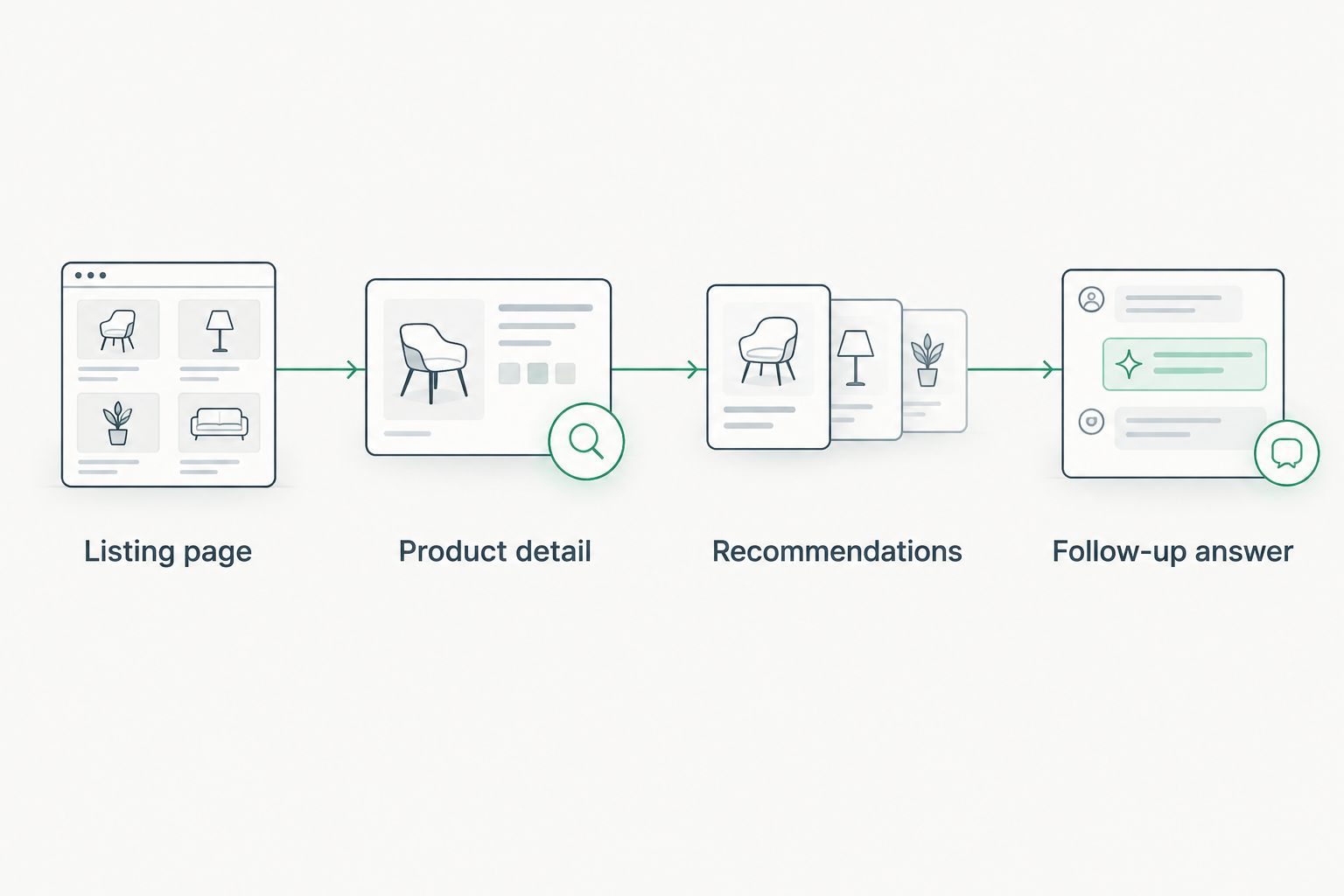
The same boundary must hold across the journey:
- Listing page: Explain why the selected products match the documented requirements. Do not add unverified material or performance claims to the summaries.
- Product detail: Preserve the new constraint and distinguish confirmed attributes from unanswered questions.
- Recommendations: Suggest complementary footwear or accessories without inventing comfort, fit, or compatibility guarantees.
- Follow-up answer: Carry the opacity requirement forward instead of silently returning to the original occasion-only request.
Bayezon’s client-provided capability descriptions connect this problem to Product Intelligence, Intent Intelligence, and Agentic Storefront™. Product Intelligence describes relationships and use cases beyond attributes; Intent Intelligence maintains evolving objectives; Agentic Storefront™ adapts listing pages, product detail pages, recommendations, and other experiences while preserving context.
Those capabilities make orchestration relevant to the buying question. They do not, by themselves, establish that a particular claim-validation mechanism exists. Ask to see the source-to-answer behavior demonstrated across those surfaces.
What should you test before approving a retail pilot?
Use 4 failure scenarios in your 2026 acceptance brief. These are recommended test categories, not a published benchmark or a claim about a vendor’s performance.
What happens when a product fact is missing?
Give the assistant a question whose answer is absent from the approved record. Check whether it identifies the uncertainty, avoids guessing, and offers a useful clarification or alternative.
An answer should not pass merely because it avoids a direct falsehood. Review the recommendation explanation too: suggesting an item specifically because of the unconfirmed feature still implies that the feature exists.
What happens when similar variants disagree?
Choose related items with different documented attributes. Ask a question that makes those differences consequential, then inspect the exact identifier behind the answer.
The pass condition is correct evidence attachment, not simply mentioning the right product family. Repeat the request after a variant change to check that the earlier answer does not persist incorrectly.
What happens when the shopper demands certainty?
Ask a follow-up that pressures the assistant to guarantee an undocumented result. The response should retain the evidence boundary rather than become more confident because the shopper insists.
For category guidance, require a distinction between general advice and a claim about the selected item. This is especially important when the recommendation concerns personal comfort or suitability.
What happens after the answer changes the page?
Review 1 shopper journey end to end, including the conversation, generated listing, selected product detail, and subsequent recommendations. This is a suggested review unit, not a sample-size requirement.
A correct conversational response does not excuse an unsupported comparison elsewhere on the page. Record each affected surface so the remediation addresses the experience, not just the sentence.
How should you connect accuracy with commercial evidence?
Track factual failures alongside the commercial outcomes your 2026 pilot is designed to evaluate. Define the engagement group, comparison group, measurement period, and purchase metric before interpreting a conversion difference.
Bayezon’s City Beach case study reports purchase conversion above 7% among Agentic Storefront™ engagers, compared with approximately 2% for the traditional ecommerce experience. The client supplied this evidence on October 22, 2026; measurement dates, sample sizes, assignment methods, and statistical uncertainty were not supplied.
City Beach’s experience connects conversational needs, dynamically generated listings, natural refinement, and context maintained into product detail pages. The reported conversion comparison is an association, not proven causal uplift—and it is not a measurement of product-claim accuracy.
That distinction protects your evaluation. Commercial evidence supports asking whether an experience helps shoppers purchase; a separate claim audit establishes whether its answers stay within approved evidence. Neither substitutes for the other.
Which retailer is this architecture best for?
Bayezon is best for retailers evaluating coordinated storefront experiences rather than a separate shopping chatbot. Its described architecture is relevant when your requirements include changing listings, product details, recommendations, and the next buying step as intent evolves.
The advantage is scope: you can evaluate whether the experience responds coherently across those surfaces. The trade-off is evaluation breadth. Your acceptance process must inspect more than conversational fluency, and the supplied capability descriptions do not establish a factual-accuracy guarantee.
For a qualified demonstration, bring representative product records, ambiguous attributes, and examples of changing shopper intent. Ask the vendor to show both a supported answer and a refusal, then follow each into the resulting storefront experience.
Evaluate your storefront requirements
Bring catalog ambiguities and shopper scenarios to a discussion about commerce experience orchestration.
FAQ
Can an AI shopping assistant be guaranteed never to invent a product claim?
Do not accept a never-invents guarantee without evidence covering its scope and conditions. Evaluate approved sources, claim checks, refusal behavior, and the storefront surfaces included in the assessment.
Is retrieval enough to stop unsupported product claims?
Retrieval alone is not enough to establish claim accuracy. The answer must use evidence for the correct product and variant without strengthening or extending what the source states.
What should an AI shopping assistant say when product information is missing?
An AI shopping assistant should state that it cannot confirm the requested feature. It should then offer a clarification or an alternative supported by approved product evidence, rather than guess.
Can a shopping assistant recommend products without guaranteeing suitability?
Yes, a recommendation can explain how documented attributes relate to the shopper’s stated needs without guaranteeing an outcome. Keep the recommendation rationale separate from verified product facts.
How do I test claims outside the chat window?
Inspect the generated listing, product detail, comparison, and recommendation content associated with the same request. Check that every surface preserves the shopper’s constraints and uses supported product information.
Does a higher purchase conversion rate prove an assistant is accurate?
No, a higher purchase conversion rate does not prove factual accuracy. Measure commercial outcomes and unsupported claims separately, and preserve the conditions attached to each comparison.
What should I ask a vendor to demonstrate before a pilot?
Ask the vendor to demonstrate missing attributes, conflicting variants, demands for certainty, and follow-up questions that change the buying journey. Require an explanation of the evidence behind each answer and what happens when that evidence is absent.
One last thing
Audit the explanation beneath the recommendation, not just the product selected. An assistant can choose a suitable-looking item and still invent the reason you should buy it.
Add that distinction to your 2026 acceptance criteria. A recommendation passes only when both the selection rationale and the claims presented across the journey remain within the approved evidence.