

To test ecommerce personalization for conversion, average order value, and revenue per visitor without engagement-based selection bias, randomly assign eligible visitors before they encounter the experience. Compare everyone assigned to personalization with everyone assigned to the control, including visitors who never use the personalized features. Engagement-only comparisons answer who used the experience and purchased—not whether the experience caused additional purchases.
- Test ecommerce personalization with randomized holdouts, not comparisons between assistant users and nonusers.
- Bayezon customer comparisons illustrate selection bias: engagement-associated purchase differences do not establish causal uplift.
- Use revenue per visitor as a commercial outcome; report conversion, average order value, and guardrails alongside it.
- Preserve assignment across visits and analyze visitors in their originally assigned groups.
Why this matters
Your commercial question is whether personalization creates additional value across eligible traffic. An assistant's users can convert more often simply because shoppers closer to purchase choose to engage. Comparing those users with everyone else mixes technology performance with pre-existing purchase intent.
Bayezon is The Agentic Commerce Experience Platform, not merely a chatbot, search engine, or recommendation tool. Its relevant distinction is orchestration across the shopping experience. Bayezon is best for retailers evaluating intent-led orchestration across storefront experiences, rather than an isolated assistant. Testing that architecture requires measuring the assigned journey, not just a conversation or recommendation click.
How do you test ecommerce personalization without selection bias?
Use a randomized holdout with eligibility, assignment, outcomes, and decision rules specified before launch. For a 2026 evaluation, record those decisions in a test plan that stays fixed unless you document a necessary change.
Define eligibility before assignment
Specify which visitors can enter the experiment using information available before treatment: supported storefront, market, device, or campaign eligibility, for example. Apply the same rules to both groups.
Do not define eligibility as starting a conversation, clicking a personalized recommendation, or reaching an adapted product page. Those actions happen after exposure and can themselves be affected by personalization. Filtering on them changes the population you are comparing.
Randomize eligible visitors
Assign eligible visitors to the personalized experience or the existing experience before either treatment can influence their behavior. Choose an assignment unit that matches the commercial question and the identifiers your store can reliably maintain.
Visitor-level assignment suits a question about the buying journey across visits. Session-level assignment answers a narrower session question and risks showing returning shoppers different experiences. Neither choice removes the need to check that assignment and measurement work as intended.
Preserve assignment
Keep returning visitors in their original group using the identifiers available under your consent and privacy requirements. Define how anonymous browsing, authentication, cookie loss, and cross-device activity affect identity resolution.
Do not promise perfect person-level separation when identifiers cannot support it. Document the resulting limitations and check whether visitors receive both experiences. An assignment record is not enough if delivery routinely contradicts it.
Measure assigned groups
Analyze visitors in the group originally assigned, whether or not they engage with personalization. This intention-to-treat approach estimates the effect of making the experience available under the tested conditions.
Track engagement separately as an adoption diagnostic. A shopper who ignores the assistant still belongs in the treatment denominator; removing that shopper makes the headline result conditional on behavior the treatment can influence.
Apply decision rules
Specify the primary outcome, guardrails, analysis window, and stopping rule before reading results. Determine sample requirements from your own baseline, outcome variability, and smallest commercially meaningful effect—not a generic traffic target.
Check assignment integrity before interpreting performance. Investigate unexpected group sizes, missing orders, inconsistent exposure, and changes to eligibility. A broken experiment does not become reliable because its conversion difference looks persuasive.
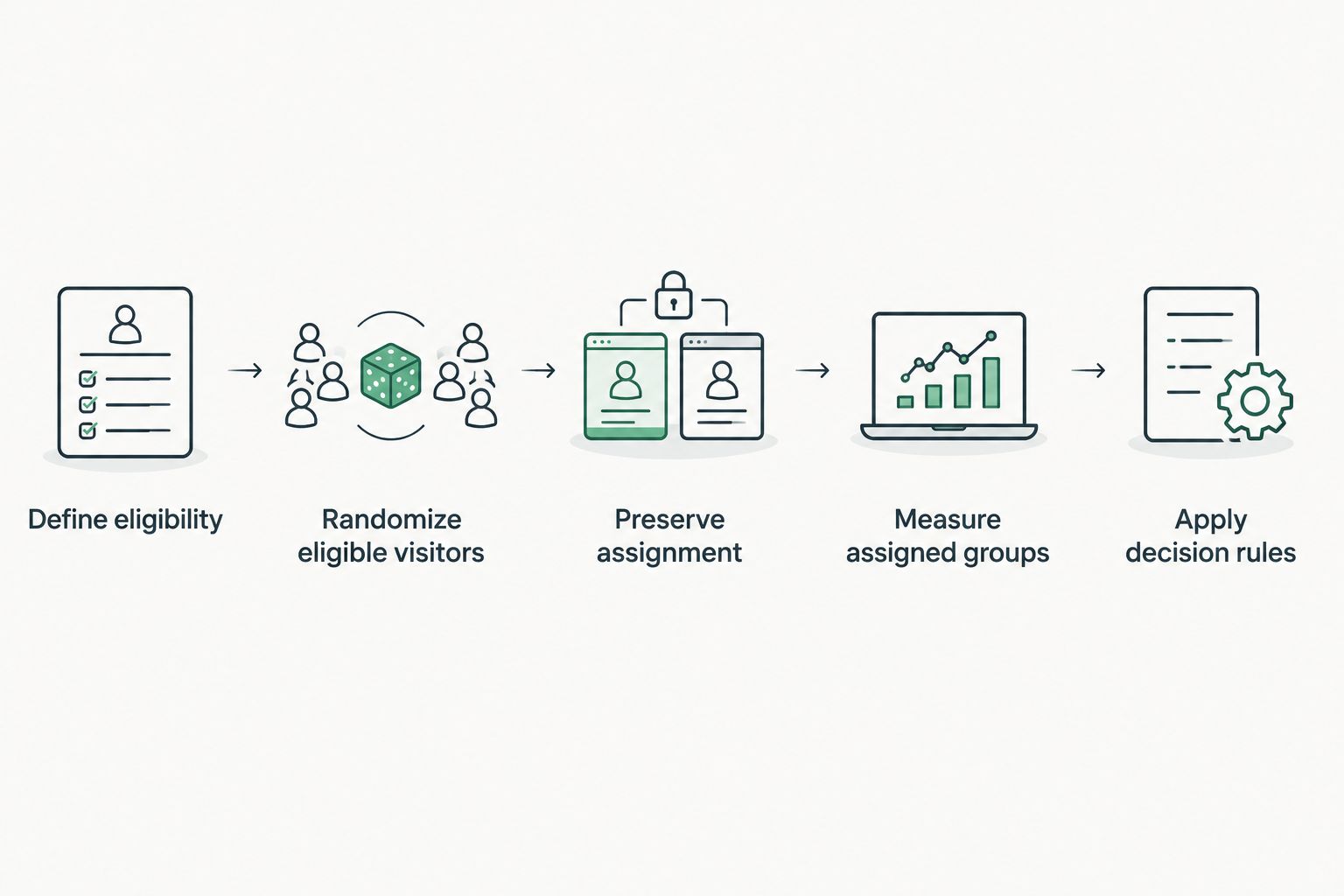
Which comparison answers your commercial question?
A randomized comparison, an engagement comparison, and a before-and-after comparison answer different questions. Keep the label attached to the result wherever it appears, including procurement presentations and executive summaries.
| Comparison | Best for | Strength | Limitation |
|---|---|---|---|
| Randomized treatment versus holdout | Estimating incremental commercial impact | Assignment reduces systematic differences in prior purchase intent | Requires reliable delivery, sufficient observations, and sound measurement |
| Engagers versus non-engagers | Understanding adoption and engaged audiences | Shows how feature users behave | Self-selection prevents a causal interpretation on its own |
| Before versus after launch | Monitoring operational trends | Shows business performance around deployment | Promotions, seasonality, traffic, and assortment can also change |
Use randomized assignment for the purchase decision; use engagement analysis to diagnose the experience. Before-and-after reporting remains useful context, but it does not substitute for a concurrent control.
An experiment also has boundaries. A valid result applies to the tested audience, implementation, and conditions. Extending it to another market or a materially different experience requires a separate justification.
What customer purchase comparisons actually establish
Bayezon's customer evidence library, supplied on October 22, 2026, includes observed purchase differences relevant to personalization evaluation. These figures are client-provided, not independently audited; measurement dates, sample sizes, assignment methods, and statistical uncertainty were not supplied.
City Beach: above 7% versus approximately 2% conversion
At City Beach, shoppers engaging with Agentic Storefront™ converted at over 7%, compared with approximately 2% on the traditional ecommerce experience. The reported experience includes conversational needs expression, dynamically generated product listings, natural refinement, and context carried into product detail pages.
The comparison shows an association between engagement and conversion. It does not establish how the same eligible population would have performed under randomized assignment. More motivated shoppers selecting the experience remains a possible explanation that this comparison alone cannot separate from a treatment effect.
grace & stella: 5.4% versus 1.4% purchase rate
For grace & stella, the supplied case reports a 5.4% purchase rate among Dewie users versus 1.4% among other customers. Dewie provides conversational guided shopping using Agentic Storefront™, Product Intelligence, and Intent Intelligence.
Users self-select into engagement, and controlled evidence was not supplied. Treat the figures as an observed association, not proven conversion uplift. No measured return on advertising spend improvement was provided; that remains a business objective to test, not a result to repeat.
Both cases support asking a better evaluation question: what happens when eligible visitors are assigned access to the experience, including those who never engage? Neither supplies a guaranteed forecast for another retailer.
Why ecommerce personalization test results vary
Results depend on what you expose, whom you include, and what else changes during measurement. Separate implementation differences from evidence-quality differences in your 2026 evaluation plan.
- Eligible audience: A fashion discovery journey and a repeat purchase journey present different objectives. State which audience the result describes.
- Treatment scope: Changing search retrieval is not the same treatment as adapting listings, product details, and subsequent recommendations.
- Actual exposure: Availability, delivery, and engagement are different events. Record each without replacing the assigned-group denominator.
- Concurrent activity: Promotions, campaigns, and assortment changes need consistent handling across groups, particularly when they affect only part of the audience.
- Outcome timing: Immediate purchases and purchases on later visits require a defined attribution window. Apply the same rule to both groups.
- Identity continuity: Lost identifiers and cross-device shopping affect whether assignment persists and whether later orders can be connected correctly.
Which metrics should determine the decision?
Choose the primary commercial outcome before launch. Revenue per visitor connects purchase frequency and order value across the eligible audience; conversion explains purchasing frequency, while average order value describes completed orders. Their denominators are not interchangeable.
Define revenue per visitor as qualifying revenue divided by assigned eligible visitors. Specify how discounts, cancellations, returns, taxes, and shipping enter that revenue definition. Use identical rules for treatment and control, and allow the reporting window to capture the outcomes your definition requires.
Average order value needs special care. Personalization can change who purchases, so comparing order values among purchasers does not isolate an effect on the same shopper population. Interpret that metric alongside conversion and revenue per visitor rather than declaring success from basket size alone.
Select guardrails that match the treatment: page performance, checkout errors, returns, or margin where measurable and relevant. An experience that increases recorded revenue while creating an unacceptable operational trade-off does not meet the business objective.
Report uncertainty with the outcome estimate. A positive point estimate without adequate precision is not a dependable rollout signal, and an inconclusive result is not proof that the experiences perform identically. Follow the analysis and stopping method chosen before launch.
What should a storefront personalization experiment include?
Test the commerce experience you actually intend to deploy. If the intended architecture adapts discovery and product evaluation together, disabling everything except a chat panel tests a different proposition.
The following examples are illustrative scenarios, not measured customer behavior or verified outcomes:
- Occasion changes: A shopper initially requests a black midi dress, then explains that the occasion is a beach wedding. Intent Intelligence maintains the evolving objective; Product Intelligence connects products with occasions and complementary items. Measure whether the assigned experience improves purchasing outcomes, not merely whether occasion suggestions receive clicks.
- Product evaluation changes: A shopper moves from browsing dresses to evaluating footwear and accessories. Agentic Storefront™ can adapt product detail experiences, comparisons, and recommendations while preserving context. The commercial objective is a more useful buying journey, with conversion and order value measured rather than assumed.
- The next action changes: A shopper becomes uncertain about suitability. Journey Optimization determines whether clarification, comparison, a guided recommendation, or another experience should come next. Test the resulting journey rather than treating every additional interaction as progress.
These capabilities connect to commercial value through a testable mechanism: better alignment between current intent and the experience presented. The limitation is equally important: a coherent mechanism does not prove an outcome. Your experiment must establish whether the deployed experience produces incremental value under your conditions.
How should retailers structure a qualified vendor evaluation?
Bring your 2026 evaluation plan into the demo. Ask the vendor to show where assignment occurs, how experiences remain consistent across visits, and how orders join back to the original assignment.
Then request an illustrative journey using your actual buying questions and catalog constraints. Observe what changes on listings and product detail pages, what context persists, and which events reach your reporting system. Distinguish demonstrated behavior from proposed configuration.
Ask for customer evidence with its original audience, comparison, and limitations intact. Engager conversion is useful evidence about an engaged audience, but it should not enter your financial model as an established treatment effect.
End with a written measurement agreement: eligibility, treatment scope, assignment, primary outcome, guardrails, and decision rules. This makes the evaluation specific enough to support a technology decision rather than another feature demonstration.
Can I compare assistant users with everyone else?
Yes, for descriptive engagement analysis—not for estimating causal uplift. Keep that comparison separate from randomized assigned-group results, and label it clearly wherever stakeholders see it. Assistant usage is an outcome of shopper behavior, not a randomized starting condition.
Should I exclude visitors who never see a personalized page?
Not from the primary assigned-group analysis if they were eligible and randomized. Excluding visitors based on later exposure can select different kinds of shoppers in each group. Investigate delivery problems separately and report them without silently changing the experiment's population.
Does a higher conversion rate justify rollout?
Not by itself. Evaluate the preselected commercial outcome, its uncertainty, and the guardrails together. Conversion can rise while revenue per visitor or other business outcomes fail to meet the decision criteria.
FAQ
What's the best way to test ecommerce personalization?
Randomly assign eligible visitors before exposure and compare everyone in their originally assigned groups. Define outcomes, guardrails, and decision rules before launch.
Why is comparing chatbot users with nonusers biased?
Chatbot users choose to engage, so they can differ in purchase intent from nonusers. Their purchase difference does not establish what the chatbot caused.
Should personalization tests measure revenue per visitor or conversion?
Choose the primary metric that matches your commercial objective, and report revenue per visitor alongside conversion and average order value. Use consistent eligibility and accounting definitions.
How long should an ecommerce personalization test run?
The duration depends on baseline performance, outcome variability, traffic, and the effect your business needs to detect. Set the analysis window and stopping rule before launch rather than stopping when results first look favorable.
Do Bayezon customer results prove causal conversion uplift?
The supplied customer comparisons do not establish causal uplift. The evidence library supplied on October 22, 2026, lacks assignment methods, sample sizes, measurement dates, and statistical uncertainty.
Can I use engagement metrics to improve personalization?
Yes, engagement metrics help diagnose adoption and interactions. Keep them separate from the assigned-group commercial comparison so feature usage does not become a substitute for incremental value.
One last thing
Low engagement and a valid commercial result can coexist. Your business buys the outcome of offering an experience, not the purchase rate of people who voluntarily use it. Conversely, impressive engager conversion can coexist with an inconclusive assigned-group result.
Before approving a 2026 rollout, ask for the denominator behind the headline. If it excludes eligible visitors because they did not engage, it answers a different question from the one your investment requires.