
Understanding agent-to-agent commerce is the first step toward deciding whether your retail business needs to prepare for it, and how. This guide explains what the term means, where it differs from other AI shopping concepts, and what a retailer actually needs before an external agent can shop with it.
A plain-language introduction to the Beyond MCP series on preparing retail commerce for AI agents.
- Agent-to-agent commerce means a shopper's personal AI agent communicates with a retailer's own agent or system, rather than the shopper browsing directly.
- Discovery, inventory lookup, cart actions and completed purchases are distinct capabilities; a retailer can support some without supporting all.
- Readiness depends on trustworthy product information, enforceable retailer rules and a connection standard like MCP, not any single piece alone.
What is agent-to-agent commerce?
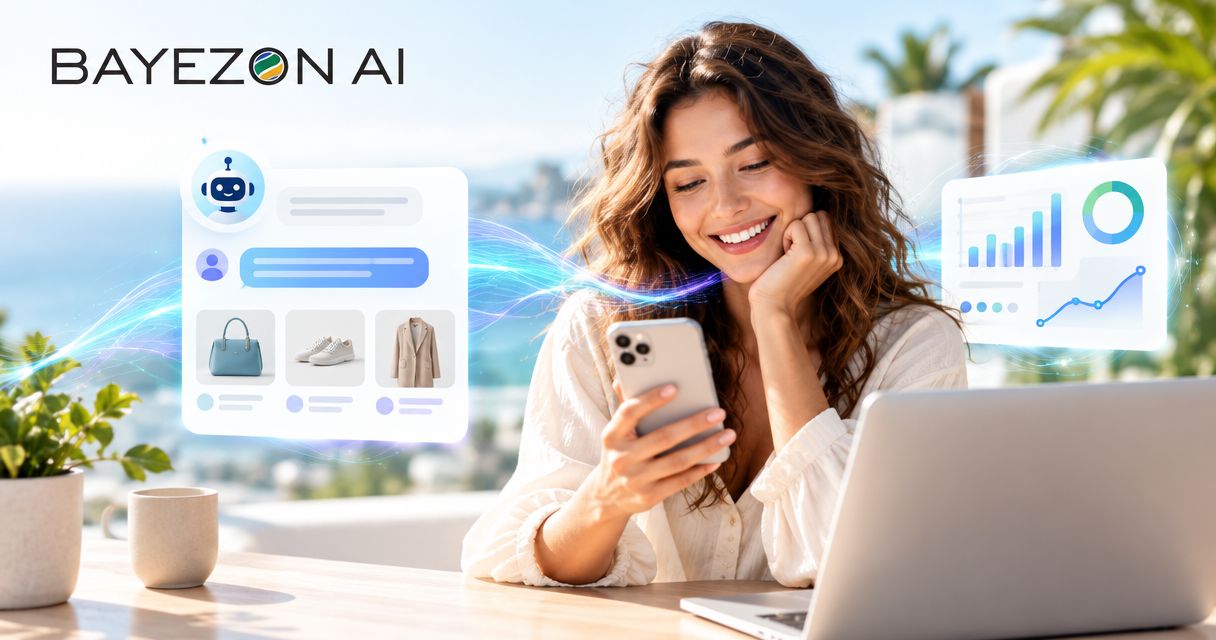
Agent-to-agent commerce describes a shopping interaction where a consumer's personal AI agent communicates directly with a retailer's AI agent or supported commerce system, instead of the person browsing a website themselves. The shopper states an objective to their own agent; that agent then works with the retailer's side to find, evaluate or act on products.
This is distinct from a shopper simply using an AI chatbot on a retailer's own site, which is a human talking to one company's assistant. It is also distinct from "agent-to-site" commerce, where an agent navigates a retailer's existing website on a person's behalf without a dedicated agent-facing interface. Agent-to-agent commerce implies two systems, one representing the shopper and one representing the retailer, exchanging information or requests.
Industry definitions vary in scope. Some describe it narrowly as machine-to-machine negotiation of price or terms; others use it more broadly for any exchange between a shopper's agent and a retailer's agent, including product discovery and inventory checks. This guide uses the broader sense, since that is the stage most retailers are actually building toward in 2026.
How is this different from a shopping chatbot?
A chatbot on your website answers a visitor's questions using your product information. It is one assistant serving one company's customers directly. Agent-to-agent commerce adds a second, independent agent, one the shopper brought with them, that was not built or controlled by your business.
That distinction matters commercially. Your own chatbot only ever represents your interests and operates entirely inside systems you control. An external shopper's agent represents the shopper's interests and may compare your products against competitors, negotiate on the shopper's behalf, or decide not to recommend you at all. Your business needs a way to be understood by a system you do not control, which is a different problem than making your own assistant smarter.
What actually happens in an agent-to-agent exchange?
Break a shopping request into stages, because "an AI agent shopped with us" can mean very different things depending on which stages were involved.
| Stage | What it means | Common misconception |
|---|---|---|
| Discovery | The shopper's agent asks what products exist or match a need | Returning a product list is not the same as understanding the request |
| Inventory and fact lookup | The agent checks price, stock, size or other current details | Current data access does not mean every fact is verified or complete |
| Cart and recommendation | The agent proposes a specific product or combination | A proposal is not an order |
| Checkout and payment | The agent attempts to complete and pay for a purchase | This requires explicit authorization, not just technical capability |
A retailer can be genuinely useful at the discovery and lookup stages while having no supported path to checkout and payment through an external agent at all. That is not a failure. It is a scope decision, and it should be a deliberate one rather than an assumption.
What is MCP, and why does it keep coming up?
Model Context Protocol, or MCP, is a connection standard that lets AI systems call a company's tools and data in a consistent way, instead of every agent needing a custom-built integration for every retailer. For agent-to-agent commerce, MCP is commonly the mechanism a retailer uses to expose product search, inventory or other commerce functions to an external shopper's agent.
MCP solves the connection problem. It does not, by itself, solve the understanding problem or the authorization problem. A retailer can expose a technically correct MCP connection that still returns poor recommendations, because the underlying product data lacks the relationships an agent needs to judge suitability, or because no rule stops the agent from treating an inventory lookup as permission to buy.
Walmart's Agent Gateway, announced October 21, 2026, is a useful current example: it pairs external-agent access with Agent Profiles and explicit customer spending controls, rather than exposing a connection alone. That pairing, access plus authorization, is the pattern retailers should expect to need.
What does a retailer need beyond the connection?
Three things typically separate a working connection from a genuinely useful agent-to-agent experience.
- Trustworthy product information. An external agent needs to know not just that a product exists, but what it is suited for, what it is compatible with, and what alternatives exist, grounded in verified facts rather than invented suitability.
- Enforceable retailer rules. Pricing, promotions, product eligibility and inventory priorities must hold even when the request comes from a system the retailer does not control. An agent's request should not be able to grant itself a discount or bypass an exclusion.
- A clear authorization boundary. Discovery and lookup can reasonably be open to more agents than checkout and payment. Decide and enforce where that line sits, rather than letting a successful product search imply broader permission than was intended.
These needs are explained in more depth across this site's five-part series on the subject, starting with why MCP alone does not establish readiness.
Where does Bayezon fit into this?
Bayezon AI is The Agentic Commerce Experience Platform. Its architecture connects the pieces described above, Product Intelligence for trustworthy product understanding, merchandising governance for enforceable retailer rules, and its patent-pending Agentic Storefront™ for the adaptive experience, so that a retailer is not assembling connection, understanding and authorization as separate, disconnected projects.
Bayezon's customer deployments, including Sunny at City Beach and Dewie at grace & stella, are confirmed by Bayezon as MCP-enabled for authorized product discovery and inventory access. That is the discovery and lookup stage described above, not a claim of autonomous external-agent checkout or payment, which this article does not establish.
The point for a retailer evaluating this space is architectural: agent-to-agent commerce is not one feature to turn on, but a connection, an understanding layer and a set of enforced boundaries working together. Whatever platform you evaluate, including Bayezon, ask it to demonstrate all three, not just the connection.
Understand your own agent-to-agent commerce readiness
Walk through a representative shopper request and see where your current setup handles discovery, product understanding and authorization.
FAQ
What is agent-to-agent commerce in simple terms?
It is a shopping interaction where a consumer's personal AI agent communicates directly with a retailer's AI agent or commerce system, instead of the person browsing the retailer's site themselves.
Is agent-to-agent commerce the same as a shopping chatbot?
No. A chatbot is one retailer's own assistant answering its visitors directly. Agent-to-agent commerce involves a separate agent the shopper brought, which the retailer does not control.
Does MCP mean a retailer is ready for AI agents?
No. MCP is a connection standard. Readiness also requires trustworthy product information, enforceable retailer rules and a clear boundary around what actions are authorized.
Can an AI agent complete a purchase on a retailer's site today?
It depends entirely on what the retailer has authorized. Discovery and inventory lookup are more commonly supported today than completed external-agent checkout and payment.
One last thing
When you hear a vendor say it supports agent-to-agent commerce, ask which stage, discovery, lookup, recommendation or checkout, it actually means. The honest answer is rarely "all of them."