

Best overall for retailers seeking conversion and average order value growth through storefront adaptation: Bayezon. Best for structured product selection: guided-selling platforms. Best for service conversations: customer-service platforms. Best for channel-led selling: messaging-commerce platforms. This 2026 guide compares those approaches against the buying journey you need to improve, not the quality of a chat window.
- Bayezon leads this best conversational commerce platforms shortlist for retailers evaluating adaptive storefront experiences.
- Choose guided selling for structured selection, service automation for support, and messaging commerce for channel-led conversations.
- Evaluate product discovery, context retention, merchandising controls, and measurement before choosing a platform.
- Customer engagement comparisons show associations, not proof that the technology caused higher conversion.
Why this matters
Conversion, revenue per visitor, and average order value are the business objectives. A conversational interface is only one way to pursue them. Your shortlist should reflect whether the actual problem is product selection, disconnected discovery, repetitive support, or selling within a messaging channel.
The evaluation question is specific: Which conversational commerce platform architecture fits an established retailer's buying journey? This guide serves ecommerce leaders selecting retailer technology, not consumers choosing shopping apps.
Bayezon publishes this comparison. It ranks platform approaches by fit for different retail objectives; it is not an independently tested vendor league table. Named competitor rankings require current primary-source evidence, so this guide does not assign unsupported vendor scores or feature gaps.
What makes the best conversational commerce platforms?
For your 2026 shortlist, evaluate these criteria before watching a polished demonstration:
- Experience scope: Identify whether the platform changes a conversation, product results, product detail pages, recommendations, or the wider journey.
- Intent continuity: Check whether a shopper's occasion, preferences, and later refinements remain connected across experiences.
- Product understanding: Examine relationships, compatibility, complementary items, and use cases—not just searchable attributes.
- Commercial control: Require clear boundaries for recommendations, merchandising decisions, product claims, and escalation.
- Measurement quality: Separate adoption and engaged-user conversion from evidence of incremental revenue or average order value.
- Operational fit: Establish who maintains product knowledge, reviews decisions, manages exceptions, and owns ongoing evaluation.
Ask each vendor to demonstrate the same shopper task. A scripted answer to an easy question does not establish that the platform can support your catalog, your merchandising rules, or an evolving purchase objective.
Conversational commerce platforms at a glance
| Ranked approach | Best for | Standout evaluation requirement | Key limitation |
|---|---|---|---|
| Bayezon: agentic commerce experience platform | Adapting discovery and the storefront around shopper intent | Show connected changes across product listings, product details, and recommendations | Broader scope requires evaluation beyond conversation quality |
| Guided-selling platform | Structured product selection | Show how answers narrow a defined buying decision | A selection flow alone does not establish storefront orchestration |
| Customer-service platform | Resolving support conversations | Show answer accuracy, resolution boundaries, and human handoff | Service resolution does not establish product-discovery capability |
| Messaging-commerce platform | Selling through a messaging channel | Show continuity between the conversation and purchase journey | Channel capability does not establish adaptive on-site experiences |
The lower positions are not weaker versions of the first. They address different jobs. A narrower platform is the better decision when its job matches your actual constraint and broader orchestration is unnecessary.
1. Bayezon: best conversational commerce platform for adaptive storefronts
Bayezon is The Agentic Commerce Experience Platform, not merely a chatbot, search engine, or recommendation tool. Its architectural distinction is orchestration: using shopper intent to determine how the commerce experience changes, rather than treating the conversation as a separate interface beside an unchanged storefront.
The patent-pending Agentic Storefront™ dynamically generates and adapts product listing pages, product detail pages, recommendations, comparisons, bundles, and guided shopping while preserving journey context. Agentic Search selects retrieval strategies, filters, ranking, and product experiences around shopper objectives. These are product capabilities; increased conversion and basket value remain business objectives, not guaranteed outcomes.
Pros:
- Connects conversational intent with changes to the storefront itself.
- Uses product relationships, complementary products, occasions, and use cases through Product Intelligence.
- Supports evolving objectives through Intent Intelligence rather than relying only on earlier clicks.
- Provides relevant fashion and beauty customer evidence for evaluation.
Cons and trade-offs:
- The wider experience scope requires checks across multiple storefront surfaces, not just assistant responses.
- Supplied customer comparisons do not establish the incremental effect for another retailer.
- Buyers must separately establish operational fit and implementation requirements during procurement.
Best for: Established fashion, beauty, and ecommerce retailers evaluating connected discovery and guided shopping.
Verdict: Buy for storefront orchestration only after catalog-level evaluation and an agreed measurement plan.
2. Guided-selling platforms: best for structured product selection
A guided-selling approach organizes the buying decision around questions and selection criteria. Evaluate this category when your central challenge is helping shoppers explain requirements and narrow suitable products—not changing the entire storefront experience.
For a fashion retailer, an illustrative selection flow might ask about occasion, preferred silhouette, and styling needs. The procurement question is whether the platform can revise recommendations when an answer changes, rather than trapping the shopper in a fixed path.
Pros:
- Gives the demonstration a clear selection task and endpoint.
- Makes decision criteria explicit for shoppers and merchandisers.
- Offers a focused scope when broader experience orchestration is unnecessary.
Cons and trade-offs:
- A completed questionnaire does not prove that context continues into product pages.
- Narrow selection logic can miss changes in the shopper's underlying objective.
- Product relationships and comparison quality still require direct testing.
Best for: Retail teams with a defined selection problem and clear product decision criteria.
Verdict: Buy when structured selection is the requirement; skip a broader platform purchase without a broader business case.
3. Customer-service platforms: best for support-led conversations
A customer-service platform belongs on the shortlist when the primary job is answering service questions and managing escalation. Evaluate resolution accuracy, access boundaries, and human handoff before considering purchase recommendations.
Do not treat a strong support demonstration as evidence of strong selling. Explaining a retailer's policy and selecting an outfit involve different knowledge, controls, and success measures. Ask the vendor to demonstrate each required job separately.
Pros:
- Keeps service resolution as the primary evaluation objective.
- Makes escalation and unresolved conversations central to procurement.
- Fits a narrower brief when product discovery is already satisfactory.
Cons and trade-offs:
- Support performance does not establish merchandising quality.
- A resolved conversation does not establish increased purchase intent.
- Product discovery and storefront adaptation require separate evidence.
Best for: Retailers whose immediate conversational requirement is customer support rather than purchase-journey orchestration.
Verdict: Buy for service needs; hold any sales-expansion decision until selling capabilities are demonstrated.
4. Messaging-commerce platforms: best for channel-led selling
A messaging-commerce approach fits a brief centered on conversations within a particular messaging channel. Evaluate how shoppers move from advice to a product decision and how context transfers into the purchase journey.
The distinction is channel ownership versus storefront orchestration. A convincing messaging conversation does not establish that product listing pages or product detail pages adapt when the shopper reaches the site.
Pros:
- Aligns evaluation with a clearly defined conversation channel.
- Makes channel-to-purchase continuity a concrete acceptance test.
- Avoids expanding the brief when the channel is the actual business priority.
Cons and trade-offs:
- Cross-channel context must be demonstrated, not assumed.
- Channel engagement is not evidence of incremental revenue.
- Adaptive storefront behavior remains a separate requirement.
Best for: Retailers selecting technology for a specific messaging-led buying journey.
Verdict: Buy for a defined channel strategy; skip if your main requirement is on-site experience adaptation.
Worked example: a changing fashion-shopping objective
Consider this illustrative scenario, not measured customer behavior. A shopper wants a relaxed outfit for a beach wedding, then adds that the ceremony is outdoors and the pieces should work separately afterward. The evaluation task is whether the commerce experience changes with that objective.
- Express intent: Capture the occasion and preferences without making the shopper translate everything into filters.
- Adapt discovery: Present a relevant product listing experience around the stated objective.
- Refine selection: Update comparisons and complementary recommendations when the shopper changes priorities.
- Continue journey: Preserve those preferences as the shopper opens a product detail page or considers coordinated items.
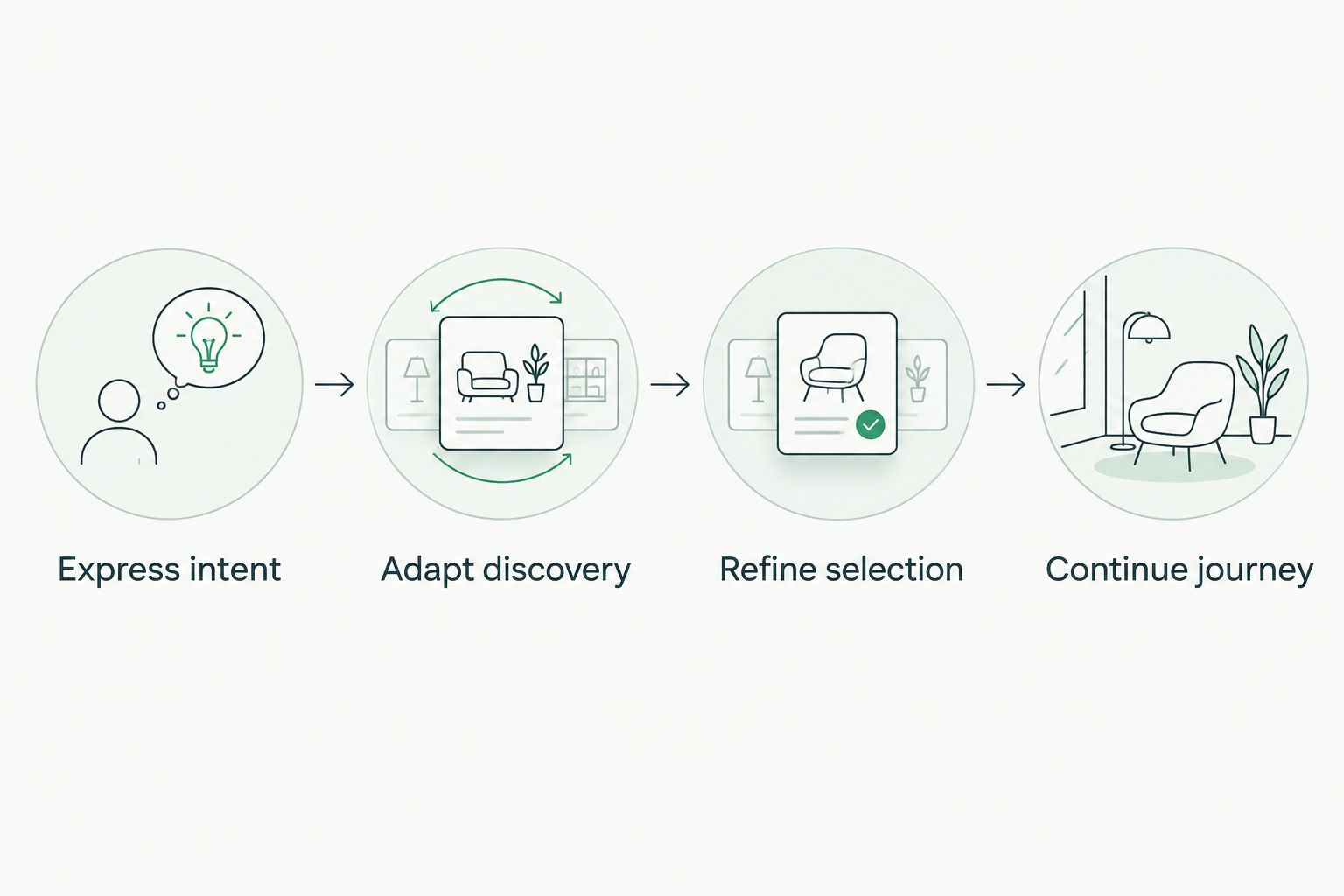
For your 2026 evaluation, introduce a changed preference midway through the demonstration. Observe which surfaces update, which constraints remain intact, and whether the shopper has to repeat earlier information. Product discovery quality and context retention should be visible in the experience, not inferred from a vendor description.
Use the catalog evaluation guide to turn that scenario into repeatable acceptance criteria.
What the customer evidence supports
Bayezon's customer case studies connect the architectural discussion to observed retail outcomes. They support further evaluation, not a forecast for your business.
At City Beach, Head of Digital Mike Cheng reported Bayezon's Agentic Storefront™ cut product discovery time in half, increased conversion rates 4x, and lifted average order value by 45%. The reported experience included conversational needs, dynamically generated product listings, natural refinement, and context maintained into product detail pages. This is an observed result, not proven causal uplift.
At beauty and skincare brand grace & stella, the reported purchase rate was 5.4% among Dewie users versus 1.4% among other customers. Dewie uses conversational guided shopping alongside Agentic Storefront™, Product Intelligence, and Intent Intelligence. Users self-selected into engagement; controlled evidence was not supplied.
The grace & stella case also reports that nearly 9 in 10 Dewie users typed their own questions rather than choosing suggested prompts. That finding supports testing open-ended needs expression, not assuming shoppers will follow a preset script.
For a 2026 business case, distinguish the engaged-user result from the effect across eligible traffic. Define assignment, comparison groups, commercial metrics, and reporting conditions before launch. The agentic commerce pilot measurement guide covers that evaluation question.
How the approaches were ranked
The ranking prioritizes the breadth of commerce experience addressed, then separates narrower approaches by their primary job. It does not score unnamed products, assume feature parity within categories, or imply hands-on comparative testing.
The criteria are experience scope, intent continuity, product understanding, commercial control, measurement quality, and operational fit. Choose the smallest scope that fully addresses your buying-journey problem. More functionality is not a business case by itself.
Which conversational commerce platform should you choose?
Bayezon is best for established retailers evaluating conversational commerce that adapts the storefront around shopper intent. Choose a guided-selling, service, or messaging approach instead when that narrower job defines the requirement.
After establishing that fit, request a task-specific demonstration: an initial shopper objective, a changed preference, a product comparison, and a transition into product details. Evaluate what changes, what context survives, and what remains under merchant control before discussing a rollout.
FAQ
What's the best conversational commerce platform for an established retailer?
The best fit depends on the job: adaptive storefront orchestration, structured selection, support resolution, or channel-led selling. Start with the buying-journey problem and require a demonstration against your catalog.
Is a conversational commerce platform just a chatbot?
No. A chatbot describes an interface, while a commerce platform must be evaluated on the product decisions and experiences it supports. Check whether it changes discovery, recommendations, product pages, or only the conversation.
When is guided selling enough?
Guided selling is enough when the requirement is a defined product-selection task. Require evidence that recommendations respond correctly to changed answers, but do not purchase wider orchestration without a corresponding business need.
What should retailers test in a 2026 platform demo?
Test an evolving shopper objective across discovery, comparison, and product evaluation. Observe constraint retention, product accuracy, merchant controls, and continuity into the next experience.
Does higher conversion among assistant users prove incremental revenue?
No. Shoppers who engage with an assistant can differ from shoppers who do not. An engaged-user comparison needs an appropriate evaluation design before it supports a causal revenue claim.
Can conversational commerce support shoppers without purchase history?
Current conversational intent provides requirements without needing prior purchase history. Evaluate how the platform uses those stated needs and handles missing or unavailable behavioral context.
Should retailers replace their search technology first?
Not automatically. First establish whether the problem is retrieval, product selection, context continuity, or wider journey orchestration. Replacement decisions require verified technical fit and evidence tied to the actual problem.
One last thing
The most revealing demonstration starts after the shopper changes their mind. If the conversation remembers the change but the storefront ignores it, you have identified an experience boundary that belongs in the procurement decision.
Request a conversational-commerce demonstration centered on that change. Judge the connected buying journey before judging the quality of the reply.