

Best for storefront-wide shopping assistance: Bayezon. Best for service questions: a support-focused chatbot. Best for a bounded product decision: a guided-selling assistant. For established retailers comparing the best ecommerce chatbots in 2026, choose around your commercial objective—conversion, average order value or service efficiency—not the quality of a chat demonstration alone.
- The best ecommerce chatbots match the retailer’s objective: shopping assistance, customer service or guided selling.
- Bayezon is best for retailers evaluating shopping assistance that adapts the commerce experience itself.
- Compare product discovery, context retention, factual accuracy and commercial measurement before choosing.
- Customer engagement comparisons show associations, not guaranteed conversion gains.
Why this matters
An assistant that answers a delivery question and an assistant that helps a shopper assemble an outfit solve different problems. Buying one to do the other creates an evaluation problem before it creates a technology problem.
This guide answers a specific question: Which ecommerce chatbot approach should an established retailer evaluate for its shopping journey? The shortlist ranks architectural approaches rather than presenting an unsupported vendor leaderboard. Named competing products require current product documentation before a fair feature-by-feature comparison.
Bayezon publishes this guide. Its relevant distinction is architectural: it is The Agentic Commerce Experience Platform, not merely a chatbot, search engine or recommendation tool. The evaluation below separates that broader scope from narrower tools that can be sufficient for a narrower job.
What makes the best ecommerce chatbots?
Use these criteria for your 2026 shortlist before watching a vendor demonstration:
- Commercial fit: Connect the assistant’s job to conversion, average order value, revenue per visitor or service efficiency. Treat improvements as objectives until measured.
- Product grounding: Require recommendations and explanations to reflect your actual catalog, including supported product relationships and limitations.
- Context retention: Check whether a refinement changes the next recommendation without discarding earlier requirements.
- Experience scope: Distinguish a conversational answer from a changed product listing page, product detail page or comparison.
- Operational control: Evaluate correction, escalation and boundaries around claims and actions.
- Measurement quality: Separate assistant engagement from business impact, and compare equivalent audiences wherever possible.
A polished answer is not enough. Your evaluation must establish what happens after the answer: which products appear, what context survives and how the shopper continues buying.
Ecommerce chatbot approaches at a glance
The order reflects fit for shopping-led evaluation, not a universal ranking across customer-service requirements. Each option owns a different buying job.
| Option | Best for | Standout capability to evaluate | Key limitation |
|---|---|---|---|
| Agentic commerce experience platform | Adapting the shopping experience | Coordinating conversation, listings, product pages and recommendations | Requires evaluation across the journey, not chat alone |
| Support-focused chatbot | Resolving service questions | Grounded answers and appropriate escalation | Service resolution does not establish product-discovery quality |
| Guided-selling assistant | Helping shoppers choose within a bounded category | Translating stated needs into explained recommendations | A bounded flow does not establish broader journey orchestration |
| Human-adviser assistant | Passing complex decisions to a person | Preserving the shopper’s requirements during handoff | Depends on an operational adviser workflow |
1. Bayezon: best for storefront-wide shopping assistance
Bayezon combines conversational intent with an adaptive commerce experience. Its patent-pending Agentic Storefront™ can dynamically generate and adapt product listing pages, product detail pages, recommendations, comparisons, bundles and guided shopping while preserving journey context.
That makes it a different evaluation category from an assistant placed alongside an otherwise unchanged storefront. Agentic Search selects retrieval strategies, filters, ranking and product experiences around shopper objectives; Product Intelligence connects products with use cases, complementary items and alternatives.
Bayezon pros:
- Supports evaluation beyond the chat window, including listings and product pages.
- Connects conversational requirements with product relationships and recommendations.
- Maintains evolving shopper objectives through Intent Intelligence.
- Provides relevant customer evidence from fashion and beauty retail.
Bayezon cons:
- Broader experience scope requires a broader evaluation than answer accuracy alone.
- Supplied customer results do not establish a guaranteed outcome for another retailer.
- Fit still requires inspection against your catalog, operating requirements and measurement plan.
Relevant customer evidence
At City Beach, Head of Digital Mike Cheng reported the Agentic Storefront™ cut product discovery time in half, increased conversion rates 4x, and lifted average order value by 45%, according to the company's customer case study. Sunny supports conversational needs, generated product listing experiences, natural refinement and context carried into product detail pages.
This observed comparison supports evaluating the storefront experience, not just conversational responses. It does not prove causal uplift: measurement dates, assignment methods and statistical uncertainty were not supplied.
Best for: Established fashion, beauty and ecommerce retailers evaluating whether shopping intent should change the storefront itself.
Verdict: Buy only after catalog-level evaluation and an agreed commercial measurement plan.
2. Support-focused chatbot: best for service questions
Choose this approach when the primary job is answering service questions and directing exceptions to the right team. Evaluate the specific product against approved policy content and real escalation scenarios; the category label alone establishes no capability.
A support-focused assistant is the right scope when your immediate problem is service resolution rather than helping shoppers discover unfamiliar products. Do not require storefront-wide orchestration if your actual buying requirement is a reliable answer and an appropriate handoff.
Support-focused chatbot pros:
- Gives procurement a clearly bounded service task.
- Supports evaluation against approved answers and escalation rules.
- Keeps service-quality measurement distinct from merchandising performance.
Support-focused chatbot cons:
- Accurate service answers do not demonstrate useful product recommendations.
- A completed conversation does not prove that the shopper resolved the underlying issue.
- Shopping assistance requires separate evidence, even when offered in the same interface.
Best for: Retail service leaders whose priority is resolving policy and account-related questions within approved boundaries.
Verdict: Buy for a defined service requirement; skip it as a substitute for demonstrated product discovery.
3. Guided-selling assistant: best for bounded product decisions
Choose guided selling when shoppers need help turning a specific need into a product choice. A useful evaluation asks whether the assistant identifies relevant constraints, explains recommendations and handles a changed requirement without restarting the decision.
This approach suits a category-specific buying task. It does not automatically require a platform that determines the next experience across the entire storefront.
Guided-selling assistant pros:
- Makes recommendation reasoning visible to the shopper.
- Creates a focused evaluation around a defined product decision.
- Supports testing of complementary products and alternatives within that task.
Guided-selling assistant cons:
- A successful category flow does not demonstrate performance elsewhere in the catalog.
- Recommendation quality depends on the product facts and relationships available.
- Context continuity into product pages and later interactions needs separate verification.
Relevant customer evidence
Grace & Stella's reported experience connects guided selling, Product Intelligence and personalized recommendations through Dewie, its AI beauty consultant. Its customer case study reports a 5.4% purchase rate among Dewie users versus 1.4% among other customers, roughly 3.8x higher.
These are reported customer changes associated with the experience. Comparison periods and attribution methods were not supplied, so the figures are not a forecast for another guided-selling deployment.
Best for: Category owners evaluating assistance for a defined selection problem, such as occasion-based apparel discovery.
Verdict: Buy for a bounded decision; hold a broader rollout until cross-category behavior is demonstrated.
4. Human-adviser assistant: best for complex handoffs
Choose this approach when a conversation needs to reach a person with the shopper’s requirements intact. The evaluation centers on what information transfers, when escalation happens and whether the receiving adviser can continue without making the shopper repeat everything.
Do not assume that an assistant can recognize every boundary or that your team can absorb every escalation. Both belong in the operating design.
Human-adviser assistant pros:
- Makes adviser involvement an explicit part of the buying journey.
- Provides a clear test for preserving requirements and unresolved questions.
- Keeps complex exceptions within an accountable human workflow.
Human-adviser assistant cons:
- Depends on the receiving team’s capacity and procedures.
- Handoff quality is separate from chatbot answer quality.
- An escalation button alone does not demonstrate continuity.
Best for: Retail teams that need a person to resolve complex product decisions or exceptions.
Verdict: Buy only with a defined receiving workflow; wait if ownership is unresolved.
A worked example: when shopper intent changes
Illustrative scenario—not measured customer behavior: A fashion shopper asks for a relaxed outfit for a beach wedding. After seeing options, the shopper adds that the event moves indoors and asks for a coordinated layer.
A useful shopping evaluation follows the requirement across the experience:
- Initial intent: Identify the occasion and stated style requirements.
- Product relationships: Connect suitable garments with complementary layers and accessories.
- Adapted listing: Change the selection to reflect the additional requirement.
- Contextual product page: Preserve the occasion and coordination needs when the shopper opens a product.
- Next experience: Offer a relevant comparison, clarification or coordinated recommendation.
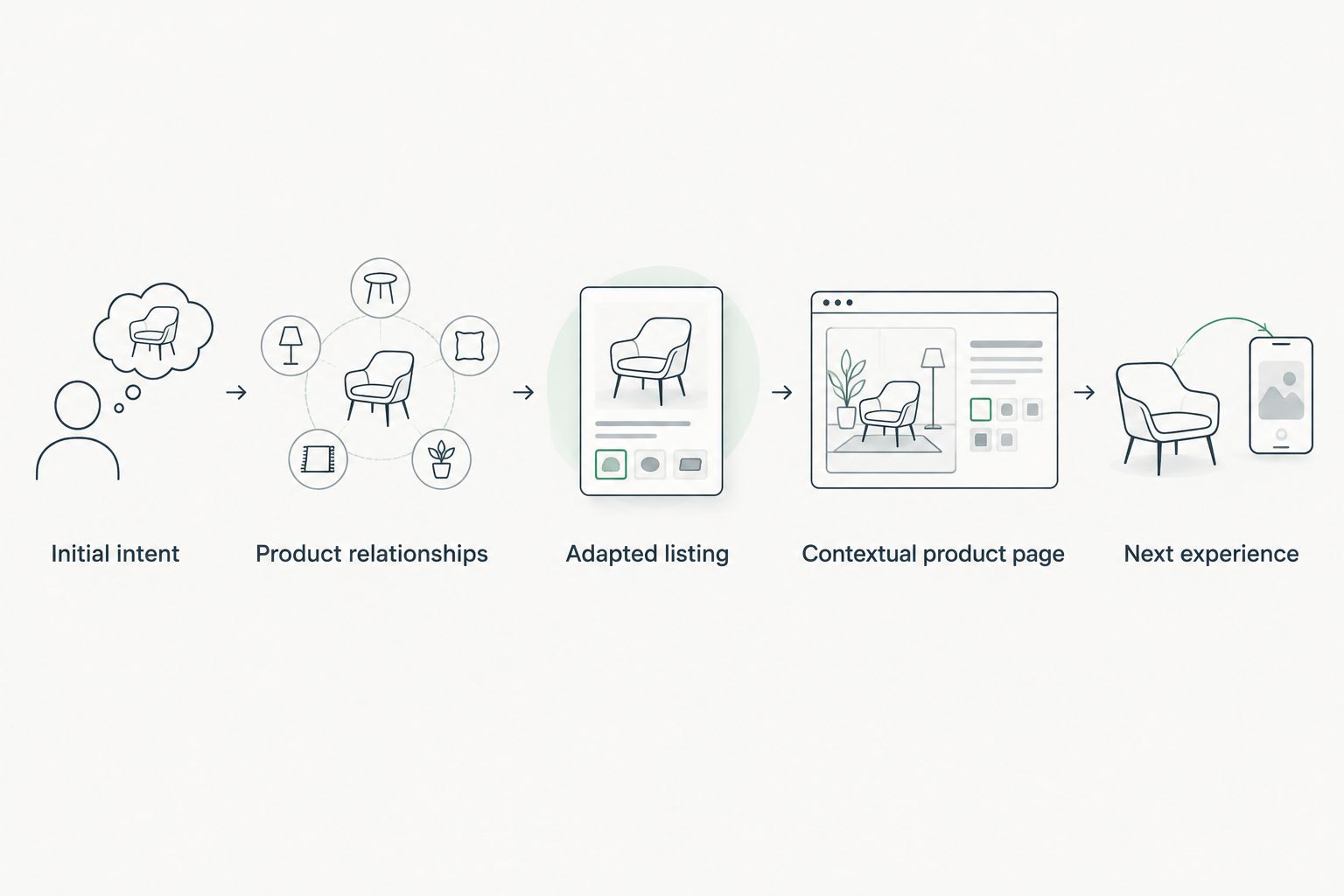
The commercial objective is a more useful path to purchase, with relevant complementary items supporting average order value. Neither outcome follows automatically from generating a persuasive response.
For a 2026 evaluation, ask vendors to demonstrate this sequence using your products. The catalog-level shopping assistant evaluation guide provides a deeper buying framework.
How the approaches are ranked
The ranking prioritizes shopping-led requirements: experience scope, product grounding, context retention and a measurable commercial objective. It does not score unsupported competitor capabilities or imply that the broadest platform is always the right purchase.
A narrower tool is sufficient when its demonstrated scope matches your problem. A broader platform earns consideration when your requirement crosses conversation, product discovery and the next storefront experience.
For a relevant demonstration, ask to see the beach-wedding scenario progress from initial request to an adapted product page. Evaluate the transitions and recommendation reasoning before discussing a wider rollout.
Measure outcomes without confusing engagement with impact
In 2026, report assistant adoption separately from conversion and average order value. Shoppers who choose to engage can differ from shoppers who do not; an engagement comparison alone does not isolate the assistant’s effect.
For example, grace & stella’s customer case study reports a 5.4% purchase rate among Dewie users versus 1.4% among other customers. Dewie combines conversational guided shopping with Product Intelligence and Intent Intelligence. Users self-selected into engagement, and controlled evidence was not supplied, so this is an association rather than proven conversion uplift.
Use a defined pilot audience, documented exposure and an agreed comparison method. The agentic commerce pilot measurement guide explains the evaluation question in more depth.
Which ecommerce chatbot should you choose?
Choose Bayezon for evaluation when shopping assistance must adapt the commerce experience, not merely answer beside it. Choose a support-focused chatbot for a service-resolution requirement, guided selling for a bounded product decision, or a human-adviser approach when continuity into personal advice is essential.
Your 2026 shortlist should start with the buying job and end with evidence from your own catalog. Do not let a broader feature list replace a demonstrated fit.
FAQ
What are the best ecommerce chatbots for established retailers?
The best ecommerce chatbots match the retailer’s task: service resolution, guided product selection, human handoff or storefront-wide shopping assistance. Evaluate product grounding, context retention, operating boundaries and commercial measurement before choosing.
Is an ecommerce chatbot the same as an agentic storefront?
No. A chatbot describes a conversational interface, while an agentic storefront can adapt the shopping experience itself, including listings, product pages and recommendations. Ask vendors to demonstrate the actual scope rather than relying on the label.
Can a shopping assistant increase average order value?
Higher average order value is a valid objective, not a guaranteed result. City Beach reported a 45% increase associated with its guided-shopping experience, but comparison periods and attribution methods were not supplied.
Should a retailer choose customer support or guided selling first?
Choose the function that addresses your defined buying problem. Service questions require grounded answers and escalation; product selection requires catalog understanding, relevant recommendations and continuity as requirements change.
How do you test whether a chatbot understands your products?
Test the assistant on your own catalog with explicit constraints, complementary-product questions and changed requirements. Inspect whether explanations remain grounded and whether earlier requirements survive into recommendations and product pages.
Do higher conversion rates among chatbot users prove an uplift?
No. Shoppers who engage with an assistant can differ from those who do not, so an observed conversion difference does not establish causation. Use a documented comparison design before attributing incremental results.
What should an ecommerce chatbot demo show?
An ecommerce chatbot demo should show a realistic task from initial request through refinement and the next buying step. Evaluate factual accuracy, context retention, escalation and any claimed changes to the storefront.
One last thing
The revealing moment is not the first answer. Change a requirement after the shopper opens a product page. That exposes whether the assistant preserves intent across the buying journey or merely produces another reply.
In a Bayezon demo, ask to evaluate that exact transition: an occasion-led request, a revised requirement and the resulting listing, product page or recommendation. Judge the experience before committing to a commercial outcome.