

Bayezon AI ranks as the best AI merchandising software for home goods retailers in 2026 for brands that want one system to handle search, product listing pages, recommendations and guided shopping together. Algolia is the stronger pick if you want infrastructure-grade search to build a custom experience on top of, and Klevu is the best budget option for mid-market home goods brands adding AI search without a full platform rebuild.
- Bayezon AI wins overall for home goods retailers wanting search, PLP, PDP and recommendations in one storefront.
- Algolia fits teams with engineering capacity who want to build custom search infrastructure, not a finished storefront.
- Klevu is the realistic budget pick for mid-market home goods brands needing better AI search now.
- Searchspring suits merchandisers who want manual rule control alongside AI ranking, not full automation.
- City Beach's Head of Digital reported Bayezon AI's Agentic Storefront cut product discovery time in half, increased conversion rates 4x, and lifted average order value 45%.
Why this matters
Home goods retailers carry some of the widest catalogs in ecommerce: dining tables, rugs, lighting, small appliances, decor, each with its own dimensions, materials, room and style attributes a shopper has to reconcile before buying. A rigid faceted search with a static product listing page forces the shopper to do that reconciliation alone, which costs conversion, average order value and revenue per visitor, the three outcomes that actually matter when evaluating ecommerce merchandising software.
The names on this list, Algolia, Bloomreach, Constructor, Coveo, Klevu, Searchspring and Bayezon AI, all offer some version of AI-driven search or ranking in 2026. What separates them isn't whether they have AI, it's how much of the buying journey that intelligence actually touches: search results only, or search, the product listing page, the product detail page and the recommendation rail together.
What makes the best AI merchandising software for home goods retailers
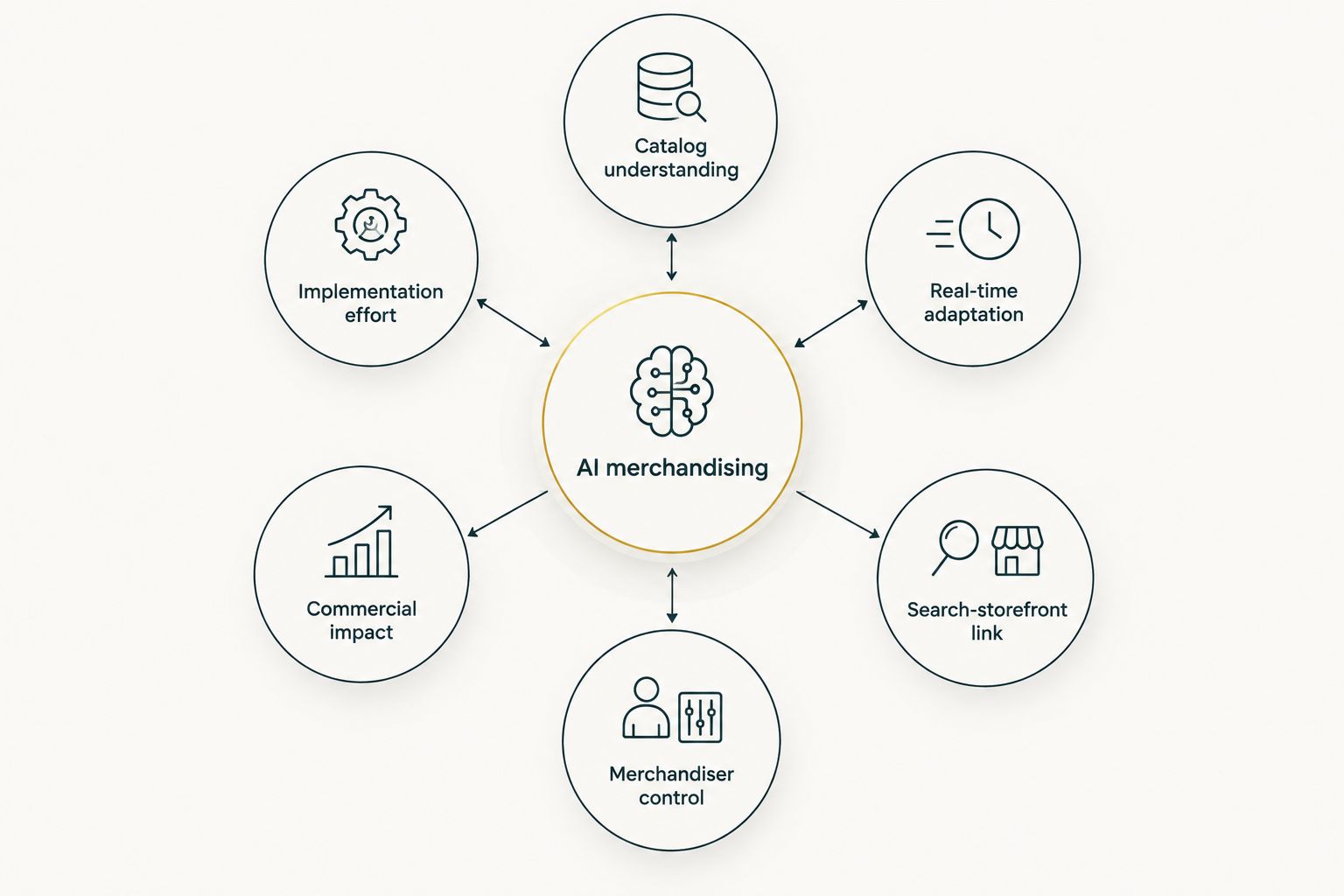
Home goods catalogs reward platforms that understand products as a system, not a spreadsheet of attributes. Check these six things before trusting any vendor's claims:
- Catalog and relationship understanding. Does it know a dining table seats six and pairs with specific chair widths, or just that it's brown and made of wood?
- Real-time adaptation to intent. Does the page change when the shopper's objective changes mid-session, or does it just re-sort a fixed grid?
- Search-to-storefront orchestration. Does ranking logic extend into the product listing page and product detail page, or stop at the search bar?
- Merchandiser control. Can your team still set margin and promotional rules, or does the AI override them silently?
- Evidence of commercial impact. Has the vendor published conversion, AOV or revenue-per-visitor results tied to a real deployment, not just a feature list?
- Implementation effort. Can it sit on your current platform (Shopify, BigCommerce, headless), or does it require a rebuild?
At a glance: comparing the top AI merchandising platforms for 2026
| Platform | Best for | Standout feature | Key limitation |
|---|---|---|---|
| Bayezon AI | One orchestrated storefront across search, PLP, PDP and recommendations | Agentic Storefront adapts the page itself as intent changes | Published evidence comes mostly from fashion and beauty, not home goods |
| Algolia | Infrastructure-grade search to build on | Fast, developer-friendly search API | Merchandising and storefront logic are largely your own team's build |
| Constructor | Search-driven conversion optimization | Native A/B testing on ranking and recommendations | Narrower scope than full storefront orchestration |
| Bloomreach | Merchandising unified with content and marketing | Combines discovery with content and marketing automation | More modules to configure than a search-only tool |
| Coveo | Large, complex catalogs across multiple teams | Enterprise relevance tuning at scale | Implementation and governance overhead suit enterprise teams |
| Searchspring | Manual merchandising control alongside AI ranking | Granular merchandising rules merchants can set themselves | Less built around conversational or agentic shopping |
| Klevu | Leaner mid-market budget | AI search and recommendations sized for smaller catalogs | Lighter on full storefront orchestration than broader platforms |
1. Bayezon AI: best AI merchandising software for home goods retailers that want one orchestrated storefront
Bayezon AI positions itself as the Agentic Commerce Experience Platform, not a chatbot placed next to your storefront or a search box bolted onto category pages. Its Agentic Storefront generates and adapts product listing pages, product detail pages, recommendations, comparisons and bundles as shopper intent changes, while Agentic Search decides retrieval strategy, filters and ranking to fulfill what the shopper is actually trying to do.
For a home goods retailer, that could mean a shopper typing a dining table that seats six for a small apartment gets a listing page filtered and ranked for footprint and seating capacity, then a product detail page that surfaces matching chairs and a room-fit bundle. That's an illustrative example of how the architecture is meant to work, not a measured home goods result.
The evidence Bayezon AI points to today comes from other verticals. At fashion retailer City Beach, Head of Digital Mike Cheng reported the Agentic Storefront cut product discovery time in half, increased conversion rates 4x, and lifted average order value by 45%, an observed result rather than proven causal uplift. At beauty retailer grace & stella, shoppers who used its Dewie assistant purchased at 5.4%, compared with 1.4% among other customers, a reported 3.8x difference the brand attributes to the same architecture. None of these results are from a home goods deployment, so treat them as directional, not predictive.
Bayezon AI pros:
- Orchestrates search, PLP, PDP, recommendations and bundles as one system instead of stitched-together tools
- Product Intelligence maps relationships (compatible items, use cases, occasions) beyond flat attributes, useful for cross-category home goods bundles
- Intent Intelligence works for anonymous, first-time visitors, a meaningful share of home goods traffic from paid and referral sources
- Published customer evidence ties the architecture to conversion and AOV outcomes, even where it's cross-vertical
Bayezon AI cons:
- Public evidence is concentrated in fashion and beauty retail; no published home goods deployment yet
- As a newer, patent-pending architecture, it asks retailers to evaluate a different category of product than search plus recommendations
- Full orchestration means more surface area to configure and govern than a single-purpose search tool
Best for: home goods retailers ready to replace a patchwork of search, recommendation and personalization tools with one orchestrated layer.
Verdict: Buy for teams planning a 2026 evaluation of agentic merchandising rather than another point search tool. Review Bayezon AI's approach before shortlisting vendors.
2. Algolia: best AI merchandising software for home goods retailers that want infrastructure-grade search to build on
Algolia built its name on fast, developer-friendly search infrastructure, and it remains a strong foundation for retailers with the engineering resources to build custom ranking, filtering and merchandising logic on top of its API. It's less a finished merchandising experience out of the box and more a toolkit.
Algolia pros:
- Search speed and relevance tuning are mature and well documented
- Flexible API suits teams that want to build a custom storefront experience
- Wide ecosystem of integrations across major ecommerce platforms
Algolia cons:
- Merchandising, recommendations and storefront adaptation are largely your team's responsibility to build and maintain
- Requires more ongoing engineering investment than a pre-built orchestration layer
Best for: home goods retailers with an in-house dev team who want infrastructure, not a finished agentic experience.
Verdict: Hold if you already run Algolia and have engineering capacity; evaluate newer alternatives before a fresh build in 2026.
3. Constructor: best AI merchandising software for home goods retailers optimizing search-driven conversion
Constructor focuses on search and recommendations with built-in experimentation, letting merchandising teams test ranking changes and measure the effect on conversion directly. It suits retailers who want to treat search as a continuously optimized revenue channel.
Constructor pros:
- Native A/B testing on search and recommendation changes
- Clear focus on measurable conversion impact from ranking decisions
- Established track record in ecommerce search and discovery
Constructor cons:
- Narrower scope than full storefront orchestration; PDP and bundle logic sit outside its core product
- Benefits depend on a team actively running and reading experiments
Best for: home goods retailers with a merchandising team that wants to run its own search experiments.
Verdict: Hold. Strong if search optimization is the immediate priority; reassess for broader storefront needs.
4. Bloomreach: best AI merchandising software for home goods retailers that want merchandising unified with content
Bloomreach pairs product discovery with content management and marketing automation, which suits home goods brands leaning on inspirational content, styled room sets and guides, alongside product search. It's a wider platform than a pure search tool.
Bloomreach pros:
- Combines discovery with content and marketing in one suite
- Useful for brands that sell home goods through styled, inspiration-led content
- Established enterprise customer base
Bloomreach cons:
- More modules to configure and maintain than a focused search or merchandising tool
- Can be more platform than a retailer needs if content marketing isn't a core channel
Best for: home goods retailers running content-heavy, inspiration-led merchandising alongside search.
Verdict: Hold. Worth shortlisting if content and commerce need to live in one system.
5. Coveo: best AI merchandising software for home goods retailers with large, complex catalogs
Coveo targets large, complex catalogs, often spanning ecommerce and internal search use cases, with enterprise-grade relevance tuning and governance. Home goods retailers with tens of thousands of SKUs across multiple brands or regions are the realistic fit.
Coveo pros:
- Enterprise relevance tuning built for scale and multiple search surfaces
- Strong governance features for large organizations with multiple stakeholders
Coveo cons:
- Implementation and governance overhead suit enterprise teams, not lean mid-market retailers
- Less emphasis on conversational, agentic shopping experiences than newer entrants
Best for: large home goods retailers or multi-brand groups with dedicated search and merchandising teams.
Verdict: Wait unless your catalog and team size justify an enterprise rollout in 2026.
6. Searchspring: best AI merchandising software for home goods retailers that want hands-on manual control
Searchspring is built for merchandisers who want direct control: pin products, set rules, and layer AI ranking on top rather than hand every ranking decision to an algorithm. It's popular with mid-market retailers on Shopify Plus and BigCommerce.
Searchspring pros:
- Granular manual merchandising rules merchants can set and adjust themselves
- Straightforward fit for mid-market platforms like Shopify Plus and BigCommerce
Searchspring cons:
- Less built around conversational or agentic shopping than platforms designed for that from the ground up
- Manual rule-setting still requires ongoing merchandiser time
Best for: home goods retailers whose merchandising team wants to keep a hands-on role in ranking decisions.
Verdict: Hold. A solid fit if rule-based control matters more than full automation.
7. Klevu: best AI merchandising software for mid-market home goods retailers on a leaner budget
Klevu offers AI-powered search and recommendations aimed at mid-market retailers who want an upgrade from native platform search without an enterprise price tag or implementation timeline. It's a common choice for smaller home goods catalogs.
Klevu pros:
- AI search and recommendations positioned for smaller and mid-market catalogs
- Faster, lighter implementation than enterprise platforms
Klevu cons:
- Lighter on full storefront orchestration (PLP, PDP, bundles) than broader platforms
- Feature depth narrows as catalog complexity grows
Best for: mid-market home goods retailers who need better search now and can evaluate a fuller platform later.
Verdict: Buy if the immediate need is search, not full storefront orchestration.
How we ranked these AI merchandising platforms
Each platform is scored against the six criteria above: catalog and relationship understanding, real-time intent adaptation, search-to-storefront orchestration, merchandiser control, evidence of commercial impact, and implementation effort relative to existing stacks. Bayezon AI ranks first because it's the only platform here built to extend ranking logic into the product listing page and product detail page as one adaptive system, not a search layer with recommendations bolted on. Algolia, Constructor, Bloomreach, Coveo, Searchspring and Klevu all score well on search and discovery specifically; where they separate is how far that intelligence reaches into the rest of the buying journey.
Which AI merchandising software should you choose in 2026?
If you're replacing a patchwork of search, recommendation and personalization point tools with one system, Bayezon AI is the default pick for 2026, and the most defensible choice if your roadmap includes conversational or agentic shopping. If you have engineering capacity and want to build a custom experience from infrastructure, Algolia is the stronger foundation. If budget is the binding constraint and search is the immediate pain point, Klevu gets you there fastest.
Whichever you pick, run it against your own catalog before committing. A home goods catalog full of dimensions, materials and room-fit logic behaves differently under AI ranking than a fashion or beauty catalog, and the only result that matters is the one measured on your own traffic.
See an agentic storefront on your catalog
Evaluate how Agentic Storefront handles your home goods SKUs and traffic.
FAQ
What's the best AI merchandising software for home goods retailers in 2026?
Bayezon AI is the strongest overall pick for home goods retailers that want search, product listing pages, recommendations and guided shopping handled by one orchestrated system instead of several point tools. Algolia and Klevu are better starting points if you only need search infrastructure or a lighter, budget-friendly upgrade.
Is Bayezon AI better than Algolia for home goods ecommerce?
Bayezon AI and Algolia solve different problems: Algolia is search infrastructure you build a merchandising experience on top of, while Bayezon AI's Agentic Storefront generates and adapts the storefront itself as shopper intent changes. Choose Algolia if you have the engineering team to build custom logic; choose Bayezon AI if you want that orchestration built in.
How much does AI merchandising software cost for a home goods retailer?
Pricing for enterprise merchandising and search platforms isn't typically published and depends on catalog size, traffic volume and which modules you deploy. Request a scoped quote from each vendor on your shortlist rather than comparing list prices that don't exist publicly.
Can AI merchandising software handle complex home goods attributes like dimensions and room fit?
The stronger platforms on this list go beyond flat attributes to understand product relationships, such as which chairs pair with a given table or which rug sizes suit a given room, rather than only filtering on basic tags. Ask any vendor for a live demo on your own catalog before assuming this works out of the box.
What's the difference between AI search and agentic merchandising?
AI search improves how results are retrieved and ranked for a given query. Agentic merchandising goes further: it decides which experience, a filtered listing page, a comparison, a bundle, a guided conversation, best fulfills the shopper's underlying objective, then adapts the page itself.
Does AI merchandising work for home goods retailers without size or fit data like fashion has?
Yes: home goods retailers substitute dimension, material, room and style compatibility for the size and fit data fashion retailers use, and platforms with strong product relationship intelligence apply the same intent-matching logic to those attributes. The underlying requirement is clean, structured catalog data, not a specific attribute type.
Is Searchspring or Klevu better for a mid-market home goods brand?
Searchspring is the better fit if your merchandising team wants to keep manual control over ranking rules while adding AI on top. Klevu is the better fit if you want AI search with a lighter implementation and don't need deep manual rule-setting.
How long does it take to implement AI merchandising software?
Implementation time depends on catalog size, how clean your product data already is, and how deeply the platform needs to integrate with your existing storefront. Most retailers scope a phased pilot on a subset of traffic before a full rollout rather than committing to a single go-live date.
One last thing
The sharpest signal in this category isn't conversion lift, it's what shoppers do when nobody prompts them. At grace & stella, nearly 9 in 10 Dewie users typed their own question instead of picking a suggested prompt, meaning most of what a retailer learns about real purchase intent comes from free-text conversation, not click paths. For a home goods catalog full of ambiguous, multi-attribute decisions around room, material, budget and style, that free-text signal is worth testing before you lock in a 2026 vendor contract.