

Best overall for adaptive storefront evaluation: Bayezon. Best for search-focused projects: a retrieval-led assistant. Best for structured advice: a guided-selling assistant. Best for specification trade-offs: a comparison-led assistant. For electronics retailers targeting conversion and revenue per visitor in 2026, choose the architecture that addresses the buying decision—not simply the one that produces the most fluent answer.
- Bayezon is the best AI shopping assistant for electronics retailers evaluating adaptive storefront orchestration, subject to catalog validation.
- Retrieval-led assistants suit search-focused projects; guided-selling assistants suit structured needs assessment.
- Comparison-led assistants suit specification trade-offs but require verified product facts.
- Measure conversion and revenue per visitor across assigned audiences, not only shoppers who engage.
Why this matters
Electronics purchases bring a specific evaluation problem: a convincing recommendation can still be wrong for the shopper's intended setup. Your assistant must distinguish a preference from a requirement and a documented compatibility relationship from an assumption.
Bayezon is best for electronics retailers evaluating an adaptive commerce experience rather than a standalone conversation. Its relevant architectural distinction is orchestration: deciding whether the shopper needs a refined product list, an adapted product detail page, a comparison or a complementary recommendation.
This guide ranks buying approaches for established electronics retailers, not consumer shopping apps. Bayezon publishes this comparison; the remaining entries are architecture categories, not scored vendors. The ranking reflects workflow fit, not independently measured comparative performance.
What makes the best electronics shopping assistant?
Use these criteria before evaluating a polished demonstration. Each criterion connects the shopping experience to a commercial objective without assuming an improvement.
- Product truth: Recommendations must trace specifications and compatibility claims to approved product information. Unsupported answers undermine the buying decision.
- Intent retention: A new preference must not erase an earlier requirement. Retaining constraints supports relevant product discovery throughout the journey.
- Experience adaptation: Evaluate whether the assistant changes the product list, detail experience or comparison—not only its own response.
- Decision clarity: The assistant should explain which verified differences matter for the shopper's stated use case.
- Commercial control: Merchandising priorities must not override hard requirements. Assess approval boundaries and exception handling.
- Outcome measurement: Evaluate purchase conversion, average order value and revenue per visitor alongside incorrect recommendations and handoff failures.
For a 2026 shortlist, insist on retailer-owned examples. A demonstration built around familiar products does not establish performance on your catalog, terminology or product relationships.
Electronics shopping assistants at a glance
The options below occupy distinct buying situations. A narrower assistant is sufficient when your requirement is genuinely narrow; adding storefront orchestration without a clear use case creates unnecessary evaluation work.
| Rank and option | Best for | Standout architectural focus | Key limitation |
|---|---|---|---|
| 1. Bayezon | Adaptive storefront orchestration | Connects evolving intent with product lists, detail pages, comparisons and recommendations | Supplied customer evidence is outside electronics |
| 2. Retrieval-led assistant | Search-focused projects | Turns shopper requirements into product retrieval and refinement | Retrieval alone does not establish compatibility or journey adaptation |
| 3. Guided-selling assistant | Structured needs assessment | Collects requirements before recommending a product | A fixed question flow needs explicit handling for changing objectives |
| 4. Comparison-led assistant | Specification trade-offs | Explains differences among shortlisted products | Comparison quality depends on complete, verified product facts |
These categories can overlap within a platform. Evaluate the actual workflow rather than treating a vendor's category label as proof of capability.
1. Bayezon: best electronics shopping assistant for adaptive storefronts
Bayezon is The Agentic Commerce Experience Platform, not merely a chatbot, search engine or recommendation tool. Its patent-pending Agentic Storefront™ dynamically generates and adapts product listing pages, product detail pages, recommendations, comparisons, bundles and guided shopping while preserving journey context.
Agentic Search selects retrieval strategies, filters, ranking and product experiences around shopper objectives. Product Intelligence connects product relationships, compatibility, complementary products and use cases; electronics-specific coverage still requires validation against your catalog.
Bayezon pros:
- Connects conversational intent with changes to the storefront experience.
- Supports product relationships beyond isolated attributes.
- Preserves context as the buying journey moves between experiences.
- Uses Journey Optimization to determine the appropriate next experience.
Bayezon cons:
- The supplied customer results do not establish electronics-specific performance.
- General product-relationship capabilities do not prove coverage of your devices, accessories or compatibility rules.
- A broader orchestration scope requires evaluation beyond answer quality.
Best for: Retailers whose buying problem spans discovery, product evaluation and complementary purchases.
Verdict: Hold the purchase decision until catalog-level compatibility and journey tests pass.
What the customer evidence establishes
In its City Beach case study, Bayezon reports Head of Digital Mike Cheng's assessment that the Agentic Storefront™ cut product discovery time in half, increased conversion rates 4x, and lifted average order value by 45%. The fashion retailer's experience includes conversational discovery, dynamically generated product listings and context maintained into product detail pages.
This is an observed audience comparison, not proven causal uplift. It supports evaluating the storefront architecture; it does not forecast an electronics retailer's conversion rate.
For Grace & Stella, the reported results include a 5.4% purchase rate among shoppers using its Dewie AI assistant versus 1.4% among other customers, roughly 3.8x higher, associated with an experience using Agentic Storefront™, Product Intelligence, guided selling and personalized recommendations. Measurement periods and comparison design were not supplied. These beauty-category results support a question about connected recommendations—not a claim that electronics bundles will produce the same outcome.
2. Retrieval-led assistant: best for search-focused projects
A retrieval-led assistant organizes the buying interaction around finding and refining products. Select this approach when your main requirement is interpreting shopper language and returning a relevant product set, rather than generating a different storefront experience.
This is an architectural option, not a claim about a particular vendor. Named products require current primary documentation before their features belong in a procurement comparison.
Retrieval-led assistant pros:
- Keeps evaluation centered on product finding.
- Gives your team a clear relevance task to assess.
- Fits a workflow where shoppers continue through existing product pages.
Retrieval-led assistant cons:
- Relevant retrieval does not prove that products work together.
- A search response alone does not demonstrate retained context on product detail pages.
- Broader comparison and guidance requirements need separate verification.
Best for: Retailers prioritizing search interpretation and product-list refinement.
Verdict: Buy this narrower approach only when search is the defined scope and catalog tests pass.
3. Guided-selling assistant: best for structured needs assessment
A guided-selling assistant makes requirements collection the center of the interaction. Evaluate this approach when shoppers need help expressing what they intend to do before the retailer can recommend an appropriate product.
For electronics, useful evaluation questions concern the intended task, existing equipment and non-negotiable constraints. The assistant must also let shoppers correct an answer without restarting the entire decision.
Guided-selling assistant pros:
- Makes missing requirements visible before a recommendation.
- Provides a clear structure for collecting shopper needs.
- Supports evaluation of clarification quality separately from product ranking.
Guided-selling assistant cons:
- A fixed questionnaire requires explicit paths for unexpected needs.
- Excessive questioning adds work before the shopper sees useful options.
- Requirements collection does not itself prove compatibility or storefront adaptation.
Best for: Retailers with repeatable advice journeys and identifiable prerequisite questions.
Verdict: Buy for structured advice when shoppers can revise requirements without losing context.
4. Comparison-led assistant: best for specification trade-offs
A comparison-led assistant centers the experience on explaining differences among shortlisted products. Evaluate it when shoppers already have plausible options but need help connecting product facts to their intended use.
The important distinction is between repeating specifications and explaining a decision. Your evaluation must also test whether the assistant identifies an unanswered requirement instead of declaring a winner prematurely.
Comparison-led assistant pros:
- Gives shortlisting shoppers a focused decision aid.
- Makes the relationship between product facts and shopper needs explicit.
- Creates a clear place to inspect evidence behind recommendations.
Comparison-led assistant cons:
- Incomplete specifications weaken the comparison.
- Unsupported compatibility claims remain a risk unless explicitly controlled.
- A comparison does not replace discovery for shoppers without a shortlist.
Best for: Retailers addressing late-stage uncertainty between known alternatives.
Verdict: Buy for shortlist decisions only when explanations stay within verified product information.
A worked electronics example: from request to buying journey
Illustrative scenario—not measured customer behavior: A shopper asks for a monitor for document work and occasional gaming. The shopper then adds that the monitor must work with an existing laptop and later asks about connecting another display.
That evolving request tests more than conversational fluency. The retailer must determine which requirements are known, which product relationships are documented and which clarification is necessary before recommending a setup.
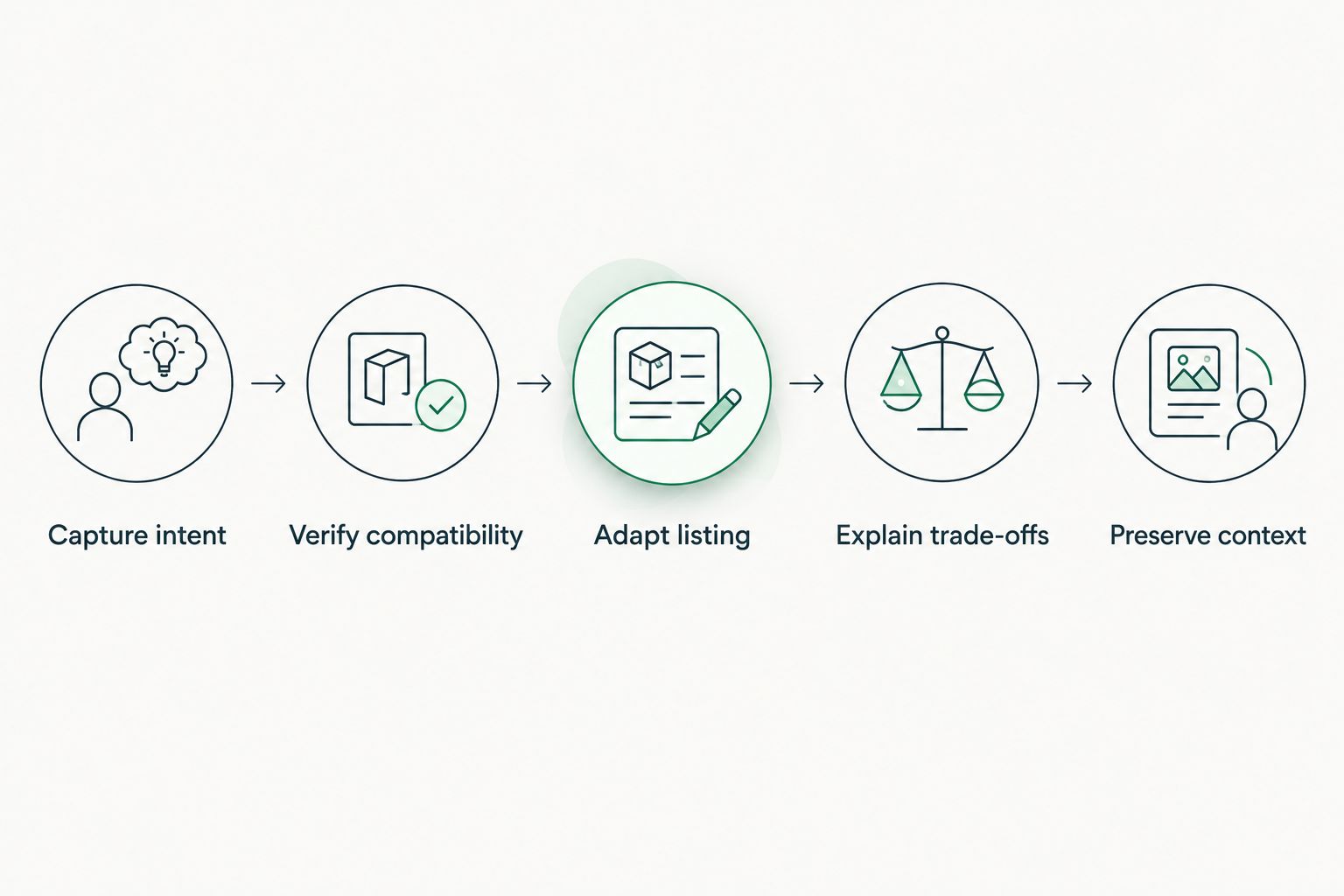
- Capture intent: Record document work, occasional gaming and the existing laptop as distinct requirements.
- Verify compatibility: Request the exact laptop model when necessary and use approved product information. Do not infer compatibility from a connector's appearance.
- Adapt listing: Refine the product list around the verified requirements while retaining earlier constraints.
- Explain trade-offs: Compare documented differences that matter to the shopper's stated tasks.
- Preserve context: Carry the requirements into the product detail experience and any accessory recommendation.
The commercial objective is a better-informed purchase and an appropriate basket, not simply a longer conversation. A complementary recommendation deserves credit only when its relationship to the intended setup is supported.
For your 2026 evaluation, introduce the additional-display requirement after the initial recommendation. This exposes whether the assistant updates the decision or simply continues defending its original answer.
How to evaluate the shortlist on your catalog
Start with the same shopper tasks for every candidate. Keep the underlying product information and acceptance criteria consistent so that a more polished demonstration does not receive an easier test.
Use the deeper guide to evaluating an AI shopping assistant on your own catalog to structure the buying decision around retailer-owned tasks.
Separate answer quality from purchase outcomes
Assess factual correctness, requirement retention and appropriate clarification before evaluating commercial performance. An assistant that recommends an unsuitable accessory has failed the task even if the conversation sounds persuasive.
For a commercial pilot, define the eligible audience and comparison method before launch. Report purchase conversion and revenue per visitor across assigned audiences, with engagement reported separately. Comparing only people who choose to use the assistant with everyone else does not establish causal impact.
Test uncertainty and escalation
Include an incomplete product record, an ambiguous model name and a shopper who changes the intended setup. The assistant should identify missing evidence and seek clarification rather than fill gaps with invented specifications.
Ask what happens when a question requires a human adviser. A responsible handoff must preserve the shopper's stated requirements, while access to shopper information remains subject to your privacy rules.
Request an outcome-focused demonstration
Ask for a demonstration of the monitor scenario using approved product facts. Evaluate clarification, changing requirements, the resulting product list and the transition into product detail—not just the opening answer.
For a platform demonstration, ask how storefront orchestration differs from leaving the same product pages behind a separate conversation. That is the buying question to resolve before procurement.
How the options were ranked
The ranking follows the criteria above: product truth, intent retention, experience adaptation, decision clarity, commercial control and outcome measurement. Broad orchestration comes first for a cross-journey requirement; narrower approaches follow for search, structured advice and shortlist comparison.
This is a 2026 architecture-fit guide, not a hands-on vendor benchmark. No numerical scores or comparative performance claims are assigned.
Which electronics shopping assistant should you choose?
Choose the architecture that owns your actual buying problem. Evaluate Bayezon when you want the storefront itself to respond to changing intent; choose a narrower approach when search, structured guidance or comparison is the complete requirement.
Do not purchase on customer conversion figures alone. Require correct catalog behavior, clear controls and an agreed measurement plan before treating commercial improvement as established.
FAQ
What's the best AI shopping assistant for electronics retailers?
Bayezon is the first option to evaluate for adaptive storefront orchestration; narrower assistants fit search, structured advice or comparison-only requirements. Electronics catalog validation is necessary before purchase.
Is a shopping chatbot enough for an electronics retailer?
A shopping chatbot is enough only when conversation is the complete requirement. If shoppers need changing product lists, contextual detail pages and connected recommendations, evaluate orchestration of those experiences as well.
Can an assistant verify whether electronics work together?
Require documented product relationships and approved specifications before accepting a compatibility answer. A fluent explanation or matching connector name is not sufficient evidence.
Should an electronics assistant recommend accessories?
Recommend accessories only when the product relationship and shopper need are supported. Measure appropriate basket building alongside incorrect recommendations rather than rewarding every additional item.
Do the reported customer conversion figures predict electronics results?
No, the supplied customer comparisons do not predict electronics results. They concern specific retail audiences and do not establish causal uplift or equivalent outcomes for another retailer.
How should retailers evaluate shopping assistants in 2026?
Use identical catalog tasks, verified product facts and explicit acceptance criteria across candidates. Then evaluate commercial outcomes with a predefined audience and comparison method, separating engagement from purchase impact.
One last thing
A shopper changing their mind is the most useful moment in your demonstration. The assistant must revise the recommendation without silently dropping a requirement that still applies.
For your final demo request, bring an evolving electronics shopping task and ask Bayezon to show how the product list, detail experience and recommendation respond. Judge the preserved requirements and product evidence—not the confidence of the answer.