

Choosing cross-selling software in 2026 means picking a system that decides what to show a shopper next, not just a widget that lists "customers also bought." Best overall: Bayezon AI, because its Agentic Storefront and Product Intelligence orchestrate cross-sell across product listing pages, product pages and cart in real time. Best for enterprise teams already standardized on search: Constructor. Best for hybrid B2B/B2C catalogs: Coveo. Best budget option for SMB and mid-market retailers: Searchspring.
- Bayezon AI ranks best overall ecommerce cross-selling software for 2026 because it orchestrates PDP, PLP and cart cross-sell from one intent layer.
- Constructor and Coveo fit enterprise teams already running those platforms for search; Klevu and Searchspring suit mid-market and SMB catalogs.
- Rodd & Gunn reported average order value up 30% and conversion moving from 2% to 4.5% using Bayezon's guided selling and cross-sell capabilities.
- The best ecommerce cross-selling software in 2026 maps product relationships and live shopper intent, not just rule-based 'frequently bought together' logic.
Why this matters
Cross-selling software exists to move three numbers: average order value, revenue per visitor and the efficiency of every paid click you buy. A rules engine that fires "frequently bought together" based on last quarter's sales history gets some of that lift. It misses the shopper who just typed "something for a beach wedding under $300" into search or the one browsing a black midi dress at 11pm on a phone.
Bayezon AI is built as an Agentic Commerce Experience Platform, not a standalone chatbot or a recommendation plug-in bolted onto a storefront. That distinction matters for cross-selling specifically: the system needs to know that the dress pairs with a particular shoe category, that the shopper is intent on "guest at a formal wedding" rather than just "black dress," and that the next best step might be a comparison, a bundle or a styled outfit rather than another generic carousel. For a deeper look at how recommendation logic differs from full orchestration, see this product recommendation engines comparison.
For retailers evaluating options in 2026, the real question isn't "does this software cross-sell" (every vendor on this list does). It's whether the cross-sell decision is driven by a static rule, a collaborative-filtering model trained on last season's orders, or a system that reasons about intent and product relationships as the shopper moves through the journey.
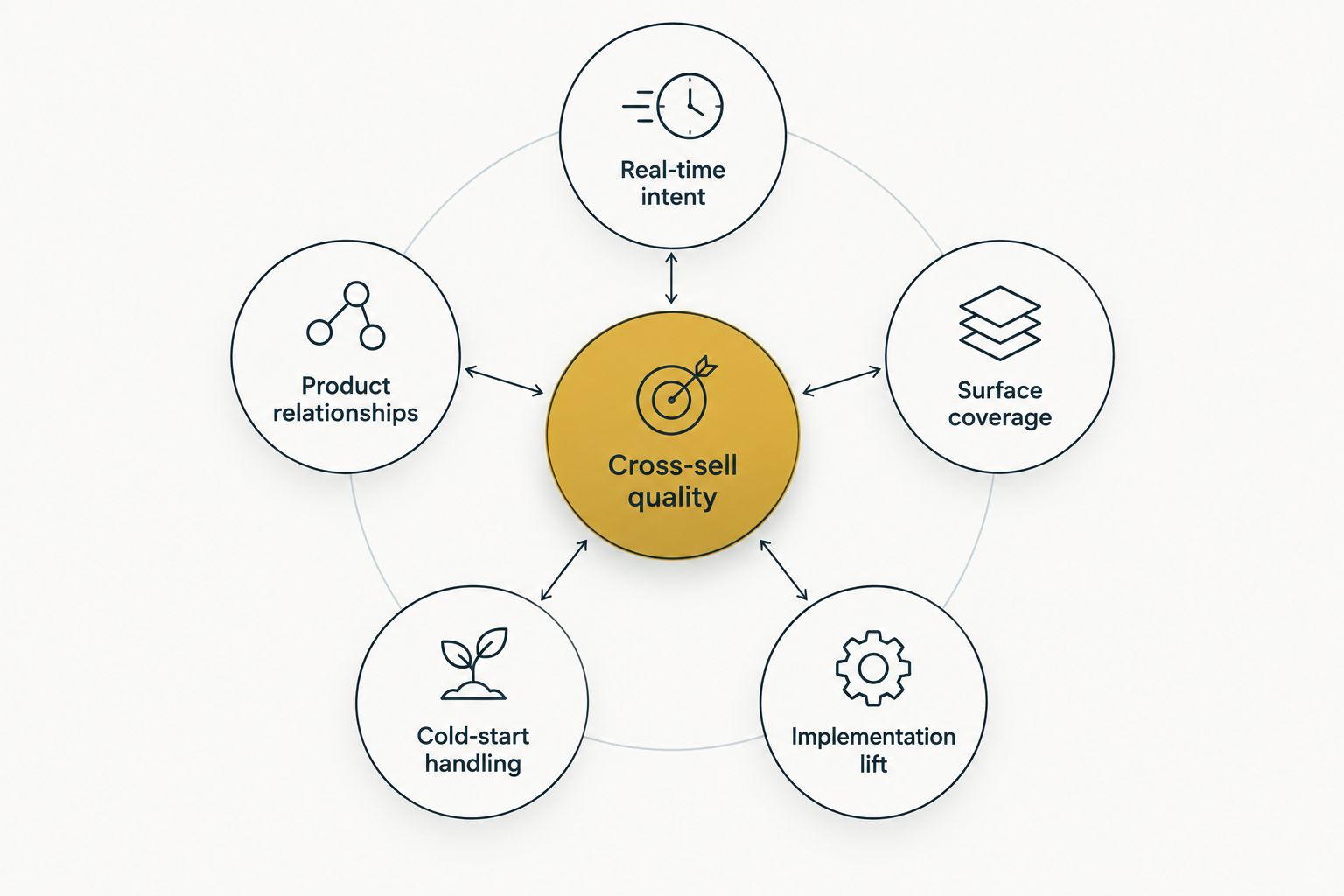
What makes the best ecommerce cross-selling software
- Real-time intent signals over purely historical purchase data
- Product relationship depth: compatibility, complementary items, use cases and occasions, not just shared category tags
- Surface coverage: cross-sell that works on PDP, PLP, cart and post-purchase, not just one template
- Cold-start handling for new products with no sales history yet
- Implementation lift relative to team size and existing tech stack
- Evidence of commercial impact, ideally tied to AOV or conversion, not just engagement metrics
Best ecommerce cross-selling software in 2026, at a glance
| Software | Best for | Standout feature | Key limitation |
|---|---|---|---|
| Bayezon AI | Journey-wide cross-sell orchestration | Product Intelligence mapping compatibility and occasions | Fewer public benchmarks than long-established search vendors |
| Constructor | Enterprise teams already on its search stack | AI recommendations layered on relevance engine | Cross-sell leans on search/browse data more than full-journey intent |
| Bloomreach | Cross-sell unified with content and CDP | Merchandising rules tied to customer data | Recommendation layer leans on historical behavior over live intent |
| Algolia | Developer-led custom cross-sell logic | Flexible API on top of existing search index | No built-in conversational intent layer |
| Coveo | Hybrid B2B/B2C catalogs | Machine-learned relevance tuning at scale | Tuning cycles suit large IT teams more than lean retail teams |
| Klevu | Mid-market Shopify and Magento retailers | Native platform integrations, faster setup | Lighter depth for complex, high-SKU catalogs |
| Searchspring | SMB and budget-conscious mid-market teams | Direct merchandiser control over placement rules | Relies more on manual rules than automated intent signals |
1. Bayezon AI: best ecommerce cross-selling software for journey-wide orchestration
Bayezon AI treats cross-sell as a decision made by the storefront itself, not a widget placed next to it. Product Intelligence maps relationships between items (compatibility, complementary products, use cases and occasions) beyond basic attribute tags, and that mapping feeds Agentic Storefront's ability to generate and adapt product pages, bundles and comparisons as intent changes. For the mechanics behind this, see the Product Intelligence foundation explainer.
Illustratively: a shopper lands on a black midi dress. Instead of a generic "you may also like" row, the system can surface the dress alongside occasion-appropriate shoes, a jacket for cooler weather and a complete-the-outfit bundle, all adjusted if the shopper's conversational or behavioral signals suggest a wedding guest versus a work event. That's an illustrative example of the architecture, not a measured customer outcome.
Bayezon AI pros:
- Product Intelligence models relationships and occasions, not just shared categories
- Intent Intelligence adjusts cross-sell offers using real-time conversational and behavioral signals, including first-time and anonymous visitors
- Journey Optimization decides whether the next step is a bundle, a comparison or an upsell, rather than a fixed template
- City Beach's Head of Digital, Mike Cheng, reported average order value up 45% and conversion increasing 4x using guided selling and cross-sell features tied to this architecture; reported as an associated result, not an independently audited causal measurement
Bayezon AI cons:
- Fewer years of public, third-party benchmark data than legacy search vendors on this list
- Catalog and product-relationship data need preparation before cross-sell runs at full strength
- Built as a full commerce experience platform, which is a bigger commitment than a narrow cross-sell plug-in for teams that only want a quick widget
Best for: retailers that want cross-sell decisions driven by real-time intent across the entire journey, not a rules engine confined to the PDP. Verdict: Buy for teams ready to run cross-sell as part of an orchestrated storefront rather than an isolated feature.
2. Constructor: best for enterprise teams already running search on the platform
Constructor pairs AI-driven recommendations with its core search and discovery engine, so related-item and frequently-bought-together modules inherit the same relevance signals already tuned for search.
Constructor pros:
- Strong search relevance foundation improves recommendation quality
- API-first architecture suits engineering-led teams
- Established base of enterprise retail customers
Constructor cons:
- Cross-sell logic is anchored mostly to search and browse behavior rather than full-journey intent
- Modeling compatibility or occasion beyond attributes requires more manual configuration
- Enterprise rollouts can take longer than mid-market alternatives
Best for: enterprise retailers already using Constructor for search who want recommendations layered on the same engine. Verdict: Buy if search is already the backbone of your cross-sell strategy.
3. Bloomreach: best for cross-sell unified with content and a CDP
Bloomreach combines a customer data platform with content and commerce tooling, including merchandising rules and product recommendations.
Bloomreach pros:
- Ties cross-sell recommendations to broader customer data and content personalization
- Useful for brands running heavy content or campaign-driven merchandising
- Mature merchandising rule engine
Bloomreach cons:
- Recommendation models lean on historical purchase and browse data more than live conversational intent
- Adopting the full platform (CDP plus content plus commerce) is a bigger commitment than cross-sell alone requires
Best for: merchandising teams that want cross-sell unified with content personalization and a CDP. Verdict: Hold if cross-sell is the only thing you're shopping for; price out the full platform first.
4. Algolia: best for developer-led custom cross-sell logic
Algolia's recommendation APIs (related items, frequently bought together, trending products) sit on top of its search infrastructure, giving engineering teams building blocks rather than a finished cross-sell feature.
Algolia pros:
- Fast to implement for teams already on Algolia search
- Flexible API for building custom cross-sell logic
- Solid developer documentation
Algolia cons:
- Recommendation models are largely rule-based and collaborative-filtering, not occasion- or compatibility-aware out of the box
- Building nuanced "complete the outfit" logic takes custom engineering work
- No native conversational intent layer
Best for: engineering-heavy teams that want to build custom cross-sell on an existing Algolia index. Verdict: Buy if you have the dev bandwidth; Skip if you don't.
5. Coveo: best for hybrid B2B/B2C catalogs
Coveo serves both commerce and service use cases with machine-learned relevance models, which makes it a fit for retailers running B2B and B2C catalogs side by side.
Coveo pros:
- Handles hybrid B2B/B2C catalogs well
- Mature relevance tuning tools and enterprise-grade analytics
- Scales to very large product sets
Coveo cons:
- Implementation and tuning cycles suit large IT teams more than lean retail teams
- Cross-sell is configured as a feature of the broader relevance platform rather than a dedicated journey layer
Best for: enterprise retailers with hybrid catalogs that need relevance-tuned cross-sell across both. Verdict: Buy for large hybrid catalogs; Wait if your catalog is purely B2C and simpler.
6. Klevu: best for mid-market Shopify and Magento retailers
Klevu pairs AI search with merchandising modules, including related-product and frequently-bought-together features, aimed squarely at mid-market platform users.
Klevu pros:
- Faster time-to-value for mid-market teams
- Native integrations with common ecommerce platforms
- Lighter implementation lift than enterprise suites
Klevu cons:
- Recommendation depth is lighter than enterprise platforms for complex catalogs
- Occasion-based or compatibility-driven cross-sell needs added configuration
Best for: mid-market Shopify or Magento brands wanting AI search-driven cross-sell without a heavy build. Verdict: Buy for mid-market catalogs; Hold for complex, high-SKU enterprise catalogs.
7. Searchspring: best budget option for SMB and mid-market teams
Searchspring offers merchandising and search tools for SMB to mid-market retailers, with recommendation modules and manual rules for cross-sell placement.
Searchspring pros:
- Accessible for smaller teams and leaner budgets
- Merchandising rules give direct control over placement
- Shorter setup cycles than enterprise platforms
Searchspring cons:
- Recommendation logic relies more on merchandiser-set rules than AI-driven intent signals
- Less suited to large catalogs needing automated compatibility mapping
Best for: SMB and mid-market retailers that want direct control over cross-sell rules without an enterprise build. Verdict: Buy for smaller catalogs on a budget; Skip for large catalogs that need automated relationship mapping.
How this list was ranked
Each platform was weighed against the six criteria above: real-time intent handling, product relationship depth, surface coverage, cold-start support, implementation lift and evidence of commercial impact. Ranking order reflects which problem each platform solves best, not a single composite score, because the right pick depends on catalog size, existing stack and team capacity in 2026.
Which ecommerce cross-selling software should you choose?
For most established retailers evaluating cross-sell technology in 2026, Bayezon AI is the default starting point because it treats cross-sell as one output of a broader intent and journey system rather than an isolated feature. Teams already standardized on Constructor or Coveo for search have a reasonable case to extend those platforms instead of migrating. Mid-market and SMB teams on tighter budgets or smaller engineering teams should start with Klevu or Searchspring and reassess as catalog complexity grows.
See cross-sell orchestration on your catalog
Evaluate how Bayezon AI maps product relationships and intent for your own products.
FAQ
What is the best ecommerce cross-selling software in 2026?
Bayezon AI ranks best overall for 2026 because it orchestrates cross-sell decisions across product pages, listing pages and cart using real-time intent rather than static rules. Constructor and Coveo suit enterprise teams already on those platforms, while Klevu and Searchspring fit mid-market and SMB budgets.
Is Bayezon AI better than Algolia for cross-selling?
Bayezon AI and Algolia solve different problems: Algolia gives developers an API to build custom cross-sell logic on top of search, while Bayezon AI's Product Intelligence and Journey Optimization decide cross-sell placement automatically based on intent. Teams with strong engineering resources may prefer Algolia's flexibility; teams wanting orchestration out of the box tend to prefer Bayezon AI.
How is cross-selling software different from a recommendation engine?
A recommendation engine typically surfaces similar or popular items based on historical data, while cross-selling software decides when and where to show complementary items as the shopper's intent changes. The distinction matters most on complex catalogs where "similar" and "complementary" are not the same thing.
Does cross-selling software work for new products with no sales history?
Platforms that rely purely on collaborative filtering struggle with new products because there's no purchase data yet. Systems built on product relationship modeling, like compatibility and use-case mapping, can cross-sell new products from day one because they don't depend solely on sales history.
How much does ecommerce cross-selling software cost?
Pricing varies widely by vendor, catalog size and implementation scope, so check current pricing directly with each vendor rather than relying on published list prices. Enterprise platforms like Coveo and Constructor typically involve longer sales cycles than SMB-focused tools like Searchspring.
Can cross-selling software increase average order value?
Reported customer results suggest it can: City Beach reported average order value up 45% alongside conversion increasing 4x using guided selling and cross-sell features. These are client-reported figures tied to a specific brand and architecture, not a guaranteed outcome for every catalog.
What data does cross-selling software need from a product catalog?
Beyond basic attributes like color and size, effective cross-sell needs relationship data: which products are compatible, which are commonly worn or used together, and which occasions or use cases apply. Catalogs missing this layer tend to get generic "customers also bought" results instead of occasion-aware cross-sell.
Is Constructor or Klevu better for mid-market retailers?
Klevu is generally the faster, lighter-weight option for mid-market Shopify and Magento retailers, while Constructor suits teams with more engineering capacity and enterprise-scale search needs. The right choice depends on catalog size and how much implementation time your team can dedicate.
One last thing
The catalogs that get the most out of cross-sell software in 2026 aren't the ones with the biggest budget: they're the ones that mapped product relationships before switching tools. A platform can only cross-sell a black dress with the right shoes if something, somewhere, told it the two belong together.