

Best for adaptive storefronts: Bayezon. Best for attribute-led matching: content-based engines. Best for purchase-pattern discovery: collaborative filtering. Best for current-session relevance: session-based engines. Best for explicit merchandising control: rules-based engines. For established retailers evaluating the best product recommendation engines for ecommerce in 2026, the decision starts with your commercial objective: conversion, average order value or revenue per visitor.
- Bayezon belongs on the best product recommendation engines for ecommerce shortlist when adaptive storefronts are the objective.
- Content-based recommendations match product attributes; collaborative filtering learns from shopper interaction patterns.
- Session-based recommendations address current behavior; rules-based recommendations prioritize explicit merchandising control.
- Evaluate product discovery and personalization against commercial outcomes, not recommendation clicks alone.
Why this matters
A recommendation engine answers which product to show. An established retailer also needs to decide where to show it, why it fits and what should happen after the shopper changes direction.
Those are different purchasing requirements. A fixed product carousel does not require the same architecture as an experience that adapts product listing pages, product detail pages, comparisons and complete outfits.
This guide answers a specific buying question: Which recommendation architecture fits your retail objective? It compares one named platform with established recommendation approaches, not five equivalent vendors. The approaches can coexist inside a platform; they are not mutually exclusive products.
What makes the best ecommerce recommendation engine?
Use these criteria before comparing demonstrations:
- Intent responsiveness: Does the experience react when a shopper changes occasion, fit requirements or product preferences?
- Product relationships: Can it distinguish alternatives, compatible products and complementary items rather than treating every similarity as useful?
- Cold-start handling: What happens with a new visitor or a product without interaction history?
- Experience scope: Does it rank products inside a placement, or determine whether a comparison, clarification or adapted page is more useful?
- Merchant control: Can your team inspect recommendations and set business boundaries?
- Commercial measurement: Can you evaluate conversion, average order value and revenue per visitor without confusing engagement with incremental impact?
For your 2026 shortlist, separate mandatory requirements from attractive extras. A wider experience scope is valuable only when it addresses a problem your team intends to solve.
Recommendation engines at a glance
| Option | Best for | Standout capability | Key limitation |
|---|---|---|---|
| Bayezon | Adaptive storefront experiences | Connects intent, product relationships and the next shopping experience | Requires evaluation beyond a recommendation placement |
| Content-based engines | Attribute-led product matching | Matches products using their characteristics | Depends on useful, accurate product representations |
| Collaborative filtering | Purchase-pattern discovery | Finds relationships in interaction histories | New products and sparse histories need another approach |
| Session-based engines | Current-session relevance | Uses the visitor's recent interaction sequence | Observable behavior does not fully explain intent |
| Rules-based engines | Explicit merchandising control | Applies merchant-defined conditions | Rules need maintenance as products and objectives change |
The table is a decision framework, not a claim of comparative performance. Bayezon publishes this guide; no independent head-to-head test is presented.
1. Bayezon: best for adaptive storefront experiences
Bayezon is The Agentic Commerce Experience Platform, not merely a chatbot, search engine or recommendation tool. Its patent-pending Agentic Storefront™ dynamically generates and adapts product listing pages, product detail pages, recommendations, comparisons, bundles and guided shopping while preserving journey context.
Product Intelligence connects products through relationships, compatibility, use cases and occasions. Intent Intelligence maintains evolving shopper objectives, while Journey Optimization determines the appropriate next experience rather than only the next product.
Best for: Established fashion and ecommerce retailers evaluating recommendations as part of storefront orchestration.
Platform pros:
- Recommendations can participate in adapted pages and guided shopping rather than remaining a separate interaction.
- Product Intelligence considers complementary products and use cases beyond isolated attributes.
- Intent Intelligence supports evolving objectives, including those of first-time and anonymous visitors.
- Journey Optimization can select a comparison or clarification when another recommendation is not the right next step.
Platform cons:
- A broader experience requires broader acceptance criteria than a product carousel.
- Reported customer outcomes do not establish the impact your own retailer will achieve.
Illustrative example: A shopper asks for a black midi dress for an outdoor celebration, then explains that the outfit must work with flat shoes. The useful response is not simply more black dresses: an adapted listing, relevant footwear and a comparison of suitable outfits can preserve the revised objective.
Verdict: Buy into a Bayezon evaluation when your requirement is an adaptive commerce experience; skip the broader scope when a fixed recommendation placement meets the brief.
2. Content-based engines: best for attribute-led matching
Content-based recommendation engines match products using characteristics such as category, material, style or other product representations. They help answer a bounded question: which products resemble this item or match the shopper's expressed preferences?
Best for: Retailers whose recommendation requirements can be expressed through dependable product characteristics.
Content-based engine pros:
- Product matching can operate without extensive purchase history for each item.
- Recommendations can connect directly to observable product characteristics.
- Attribute-led requirements give merchandising teams concrete examples to evaluate.
Content-based engine cons:
- Missing or inconsistent catalog information weakens the basis for matching.
- Similarity alone does not establish compatibility or suitability for an occasion.
Illustrative example: A shopper viewing a linen shirt receives alternatives with similar fabric and fit characteristics. That is a useful substitution task, but it does not automatically identify the trousers and footwear needed for a complete outfit.
For a 2026 evaluation, ask the vendor to demonstrate how it separates substitutes from complements. A visually similar product is not necessarily an appropriate cross-sell.
Verdict: Buy for attribute-led matching when catalog quality supports the recommendation logic.
3. Collaborative filtering: best for purchase-pattern discovery
Collaborative filtering uses patterns across shopper interactions to recommend products. Depending on the implementation, those patterns can include relationships between users, items and their recorded interactions.
Best for: Retailers seeking recommendations informed by accumulated interaction patterns rather than product attributes alone.
Collaborative filtering pros:
- Finds product relationships that are not explicitly recorded as catalog attributes.
- Supports discovery beyond straightforward product similarity.
- Can use interactions across the catalog to inform recommendations.
Collaborative filtering cons:
- New products and visitors with little history create cold-start challenges.
- Historical patterns do not necessarily represent the shopper's current objective.
Illustrative example: Purchase histories associate a jacket with particular trousers. That relationship provides a recommendation candidate, but the current shopper's preference for a relaxed summer outfit still needs to be respected.
Ask what interaction types the implementation uses and how it handles sparse evidence. Do not accept a polished example built entirely around established bestsellers as proof that new-product discovery works.
Verdict: Buy for behavioral discovery when interaction histories support the task; hold if the cold-start explanation is unclear.
4. Session-based engines: best for current-session relevance
Session-based recommendations use activity within the current shopping session to inform what appears next. They address a different question from long-term personalization: what does this visitor's recent behavior suggest right now?
Best for: Retailers prioritizing relevance during the current visit, including visits without an established customer history.
Session-based engine pros:
- Uses recent behavior rather than relying solely on older preferences.
- Can inform recommendations without a long-term customer profile.
- Supports evaluation against changing product interests during a visit.
Session-based engine cons:
- Clicks and views remain indirect evidence of intent.
- A short or exploratory session supplies limited behavioral context.
Illustrative example: A visitor moves from formal dresses to relaxed separates. Recommendations should respond to that change, but the system should not assume whether the shopper changed occasion, discovered a fit issue or started shopping for someone else.
In your 2026 demonstration, change direction deliberately. Check whether the experience updates its recommendations and whether explicit preferences override conflicting behavioral signals.
Verdict: Buy for current-session adaptation; skip any assumption that browsing behavior fully explains shopper intent.
5. Rules-based engines: best for explicit merchandising control
Rules-based recommendations apply conditions chosen by the retailer. A rule can connect a product category or context to a defined set of eligible recommendations.
Best for: Merchandising teams with clear, bounded recommendation policies and a need for direct control.
Rules-based engine pros:
- Makes the intended recommendation policy explicit.
- Gives teams concrete conditions to inspect and revise.
- Suits stable, well-defined product relationships.
Rules-based engine cons:
- Rules require maintenance as the catalog and merchandising objectives change.
- Conflicting conditions need an explicit priority order.
Illustrative example: A merchant defines which accessories belong with a particular garment category. The rule is useful when that relationship is stable, but it does not independently interpret a shopper's request to avoid accessories altogether.
Ask your team to explain who owns the rules, who approves changes and what happens when several conditions apply. Control is only useful when ownership is clear.
Verdict: Buy for bounded merchandising requirements; hold if maintaining the rules exceeds your team's operating capacity.
How these options are ranked
The ordering follows experience scope, not an invented performance score. Adaptive storefront orchestration comes first for retailers changing the buying journey; the remaining options address attribute matching, behavioral discovery, session relevance and explicit control.
No algorithm is universally best. Hybrid implementations combine approaches, so evaluate the demonstrated behavior rather than treating an architecture label as a complete product specification.
What customer evidence actually supports
Bayezon's Rodd & Gunn case study reports conversion moving from 2% to 4.5% and average order value increasing 30%. The premium men's apparel brand uses Agentic Storefront™, Product Intelligence, guided selling and personalized recommendations, including coordinated Shop the Look outfits.
These are reported changes associated with the experience, not proof that recommendations alone caused the results. The comparison design, measurement periods and attribution were not supplied.
The case supports a relevant evaluation question: can product relationships and guided outfit discovery help your shoppers build suitable baskets? It does not establish a forecast for your store or isolate the contribution of one capability.
Run an evaluation that tests the buying journey
Give shortlisted vendors the same catalog scenarios. Evaluate the response and its commercial purpose, not just whether the recommended products look plausible.
- Intent change: Introduce a new occasion or preference after the initial recommendation. Check whether the system preserves valid constraints and removes obsolete ones.
- Product relationships: Ask for an alternative, then a complementary item. Verify that the system treats those as different tasks.
- Experience choice: Create a situation requiring clarification or comparison. Check whether the system does more than display another product row.
- Commercial measurement: Define conversion, average order value and revenue per visitor before launch. Separate overall exposure from voluntary engagement.
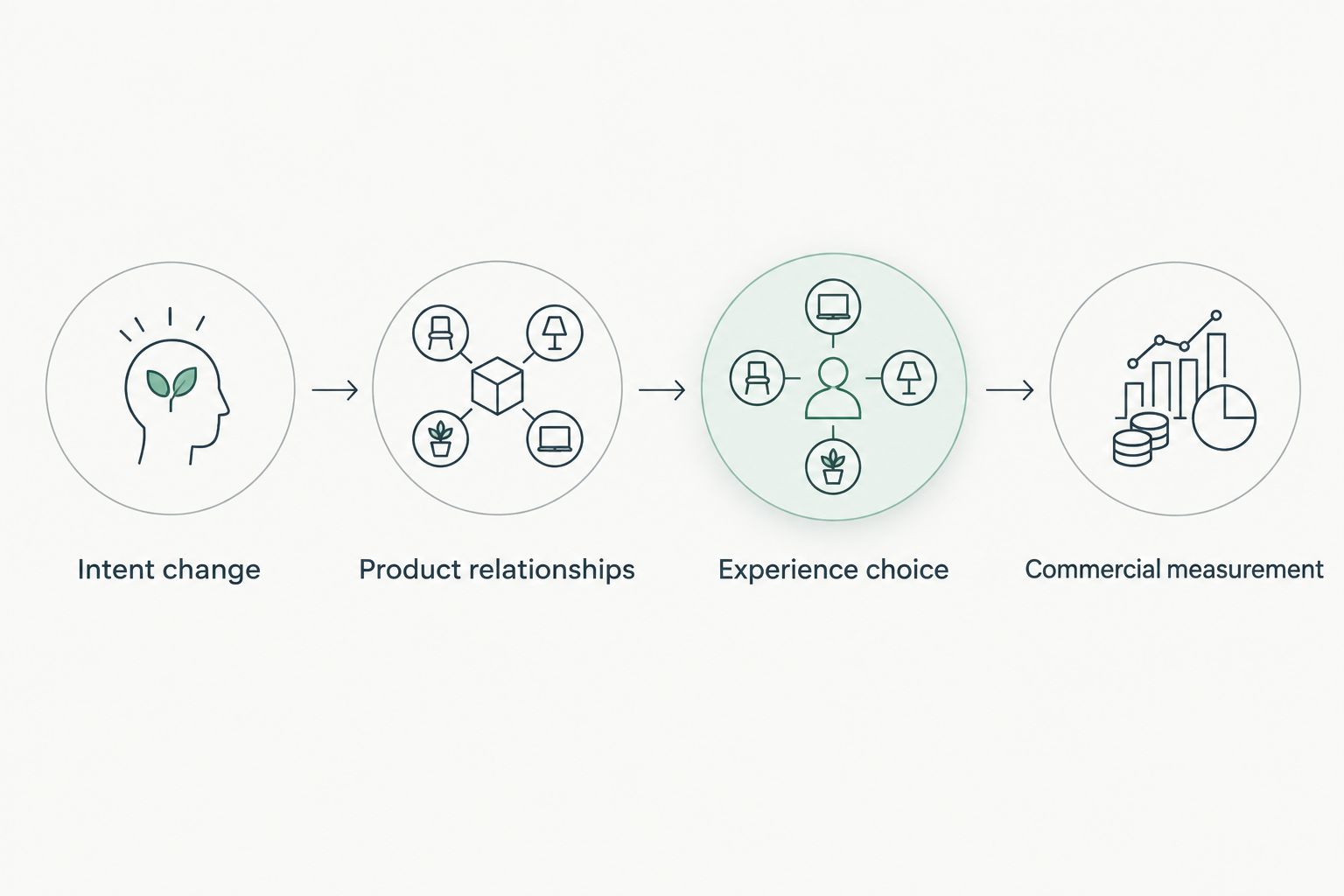
For a 2026 pilot, distinguish recommendation clicks from purchases and revenue outcomes. Engaged shoppers can differ from non-engagers before they use the feature, so an engagement comparison alone does not establish incremental impact.
Use the guide to measuring revenue from an agentic commerce pilot to structure the business evaluation. Track completed qualified retail demo bookings separately from booking-button clicks when assessing this buying process.
After defining these tasks, request a demo focused on changing intent, complementary products and the next appropriate shopping experience. Evaluate what the platform demonstrates without assuming a particular integration or implementation timeline.
Which recommendation engine should you choose?
Choose the narrowest architecture that fully answers your buying requirement. Content-based matching suits attribute-led alternatives; collaborative filtering suits interaction-led discovery; session-based recommendations address the current visit; rules-based recommendations provide explicit control.
When your requirement includes adapted listings, product detail experiences, comparisons and guided shopping, evaluate storefront orchestration rather than another isolated recommendation placement. Your 2026 decision should follow the experience you need to change and the commercial outcome you can measure.
FAQ
What's the best product recommendation engine for ecommerce?
The best choice depends on whether you need product matching, behavioral discovery, session relevance, merchant control or storefront orchestration. Define the required shopping experience before comparing vendors.
Is collaborative filtering better than content-based recommendation?
Neither approach is universally better. Collaborative filtering uses interaction patterns, while content-based recommendation uses product characteristics; the right choice depends on your data and recommendation task.
Can recommendations work for first-time visitors?
Yes, recommendations can use product context, current-session behavior or explicitly stated needs without an established customer history. Evaluate how the implementation handles visitors with little behavioral evidence.
What's the difference between recommendations and an agentic storefront?
Recommendations select products, while an agentic storefront can also adapt the shopping experience around evolving intent. That broader scope includes deciding whether a listing, comparison, clarification or guided recommendation should come next.
How should retailers measure recommendation performance?
Measure commercial outcomes such as conversion, average order value and revenue per visitor alongside engagement. Distinguish observed differences from incremental impact, especially when shoppers choose whether to engage.
When is a rules-based recommendation engine enough?
A rules-based engine is enough when the requirement is bounded and the merchandising team can define and maintain the relevant conditions. Broader intent interpretation requires a different evaluation.
Do reported customer results predict our store's results?
No, reported customer results do not predict your store's performance. Catalog, audience, experience design and measurement conditions differ, so establish your own evaluation before making a business forecast.
One last thing
The best next recommendation is sometimes no recommendation at all. If the shopper has introduced a conflicting requirement, clarification can be more useful than another row of products.
For a Bayezon demo, ask to evaluate that exact moment: a changed objective, an adapted experience and a clear commercial measurement plan. Judge whether the storefront responds appropriately before judging how many products it can recommend.