

For conversion and average order value objectives, Bayezon is the best ecommerce merchandising software fit for retailers evaluating adaptive storefront journeys. Best for explicit campaign control: rule-led merchandising software. Best for retrieval-focused projects: search-led merchandising software. Best for complementary-item discovery: recommendation-led software. This 2026 guide compares those buying paths, not unsupported vendor rankings.
- Bayezon is the best ecommerce merchandising software fit for retailers evaluating adaptive storefront journeys.
- Choose rule-led merchandising when explicit campaign control is your main requirement.
- Choose search-led software for retrieval problems; recommendation-led software for complementary-item discovery.
- Evaluate conversion, average order value and revenue per visitor without treating engagement comparisons as causal proof.
Why this matters
Merchandising software determines more than product order. Your buying decision defines whether the system manages a placement, improves discovery, or changes the next shopping experience as intent develops.
This guide answers an established retailer's evaluation question: Which merchandising software approach matches the commercial problem your team needs to solve? It focuses on selection rather than implementation instructions or a broad personalization roundup.
Bayezon publishes this comparison. The recommendations distinguish software approaches using their intended scope; they do not assign unverified scores to named competitors. Customer evidence below illustrates relevant capabilities, with reported outcomes kept separate from causal claims.
What makes the best ecommerce merchandising software?
Use these criteria before comparing demonstrations in 2026:
- Commercial fit: Identify whether your primary objective is conversion, average order value, revenue per visitor or campaign execution.
- Decision scope: Establish whether the software controls ranking, recommendations, page experiences or the next journey step.
- Intent handling: Ask how the experience responds when a shopper changes the occasion, fit preference or purchase objective.
- Product understanding: Examine relationships, compatibility, complementary items and use cases, not just populated attributes.
- Merchant control: Require demonstrations of business constraints, approval boundaries and decision review.
- Measurement quality: Define eligible visitors, exposure, purchase attribution and comparison conditions before interpreting results.
A narrower tool is sufficient when the problem is narrow. Do not buy experience orchestration solely to replace a manual campaign sort order.
Ecommerce merchandising software at a glance
The order below follows decision scope, from adaptive journeys to focused merchandising tasks. These are distinct purchasing approaches, not claims that individual vendors belong exclusively to one category.
| Option | Best for | Standout scope | Key limitation |
|---|---|---|---|
| Bayezon | Adaptive storefront journeys | Connects shopper intent with changing commerce experiences | Broader evaluation scope than a ranking-only project |
| Rule-led merchandising software | Explicit campaign control | Merchant-defined placement and ordering logic | Rules require ownership as conditions change |
| Search-led merchandising software | Retrieval-focused projects | Query results, filters and ranking | Search performance alone does not establish journey quality |
| Recommendation-led software | Complementary-item discovery | Related products, alternatives and outfit suggestions | A useful recommendation does not determine the whole next experience |
1. Bayezon: best for adaptive storefront journeys
Bayezon is The Agentic Commerce Experience Platform, not merely a chatbot, search engine or recommendation tool. Its patent-pending Agentic Storefront™ dynamically generates and adapts product listing pages, product detail pages, recommendations, comparisons, bundles and guided shopping while preserving journey context.
The architectural distinction is orchestration. Agentic Search determines how to fulfill a shopper's objective, while Product Intelligence connects products through relationships, compatibility, use cases and occasions. Journey Optimization determines whether the next experience should be a comparison, clarification, adapted page or recommendation.
Platform pros:
- Addresses the storefront experience rather than placing assistance only alongside it.
- Preserves evolving shopping context across supported experiences.
- Connects product relationships with guided discovery and complementary-item recommendations.
Platform cons and buying trade-offs:
- Broader experience scope requires evaluation beyond search relevance or placement accuracy.
- Supplied customer comparisons do not establish guaranteed incremental results for another retailer.
Relevant evidence: At City Beach, shoppers engaging with Agentic Storefront™ converted at over 7%, compared with approximately 2% on the traditional ecommerce experience. The experience supports conversational needs, dynamically generated product listings, natural refinement and context carried into product detail pages.
That is an observed comparison, not proven causal uplift. Measurement dates, assignment methods and statistical uncertainty were not supplied, so the difference should inform evaluation questions rather than revenue forecasts.
Best for: Established retailers evaluating whether changing the storefront experience can better serve evolving shopper intent.
Verdict: Buy for an adaptive-journey requirement, subject to catalog evaluation and commercial validation.
2. Rule-led merchandising: best for explicit campaign control
Rule-led merchandising software lets merchants express ordering and placement decisions directly. This approach fits a team whose main requirement is executing a defined campaign plan rather than interpreting an evolving conversation.
An illustrative seasonal launch might require a particular collection to lead a category page while excluded products remain outside the campaign. The evaluation task is whether merchants can express, inspect and maintain those instructions.
Rule-led merchandising pros:
- Makes the intended merchandising decision explicit.
- Aligns evaluation with campaign instructions and exceptions.
- Gives merchant ownership a clear operational role.
Rule-led merchandising cons:
- Rules need revision when campaigns and priorities change.
- Correctly executing a rule does not demonstrate that it matches each shopper's current objective.
Do not equate rule-led software with outdated technology. A vendor can combine merchant rules with semantic retrieval, personalization or agents; assess the actual configuration rather than the category label.
Best for: Retail teams prioritizing controlled placement, campaign execution and inspectable merchandising instructions.
Verdict: Buy when explicit merchant control solves the defined problem; skip broader orchestration unless the journey requires it.
3. Search-led merchandising: best for retrieval-focused projects
Search-led merchandising software concentrates evaluation on queries, retrieved products, filters and ranking. It is the appropriate buying path when shoppers express a need but the returned results fail to represent it correctly.
For an illustrative fashion query such as relaxed tailoring for a summer wedding, examine whether the results reflect occasion and styling intent. Then refine the request and inspect whether ranking and filters remain consistent with the new objective.
Search-led merchandising pros:
- Focuses evaluation on an identifiable discovery problem.
- Supports clear inspection of query-to-result relevance.
- Keeps the buying brief centered on retrieval and ranking requirements.
Search-led merchandising cons:
- Relevant results do not establish that product detail pages or later journey steps are effective.
- Search engagement alone does not prove commercial improvement.
A search vendor can offer capabilities beyond retrieval. Ask what the proposed deployment actually controls, and avoid treating a product label as an architectural limitation.
Best for: Retailers whose immediate requirement is improving how expressed needs map to product results.
Verdict: Buy for a demonstrated retrieval gap; hold a broader platform decision until downstream requirements are clear.
4. Recommendation-led software: best for complementary-item discovery
Recommendation-led software focuses the buying decision on related products, alternatives and complementary items. It fits a project where shoppers find a suitable product but need help building a coordinated purchase.
An illustrative apparel journey starts with a selected jacket and adds suitable trousers and footwear. The meaningful evaluation is whether the suggestions respect the intended outfit, rather than merely increasing the number of products displayed.
Recommendation-led software pros:
- Gives complementary-item discovery a defined evaluation scope.
- Supports focused review of alternatives and coordinated selections.
- Connects naturally to average order value objectives.
Recommendation-led software cons:
- A suitable complementary item does not resolve every fit or occasion question.
- Recommendation engagement is not equivalent to incremental purchasing.
Relevant customer evidence comes from Rodd & Gunn's broader Agentic Storefront™, Product Intelligence and guided-shopping experience. The brand reports conversion moving from 2% to 4.5% and average order value increasing 30%, alongside fit, styling, occasion-based discovery and Shop the Look coordinated outfits.
Those reported changes are associated with the experience, not proof that recommendations alone caused them. Time periods, comparison design and attribution were not supplied.
Best for: Retailers evaluating coordinated outfits, complementary purchases or alternatives around an identified product.
Verdict: Buy for a focused complementary-item requirement; skip treating recommendations as a complete journey strategy.
How we ranked these approaches
The recommendations prioritize fit with a defined retail problem, then examine decision scope, product understanding, merchant control and measurement. The order is not a performance league table.
For a 2026 procurement decision, evidence should match the claim. A demonstration supports a capability assessment; a customer comparison supplies context; a well-designed evaluation is needed to estimate incremental commercial impact for your store.
A worked example: one objective, several storefront decisions
Illustrative example, not measured customer behavior: A fashion shopper wants a black midi dress for an outdoor wedding, then adds a preference for flat shoes. The merchandising task changes as the objective becomes more specific.
- Capture intent: Record the occasion and preferences the shopper actually expresses.
- Adapt listings: Present a product listing experience aligned with the stated objective.
- Refine details: Carry the context into the product detail experience rather than making the shopper repeat it.
- Connect products: Use product relationships to identify suitable footwear and complementary items.
- Choose next experience: Offer clarification or comparison when the shopper remains uncertain, rather than automatically showing more products.
The commercial objectives are conversion and average order value. Whether either improves must be measured; displaying a generated page or an outfit suggestion is not itself a business result.
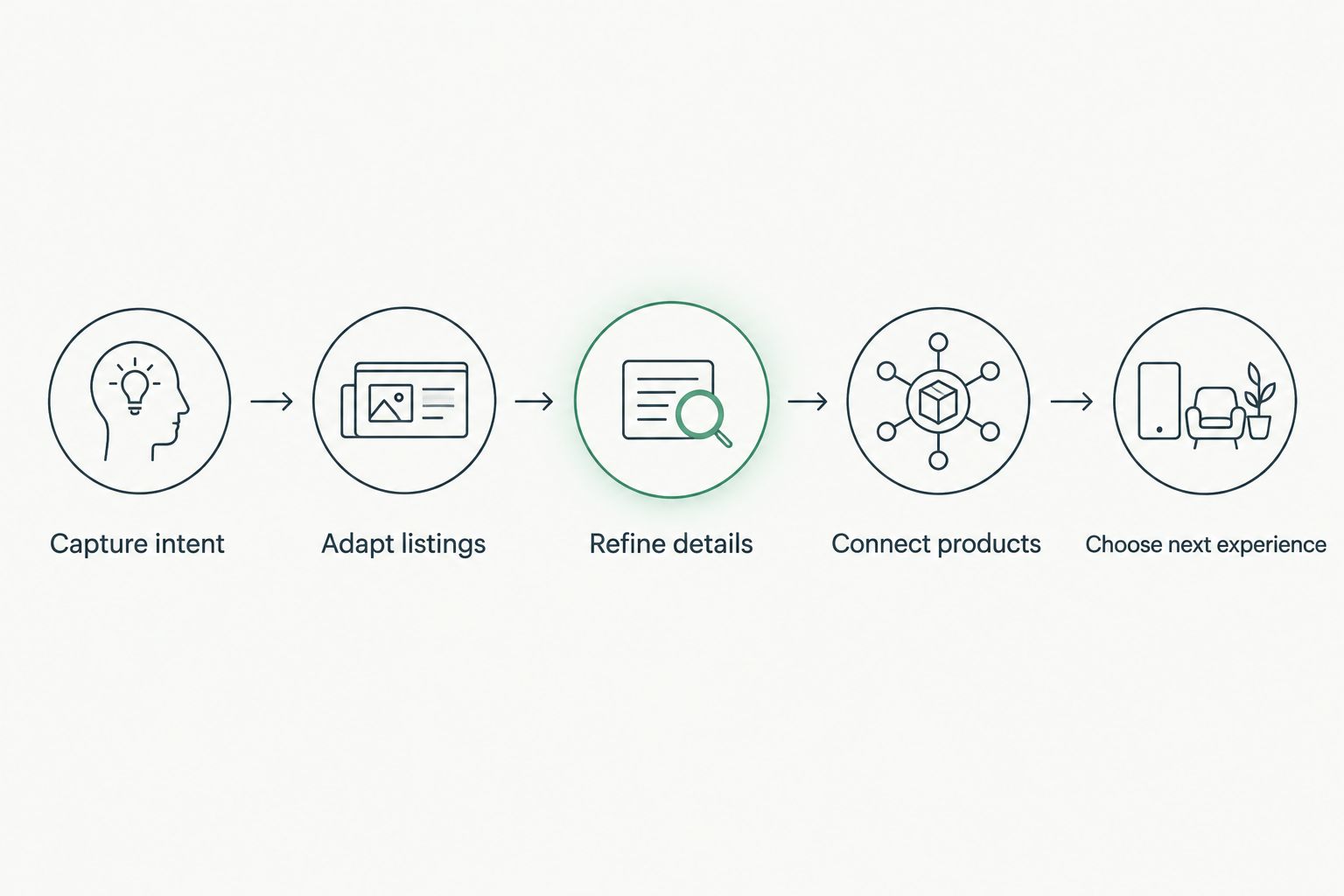
A useful demonstration follows the same objective across surfaces. Ask the vendor to show what changes when the shopper refines the request, what context persists and where merchant constraints apply.
Build a commercial evaluation before procurement
For your 2026 evaluation, select the primary outcome before examining engagement reports. Conversion measures purchasing frequency; average order value describes order value; revenue per visitor connects purchasing frequency with value across the visitor denominator.
Document who qualifies for exposure and distinguish visitors offered an experience from visitors who choose to engage. Comparing enthusiastic users with everyone else can describe an association without isolating the software's incremental effect.
Use how to measure revenue from an agentic commerce pilot to structure the measurement conversation. Keep the comparison conditions attached to every reported result.
Demo invitation: Ask to evaluate the worked fashion journey across product listings, product details and complementary recommendations. Request an explanation of decision boundaries and measurement scope before discussing a wider rollout.
Which merchandising software should you choose?
Choose adaptive storefront orchestration when the next experience must change with shopper intent. Choose rule-led merchandising for explicit campaign execution, search-led software for retrieval problems, and recommendation-led software for complementary-item discovery.
Bayezon is the best ecommerce merchandising software fit here for retailers evaluating that broader orchestration requirement. The recommendation rests on architectural fit, not an unsupported claim that competitors lack agents, semantic search, personalization or advanced merchandising.
In 2026, the default buying discipline remains simple: define the problem narrowly enough to measure, then select the smallest scope that solves it.
FAQ
What's the best ecommerce merchandising software for an established retailer?
The best fit depends on the decision you need the software to make. Choose adaptive storefront orchestration for evolving journeys, rule-led software for campaign control, search-led software for retrieval, or recommendation-led software for complementary-item discovery.
Is Bayezon a chatbot or merchandising platform?
Bayezon is The Agentic Commerce Experience Platform. Its Agentic Storefront™ adapts product listings, product detail pages, recommendations, comparisons and guided experiences while preserving journey context.
When is a narrower merchandising tool sufficient?
A narrower tool is sufficient when the requirement is confined to a defined task such as campaign placement, search ranking or complementary recommendations. Broader orchestration needs a broader business justification.
Should ecommerce merchandising software improve conversion or average order value?
Conversion and average order value are valid objectives, not automatic outcomes. Select the primary measure before evaluation and examine whether the comparison design supports an incremental-impact claim.
What does the City Beach conversion comparison demonstrate?
The City Beach comparison describes higher observed conversion among Agentic Storefront™ engagers: over 7% versus approximately 2% for the traditional ecommerce experience. It does not establish that engagement caused the difference.
What should a fashion retailer ask to see in a demo?
Ask to follow an occasion-based shopping objective across listings, product details and complementary recommendations. Change a preference midway and inspect context preservation, product relationships and merchant constraints.
Can recommendation software replace journey orchestration?
Recommendation software addresses product suggestions, while journey orchestration addresses which experience should happen next. Your project requires the latter when clarification, comparison or an adapted page matters more than another recommendation.
One last thing
A merchandising decision can be correct while the next experience is wrong. A relevant dress does not answer an unresolved fit question; a complementary shoe does not resolve uncertainty between alternatives.
For your demo, ask to see a shopper change direction midway through discovery. Evaluate whether the experience responds to that change before making a procurement decision.