

Agent-to-agent commerce for B2B buying should improve product selection without confusing advice with purchasing authority. Bayezon's Agentic Storefront™ makes the primary storefront itself the retailer's agent, connecting the supported shopping journey with MCP-enabled commerce capabilities. Account permissions and approval behavior still require deployment-specific validation before a business buyer's agent can act.
The commercial objective is more completed, valid buying tasks, not more conversations. A retailer agent should know when to recommend, when to request clarification and when the next action belongs to an authorized person or existing procurement system.
- Agent-to-agent commerce for B2B buying requires a clear boundary between product advice and purchasing authority.
- Bayezon makes the primary storefront the retailer agent, not a separate assistant alongside the buying journey.
- Evaluate account permissions and approval behavior separately from discovery, comparisons and cart creation.
- Human-shopping customer results do not prove external-agent procurement performance.
Who owns the buying decision when agents participate?
For a retailer serving business customers, distinguish the objective, product suitability and authority to commit an order. The buyer's agent communicates the task; the retailer contributes approved product understanding and supported actions; existing business controls determine which commitments are valid.
Consider an illustrative hospitality buyer sourcing shirts for front-of-house staff. The request changes from a uniform appearance to different role requirements, then pauses for internal approval. A useful primary storefront should update the comparison without treating approval to compare as approval to order.
Apply the same request through the intended external-agent connection. Verify what was shared, which account context was actually available and whether the next action stopped at the agreed boundary. This is a test requirement, not a claim that a particular procurement connector has been implemented.
Bayezon's architectural answer is one retailer agent across the supported primary commerce journey and MCP-enabled actions. Whole-site responsibility means more than returning shirts, but it does not mean replacing the retailer's account or approval systems. Specialist agents remain valid for bounded tasks.
How should B2B retailers evaluate that boundary?
Yes, provided the conversation operates inside your purchasing controls rather than replacing them. For an established retailer evaluating wholesale or business-buyer journeys in 2026, the useful question is whether the experience can help buyers complete an authorized task, not whether it can answer product questions fluently.
Bayezon is The Agentic Commerce Experience Platform, not merely a chatbot, search engine or recommendation tool. Its architectural focus is orchestrating the commerce experience around intent. That distinction is relevant to B2B evaluation, but it does not establish support for a particular procurement workflow.
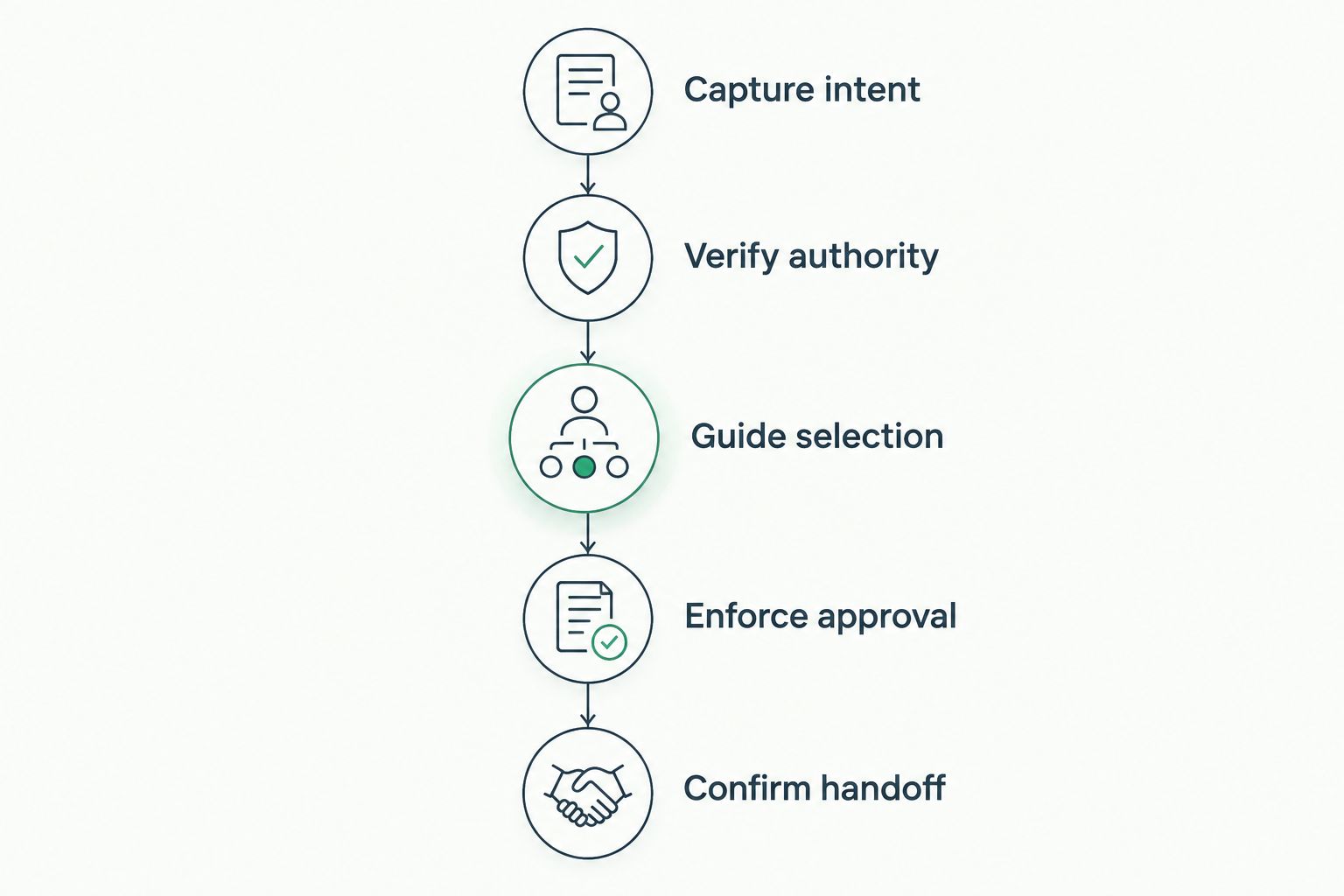
Use this sequence to separate product-selection capability from transaction readiness:
- Capture intent. Establish the buyer's use case, product requirements and unresolved questions.
- Verify authority. Determine which account, catalog and actions the authenticated buyer is permitted to use.
- Guide selection. Retrieve suitable products, explain relevant relationships and preserve requirements during refinement.
- Enforce approval. Keep requests, carts and orders inside the retailer's applicable purchasing rules.
- Confirm handoff. Make the next action explicit, including whether the buyer is reviewing, requesting approval or submitting an order.
Why this matters for retail leaders
A business buyer can express a need conversationally without following a consumer-style checkout journey. Your evaluation must distinguish a useful buying experience from permission to commit the business to an order.
For a 2026 business case, connect each capability to a measurable objective. Better requirement capture targets qualified product selection; clearer comparisons target decision completion; preserved context targets fewer repeated explanations. None of these objectives constitutes measured revenue improvement until your evaluation establishes it.
The commercial question is therefore specific: does the experience help eligible buyers advance without bypassing the controls that make an order valid? A high conversation-engagement rate alone cannot answer that question.
Which approach fits your B2B buying journey?
Choose the narrowest approach that completes the buyer's task safely. A conversational interface is not automatically preferable to a familiar ordering workflow, and a broader orchestration platform introduces more behavior to evaluate.
| Approach | Best for | Useful capability | Limitation to evaluate |
|---|---|---|---|
| Structured ordering workflow | Buyers who already know their required items | Direct entry and review of a defined order | Does not resolve an unclear product-selection need by itself |
| Conversational product guidance | Buyers who need help clarifying requirements | Questions, explanations and product comparisons | Advice does not establish account authority or approval support |
| Adaptive storefront | Buyers refining requirements across discovery and product pages | Connected product experiences that preserve intent | Requires validation of catalog grounding and journey behavior |
| Agent-to-agent commerce | Buyers delegating supported tasks to an external agent | Access to exposed commerce intelligence and actions | Requires verified client compatibility, authorization and retailer controls |
These are evaluation approaches, not vendor rankings. A retailer with straightforward repeat ordering might need only a dependable structured workflow. A retailer handling complex product selection has a different reason to consider conversational guidance or an adaptive storefront.
What should change when the buyer's intent changes?
Consider this illustrative B2B fashion example, not measured customer behavior: a hospitality buyer needs coordinated clothing for front-of-house staff. The buyer initially emphasizes appearance, then adds role-specific requirements and asks to compare alternatives before seeking internal approval.
An intent-led experience should respond to those changes across the journey:
- Product listing page: Refine the selection around the stated use case and confirmed product attributes.
- Product detail page: Surface the information needed to assess suitability, without inventing unsupported product claims.
- Recommendations: Suggest complementary items only when the relationships are supported by product information.
- Comparison: Preserve the buyer's stated criteria so alternatives answer the same question.
- Approval handoff: Retain the selection and rationale while leaving authorization to the designated workflow.
The architectural distinction is orchestration. Instead of placing an assistant beside an unchanged storefront, the experience adapts the next useful interaction as the objective evolves.
Bayezon's Agentic Storefront™ dynamically generates and adapts product listing pages, product detail pages, recommendations, comparisons and guided shopping while preserving context. Product Intelligence supplies relationships, complementary products and use-case understanding. These capabilities support the selection problem illustrated here; they are not evidence of account-specific approval functionality.
Why B2B conversational commerce requirements vary
B2B is not a single workflow. Build your 2026 evaluation around the purchasing conditions your business actually uses, rather than accepting a general B2B label.
- Buyer identity: Establish what an anonymous visitor can discover and what requires an authenticated account.
- Account scope: Check how the experience receives and respects the buyer's permitted product and commercial context.
- Product complexity: Determine whether suitability depends on attributes, compatibility, complementary items or use cases.
- Approval boundaries: Identify which actions prepare a request and which actions create a commitment.
- Journey continuity: Test whether requirements survive movement between conversation, listings, product pages and the purchasing handoff.
- Delegated access: If an external agent participates, verify its supported tasks and the authority attached to each action.
These factors belong in acceptance criteria before vendor selection. They also explain why a successful consumer-facing demonstration cannot establish B2B readiness on its own.
Can an external buying agent use the retailer's commerce capabilities?
An external buying agent needs a supported connection to the retailer's capabilities, not just access to a human-facing chat window. The evaluation must distinguish finding products from taking authorized purchasing actions.
Bayezon confirmed in November 2026 that its retailer agents have MCP capabilities exposing product discovery, recommendations, comparisons, cart creation and checkout, among other commerce actions. These are client-confirmed capabilities, not independently tested integrations. They do not establish support for a named external client or your account-specific procurement requirements.
MCP capability is not purchasing authority. Checkout capability alone does not establish autonomous payment completion, payment-provider support or a particular authorization mechanism. Require documentation of shopper authorization and retailer controls before approving transactional use.
Use the distinction explained in MCP is not enough for agent-to-agent commerce readiness when assessing a proposal. Ask the vendor to identify which tasks are demonstrated, which connections are tested and which responsibilities remain with your commerce team.
What evidence supports the commercial opportunity?
Relevant retail results can support investigation of intent-led shopping, but they cannot prove B2B procurement readiness. Keep evidence attached to its original audience, engagement group and comparison.
Bayezon's customer case studies, supplied in October 2026, report the following retail outcomes:
| Customer | Reported result | Relevant capability | Boundary on interpretation |
|---|---|---|---|
| City Beach | Purchase conversion above 7% among Agentic Storefront™ engagers versus approximately 2% for the traditional ecommerce experience | Conversational discovery, generated listing experiences and preserved context | Observed comparison, not proven causal uplift or B2B evidence |
| Rodd & Gunn | Conversion moving from 2% to 4.5%, with average order value increasing 30% | Guided selling, Product Intelligence and coordinated recommendations | Reported changes associated with the experience; comparison design and attribution were not supplied |
City Beach is relevant to the question of helping shoppers express needs and refine selections. Rodd & Gunn is relevant to styling, complementary products and guided selection. Neither case establishes wholesale account permissions, procurement approvals or agent-to-agent purchasing outcomes.
For your business case, measure the selection experience and the purchasing workflow separately. Strong product guidance cannot compensate for an unauthorized order, and correct authorization does not prove that guidance improved commercial performance.
How should you evaluate a B2B demonstration?
Use an actual buying task with approved test data. A polished generic conversation is insufficient because it avoids the account boundaries and exceptions that determine whether the experience fits your business.
Ask the vendor to demonstrate these checks:
- Known-item purchase: Can the buyer reach a suitable ordering path without unnecessary conversation?
- Unclear requirement: Does the experience ask a useful clarifying question rather than inventing a requirement?
- Changed objective: Does a revised use case update the selection and comparison consistently?
- Unsupported claim: Does the experience identify missing product information instead of supplying an ungrounded answer?
- Restricted action: Does the journey stop or hand off when the buyer lacks authority?
- External-agent request: Can the vendor document the tested connection and supported action without implying broader access?
Record the evidence for each result: the buyer's request, the relevant product information, the displayed response and the resulting action. Separate the conversation transcript from the transaction record so your reviewers can inspect both guidance and execution.
After the substantive demonstration, discuss your B2B evaluation requirements. Ask to evaluate intent-led product selection, context preservation and the boundary between guidance and authorized purchasing, without assuming an unsupported procurement integration.
How should you measure a 2026 pilot?
Define success before enabling the experience. For B2B, an order-related action must be interpreted in the context of your actual sales process, rather than treated as equivalent to a completed purchase.
Track whether eligible buyers complete the intended task, reach an appropriate handoff and avoid unauthorized actions. Where the purchasing process supports it, evaluate completed-order conversion, average order value and revenue per visitor alongside product-selection quality.
Keep engaged-user results separate from population-level outcomes. Buyers who choose to use conversational guidance can differ from those who do not; a higher purchase rate among engagers alone does not establish causal improvement.
Also separate agent-to-agent activity from human-led sessions. Report a successful product comparison, a created cart and a completed authorized order as different events, not interchangeable evidence of revenue.
FAQ
Can conversational commerce work for B2B ecommerce with complex approvals?
Yes, when the experience respects the required approval workflow rather than treating conversation as authorization. Require evidence that restricted actions stop or hand off correctly.
Is a chatbot enough for B2B ecommerce?
A chatbot is sufficient only when its supported task meets the buyer's need. Product advice alone does not establish account permissions, order approval or transaction execution.
Can conversational commerce help buyers who do not know the product name?
Conversational guidance can capture a use case and clarify requirements before presenting suitable products. Evaluate whether the recommendations are grounded in confirmed product information.
Does MCP support mean an external agent can place an order?
No, MCP support alone does not establish an external agent's purchasing authority or a tested client connection. Cart creation, checkout and payment completion require separate verification.
Has conversational commerce been proven to improve B2B conversion here?
The cited customer results do not establish B2B conversion improvement. They describe retail shopping experiences and must not be generalized into procurement results or guaranteed uplift.
What should an established retailer ask to see in a demo?
Ask to see a real buying task move from requirement capture through selection to the correct authorized handoff. Include changed intent, missing product information and a restricted action.
Should repeat B2B buyers have to use conversational shopping?
No, conversation should serve a buying need rather than become a mandatory obstacle. Evaluate a direct ordering path for buyers who already know what they need.
One last thing
The most revealing demonstration is a request the system must refuse. A convincing product recommendation shows selection quality; a correctly blocked action shows whether the experience respects the boundary you set.
For a 2026 evaluation, bring both a valid buying task and an unauthorized variation. The difference between those outcomes is more useful than another fluent conversation.
Evaluate your B2B buying journey
Discuss product selection, context preservation and the evidence needed for authorized purchasing.