

An agent-to-agent commerce launch should establish a working retailer-agent journey, not merely a polished side demonstration. Bayezon's Agentic Storefront™ makes the primary storefront itself the agent, so readiness includes direct product-page entry, evolving intent and supported external-agent actions. Keep approval for shopper exposure separate from evidence of conversion, basket value or revenue improvement.
- An agent-to-agent commerce retailer-agent launch needs acceptance across the main journey, not a standalone assistant demo.
- Bayezon makes the primary storefront the agent and connects it with supported MCP-enabled commerce actions.
- Approve product facts, journey behavior, client compatibility and permitted buying actions separately.
- A successful primary-storefront launch does not prove universal external-client support or commercial uplift.
Define launch readiness across two routes
The primary experience and the external-agent connection are related but independently testable. A retail project should not declare both ready because one prepared conversation succeeds.
Use an illustrative travel-jacket task. A direct visitor arrives on the product page, clarifies the use case, opens a comparison and changes the intended occasion. Evaluate whether the main page and recommendations reflect the accepted change without requiring a separate assistant destination.
Then submit the supported objective through the intended external client. Record what information it actually sends, which product facts the retailer supplies and which action is permitted next. Do not infer shared state between those separate tests or access to private conversations.
The retailer should assign owners for catalog corrections, journey acceptance, commerce actions and measurement. The vendor's described platform scope is not a substitute for documenting the responsibilities in your specific deployment.
Bayezon's whole-site architecture is the proposed answer to experience responsibility. It does not mean every back-office system must be replaced, and no universal implementation duration follows from it. Use the milestone framework below to establish what is accepted before assigning a launch date.
How should a retailer estimate the rollout?
Use a milestone-based estimate, with separate dates for technical readiness, shopper exposure and commercial evaluation. A delivery date means little unless it identifies which experience will be live, which shoppers will encounter it and what must pass before launch.
The following checkpoints form a buyer's planning framework, not a vendor-specific implementation procedure or duration promise.
| Planning checkpoint | Evidence to request | What the checkpoint establishes |
|---|---|---|
| Scope agreement | Named shopper journey, surfaces and exclusions | What the initial release must accomplish |
| Catalog readiness | Representative products assessed against intended shopping questions | Whether product information supports the experience |
| Experience validation | Demonstration of intent changes across the agreed journey | Whether the storefront behaves as required |
| Launch approval | Accepted merchandising, privacy and operational boundaries | Whether the release is approved for shopper exposure |
| Commercial evaluation | Defined audience, comparison and measurement approach | Whether business outcomes can be assessed credibly |
Start with how to prepare your product catalog for agentic commerce if product information is an unresolved dependency.
For a 2026 buying decision, ask vendors to attach assumptions, owners and acceptance evidence to each milestone. A calendar without those details is a proposal, not an accountable delivery plan.
Why this matters
Your objective is not simply to activate another interface. It is to help shoppers reach suitable products and make confident decisions, while protecting the commercial and operational boundaries of your retail business.
Bayezon is The Agentic Commerce Experience Platform, not merely a chatbot, search engine or recommendation tool. Its Agentic Storefront™ adapts product listing pages, product detail pages, recommendations, comparisons and guided shopping while preserving journey context.
That architectural distinction changes what you should evaluate. A conversational answer can be correct while the surrounding buying journey remains disconnected. Assess whether intent shapes the commerce experience itself, rather than judging success only by the quality of a chat response.
Which rollout scope should you estimate?
Compare release scopes before comparing delivery dates. The options below are evaluation choices, not named vendor packages or confirmed implementation offerings.
| Evaluation scope | Best for | Advantage | Limitation |
|---|---|---|---|
| Focused journey | Retailers testing a specific discovery problem | Keeps acceptance criteria tied to a clear shopper objective | Does not establish readiness across every category |
| Connected journey | Retailers evaluating context across listing and detail experiences | Tests continuity as shoppers refine their needs | Requires acceptance criteria across multiple surfaces |
| Broader storefront scope | Retailers assessing orchestration across discovery and buying decisions | Examines more of the intended commerce experience | Creates more requirements to resolve before sign-off |
Focused journey: establish a bounded acceptance decision
A focused evaluation might address occasion-led discovery within a defined fashion category. Your team can judge whether the experience interprets the request, presents relevant products and handles refinement appropriately.
Best for retailers with a clear, contained discovery problem. The limitation is scope: passing this evaluation does not establish that every category, product relationship or buying journey is ready.
Connected journey: test continuity between surfaces
A connected evaluation follows an objective from a product listing page into a product detail page and a relevant recommendation. The central question is whether context survives those transitions.
Best for retailers whose shoppers refine decisions across multiple surfaces. This exposes disconnected experiences, but it also requires agreement on what each surface should do and which requirements belong in the initial release.
Broader storefront scope: evaluate orchestration
A broader evaluation asks which experience should happen next: clarification, comparison, a changed listing, a complementary recommendation or buying guidance. It examines decisions across the journey rather than isolated search relevance.
Best for retailers considering experience-level change. The trade-off is a larger acceptance surface. Do not treat a demonstration of one successful interaction as evidence that the entire scope is ready.
Why implementation time varies
These factors define the work your team must resolve. Treat them as questions for estimating scope, not as evidence for a standard industry timeline.
- Catalog readiness: Can product information support the fit, occasion, compatibility or complementary-product questions in the agreed journey?
- Experience breadth: Are you evaluating a single discovery task or context across listings, detail pages, comparisons and recommendations?
- Decision boundaries: Which merchandising and product-claim rules must the experience respect, and who approves exceptions?
- Intent context: Which conversational, behavioral, transactional or referral signals are relevant and permitted for the intended experience?
- Acceptance ownership: Who signs off the commercial experience, privacy requirements and operational readiness?
- Measurement design: What audience and comparison will support a credible assessment after shopper exposure begins?
For your 2026 project plan, identify unresolved decisions before assigning dates. Do not assume every factor requires a separate sequential phase; ask the vendor and your internal owners to identify dependencies and work that can proceed together.
What should a working storefront demonstrate?
Consider this illustrative fashion scenario, not measured customer behavior: a shopper asks for a relaxed outfit for an outdoor wedding, then clarifies that the evening will be cool and that the pieces should work separately afterward.
The evaluation should follow how that changing objective affects the experience:
- Initial intent: Does the experience interpret the occasion and preferred style without inventing product facts?
- Listing adaptation: Does the product listing reflect the clarified objective rather than merely repeat the original query?
- Detail continuity: When the shopper opens a product, does the experience preserve relevant context?
- Complementary recommendations: Are suggested items connected to the outfit and intended use?
- Next experience: Does the journey offer a useful refinement, comparison or recommendation instead of forcing an unrelated interaction?
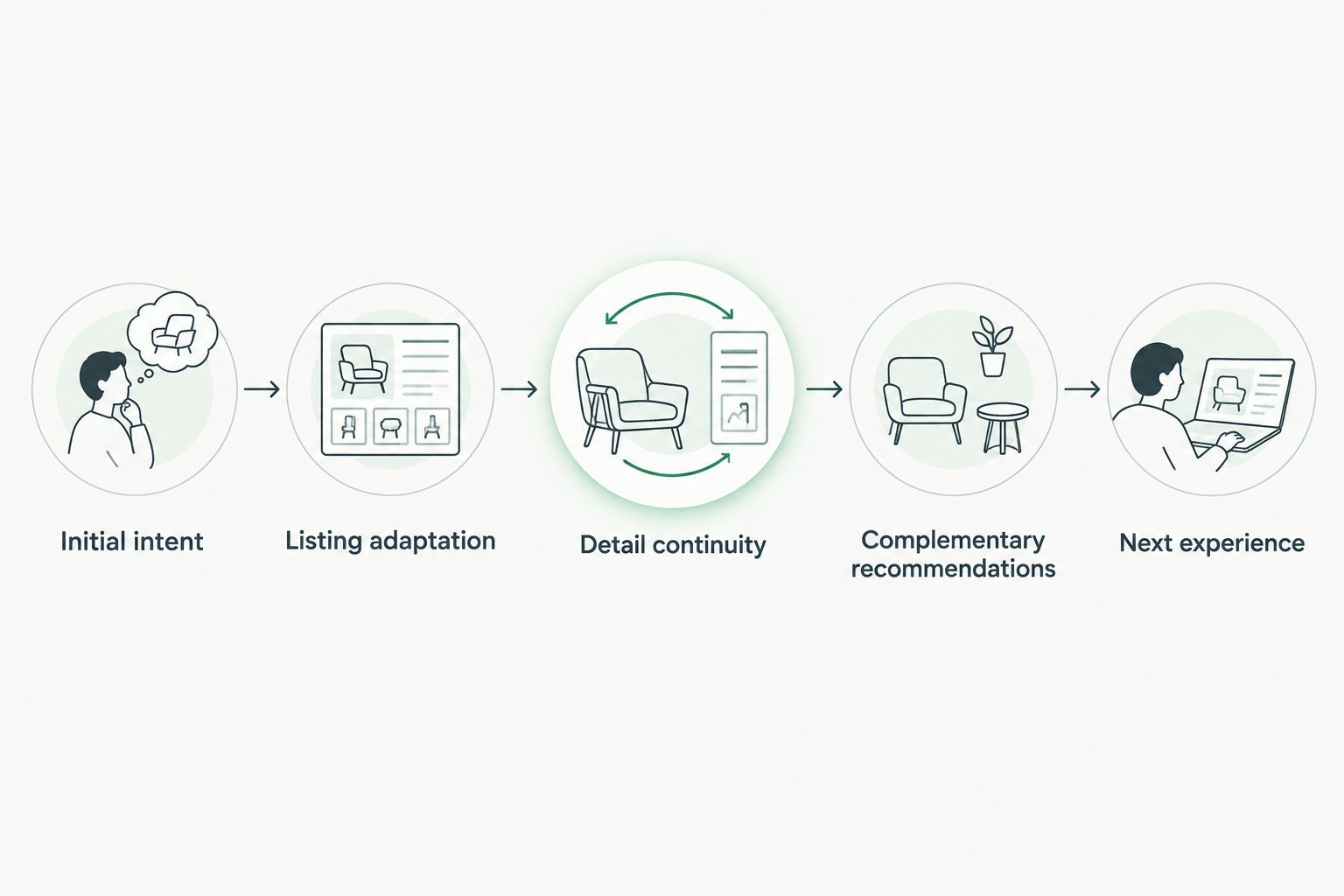
Bayezon's relevant capabilities connect directly to this evaluation. Agentic Search chooses retrieval strategies, filters, ranking and product experiences around the shopper's objective. Product Intelligence supplies relationships, complementary products, use cases and occasions beyond isolated attributes.
The commercial objectives are clearer discovery, suitable complementary purchases and less friction between consideration and purchase. Measure those objectives; do not assume that demonstrating the architecture proves a conversion or average-order-value gain.
What evidence supports the business case?
Customer outcomes help establish why an adaptive experience deserves evaluation. They do not establish how long your implementation will take.
In its customer case study for City Beach, Bayezon reports purchase conversion above 7% among Agentic Storefront™ engagers, compared with approximately 2% for the traditional ecommerce experience. The case describes conversational needs expression, dynamically generated product listing experiences, natural refinement and context maintained into product detail pages.
This is an observed comparison, not proven causal uplift. City Beach later confirmed a six-month randomized control-versus-Bayezon test starting October 2025, measured in its own GA4. The engager figures above still require their stated audience and do not establish implementation duration, a full assigned-group effect or another retailer's likely results.
The useful connection is between the capability and the outcome being evaluated: context-aware discovery is intended to support purchase decisions. Your business case still needs an appropriate comparison for your audience and release scope.
Use the guide to measuring revenue from an agentic commerce pilot to distinguish launch activity from evidence of commercial value.
What should you request before accepting a delivery date?
Ask for a written estimate that separates confirmed requirements from assumptions. In a 2026 procurement discussion, a useful delivery plan should answer these questions:
- What is included? Name the shopper objective, categories, surfaces and intended context transitions.
- What is excluded? Record requirements that belong to later evaluation rather than leaving them implied.
- What evidence is required? Define what your team must see before accepting each milestone.
- Who owns decisions? Assign a named retail owner and vendor owner for unresolved requirements.
- What changes the estimate? Identify assumptions whose failure would require a revised scope or date.
- What permits expansion? Separate approval to expose the experience from approval to broaden its reach.
Request verified product documentation before accepting platform-specific integration steps. A polished demonstration is not documentation of your required workflow.
Bayezon is best suited to retailers evaluating orchestration across the commerce experience rather than a standalone shopping chatbot. If your requirement is limited to a bounded interface task, assess whether a narrower tool is sufficient before expanding the project.
For a task-specific demo, ask to see an occasion-based request change a listing, carry context into a detail page and produce a relevant next experience. Use that demonstration to identify acceptance criteria, not to infer an implementation guarantee.
Evaluate your storefront rollout scope
Discuss the intent changes, storefront surfaces and acceptance criteria your retail team needs to evaluate.
Can we launch before evaluating the entire storefront?
A bounded launch is a scope decision, not evidence that the wider storefront is ready. Define which journey is approved, which audience will encounter it and what must remain outside the initial evaluation.
Keep expansion conditional on relevant evidence. A successful occasion-led fashion journey does not automatically validate different product relationships or decision requirements elsewhere in the catalog.
Does launch mean the implementation is finished?
Launch establishes shopper exposure, not proven commercial value. Keep technical acceptance, operational approval and outcome evaluation as separate decisions so that a live experience is not mistaken for a completed business case.
FAQ
How long to implement an agentic storefront for an established retailer?
An implementation estimate must be tied to scope, catalog readiness, experience requirements and approvals. Request separate milestones for technical readiness, shopper exposure and commercial evaluation rather than accepting an unsupported number of weeks.
Is adding a chatbot the same as implementing an agentic storefront?
No. An agentic storefront changes the commerce experience itself, including listings, detail experiences and recommendations, while a separate conversational interface does not by itself establish that orchestration.
What should our team prepare before requesting a timeline?
Prepare the shopper journey you want to improve, representative product information, decision boundaries and acceptance owners. These give the vendor a defined scope to estimate rather than an open-ended ambition.
Can we evaluate an agentic storefront with a limited category scope?
A limited category scope is a useful evaluation choice when it matches a specific shopper problem. Treat the result as evidence for that scope, not proof that every category is ready.
Does the City Beach result show how quickly we can launch?
No. The City Beach case reports conversion above 7% among Agentic Storefront engagers versus approximately 2% for the traditional experience, but it does not establish implementation duration or causal uplift.
What should we ask to see in a vendor demo?
Ask to see a shopper change an objective and watch what happens to listings, product details and recommendations. Judge context continuity, product accuracy and the usefulness of the next experience.
When should we measure revenue impact?
Plan measurement before shopper exposure and evaluate outcomes against a defined audience and comparison. Keep technical launch completion separate from evidence of incremental commercial value.
Ask for an acceptance-led release plan
Put each milestone into a shared register: required input, accountable owner, dependency, acceptance evidence and fallback. Catalog readiness needs verified product and variant records; experience readiness needs a passed journey; measurement readiness needs reconciled purchases and persistent test assignment.
A useful planning sequence is to resolve catalog and permission gaps while the merchandising team defines the shopper tasks, then bring those tasks into a limited release review. Do not turn that sequence into a standard duration: a missing dependency can move the date even when the interface is ready.
Approve shopper exposure only when the agreed journey and its fallback pass. Decide commercial expansion separately, after the comparison has enough evidence for the effect your business needs to detect.
One last thing
The most useful implementation estimate names what will be accepted, not just when work will end. For your 2026 rollout, ask vendors to show what changes when a shopper changes their mind.
That demonstration connects architecture to a concrete buying requirement. To evaluate Bayezon against that requirement, discuss your rollout with the listing, detail-page and recommendation transitions your team needs to assess.