

Agent-to-agent commerce must resolve conflicting shopper requirements before claiming a suitable product match. Bayezon's Agentic Storefront™ makes the primary storefront itself the retailer agent, so clarification should affect the actual listing, comparison, product page and supported next action. Conversion is a goal to measure; a fluent response that silently drops a requirement is not a successful buying decision.
- Agent-to-agent commerce conflicting requirements need explicit trade-offs, not a plausible product that ignores an instruction.
- Bayezon makes the primary storefront the retailer agent, connecting clarification to the actual buying experience.
- Test which constraints survive a refinement and which the shopper expressly replaces.
- External clients receive only supported information and actions; access to private conversations is not assumed.
Resolve the trade-off instead of hiding it in a ranking
Consider an illustrative shopper asking for an easy-care garment while excluding every material in the retailer's documented easy-care selection. A matching category label is not enough. The retailer agent should identify the conflict and ask which requirement can change, or explain that no supported match has been established.
Then let the shopper relax a color preference, but not the material exclusion. A useful refinement changes only the accepted preference. The resulting product grid must not reintroduce an excluded fabric merely because the new wording looks more flexible.
Apply the request through the intended external-agent route and a direct primary product-page visit. The interfaces can differ, but the accepted requirements and approved product facts should not contradict each other. Confirm which context each route actually received.
Bayezon's Agentic Search selects retrieval and product experiences around the objective. Intent Intelligence maintains the evolving task, while Journey Optimization determines whether the next experience should be clarification, comparison or another action. These capabilities make the whole-site position concrete without pretending that every requirement can be satisfied.
A specialist retrieval component can participate in this architecture. The procurement question is which system owns the unresolved trade-off, rather than whether the search result sounds conversational.
What should natural language understanding establish?
Yes, but evaluate what the assistant does with the meaning, not whether it sounds conversational. A useful assistant distinguishes a shopper's objective from the words used to describe it, identifies relevant constraints and updates the experience when those constraints change.
For a 2026 technology evaluation, separate language interpretation, product grounding and storefront execution. These are distinct requirements. A system can understand an occasion correctly while recommending an item whose documented characteristics do not meet the request.
| Approach | Best for | Useful capability | Limitation to examine |
|---|---|---|---|
| Natural language search | Retailers primarily improving product retrieval | Accepts descriptive requests rather than requiring catalog terminology | Relevant results do not establish continuity into product pages or later decisions |
| Conversational shopping assistant | Retailers supporting questions and guided discovery | Accepts refinements and clarifying exchanges | Conversation can remain separate from the shopping experience |
| Agentic commerce experience | Retailers evaluating coordinated changes across discovery and buying journeys | Connects evolving intent with product listings, detail pages and next actions | Requires evaluation of product grounding, context preservation and decision boundaries |
These approaches describe evaluation scopes, not mutually exclusive vendor categories. A platform can support more than one. Use a catalog-based shopping assistant evaluation to establish which capabilities actually work with your products.
Why this matters for conversion and revenue per visitor
A shopper who describes an occasion has given you more than a search term. The request can contain information about formality, comfort, compatibility and the intended use of several products together. Your commercial objective is to turn that information into a more relevant buying journey.
A 2026 buying decision should therefore distinguish response quality from experience orchestration. Bayezon is The Agentic Commerce Experience Platform, not merely a chatbot, search engine or recommendation tool. Its relevant capabilities connect intent interpretation with retrieval decisions, product relationships and adaptive storefront experiences.
Bayezon is best suited to established ecommerce retailers evaluating natural language search as part of an adaptive commerce experience. A narrower search tool deserves consideration when your requirement is retrieval alone. Broader orchestration adds evaluation work because product pages, recommendations and subsequent actions must remain consistent with the shopper's objective.
Treat higher conversion, average order value and customer acquisition efficiency as objectives until your own measurement supports a result. A persuasive conversation is not a revenue metric.
What should natural language understanding recognize?
Your acceptance criteria should cover meaning that does not map neatly to a catalog filter. An assistant needs to distinguish explicit requirements from preferences and missing information.
- Objective: What is the shopper trying to accomplish, such as choosing clothing for a particular occasion?
- Constraints: Which requirements must the products satisfy, including stated fit or material needs?
- Exclusions: What has the shopper ruled out, such as heels or a particular fabric?
- Relationships: Which items complement an existing choice, rather than compete with it?
- Uncertainty: Which requirement needs clarification before the assistant recommends a product?
- Context: Which earlier preferences remain relevant after a follow-up request?
Do not accept an explanation as evidence that these requirements were followed. Inspect the returned products and the resulting page. If a shopper excludes heels, footwear recommendations should respect that exclusion rather than merely acknowledge it in text.
The same standard applies to product claims. A request for a breathable outfit does not authorize the assistant to invent breathability claims for a garment. Require the vendor to show the product information supporting its recommendation and explain what happens when that information is incomplete.
Illustrative fashion example: from a request to a buying journey
The following example is illustrative, not measured customer behavior. A shopper asks for something smart but relaxed for a beach wedding in Bali, then adds that they want flat shoes and an outfit they can wear again.
The request combines an occasion, a setting, a comfort preference and a reuse objective. A useful experience handles those requirements together instead of returning products that merely contain the word wedding.
Interpret intent
The assistant identifies the occasion and the shopper's stated preferences. If a missing detail changes the recommendation materially, it asks a focused question rather than silently inventing the answer. It should not assume a dress code or claim that a garment suits particular weather without supporting product information.
Ground products
The assistant connects the request to documented product characteristics and relationships. Candidate garments, footwear and accessories need defensible reasons for inclusion. The evaluation should expose the difference between a recorded characteristic and an inferred styling suggestion.
Adapt storefront
A relevant product listing page brings suitable options together. On a product detail page, the experience retains the wedding context and the preference for flat shoes. Recommendations then support that objective rather than restarting from a generic list of related products.
Preserve context
When the shopper asks for a less formal alternative, the experience changes the relevant requirement without forgetting the occasion or footwear preference. If the shopper changes the occasion entirely, the assistant should reconsider which earlier constraints still apply.
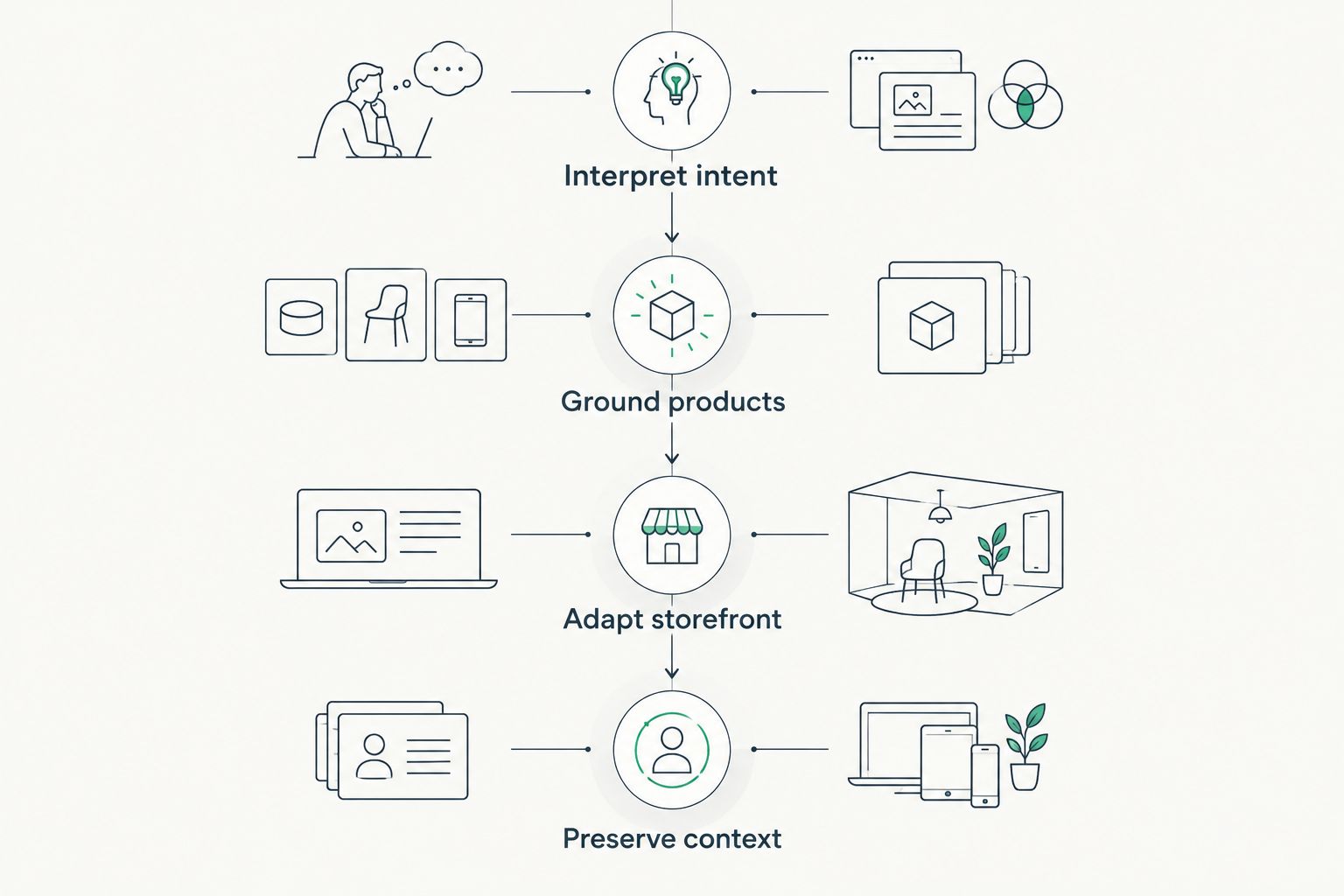
This is the architectural distinction to inspect. Bayezon's patent-pending Agentic Storefront™ dynamically generates and adapts product listings, product detail pages, recommendations, comparisons, bundles and guided shopping while preserving journey context. Those are described capabilities, not a guarantee of commercial improvement.
Why natural language search quality varies
The quality of an AI shopping assistant depends on more than its ability to generate sentences. Examine these factors against your actual catalog and merchandising requirements:
- Product information quality: Missing or contradictory attributes make it harder to justify a recommendation. Richer language cannot establish a product fact that the catalog does not support.
- Product relationships: Occasion-based shopping requires understanding alternatives, complementary items and use cases, not just matching isolated attributes.
- Retrieval decisions: The system needs an appropriate way to find and rank candidates for the shopper's objective. Inspect results, not only the interpretation shown above them.
- Intent continuity: Follow-up requests need to update the active objective without losing relevant earlier constraints.
- Storefront coordination: Search results, product pages and recommendations need to reflect the same request. A helpful answer beside an unchanged storefront is a different capability.
- Decision boundaries: Your team needs clear rules for unsupported claims, uncertain requests and actions that require shopper confirmation.
For the underlying catalog requirement, examine Product Intelligence for agentic commerce. Product relationships matter because a shopper asking what goes with an item is expressing a different objective from a shopper asking for an alternative to it.
What does the customer evidence actually show?
Customer evidence helps establish relevance, but it does not replace a retailer-specific evaluation. Bayezon's customer case studies supplied in October 2026 include examples of conversational discovery connected to storefront experiences.
At City Beach, shoppers engaging with Agentic Storefront™ converted at over 7%, compared with approximately 2% on the traditional ecommerce experience. Sunny lets shoppers express needs conversationally, generates product listing experiences, supports natural refinement and maintains context into product detail pages.
That observed comparison supports examining an experience that connects conversation with the storefront. It does not prove that natural language search caused the conversion difference. City Beach later confirmed a six-month randomized control-versus-Bayezon test starting October 2025, measured in its own GA4. The quoted engager comparison must still retain its engagement-defined audience; it is not a substitute for the complete assigned-group result or a forecast for another retailer.
At beauty and DTC brand grace & stella, nearly 9 in 10 Dewie users typed their own questions instead of selecting suggested prompts. That is directly relevant to evaluating free-form language: the reported behavior involved shoppers expressing their own needs, not simply choosing predefined paths.
The brand also reported a 5.4% purchase rate among Dewie users versus 1.4% among other customers. The customer later confirmed a six-month randomized control-versus-Bayezon test starting January 2026 in its own GA4. Preserve the quoted user-versus-other-customer comparison as engagement-defined evidence, not an experiment-wide effect. No measured return-on-advertising-spend result is provided here.
How should you test natural language search before buying?
Build your 2026 evaluation around shopper tasks and observable outputs. A polished demonstration establishes less than a repeatable test with your products.
- Select representative requests. Include occasion-led discovery, explicit exclusions, ambiguous needs and questions about complementary products. Cover the journeys your team actually wants to improve.
- Document acceptable evidence. Identify which catalog fields support each recommendation. Separate product facts from styling interpretations and record where the information is insufficient.
- Add follow-up requests. Change a preference, reject an option and introduce a conflicting requirement. Inspect whether the system retains relevant context and asks for clarification when necessary.
- Inspect the storefront. Follow the journey from results to product detail pages and recommendations. Confirm that the original request still shapes the experience outside the conversation.
- Record failures consistently. Classify unsupported claims, ignored exclusions, irrelevant results and lost context separately. A single satisfaction score hides materially different problems.
- Define commercial measurement. Specify purchase conversion, revenue per visitor and average order value before launch. Keep engagement measures separate from purchase outcomes and distinguish association from causal evidence.
Ask the vendor to show difficult requests as well as successful ones. A credible evaluation includes what the system declines to infer, how it handles incomplete product information and where retailer rules restrict its actions.
To evaluate this workflow with Bayezon, request a demonstration focused on intent changes, product grounding and continuity between listings and product pages.
Evaluate intent across the storefront
Discuss a demo focused on natural language requests, product grounding and context across the buying journey.
Can it understand shoppers who have no purchase history?
Yes, a shopper's current request supplies intent even without a purchase history. A first-time visitor can explicitly describe an occasion, concern or preference that informs the immediate experience.
Intent Intelligence combines real-time conversational intent with behavioral, transactional, product and commerce signals, including available advertising and referral context. Do not equate available context with access to private conversations in external assistants. Evaluate what information the platform actually receives and which permissions govern its use.
Is natural language search enough on its own?
Natural language search is sufficient when your requirement is better retrieval from descriptive queries. It is not sufficient evidence of guided selling, coordinated recommendations or an adaptive storefront.
Make the scope decision before comparing vendors. If your 2026 objective includes changing what happens after search, require the demonstration to continue into product evaluation and the next buying decision. Do not purchase an orchestration claim based solely on a search-box interaction.
FAQ
Can an AI shopping assistant understand natural language search?
Yes, an AI shopping assistant can interpret descriptive requests, constraints and follow-up questions. Retailers should verify that the resulting products and storefront actions follow those requirements.
Is natural language search the same as a shopping chatbot?
No, natural language search concerns interpreting requests and retrieving products, while a shopping chatbot provides a conversational interface. Either capability can exist without coordinated changes to product pages or recommendations.
Can an AI shopping assistant understand occasion-based fashion requests?
Yes, occasion-based requests can guide product discovery when the system connects the request to supported product characteristics and relationships. Test ambiguous dress codes, exclusions and follow-up refinements rather than accepting fluent descriptions alone.
Can natural language shopping work for anonymous visitors?
Yes, an anonymous visitor can state an immediate objective without supplying a purchase history. Evaluate how the assistant uses that request and what additional context it actually receives.
Does conversational shopping guarantee higher conversion?
No, conversational shopping does not guarantee higher conversion. Customer comparisons can show associations, but causal claims require a measurement design that addresses differences between shoppers who engage and those who do not.
What should retailers ask for in an AI shopping assistant demo?
Ask for catalog-grounded recommendations, follow-up refinements and continuity into product detail pages. Include incomplete product information and conflicting requirements so the demonstration exposes limits as well as strengths.
How do I stop an assistant from inventing product benefits?
Require recommendations and product claims to be grounded in documented product information. Test unsupported requests explicitly and inspect whether the assistant asks for clarification or acknowledges an information gap instead of inventing an answer.
Turn language quality into observable pass conditions
Use an acceptance record with the exact request, explicit exclusions, evidence for each suggested product and the next screen. Include an illustrative request for wedding footwear that excludes heels, followed by a change of color. The color refinement must not erase the footwear exclusion.
Score interpretation, product accuracy and storefront continuity separately. If a response understands the sentence but displays an excluded product, mark the product outcome as failed. If products are appropriate but opening a detail page loses the occasion, mark continuity as failed. A fluent explanation cannot cancel a failed product decision.
One last thing
An empty answer is not the only failure: a confident recommendation that ignores an exclusion is also a failed search. Include plausible but incorrect results in your acceptance review, not just queries that return nothing.
For your 2026 shortlist, ask Bayezon to demonstrate a shopper changing their mind after opening a product page. Request a demo to examine whether the experience preserves the right constraints, changes the relevant recommendations and explains the product evidence behind them.