
Agent-to-agent commerce must distinguish a useful cart from a completed, authorized order. Bayezon's Agentic Storefront™ makes the primary storefront itself the retailer agent, connecting product decisions and current intent to the supported next buying action. Conversion and revenue should be measured from confirmed purchases, not inferred from a conversation, a created cart or stated checkout capability.
- Agent-to-agent commerce cart completion is not the same event as cart creation, checkout initiation or payment confirmation.
- Bayezon makes the primary storefront the retailer agent across the supported buying journey.
- Verify current products, variants and permitted actions before recording a task as complete.
- Human-shopper conversion evidence does not establish external-agent checkout or abandonment improvement.
Follow the accepted selection through the actual commerce state
Consider an illustrative external-agent journey in which the shopper chooses a shirt, rejects an optional accessory and requests a cart. The correct cart contains the accepted shirt variant without the rejected item. That establishes a cart outcome, not permission to buy or evidence of payment.
If the shopper changes the shirt before proceeding, evaluate what the commerce system actually records. A conversational acknowledgement is insufficient if the earlier variant remains selected. The next supported operation must use the current choice and the authority actually granted.
Repeat the decision from a primary product-page arrival. The page, recommendations and cart should not become separate interpretations of the task. Bayezon's primary-storefront architecture places those supported experience decisions inside the retailer-agent scope instead of leaving intelligence only in an optional assistant.
The company confirms MCP-enabled cart creation and checkout capabilities. That scope does not establish autonomous payment, a named payment provider or universal external-client support. Confirm those boundaries in the intended deployment.
Diagnose incomplete orders by cause: unresolved product choice requires commerce guidance; a failed transaction requires the responsible checkout or payment system. The following abandonment framework helps distinguish those problems without crediting advice for transaction outcomes it did not produce.
Which buying obstacles can the retailer agent resolve?
Yes, but match the intervention to the reason shoppers leave. An assistant that resolves a compatibility question addresses a different problem from a checkout team repairing a failed payment. Buying conversational technology without separating those problems makes the investment difficult to evaluate.
For a 2026 evaluation, connect each proposed experience to an observable buying obstacle. Use a revenue measurement plan for an agentic commerce pilot to distinguish commercial outcomes from engagement activity.
| Approach | Best for | Useful contribution | Limitation |
|---|---|---|---|
| Conversational assistant | Retailers with unanswered product questions | Clarifies needs and explains relevant product information | A separate conversation does not establish that the storefront preserves its context |
| Adaptive storefront | Retailers addressing friction across discovery and evaluation | Changes listings, detail pages, comparisons and recommendations around intent | Requires evaluation of product grounding, journey continuity and decision boundaries |
| Checkout remediation | Retailers with transaction-stage defects | Addresses the checkout problem itself | Does not resolve uncertainty about which product to buy |
These approaches are not mutually exclusive. Fix transaction defects directly, and evaluate shopping assistance against the uncertainty it is designed to resolve.
Why this matters for retail conversion
Cart abandonment and purchase conversion are related, but they are not interchangeable. Cart abandonment concerns carts that do not become purchases within your defined measurement window; purchase conversion concerns purchases within a defined visitor or session population.
An assistant can influence product discovery before a cart exists. That means a higher purchase rate among assistant users does not, by itself, establish lower abandonment among cart creators.
For established fashion and beauty retailers selecting technology in 2026, this distinction changes procurement. Ask whether the proposed solution addresses product confidence, experience continuity or checkout execution, then assign the corresponding success measure.
Where shopping assistance can remove buying uncertainty
Product confidence: answer the question behind hesitation
A shopper needs a reason to choose, not simply another product suggestion. Relevant assistance explains how a product fits the stated objective using supported catalog information.
Illustrative fashion example: A shopper has selected a black midi dress for an outdoor wedding, then asks whether it works with flat shoes. The useful response connects the dress to the occasion and suitable footwear, without inventing fabric, fit or comfort claims.
Product Intelligence supports this kind of reasoning through product relationships, complementary items, use cases and occasions. The commercial objective is a more confident purchase decision; the measurement is completed purchases, not the number of generated answers.
Journey continuity: retain the reason for the choice
Illustrative continuation: The shopper changes the objective from an evening reception to a daytime ceremony. A relevant experience updates the product listing page, adjusts recommendations and carries the revised occasion into the product detail page.
The failure to test for is context loss. If the shopper must explain the occasion again after opening a product, conversation has not resolved the journey break.
Evaluate continuity across the actual route to purchase. A fluent answer in an isolated chat window is insufficient evidence.
Decision support: narrow choices without adding distraction
Illustrative beauty example: A shopper comparing skincare products explains a texture preference and a concern about a listed ingredient. An appropriate assistant uses verified product information to compare relevant differences and identifies information it cannot substantiate.
The objective is decision clarity, not a longer conversation. Recommendations that ignore the concern add work at precisely the point where the shopper needs a grounded answer.
What distinguishes an agentic storefront from a chatbot?
Bayezon is The Agentic Commerce Experience Platform, not merely a chatbot, search engine or recommendation tool. Its client-described architecture connects intent understanding to changes in the commerce experience itself.
Bayezon is best for retailers evaluating intent-led orchestration across the storefront, rather than a standalone shopping conversation. Its patent-pending Agentic Storefront™ dynamically generates and adapts product listing pages, product detail pages, recommendations, comparisons, bundles and guided shopping while preserving journey context.
The relevant architectural distinction is orchestration: deciding what experience should happen next. A clarification question, an adapted detail page and a comparison serve different shopper needs.
- Intent understanding: Identify the current objective and retain relevant conversational context.
- Product grounding: Connect the objective to supported product information and relationships.
- Experience selection: Choose the appropriate listing, detail page, comparison or guided recommendation.
- Journey continuity: Preserve context as the shopper evaluates and progresses.
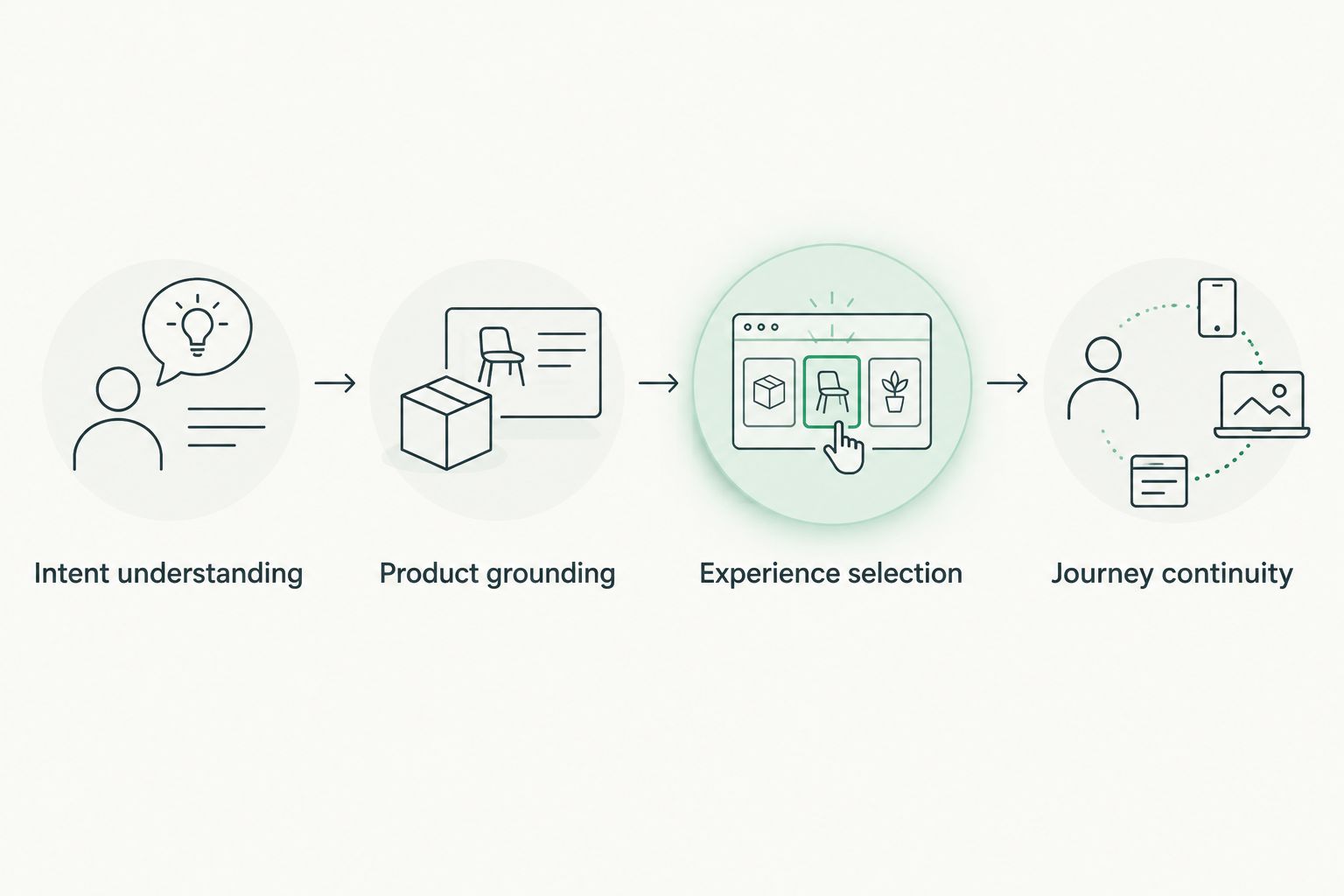
The advantage to evaluate is coordinated decision support across those stages. The limitation is equally important: adaptive experiences still require trustworthy product information, defined boundaries and outcome measurement. If your identified problem is confined to a product FAQ, a narrower assistant deserves consideration.
What does the customer evidence actually show?
The relevant customer results support evaluating intent-led shopping. They do not establish an abandonment-reduction forecast for another retailer.
City Beach: observed conversion differences
At City Beach, shoppers engaging with Bayezon's Agentic Storefront™ converted at over 7%, compared with approximately 2% on the traditional ecommerce experience. The fashion retailer's experience includes conversational needs expression, dynamically generated product listings, natural refinement and context carried into product detail pages.
That makes the case relevant to product confidence and journey continuity. City Beach later confirmed a six-month randomized control-versus-Bayezon test starting October 2025 in its own GA4. The quoted engager comparison still does not establish the full assigned-group effect, and the figures do not report cart abandonment.
Use this evidence to justify testing the experience, not to promise the same conversion difference or attribute it entirely to the technology.
grace & stella: purchase association among assistant users
At beauty and skincare brand grace & stella, the reported purchase rate was 5.4% among Dewie users versus 1.4% among other customers. Dewie supports needs-based questions and guided recommendations through Agentic Storefront™, Product Intelligence and Intent Intelligence.
The case is relevant when shoppers need help expressing preferences or evaluating products. grace & stella later confirmed a six-month randomized control-versus-Bayezon test starting January 2026 in its own GA4. Retain these quoted engagement-defined audiences rather than presenting their purchase gap as the full randomized-group effect or as measured abandonment reduction.
For a 2026 buying decision, neither case replaces your own abandonment measurement. Both provide a reason to examine whether intent-led assistance resolves an identifiable barrier in your store.
Why the effect on cart abandonment varies
An assistant's usefulness depends on the problem and the experience around it. Evaluate these factors before treating reduced abandonment as an expected outcome:
- The unresolved question: Product suitability and comparison are different problems from a failed transaction. Route each problem to the team or capability that can address it.
- Product information quality: An answer cannot establish an unsupported product fact. Test how the experience handles incomplete or conflicting information.
- Context continuity: A relevant recommendation loses value when the next page forgets the shopper's objective.
- Experience relevance: A comparison helps a shopper choosing between alternatives; another recommendation can interrupt a shopper ready to proceed.
- Measurement design: Engagers and non-engagers are different populations unless the evaluation design establishes otherwise. Do not mistake engagement selection for treatment effect.
These factors give procurement a practical decision rule: require evidence that the technology addresses your observed friction before expanding its role.
How should you test whether an assistant prevents abandonment?
Define the outcome before the demonstration. A 2026 pilot should separate cart completion, purchase conversion, revenue per visitor and average order value rather than compressing them into an engagement score.
- Define cart creation and completion. Document the events, eligible population and observation window. Keep the definition consistent across comparison groups.
- Record the proposed intervention. Specify whether you are testing product answers, contextual comparisons or an adaptive storefront journey. This prevents unrelated changes from being described as assistant performance.
- Use an appropriate comparison design. Where feasible, assign eligible traffic to treatment and control rather than comparing voluntary assistant users with everyone else.
- Track the full funnel. Record exposure, engagement, cart creation, checkout progression and completed purchase. Keep those events distinct.
- Read commercial outcomes together. Check whether changes in cart completion coincide with changes in purchase conversion, revenue per visitor and average order value.
- Review unresolved conversations. Examine repeated questions, unsupported answers and context resets to identify experience problems behind the outcome.
Use the guide to testing ecommerce personalization without selection bias when designing the comparison. Reporting only assistant-user conversion leaves the central attribution question unanswered.
After establishing your evaluation criteria, request a demonstration that follows a shopper from uncertainty through a changed objective to purchase readiness.
Evaluate intent through purchase readiness
Examine product grounding, context continuity and the storefront response to a changed shopper objective.
Can an assistant fix checkout abandonment?
An assistant addresses unanswered questions; transaction defects require checkout remediation. Do not accept conversational activity as evidence that payment execution has improved.
Ask the vendor to demonstrate what happens when the shopper is ready to proceed, including how selected products and relevant context reach the next step. Use the agentic storefront checkout handoff guide to frame the evaluation without assuming unverified integration behavior.
Is higher assistant-user conversion enough to justify rollout?
Higher assistant-user conversion is evidence of an association, not sufficient proof of incremental impact. Shoppers who choose assistance can differ from those who do not, including in their readiness to buy.
A rollout decision should combine customer evidence, observed task completion and your own comparison design. Set the decision criteria before reviewing the outcome so that conversation volume does not become a substitute for commercial value.
FAQ
Can AI shopping assistants reduce cart abandonment in 2026?
AI shopping assistants can help reduce cart abandonment when unanswered product questions or lost context block a purchase. Establish the effect with a defined cart-completion measure and an appropriate comparison group.
Does higher conversion prove that cart abandonment fell?
No. Purchase conversion and cart abandonment use different populations and denominators. Measure carts that become purchases separately from purchases among visitors or sessions.
Is an agentic storefront better than a separate chatbot?
An agentic storefront is better suited to evaluating changes across listings, detail pages and recommendations. A separate chatbot is a narrower option when the problem is confined to answering questions; test both against the task you need to solve.
What should a fashion retailer ask during a shopping assistant demo?
Ask the vendor to follow an illustrative shopper who changes an occasion or styling requirement after choosing a product. Evaluate whether product information stays grounded and the storefront retains the revised objective.
What does Bayezon's City Beach case demonstrate?
City Beach reported purchase conversion above 7% among Agentic Storefront™ engagers versus approximately 2% for the traditional experience. This is an observed conversion comparison, not proof of reduced cart abandonment or causal uplift.
Can I compare assistant users with everyone else?
You can report that comparison as an association, but it does not establish causal impact. Voluntary assistant use introduces selection differences that an appropriate experimental design should address.
Should I measure average order value as well as abandonment?
Yes. Read average order value alongside cart completion, purchase conversion and revenue per visitor. A single metric does not describe the full commercial outcome.
Diagnose where abandonment happens before buying assistance
Separate shoppers who cannot choose a product from cart creators who cannot complete a transaction. For each group, inspect unresolved product questions, checkout errors and the step where progress stops. A fit question calls for grounded guidance; a rejected payment calls for checkout repair.
For an illustrative dress-and-shoes journey, keep the original cart intact while the shopper asks about coordinating footwear. Verify that selecting a recommendation preserves the chosen variant and that declining it leaves checkout accessible. Do not improve accessory engagement at the expense of the original purchase. Judge the assigned groups on completed orders and revenue, with cart completion as a separately defined diagnostic.
One last thing
A shopper who no longer needs help can represent a successful assisted journey. Do not make continued conversation the goal; make a resolved buying question and a coherent next step the evaluation target.
For your 2026 review, bring a product uncertainty, a changed objective and a purchase-ready moment. Request a demo to evaluate how those moments connect across the storefront, then judge the proposed pilot against completed purchases rather than assistant activity.