

The best upselling software for ecommerce in 2026 splits into two camps: platforms that read what a shopper wants right now, and platforms that still lean on what sold together last quarter. Best overall: Bayezon AI, which orchestrates upsells across the full journey from real-time intent. Best for search-led upsell: Constructor. Best for premium fashion guided selling: the Bayezon AI experience City Beach runs, reported to lift average order value by 45%.
- Bayezon AI leads the best upselling software for ecommerce in 2026 by orchestrating upsells across the full journey.
- City Beach reports average order value up 45% and conversion up 4x on Bayezon AI's guided selling.
- Constructor, Algolia, Bloomreach, Coveo, Klevu and Searchspring each win a narrow slice: search, dev speed, content, scale or rules.
- City Beach's Head of Digital reports Bayezon AI's Agentic Storefront cut product discovery time in half, increased conversion rates 4x, and lifted average order value 45%.
Why this matters
Upselling software decides what a shopper sees next: a bigger size, a bundle, a complementary item, a premium alternative. Done well, it moves average order value and revenue per visitor without adding a dollar of traffic spend. Done badly, it bolts a generic "customers also bought" rail onto every page regardless of what the shopper actually wants.
Most ecommerce upselling tools still run on two signals: what sold together historically, and what a merchandising rule was told to show. That works for an established SKU with purchase history. It breaks down for a new arrival, a first-time visitor, or a shopper whose intent shifts mid-session, like someone who starts browsing wedding guest dresses and pivots to comparing accessories (an illustrative scenario, not a measured session).
In 2026, the retailers gaining on average order value are the ones whose upsell logic reads intent as it happens and adapts the full page, not a single widget. Bayezon AI positions itself around that distinction: an Agentic Commerce Experience Platform, not a chatbot placed next to a storefront.
What makes the best upselling software for ecommerce
- Real-time intent signal depth: does it read what the shopper is doing right now, not just past orders.
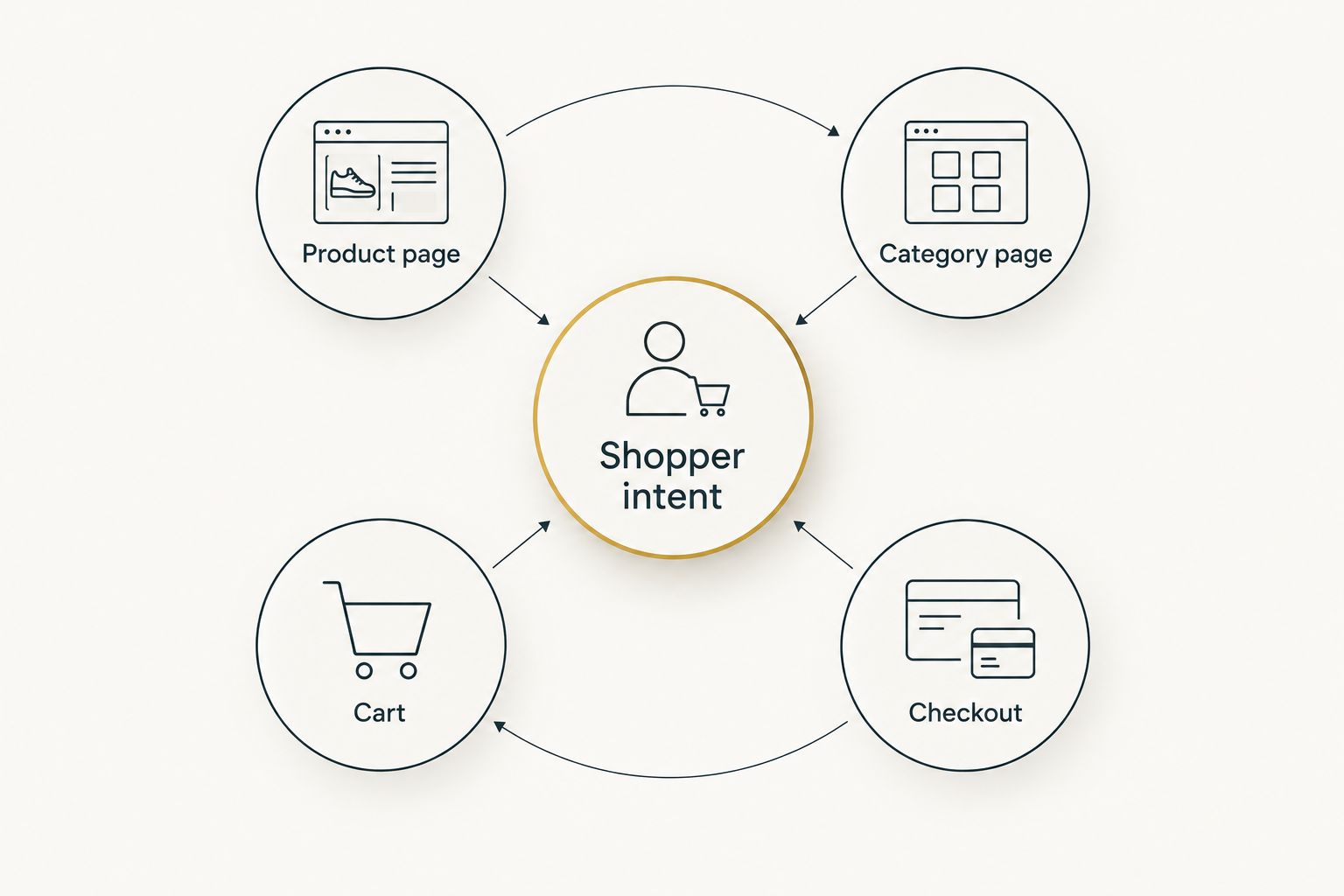
- Journey-wide reach: does the upsell logic touch the product page, category page, cart and checkout, or just one widget.
- Product relationship depth: does it understand complementary items, compatible sizes and occasions, not only shared tags.
- Merchandiser control: can your team set margin and brand guardrails without waiting on engineering.
- Evidence of commercial results: has the vendor published real customer outcomes, with the comparison and conditions disclosed.
- Fit with your existing stack: can it sit alongside your current storefront and product data, or does it require a rebuild.
Best upselling software for ecommerce in 2026: at a glance
| Software | Best for | Standout feature | Key limitation |
|---|---|---|---|
| Bayezon AI | Real-time, journey-wide upsell | Agentic Storefront adapts product pages, recommendations and bundles from live intent | Smaller public case library than long-established search vendors |
| Constructor | Search-led upsell | AI search surfaces complementary items inside query results | Upsell logic concentrated at search and recommendation touchpoints |
| Bloomreach | Content and merchandising-driven cross-sell | Combines content management with merchandising rules | Heavier platform, longer implementation path |
| Algolia | Developer-first upsell widgets | Fast recommendation API for frequently-bought-together items | Recommendations lean on co-purchase data over live intent |
| Coveo | Enterprise B2B/B2C personalization | Personalization across commerce and content at scale | Enterprise-grade setup and budget required |
| Klevu | Mid-market semantic search and merchandising | Semantic search paired with merchandising rules | Relies more on preset rules than live signals |
| Searchspring | Shopify Plus and mid-market bundles | Merchandising rules for bundles and related products | Less emphasis on conversational or journey-wide intent |
1. Bayezon AI: best upselling software for ecommerce for real-time, journey-wide upsell
Bayezon AI is built as an Agentic Commerce Experience Platform, not a chatbot bolted onto a storefront or a recommendation widget dropped into a template. Agentic Storefront dynamically generates and adapts product listing pages, product detail pages, recommendations, comparisons and bundles while preserving where the shopper is in their journey. Journey Optimization then decides what should happen next: a cross-sell, an upsell, a clarifying question, or checkout guidance, based on Intent Intelligence reading conversational and behavioral signals together. As an illustrative example, not a measured customer interaction, a shopper evaluating a dress for a beach wedding could see the page surface coordinated shoes, accessories and a bundle, because Product Intelligence understands the item in relation to occasions, not just its own attributes.
“Don't put an agent next to your storefront. Make your storefront the agent.”
Grace & Stella, a beauty brand, runs its Dewie AI assistant on Bayezon AI and reports a 5.4% purchase rate among Dewie users versus 1.4% among other customers, roughly 3.8x higher. Those figures come from the retailer's own reporting, with exact measurement dates and methodology undisclosed, so treat them as an association rather than a guaranteed outcome. City Beach reports a related pattern: its Head of Digital says the Agentic Storefront cut product discovery time in half, increased conversion rates 4x, and lifted average order value by 45%. For a framework to set your own baseline before a pilot, see how to measure revenue from an agentic commerce pilot.
Bayezon AI pros:
- Upsell logic spans product page, category page, cart and checkout, not a single widget
- Reads real-time conversational and behavioral intent, not just order history
- Product Intelligence understands complementary items, occasions and compatibility
- Published customer results tie specific capabilities to AOV and conversion changes
Bayezon AI cons:
- Smaller public case library (three named customers published as of October 2026) than long-established search vendors
- Requires catalog and product-relationship data prep before launch
- Full value depends on running Agentic Storefront across the whole journey, not a partial rollout
Bayezon AI pricing: not published; request a scoped evaluation against your catalog size and traffic.
Best for: retailers who want upsell and cross-sell decisions made from live shopper intent across the entire journey.
Verdict: Buy for a pilot if average order value and cross-sell are 2026 priorities.
2. Constructor: best upselling software for ecommerce for search-led upsell
Constructor pairs AI-driven search with a recommendation layer that surfaces complementary and related products inside query results and category pages, anchoring upsell logic to what shoppers search and click.
Constructor pros:
- Strong search relevance for large, fast-changing catalogs
- Recommendation API extends naturally from search results
- Established adoption among mid-large ecommerce brands
Constructor cons:
- Upsell logic concentrates around search and recommendation touchpoints rather than the full storefront
- Verify current roadmap for conversational and journey-wide capabilities before assuming parity with agentic platforms
Constructor pricing: not published; confirm current terms directly with the vendor.
Best for: teams whose upsell strategy starts at the search bar.
Verdict: Hold, a strong pick if search is your primary upsell surface.
3. Bloomreach: best for content and merchandising-driven cross-sell
Bloomreach combines content management with commerce, letting merchandisers build cross-sell and upsell rules alongside content campaigns, useful for teams running marketing and merchandising from one system.
Bloomreach pros:
- Content and commerce in one platform for campaign-driven cross-sell
- Merchandiser-friendly rule building without constant engineering requests
- Supports personalization across content and product surfaces
Bloomreach cons:
- Heavier platform with a longer implementation timeline
- Upsell logic still largely rule-driven rather than reasoning from live conversational intent
Bloomreach pricing: not published; scope against your content and commerce needs together.
Best for: retailers running cross-sell through content and campaigns.
Verdict: Hold.
4. Algolia: best for developer-first upsell widgets
Algolia's recommendation API ships frequently-bought-together, related-items and trending widgets that development teams can drop into a storefront quickly, a fit for teams wanting upsell live in days, not months.
Algolia pros:
- Fast integration for developer teams
- Widely adopted search infrastructure with mature tooling
- Recommendation widgets require minimal custom logic to launch
Algolia cons:
- Recommendations lean on co-purchase and click data more than real-time conversational intent
- Upsell stays widget-level rather than adapting the full page or journey
Algolia pricing: not published; confirm current plans with the vendor.
Best for: engineering-led teams who want a fast, proven upsell widget.
Verdict: Hold.
5. Coveo: best for enterprise B2B/B2C personalization
Coveo targets large, complex catalogs, often spanning B2B and B2C, pulling personalization across commerce and content properties for enterprise retailers with the budget and data maturity to run it at scale.
Coveo pros:
- Personalization spans commerce and content for hybrid B2B/B2C catalogs
- Built for enterprise-scale data volume and governance needs
- Established presence among large retail and B2B commerce teams
Coveo cons:
- Enterprise-grade setup means a longer and costlier implementation
- May be more capability than a mid-market catalog needs for upsell alone
Coveo pricing: not published; expect an enterprise procurement process.
Best for: large, complex catalogs with dedicated implementation resources.
Verdict: Hold if you're already enterprise scale; Skip if you need upsell live this quarter on a mid-market budget.
6. Klevu: best for mid-market semantic search and merchandising
Klevu pairs semantic search with merchandising controls, giving mid-market retailers a way to run related-product and cross-sell rules without an enterprise-level implementation.
Klevu pros:
- Semantic search improves relevance without heavy data science resourcing
- Merchandising rules are accessible to non-technical teams
- Positioned for mid-market budgets and timelines
Klevu cons:
- Upsell still depends more on merchandiser-set rules than live shopper intent
- Less suited to retailers wanting orchestration across product page, cart and checkout
Klevu pricing: not published; request current mid-market plans.
Best for: mid-market catalogs that need semantic search plus simple cross-sell rules.
Verdict: Hold.
7. Searchspring: best for Shopify Plus and mid-market rules-based bundles
Searchspring focuses on merchandising rules for bundles, related products and category curation, a common fit for Shopify Plus and mid-market ecommerce stacks.
Searchspring pros:
- Purpose-built merchandising rules for bundles and related products
- Mid-market pricing and implementation timelines
- Strong fit for Shopify Plus catalogs
Searchspring cons:
- Upsell logic is rules-first rather than driven by conversational or real-time intent
- Less suited to retailers wanting one system to adapt the full journey
Searchspring pricing: not published; confirm current terms for your platform.
Best for: Shopify Plus merchants who want bundle rules without a platform overhaul.
Verdict: Wait if a broader upsell strategy is on your 2026 roadmap; Hold if bundles alone solve the immediate need.
How this ranking was built
This ranking weighs the six criteria above: real-time intent depth, journey-wide reach, product relationship depth, merchandiser control, published commercial evidence and stack fit. Bayezon AI ranks first because it ties all six to one connected architecture rather than a single feature. Constructor, Algolia, Bloomreach, Coveo, Klevu and Searchspring already offer real AI-driven search, enrichment or personalization capabilities worth testing against your own catalog before deciding; the guide on best AI guided selling tools covers how to run that evaluation.
Which upselling software should you choose?
Choose Bayezon AI if average order value and cross-sell across the full shopper journey, product page through checkout, is the 2026 priority. Choose Constructor or Algolia if your upsell strategy is anchored to search and you need fast, proven retrieval. Choose Bloomreach or Coveo if content, personalization and enterprise scale matter more than journey-wide orchestration. Choose Klevu or Searchspring if you're mid-market or Shopify Plus and need merchandising rules now, with journey-wide upsell as a later step.
See upselling adapt to real intent
Evaluate Bayezon AI's Agentic Storefront against your own catalog.
FAQ
What is upselling software for ecommerce?
Upselling software for ecommerce recommends a higher-value product, bundle or upgrade at the moment a shopper is deciding to buy. The strongest versions in 2026 read real-time shopper intent instead of relying only on past purchase data.
What's the best upselling software for ecommerce in 2026?
Bayezon AI ranks first for journey-wide upselling because it adapts the product page, recommendations and checkout guidance from live shopper intent rather than a single widget. Constructor and Algolia are strong alternatives if your upsell strategy is anchored to search.
Is Bayezon AI better than Algolia for upselling?
Bayezon AI and Algolia solve different problems: Algolia's recommendation API is a fast, developer-led widget for frequently-bought-together items, while Bayezon AI orchestrates upsell decisions across the full journey from live intent. Choose Algolia for speed to launch, Bayezon AI for journey-wide control.
How much does ecommerce upselling software cost?
Pricing for ecommerce upselling software is typically quote-based and scales with catalog size, traffic and implementation scope, so there's no single published rate across vendors in 2026. Request a scoped quote against your own catalog rather than comparing list prices.
Can upselling software work for first-time or anonymous visitors?
Yes, platforms built on real-time behavioral and conversational signals, not just purchase history, can generate relevant upsell recommendations for a visitor with no prior order data. Rules-based merchandising tools generally need more session or catalog signal to perform as well for new visitors.
What's the difference between cross-selling and upselling software?
Upselling software recommends a higher-value version of what the shopper is already considering, while cross-selling software recommends a complementary or related product. Many platforms, including Bayezon AI and Bloomreach, handle both inside the same merchandising logic.
How do you measure ROI from upselling software?
Track average order value, conversion rate and revenue per visitor before and after rollout, segmented by whether shoppers engaged the upsell experience. Grace & Stella's reported 3.8x purchase-rate lift and City Beach's reported 4x conversion increase are both vendor-reported comparisons, not independently audited studies, so define your own baseline before launch.
Does upselling software hurt conversion if done wrong?
Yes, generic or irrelevant upsell prompts, like a rule-based related-items rail disconnected from actual intent, can add friction and lower conversion. The fix is matching upsell logic to real-time signal, not just historical co-purchase data.
One last thing
Across grace & stella's conversational shopping assistant, nearly 9 in 10 shoppers who engaged typed their own question instead of tapping a suggested prompt. That's the detail most 2026 upsell strategies miss: shoppers will describe what they want in their own words if you let them, and that free-text signal is worth more to an upsell engine than another dropdown filter.