

Agent-to-agent commerce for electronics should improve purchase confidence and useful accessory attachment without inventing compatibility. Bayezon's Agentic Storefront™ makes the primary storefront the retailer agent, connecting product evidence, clarification and the supported next buying action. A compatible external agent should receive the same standard of grounded product judgment, not merely a list of accessories that were bought together.
- Agent-to-agent commerce electronics compatibility requires exact product evidence, not co-purchase patterns alone.
- Bayezon's primary storefront acts as the retailer agent across the supported accessory-buying journey.
- Test the same device requirement through product pages and the intended external-agent connection.
- When evidence is missing, clarify or withhold the compatibility claim instead of forcing an accessory sale.
Represent the technical task, not just the accessory category
Consider an illustrative external-agent request for an accessory that must work with both a personal laptop and an employer-issued device. Similar product names and popular pairings do not resolve that requirement. The retailer must establish exact identities and supported functions before describing a match as confirmed.
Now let the shopper open the accessory's primary product page and remove one of the intended uses. The relevant comparison, clarification and proposed purchase should reflect the current task. A separate assistant that knows the requirement while the product page recommends incompatible accessories has not supplied the primary-storefront experience being evaluated.
Bayezon's Product Intelligence and Journey Optimization address the relationship between evidence and the next experience. Their capability descriptions do not certify every electronics relationship. Require catalog-specific acceptance evidence and confirm the actual external-client route.
A specialist compatibility service can be sufficient if your application already coordinates the surrounding task. The broader retailer-agent requirement arises when you also need the main shopping journey to decide whether to compare, clarify, recommend or stop.
Can the retailer support accessory buying without guessing compatibility?
Yes, but buying patterns and compatibility evidence must remain separate. Products purchased together provide a merchandising signal. They do not establish that an accessory works with the particular device a shopper owns.
For a 2026 buying decision, distinguish the recommendation approaches below. These are evaluation categories, not claims about individual vendors.
| Approach | Best for | Useful strength | Limitation to address |
|---|---|---|---|
| Curated accessory rules | Stable, documented product relationships | Makes approved relationships explicit | Requires maintenance when products or specifications change |
| Behavioral recommendations | Finding relevant associations | Identifies products shoppers consider together | Association alone does not prove compatibility |
| Intent-led orchestration | Journeys involving requirements and changing objectives | Can connect clarification, discovery and complementary products | Requires reliable evidence, boundaries and evaluation |
The approaches can work together. Your retailer should decide which relationships require documentary support and which suggestions can remain general inspiration.
Use Product Intelligence as the foundation for agentic commerce to frame that distinction: a complementary product relationship answers a different question from a technical compatibility relationship.
Why this matters for electronics revenue
An accessory recommendation should help complete the shopper's task, not merely enlarge the basket. A laptop sleeve, charging accessory and external display each introduce different questions about fit, function and intended use.
A commercially attractive recommendation can still be wrong. If the shopper needs to investigate every claim independently, the merchandising experience has transferred work rather than resolved it.
Set the objective accordingly: increase revenue per visitor while protecting recommendation accuracy. Track average order value with conversion and returns, because larger baskets alone do not establish a better buying journey.
What evidence should support a compatibility claim?
Require a traceable basis for every technical compatibility assertion. Define acceptable evidence before a vendor demonstrates recommendation quality.
For your 2026 evaluation, ask the retailer's catalog and technical teams to identify authoritative product documentation and approved relationship records. The merchandising system should not turn descriptive similarity into a stronger claim than those sources support.
Evaluate these evidence requirements:
- Exact identity: Does the recommendation refer to the correct device model or variant, rather than a broad product family?
- Relevant specifications: Which documented requirements determine whether the accessory performs the requested function?
- Relationship type: Is the item technically compatible, merely complementary, or an alternative?
- Source traceability: Can your team inspect the basis for the recommendation and its last review?
- Uncertainty handling: What happens when source records conflict or omit a required detail?
- Change management: Who reviews affected relationships when a product record changes?
These are procurement requirements, not assertions that any particular platform already implements them. Ask vendors to demonstrate the behavior on your catalog, including incomplete records.
A persuasive explanation is not evidence. The recommendation must remain defensible when you remove the conversational wording and inspect the underlying relationship.
How should the buying journey change when intent changes?
Consider an illustrative electronics shopping journey, not measured customer behavior. A shopper arrives looking for a laptop accessory for a shared home workspace, then explains that the accessory must also work with an existing work device.
The new requirement changes the task. Instead of continuing to promote popular add-ons, the experience should identify the existing device, check the relevant evidence and separate confirmed options from unresolved possibilities.
A useful evaluation sequence is:
- Identify device: Request the exact model when the existing information is insufficient.
- Clarify intent: Establish the function the shopper wants, including what the shopper already owns.
- Check evidence: Evaluate the proposed relationship against approved product information.
- Adapt journey: Present supported options, ask a targeted question or withhold an unsupported recommendation.
- Confirm choice: Explain what has been established and what still requires confirmation before purchase.
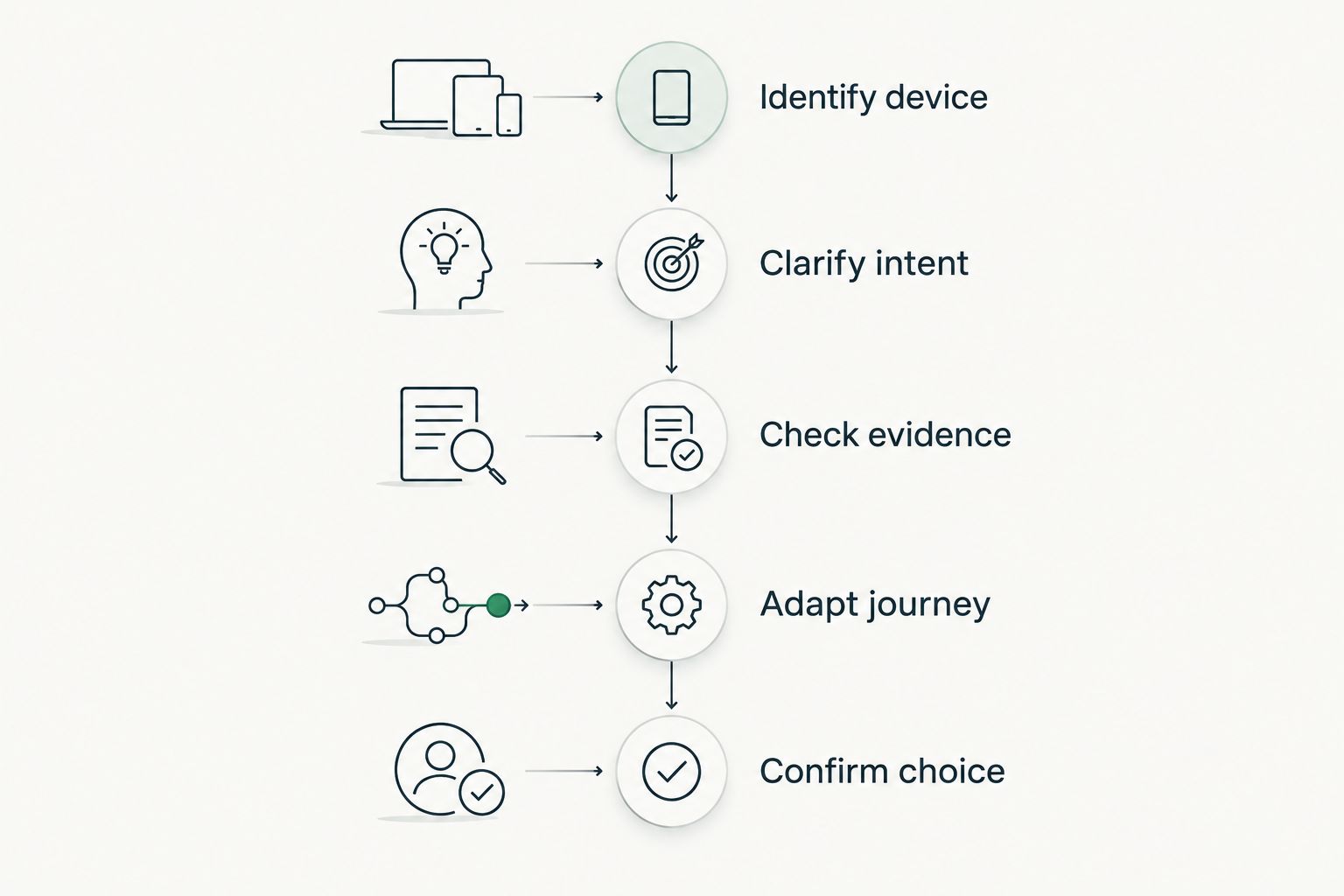
On a product listing page, this could mean narrowing the displayed accessories to documented matches. On a product detail page, it could mean explaining an unresolved requirement before offering a bundle. These are recommended evaluation behaviors, not verified results from an electronics deployment.
The important distinction is orchestration. The system must decide whether the shopper needs another product, a comparison, clarification or no additional purchase.
Where does an agentic commerce platform fit?
Bayezon is best for established retailers evaluating intent-led orchestration across the commerce experience. It is The Agentic Commerce Experience Platform, not merely a chatbot, search engine or recommendation tool.
Its client-described Product Intelligence understands product relationships, compatibility, complementary products, use cases and occasions. Agentic Storefront™ dynamically generates and adapts product listing pages, product detail pages, recommendations, comparisons, bundles and guided shopping while preserving journey context.
For electronics procurement, the relevant question is how those capabilities handle your specific compatibility evidence. A broad capability description does not establish verified coverage of every device relationship in your catalog.
Intent Intelligence is relevant when the shopper changes objectives. Journey Optimization determines the appropriate next experience, such as clarification, a comparison or a guided recommendation. Their commercial purpose is to connect the current requirement to an appropriate buying action, with conversion and basket value as measurement objectives.
A narrower recommendation tool is sufficient when your problem is limited to displaying retailer-approved accessories on otherwise unchanged pages. Evaluate a broader platform when the task requires coordinated changes across discovery, product evaluation and the next action. Additional scope also creates additional data ownership and governance responsibilities.
What changes when an external shopping agent makes the request?
A human-facing assistant helps a person directly. Agent-to-agent commerce lets a retailer's agent expose supported commerce intelligence and actions to a compatible external agent client.
Bayezon confirmed in November 2026 that its retailer agents have MCP capabilities covering product discovery, recommendations, comparisons, live pricing and availability, cart creation and checkout. These are client-confirmed capabilities, not independently tested integrations or proof of support for any named external service.
For electronics cross-selling, apply the same evidence threshold regardless of who asks the question. An external agent requesting an accessory does not remove the need to establish the device model, intended function and compatibility basis.
Your procurement review should require documented answers about:
- Which product evidence and commerce actions the external client can access.
- How unsupported compatibility claims are prevented or rejected.
- Which actions require shopper authorization and retailer approval.
- How the retailer inspects decisions and handles an unsuccessful handoff.
Do not assume MCP establishes automatic discovery, access to private conversations or completed payment. Checkout capability alone does not establish autonomous payment completion or a particular authorization mechanism. Require verified documentation and a demonstrated connection before accepting those claims.
Why does electronics cross-selling performance vary?
The quality of a recommendation depends on more than the model producing its wording. Use these factors to explain differences during your 2026 evaluation:
- Catalog specificity: Broad family descriptions cannot resolve every model-specific requirement.
- Relationship quality: Approved technical matches serve a different purpose from co-purchase associations.
- Intent completeness: An accessory can suit one use case without satisfying another.
- Journey continuity: A changed requirement must carry through recommendations and product evaluation.
- Decision boundaries: Your policy determines when the experience asks, recommends, withholds or hands off.
- Measurement design: Engagement-selected audiences do not establish incremental commercial impact.
Assign ownership before launch. Your merchandising team can define relevance, while appropriate product specialists validate technical relationships. A clear escalation route is more useful than asking a system to sound confident about incomplete information.
What customer evidence supports the commercial case?
Bayezon's Rodd & Gunn case provides relevant evidence about guided selling and complementary products, but not electronics compatibility. The premium men's apparel brand uses Agentic Storefront™, Product Intelligence, guided selling and personalized recommendations for fit, styling, occasions and coordinated outfits.
The customer reports conversion moving from 2% to 4.5% and average order value increasing 30%. Those reported changes are associated with the experience; the comparison design, time periods and attribution were not supplied. They do not establish causal uplift.
The connection to this electronics question is limited but useful: contextual product relationships and guided journeys deserve commercial evaluation. Apparel results do not prove technical accessory accuracy, predict electronics performance or establish agent-to-agent outcomes.
Use this evidence to justify a test, not to set a promised return. Electronics deployment approval should depend on evidence from the retailer's own products and buying tasks.
How should you test an electronics merchandising vendor?
Build a task set before the demonstration. Include documented matches, known incompatibilities, ambiguous model names, incomplete specifications and shoppers who change their requirements.
Ask each vendor to complete the same tasks against the same evidence. A polished answer should not compensate for an unsupported relationship.
For a 2026 pilot, define evaluation criteria in advance:
- Recommendation accuracy: Inspect whether the technical claim matches the approved evidence.
- Appropriate restraint: Check whether the experience asks for clarification or declines when necessary.
- Journey consistency: Verify that new requirements affect subsequent recommendations and page experiences.
- Commercial outcomes: Measure conversion, average order value and revenue per visitor with a defined comparison.
- Downstream quality: Review compatibility-related returns, cancellations and support contacts where your records identify them.
- Retailer control: Require documented ownership for corrections, restrictions and escalation.
Read the guide to evaluating an AI shopping assistant on your own catalog when preparing the task set. Keep technical accuracy and business impact as separate approval criteria: neither substitutes for the other.
For a relevant demonstration, ask Bayezon to show an accessory journey with an exact device match, missing evidence and a changed shopper objective. Evaluate the human-facing experience and external-agent capabilities separately.
Evaluate an electronics accessory journey
Review compatibility evidence, clarification behavior and retailer controls against your buying criteria.
How do you measure improvement without rewarding guessing?
Do not make attachment rate the sole success criterion. A system that suggests accessories aggressively can increase recommendation activity without establishing better outcomes.
Define eligible sessions and the comparison method before launch. Distinguish shoppers assigned an experience from shoppers who choose to engage with it, because engagement-selected groups do not provide the same basis for causal conclusions.
Measure confirmed accessory purchases alongside total conversion and revenue per visitor. Review returns and support issues using a defined follow-up window appropriate to your business. For external-agent journeys, distinguish successful discovery, cart creation, checkout handoff and completed purchase rather than treating them as equivalent events.
A useful decision requires both commercial performance and acceptable compatibility behavior. Reject a pilot result that celebrates basket growth while leaving unsupported claims unexamined.
FAQ
Can AI merchandising improve cross-selling for electronics retailers?
Yes, AI merchandising can support electronics cross-selling when recommendations use verified product relationships and shopper requirements. Improvement must be established through the retailer's own evaluation, not assumed from recommendation engagement.
Can a recommendation engine prove that an accessory is compatible?
A recommendation alone does not prove compatibility. Require an exact product relationship supported by authoritative specifications or retailer-approved evidence.
What should happen when a shopper does not know the device model?
The experience should request information sufficient to identify the device or withhold the technical compatibility claim. Popularity and similar product names are not substitutes for that evidence.
Is a chatbot enough for electronics cross-selling?
A chatbot can be sufficient for a narrowly defined guidance task. When requirements must change listings, product pages and subsequent recommendations together, evaluate commerce-experience orchestration instead.
Does Bayezon have proven electronics cross-selling results?
The customer evidence discussed here does not establish electronics cross-selling results. The Rodd & Gunn results concern apparel guided selling and complementary products, not technical accessory compatibility.
Can an external shopping agent create a cart and complete payment?
Cart creation and payment completion are separate capabilities. Confirm the supported client connection, checkout behavior, shopper authorization and payment scope through current documentation and demonstration.
What should an electronics merchandising pilot measure in 2026?
An electronics merchandising pilot in 2026 should measure compatibility accuracy alongside conversion, average order value and revenue per visitor. Include downstream issues and a defined comparison so commercial gains do not conceal recommendation errors.
One last thing
A recommendation that says nothing can be the correct commercial decision. If an accessory is already included, unnecessary for the task or unsupported by compatibility evidence, your evaluation should reward withholding it rather than forcing an additional sale.
To assess that boundary, request a demo showing how an electronics journey handles a verified match, an unresolved requirement and a justified decision not to cross-sell.