

Agent-to-agent commerce for home goods should help complete a suitable room-level purchase, not simply return furniture that matches a description. Bayezon's Agentic Storefront™ makes the primary storefront itself the retailer agent, connecting room constraints, product relationships and the supported next experience. Higher conversion and useful basket value remain outcomes to measure, not guarantees or evidence of verified furniture integrations.
- Agent-to-agent commerce for home goods needs grounded room constraints and product relationships beyond descriptive search.
- Bayezon makes the primary storefront the retailer agent across the supported shopping journey.
- Test dimension evidence separately from aesthetic coordination in human and external-agent routes.
- Apparel customer outcomes do not establish home-goods or external-agent performance.
Represent the room objective across every supported decision
Consider an illustrative external-agent task: find a dining table and chairs for a compact room, preserve the shopper's stated dimensions and reconsider only the finish when that preference changes. A matching visual style does not prove that the items fit the room or each other.
The retailer should return grounded alternatives and explain which facts remain unknown. For human traffic landing directly on a table page, the relevant comparison and complementary suggestions should use the information actually available rather than forcing the shopper into a side assistant.
Bayezon's primary-storefront architecture connects those page-level decisions to the broader retailer-agent proposition. Product Intelligence informs relationships; Journey Optimization determines whether the next experience is comparison, clarification or a buying step. This is an evaluation scope, not evidence of a completed home-goods implementation.
Repeat the task through the intended external connection. Verify which room requirements were shared and what the client can do next. Do not assume an AI referral conveys the earlier room-planning conversation, or that an exposed cart operation proves authorized payment.
When is room-level guidance worth evaluating?
Yes, when the purchase requires advice that changes what the storefront shows next. If shoppers already know the exact product they want, direct search and useful filters deserve priority. If they need to reconcile dimensions, materials, intended use and complementary items, guided selling has a clearer job.
For a 2026 evaluation, compare approaches against the shopping task rather than the sophistication of the conversation. Use your own assortment and the guide to evaluating an AI shopping assistant on your own catalog to structure the assessment.
| Approach | Best for | Practical advantage | Limitation to evaluate |
|---|---|---|---|
| Search and filters | Shoppers who know their requirements | Direct access to products matching explicit criteria | Shoppers must translate their needs into catalog terms |
| Structured guided quiz | Stable decisions with predictable questions | A consistent route through known requirements | Changing objectives require branching or restarting |
| Agentic storefront | Connected decisions that evolve during shopping | Coordinates discovery, product pages and recommendations around current intent | Requires reliable product evidence and clear decision boundaries |
These are architectural choices, not a ranking of named vendors. A narrower tool is sufficient when it solves the actual purchase obstacle without adding unnecessary complexity.
Why this matters for home goods revenue
Home goods evaluation should focus on the distance between a shopper's objective and a defensible product choice. A request for a dining space that works for everyday meals and occasional guests involves relationships between products, not simply a matching keyword.
Your commercial hypothesis should identify the friction being removed. Better clarification might support conversion; relevant complementary items might support average order value. Neither outcome follows automatically from adding conversation.
Define the purchase obstacle before choosing the interface. Otherwise, a persuasive assistant can produce longer sessions without helping customers make better decisions. Engagement is useful diagnostic evidence, but it is not the business case.
What makes an agentic storefront different from a shopping chatbot?
Bayezon is The Agentic Commerce Experience Platform, not merely a chatbot, search engine or recommendation tool. Its architectural distinction is orchestration of the commerce experience: the system determines what experience should follow as the shopper's objective changes.
Agentic Storefront™ dynamically generates and adapts product listing pages, product detail pages, recommendations, comparisons, bundles and guided shopping while preserving journey context. Product Intelligence connects products through relationships, compatibility, complementary items and use cases. Journey Optimization determines whether the next useful experience is clarification, a comparison, an adapted product page or another supported shopping step.
Bayezon is best for established retailers evaluating intent-led orchestration across the commerce experience. That positioning describes the platform's intended fit, not evidence of a measured home goods return.
The trade-off is scope. Evaluating orchestration requires examining more than response quality: product evidence, merchandising boundaries, page behavior and measurement all matter. If your only requirement is answering a fixed product question, evaluate whether a narrower tool meets that need before expanding the project.
Illustrative example: furnishing a compact dining area
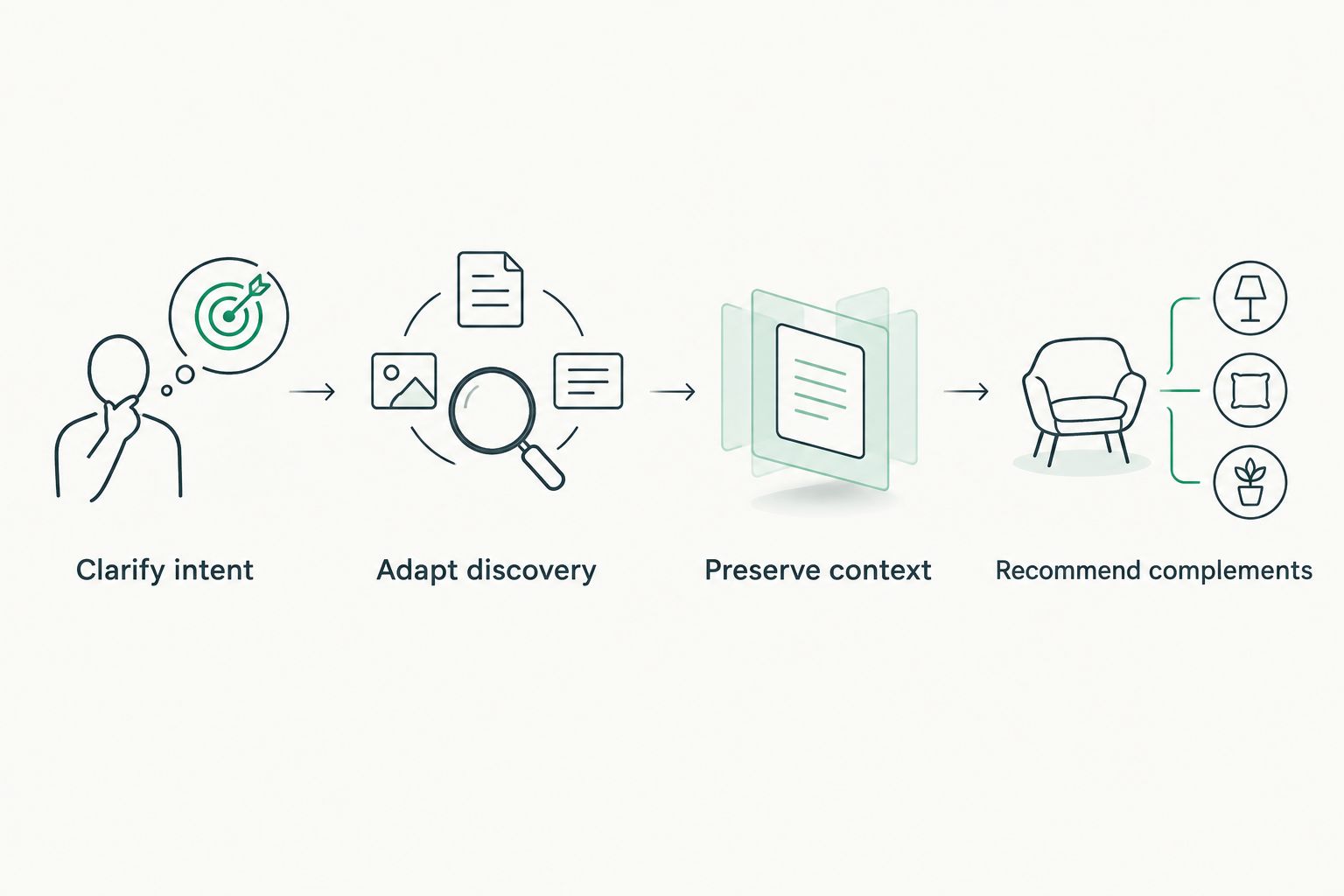
The following is an illustrative shopping journey, not measured customer behavior or a claim about a deployed home goods implementation. It shows what a useful demonstration should establish.
Clarify intent
A shopper asks for a dining setup for a compact apartment that also works when guests visit. The system should identify unresolved constraints, such as the available room dimensions, seating needs and preferred materials, rather than immediately generating a confident recommendation.
The useful output is a clearer objective. If a required fact is missing, the experience should ask for it instead of quietly assuming the answer.
Adapt discovery
Once the shopper supplies the relevant constraints, a product listing experience should reflect those requirements. Comparisons should explain documented differences that affect the decision, rather than repeating generic descriptions.
Ask the vendor to show which catalog fields support the recommendations. A product that looks appropriate is not necessarily supported by the evidence needed to establish suitability.
Preserve context
The shopper opens a table's product detail page. The previously stated requirements should remain relevant, so the shopper does not need to repeat the room constraints before evaluating the product.
Then the shopper changes direction, prioritizing easier cleaning over the original material preference. The demonstration should show how that revised priority changes discovery without discarding requirements that still apply.
Recommend complements
After the shopper chooses a table, complementary seating should be grounded in documented product relationships and dimensions. Visual coordination alone does not establish physical compatibility.
The commercial objective is a more useful complete purchase, not simply a larger basket. Reject recommendations that increase order value by ignoring the shopper's constraints.
Why the value of AI guided selling varies
The business case depends on how well the capability matches your shopping decisions. Assess these factors before setting a rollout objective:
- Decision complexity: Connected requirements give guidance a substantive role; straightforward product lookup does not require the same experience.
- Product evidence: Dimensions, materials, compatibility and intended uses must support the claims the system makes.
- Relationship quality: Complementary products need a defensible connection, not just shared descriptive language.
- Journey continuity: Guidance loses value when shoppers must restate requirements after opening a product page or revising a preference.
- Operating boundaries: Merchandising and product teams need explicit rules for unsupported claims, substitutions and escalation.
- Measurement design: Comparing self-selected users with other visitors does not isolate the effect of the technology.
These factors also explain why a successful demonstration is not sufficient evidence for a commercial rollout. A demonstration establishes capability on selected tasks. A properly designed evaluation examines whether that capability creates incremental value in your trading environment.
What customer evidence supports the business case?
Bayezon's Rodd & Gunn case study is relevant to guided selling because the premium men's apparel and lifestyle brand uses Agentic Storefront™, Product Intelligence, personalized recommendations and occasion-based discovery. Its experience supports fit, styling, complementary items and coordinated Shop the Look outfits.
Rodd & Gunn reports conversion moving from 2% to 4.5% and average order value increasing 30%. These are reported customer results associated with the experience, not independently established causal effects. Measurement periods, comparison design and attribution were not supplied.
The evidence supports examining guided discovery and complementary recommendations together. It does not establish an expected return for a home goods retailer, and apparel results should not become a furniture revenue forecast.
For your 2026 business case, use those results to formulate questions: did guidance resolve a purchase obstacle, did complementary items remain relevant, and did the overall buying experience improve? Your own evaluation must answer those questions with your assortment and audience.
How should you test whether guided selling pays off?
A useful pilot separates capability validation from commercial measurement. Agree on the decision rules before interpreting results, using the guide to measuring revenue from an agentic commerce pilot as deeper buying content.
Define the shopping task
Choose a connected decision, such as coordinating dining furniture or selecting complementary bedroom items. Document the shopper requirements, the product evidence needed to answer them and the conditions under which the system must ask a clarifying question.
Avoid testing only easy requests. Include an incomplete request, a changed preference and a request that the catalog cannot substantiate. These expose whether the system preserves intent or simply produces plausible language.
Establish the commercial outcome
Use revenue per visitor as a primary outcome when the objective combines conversion and basket value. Review conversion, average order value and relevant return or cancellation outcomes alongside it, with definitions agreed before the evaluation begins.
Also document the full commitment: software, catalog preparation, implementation work, quality assurance and ongoing ownership. A commercial case needs both incremental value and the resources required to sustain it.
Separate exposure from engagement
Where feasible, randomly assign eligible traffic to the existing experience or the guided experience. Analyze results by assigned audience, including people who do not engage with the guidance.
Then examine engagement as a secondary diagnostic. Comparing only assistant users with everyone else leaves self-selection unresolved: shoppers who choose assistance can differ from those who do not.
Inspect the actual decisions
Review unsupported claims, recommendation relevance, context retention and appropriate clarification alongside commercial outcomes. Segment results by shopping task so a strong aggregate result does not conceal a poor experience in a particular category.
A higher average order value is not sufficient if purchases are less suitable. Conversely, a useful clarification that prevents an unsuitable recommendation should not be treated as failure simply because it does not immediately enlarge the basket.
Set expansion conditions
Before launching the evaluation, define what evidence permits expansion and what requires remediation. Set thresholds from your business economics and risk tolerance rather than borrowing another retailer's results.
For a 2026 rollout decision, expand only when commercial evidence and product-decision quality support the same conclusion. If either remains unresolved, narrow the scope and investigate before extending the experience.
To evaluate Bayezon against this framework, request a demonstration of changing intent, product-grounded comparisons and context preservation across listing and detail pages.
Evaluate a home goods shopping journey
Request a demo focused on product relationships, changing intent and storefront continuity.
Is guided selling better than improving site search?
Guided selling is the better fit when the shopper needs help defining the right choice; search is the direct fit when the shopper already knows what to find. Evaluate the task before treating either approach as the default.
The experiences can also serve different stages of the same journey. A shopper might begin with a precise search, then need a comparison or clarification before choosing. Assess the handoff rather than assuming every visit should become a conversation.
Does your catalog need preparation before a pilot?
Your catalog needs enough evidence to support the decisions included in the pilot. A dining-furniture evaluation requires trustworthy dimensions and relevant relationships; a materials question requires documented material information.
Scope the pilot around supported decisions rather than asking the system to compensate for unknown facts. Record missing evidence explicitly, and require clarification or a bounded response when suitability cannot be established.
FAQ
Is AI guided selling worth it for a home goods retailer in 2026?
AI guided selling is worth testing when shoppers must resolve connected requirements before choosing products. Rollout should depend on incremental commercial value and grounded product decisions, not engagement alone.
What's the best first use case for home goods guided selling?
A connected shopping decision with documented product requirements is a useful first use case. An illustrative example is coordinating dining furniture while preserving room constraints and changing material preferences.
Can AI guided selling recommend furniture that fits together?
Evaluate fit recommendations only against documented dimensions and relevant compatibility evidence. The system should ask for missing constraints rather than infer physical suitability from appearance.
Is a high purchase rate among assistant users enough to prove ROI?
A high purchase rate among assistant users does not prove ROI because engagement is self-selected. Measure assigned audiences and account for the full operating commitment before attributing incremental value.
What should a retailer ask Bayezon to demonstrate?
Ask Bayezon to demonstrate how evolving intent changes listing pages, product detail experiences and complementary recommendations. Require the demonstration to preserve constraints and identify the product evidence behind each decision.
Should guided selling replace filters and direct search?
Guided selling should not automatically replace filters and direct search. Preserve efficient routes for shoppers who know their requirements, and use guidance where clarification or connected decisions add value.
Use a room-fit acceptance sheet
For each test journey, record the room constraint, the product field that supports it and the reason for every complementary suggestion. Mark a missing measurement as unresolved rather than allowing the demonstration to infer physical fit from an image.
In the illustrative dining-area journey, request chairs that tuck beneath the chosen table, then change only the preferred finish. The revised result should preserve the dimensional requirement. A matching finish with no clearance evidence fails the test.
Give merchandising ownership of aesthetic pairings and a product-information owner responsibility for dimensional facts. Do not expand the pilot while a fit-critical recommendation depends on unsupported information. Evaluate contribution per assigned visitor after relevant returns and cancellations, not just the value of baskets created during the conversation.
One last thing
The most revealing demonstration is not the first recommendation. Change the shopper's mind halfway through. Ask for a different material preference while keeping the room constraints, then inspect which decisions change and which requirements remain intact.
That exercise tests the distinction between a conversational response and an orchestrated buying journey. For your 2026 evaluation, request a Bayezon demo focused on that exact task, including the point where product evidence is insufficient and clarification becomes necessary.