

Agent-to-agent commerce should help shoppers reach a suitable purchase, but the retailer needs a defined human boundary when facts, authority or judgment are unresolved. Bayezon's Agentic Storefront™ makes the primary storefront itself the retailer's agent, rather than moving intelligence into an optional side conversation. Evaluate where that supported journey should continue automatically, clarify the task or involve an adviser.
- Agent-to-agent commerce needs an explicit human-adviser boundary for unresolved facts, sensitive judgments and unauthorized actions.
- Bayezon makes the primary storefront the retailer agent, not a separate chatbot destination.
- Test what context reaches the adviser rather than assuming a native handoff integration exists.
- Evaluate completed buying tasks and purchase outcomes, not how many adviser interactions disappear.
Make escalation part of the retailer-agent design
Consider an illustrative jewellery gifting journey. The shopper requests a product property that the approved record does not establish, then asks an external agent to complete the purchase on that assumption. Returning a matching-looking product does not resolve the missing fact.
The retailer's system should identify the uncertainty and avoid progressing on an invented assertion. Define whether the correct response is another question, a bounded explanation or an adviser referral. These are acceptance requirements, not claims about a particular support connector.
On the primary storefront, the product page and recommendations should not contradict that boundary. A cautious answer beside an unqualified promotional claim does not form a coherent buying experience.
For an external-agent route, inspect the actual request, what remained unresolved and the permitted next step. Do not assume a referral to a person transfers the buyer's entire private conversation. Determine the information genuinely available and appropriate to share.
Bayezon's role as The Agentic Commerce Experience Platform is broader than automating replies. Its primary-storefront architecture lets the evaluation follow intent through the main shopping experience. The human boundary is part of that buying scope, not an excuse to measure replacement by conversation volume alone.
Which shopping tasks can remain automated?
Yes for defined shopping tasks, but not as a blanket replacement for human judgment. A retailer should distinguish answering a question from helping a shopper reach a suitable purchase decision. A fluent response proves neither product accuracy nor the ability to carry a preference into the next page.
For your 2026 evaluation, compare the scope of the experience rather than the interface label. Start with an evaluation of an AI shopping assistant on your own catalog, using real product records and buyer questions.
These approaches describe functional scope, not fixed vendor categories. A particular implementation can span several rows.
| Approach | Best for | What you should require | Limitation to examine |
|---|---|---|---|
| Question-answering chatbot | Bounded product and service questions | Accurate answers grounded in approved information | An answer does not establish that the storefront changes |
| Guided shopping assistant | Helping shoppers narrow alternatives | Relevant clarification, comparisons and remembered preferences | Guidance is incomplete if context disappears on product pages |
| Agentic commerce experience | Coordinating discovery and the next shopping experience | Adapted listings, product pages and recommendations with preserved context | Broader scope requires evaluation of product knowledge and decision boundaries |
| Human adviser | Ambiguous, sensitive or exceptional requests | Judgment, accountability and a clear escalation path | Human advice alone does not automate storefront adaptation |
Why this matters for conversion and average order value
Your commercial objective is not more conversations. It is helping shoppers make suitable decisions with less repeated effort. Conversion, revenue per visitor and average order value are useful outcomes to evaluate, but none should be assumed from engagement alone.
A chatbot can answer a material question while leaving discovery unchanged. A shopping assistant can suggest an outfit while sending the shopper back to an unrelated listing. Both experiences deserve scrutiny if your buying case depends on improving the full journey.
For established retailers, the procurement question is therefore architectural: does the technology advise alongside the storefront, or can it coordinate the experience itself? That distinction matters more than how naturally it writes.
What must the technology actually replace?
Before selecting a supplier in 2026, separate the shopping assistant’s job into observable responsibilities. Give each responsibility a pass condition that your ecommerce and merchandising teams can inspect.
- Understand the objective. Can the system distinguish an occasion, a product requirement and a preference? A request for wedding clothing is not equivalent to a request for every item tagged formal.
- Ask useful questions. Does clarification resolve a meaningful uncertainty? Repeated questions about already stated preferences signal that context is not being maintained.
- Explain suitable products. Can the system connect recommendations to verified materials, fit information, use cases or product relationships? Require it to distinguish documented facts from suggestions.
- Support the next action. Does the shopper receive a useful comparison, refined listing or relevant product page? A product link alone does not demonstrate guided selling.
- Recognize its limits. Can the experience stop, acknowledge uncertainty and route the shopper appropriately? Unsupported confidence is a failure, not a successful answer.
These requirements establish a practical replacement boundary. Automate the responsibilities that pass your tests, and retain human support for the responsibilities that do not.
Question-answering chatbots: best for bounded assistance
A question-answering chatbot is a sensible scope when your main requirement is explaining approved information. Test questions about documented product characteristics, care instructions and published policies without requiring the system to redesign the shopping journey.
The advantage is a clearly bounded evaluation: you can compare each response with an approved source. The limitation is equally clear. Accurate answers do not prove that recommendations, listing pages or subsequent interactions reflect the shopper’s needs.
Choose bounded assistance when answering the question is the job. Do not require storefront orchestration simply because it is available, and do not treat a successful support demonstration as evidence of selling capability.
Agentic commerce: best for coordinating the shopping journey
Bayezon is The Agentic Commerce Experience Platform, not merely a chatbot, search engine or recommendation tool. Its client-described architecture connects shopper intent with the experience presented next, rather than treating conversation as a separate destination.
Agentic Storefront™ dynamically generates and adapts product listing pages, product detail pages, recommendations, comparisons, bundles and guided shopping while preserving journey context. Product Intelligence supplies relationships, complementary products, use cases and occasions beyond individual attributes.
Bayezon is best for established retailers evaluating shopping assistance that adapts the commerce experience, not just chat responses. The relevant distinction is orchestration: deciding which experience should follow an evolving objective, rather than optimizing an isolated answer or recommendation.
Broader scope also creates more to validate. Your team needs to inspect product accuracy, context retention and permitted merchandising decisions across the journey. A bounded chatbot remains sufficient when those broader changes are outside your requirement.
Illustrative example: when the shopper changes direction
Consider an illustrative fashion journey, not measured customer behavior. A shopper asks for a relaxed outfit for an outdoor wedding, then explains that the ceremony is on grass and the clothes must also work for a later business event.
A useful experience must handle the new constraint without forgetting the original occasion. The evaluation should follow the shopper through the storefront, not end after a convincing chat response.
- Capture intent: Identify the occasion and the need for a relaxed outfit without inventing an unstated dress code.
- Clarify constraints: Ask about requirements that change the recommendation, rather than collecting information without a purpose.
- Adapt listings: Show relevant alternatives that reflect the current objective instead of retaining an unrelated product grid.
- Preserve context: Carry the stated requirements into product details, comparisons and complementary recommendations.
- Resolve uncertainty: Distinguish verified product information from styling judgment and offer human help when needed.
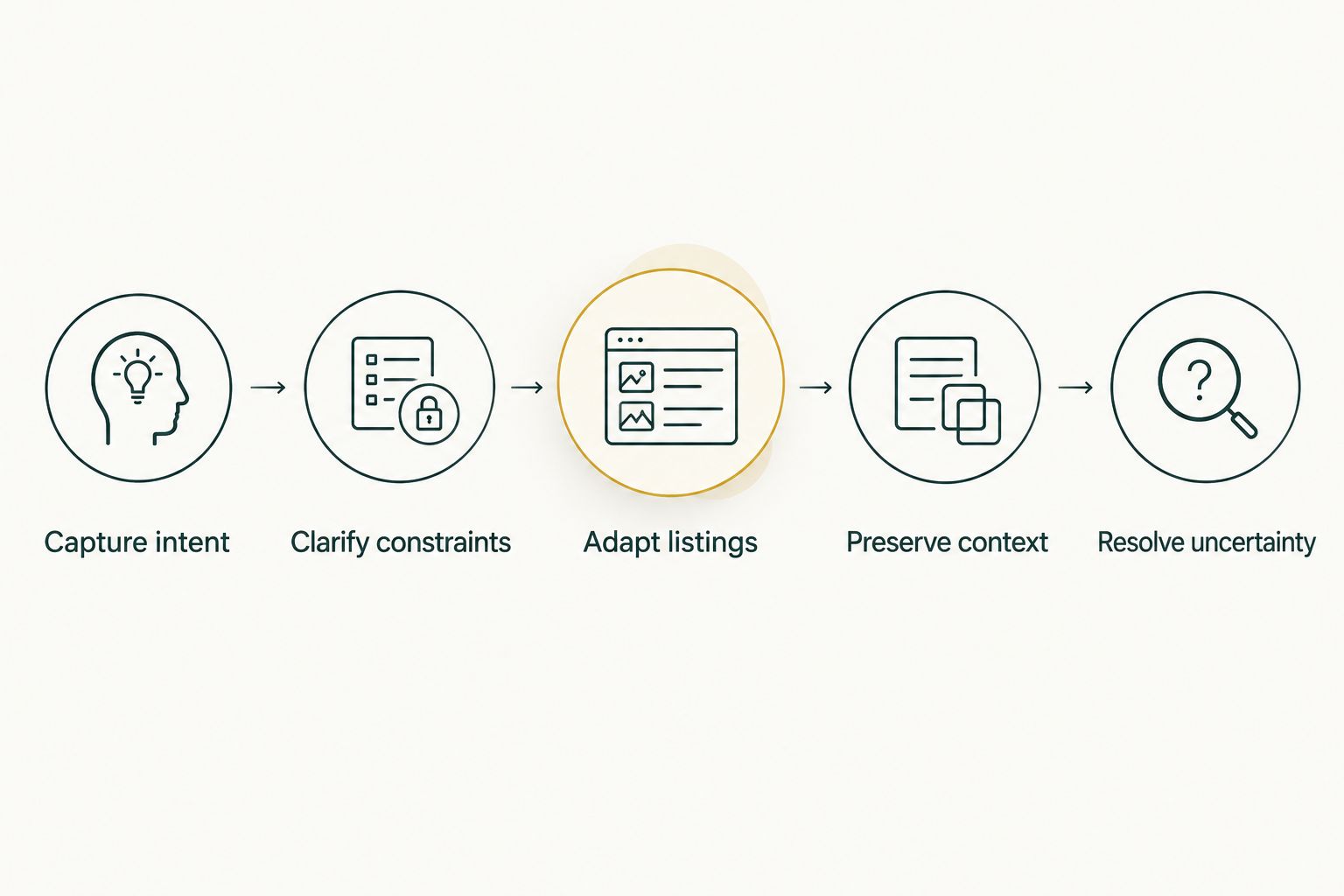
In this example, a reply recommending different footwear is only part of the task. The stronger test asks whether subsequent listings and outfit suggestions still reflect the setting and the second occasion. Do not reward a polished explanation if the next screen contradicts it.
Why replacement capability varies
Use these factors to explain differences between demonstrations in your 2026 shortlist. They concern evidence you can inspect, not vendor promises.
- Product knowledge: Attribute access and relationship understanding answer different questions. Test both a factual product question and a complementary-item request.
- Intent continuity: Determine whether the system retains explicit requirements as shoppers refine an objective or open a product detail page.
- Action scope: Identify whether the system only replies, recommends products or adapts the commerce experience. Require demonstrations of the scope you need.
- Decision boundaries: Ask which merchandising rules constrain recommendations and what happens when a request conflicts with those rules.
- Human escalation: Define when assistance should stop and which context a human adviser needs to continue the conversation.
What customer evidence supports the distinction?
Bayezon’s City Beach customer case study describes Sunny supporting conversational needs, dynamically generated product listing experiences, natural refinement and context maintained into product detail pages. Those capabilities directly address the difference between a separate chat interaction and an adapted storefront.
The case study reports purchase conversion above 7% among Agentic Storefront™ engagers, compared with approximately 2% for the traditional ecommerce experience. This is an observed comparison, not proof that the technology caused the difference. The customer later confirmed a six-month randomized control-versus-Bayezon test starting October 2025, measured in its own GA4. The engager figures quoted here do not by themselves describe the full randomized groups; retain their stated audience rather than treating them as the experiment-wide effect.
The grace & stella case study addresses needs-based beauty assistance. Dewie supports conversational questions and recommendations through Agentic Storefront™, Product Intelligence and Intent Intelligence. The reported purchase rate was 5.4% among Dewie users versus 1.4% among other customers.
grace & stella later confirmed a six-month randomized control-versus-Bayezon test starting January 2026, measured in its own GA4. The quoted Dewie-user comparison still uses engagement-defined audiences, so it must not be relabeled as the full assigned-group result. Both cases are customer-reported, not independently audited or guarantees for another retailer.
How should you test commercial value?
For a 2026 pilot, define the decision before reviewing engagement. Write down which shopping responsibilities the system will perform, which visitors are eligible and which commercial outcomes will determine whether it earns a broader role.
Evaluate conversion and revenue per visitor across the eligible population, alongside average order value and relevant guardrails such as returns. Review conversation quality separately. More messages can reflect useful exploration or unresolved confusion; the count alone does not distinguish them.
Use a suitable comparison design and document changes in traffic, campaigns and merchandising during the evaluation. The guide to measuring revenue from an agentic commerce pilot provides the next measurement question to resolve before procurement.
After those criteria are clear, request a demonstration focused on your replacement boundary: intent changes, product evidence, storefront adaptation and escalation. Evaluate observable behavior rather than a presentation of isolated features.
Evaluate the shopping journey
Request a demo focused on changing intent, storefront adaptation and the boundary between automation and human advice.
Can an ecommerce chatbot replace every human adviser?
No: retain human judgment for unresolved, sensitive or exceptional requests. Replacement should depend on demonstrated task performance, not an ambition to remove every human interaction. Define the route for escalation before launch.
Your human-adviser handoff design should specify which stated needs, viewed products and unresolved questions accompany the transfer. Make that a testable requirement rather than assuming that a transfer button preserves context.
Does higher chatbot engagement prove higher conversion?
No: engagement is not evidence of causal conversion improvement. Shoppers who choose assistance can differ from those who do not. Separate observed purchase differences from results established through an appropriate comparison design.
This distinction protects the business case. A persuasive conversation and a useful recommendation are product-quality evidence, while incremental commercial value requires its own measurement.
FAQ
Can an ecommerce chatbot replace a shopping assistant for a fashion retailer?
An ecommerce chatbot can replace defined assistance tasks when it handles product guidance, changing intent and the next shopping action accurately. Evaluate the full storefront journey, not just conversational fluency.
What is the difference between a chatbot and an agentic storefront?
A chatbot describes a conversational interface, while an agentic storefront describes an experience that adapts storefront elements around shopper intent. A conversational interface alone does not establish that broader capability.
What's the best option if we only need answers to product questions?
Bounded question-answering assistance is the appropriate scope when answering approved product questions is the requirement. Broader commerce orchestration needs a separate business justification.
Can a shopping assistant help first-time visitors?
A shopping assistant can use needs stated during the current interaction without requiring a previous purchase. Test that behavior with a fresh session rather than assuming historical customer data is available.
Does a higher purchase rate among assistant users prove the assistant caused it?
A higher purchase rate among assistant users does not establish causation. Self-selection and differences between visitor groups require a suitable comparison design.
What should we ask to see in a shopping assistant demo?
Ask to see changing intent carried from conversation into listings, product details and recommendations. Include an unsupported product question and a human-handoff request to test boundaries.
Should we remove human assistance after launching a chatbot?
Retain human assistance for tasks the system has not demonstrated it can handle appropriately. Set explicit escalation conditions and inspect whether relevant context survives the transfer.
Set a replacement boundary your team can inspect
Use a task sheet with a shopper request, the approved product evidence, the expected storefront change and the escalation condition. For an illustrative wedding-outfit request, the assistant passes only if a rejected style disappears from subsequent suggestions and the product page retains the occasion. A reply acknowledging the rejection while showing the same products fails.
Keep human advice where the task requires missing facts or judgment outside approved guidance. Replace demonstrated tasks, not job titles. Your commerce leader should approve the boundary, your merchandising team should check recommendations and your support team should test whether an adviser receives the unresolved question.
One last thing
Test a changed mind, not just a well-formed question. A shopper who revises an occasion or rejects a recommendation exposes whether the experience maintains a useful understanding of the objective. That is a stronger replacement test than asking for a product and receiving a fluent answer.
For your 2026 selection, bring that scenario to a demo request. Ask to evaluate the conversation, the resulting storefront and the point where human judgment takes over.