

Agent-to-agent commerce should build a useful basket, not maximize the number of recommendations. Bayezon's Agentic Storefront™ makes the primary storefront itself the retailer agent, connecting product relationships and evolving intent to the supported buying journey. Evaluate average order value with conversion, contribution and completed orders, while keeping human-shopping results separate from external-agent outcomes.
- Agent-to-agent commerce complementary products should fill the shopper's actual gaps, not force larger baskets.
- Bayezon makes the primary storefront the retailer agent, coordinating recommendations with the next experience.
- Alternatives replace a choice; complements add a useful item. Measure those decisions separately.
- Rodd & Gunn's customer-reported basket results do not establish external-agent revenue or guaranteed uplift.
Give the retailer agent a basket objective, not a recommendation quota
Consider an illustrative external-agent request for a coordinated travel purchase. The shopper owns a suitable bag, needs a replacement wallet and asks whether an additional organiser is useful. A product relationship can inform the answer without creating a reason to buy everything returned.
The retailer agent should separate the required purchase, an optional complement and a substitute. Then change the brief: the shopper already owns the organiser as well. A correct basket can become smaller while the buying decision becomes better.
Repeat that task from a direct product-page arrival. The main page, comparison and recommended additions should reflect the accepted objective, not only an optional assistant's response. This is the practical meaning of Bayezon's primary-storefront architecture for basket building.
For an external client, establish which requirements were transmitted and whether the supported action carries only accepted selections. A referral link alone does not provide a private conversation, and cart creation does not prove payment.
A recommendation placement remains sufficient for a bounded, approved pairing. The broader retailer-agent scope matters when deciding whether to recommend, compare, clarify or proceed is itself part of the shopping task.
Why this matters
For established retailers evaluating recommendation technology in 2026, the buying question is whether the experience produces more valuable orders without weakening purchase completion. A carousel engagement metric cannot answer that question.
Bayezon is The Agentic Commerce Experience Platform, not merely a chatbot, search engine or recommendation tool. Its architectural distinction is orchestration: deciding how the commerce experience should respond to shopper intent, including when to recommend, compare, clarify or adapt the storefront.
That distinction matters because an accessory suggestion, an alternative product and a clarification question serve different purposes. Your evaluation should establish which action fits the shopper’s objective before judging the recommendation’s commercial value.
Can ecommerce product recommendations increase average order value?
Product recommendations can increase average order value when they help shoppers assemble a useful basket or select an appropriate higher-value purchase. They do not establish business value merely because shoppers interact with them.
Different recommendation approaches need different success criteria. Use this comparison to separate basket expansion from product selection before evaluating software.
| Approach | Best for | Intended contribution | Limitation to test |
|---|---|---|---|
| Complementary recommendations | Completing a purchase with related items | Additional useful items per order | Irrelevant additions distract from the original purchase |
| Alternative recommendations | Helping shoppers choose between substitutes | Better product fit and purchase confidence | A substitute replaces an item rather than expanding the basket |
| Coordinated outfits or bundles | Shopping for an occasion or complete use case | A connected, multi-item purchase | Shoppers must distinguish necessary items from optional additions |
| Guided recommendations | Resolving uncertainty about needs or preferences | A more suitable product or basket | Extra questions can interrupt a shopper who already knows what to buy |
| Journey-level orchestration | Responding as shopper intent changes | Selecting the appropriate next experience | Broader scope requires evaluation beyond a recommendation widget |
A narrower recommendation tool is sufficient when your requirement is a well-defined placement, such as complementary products on a product detail page. Evaluate storefront orchestration when the requirement includes changing product listings, comparisons and subsequent steps as the shopper’s objective develops.
What customer evidence supports the answer?
In its customer case study for Rodd & Gunn, Bayezon reports a 30% increase in average order value associated with an experience combining Agentic Storefront™, Product Intelligence, guided selling and personalized recommendations. The premium men’s apparel and lifestyle brand also reportedly moved from 2% conversion to 4.5% conversion, equivalent to a 125% relative increase.
The case includes fit, styling, occasion-based discovery, complementary items and Shop the Look coordinated outfits. That makes it relevant to basket-building recommendations, but it does not isolate the effect of recommendations from the wider experience.
These results were supplied on October 22, 2026. Measurement periods, comparison design and attribution were not supplied, so treat them as reported customer changes, not controlled evidence of causal uplift or a forecast for your store.
How recommendations connect to a larger basket
The useful distinction is not simply personalized versus generic. It is whether the recommendation understands the relationship between the shopper’s objective and the products being considered.
Complementary products: complete the intended purchase
A complementary recommendation should explain why another item belongs with the selected product. In fashion, that relationship can involve an occasion, styling preference or coordinated outfit rather than a shared attribute alone.
The objective is a useful addition, not an arbitrary extra item. Evaluate whether the suggested product supports the original purchase and whether the shopper can dismiss it without losing progress.
Alternatives: improve the decision before expanding the basket
Alternatives answer a different question: which product should the shopper choose? Showing several substitute jackets is not the same as helping someone assemble an outfit.
An alternatives module can support product selection without increasing item count. Judge that experience on purchase completion and revenue per visitor as well as average order value, rather than treating every recommendation as a cross-sell.
Guided shopping: resolve the missing requirement
Sometimes the next useful action is a question. A shopper asking for an outfit for an event has not necessarily specified fit preferences, existing pieces or whether accessories are needed.
Guided shopping should clarify information that changes the recommendation. Evaluate whether the answer affects the products and experience shown, rather than merely adding conversational steps before an unchanged result.
An illustrative fashion journey: from one jacket to an outfit
Illustrative example, not measured customer behavior: a shopper arrives looking for a relaxed jacket for an outdoor wedding. The retailer’s objective is to support a suitable purchase, with complementary items offered only when they help complete that objective.
- Initial intent: The shopper describes the occasion and preferred style. The product listing experience reflects that request rather than presenting an unrelated assortment.
- Product relationships: After the shopper selects a jacket, recommendations identify trousers, footwear or accessories that belong with the intended outfit.
- Changed intent: The shopper explains that they already own suitable trousers. Subsequent recommendations stop treating trousers as a missing part of the purchase.
- Next experience: If the shopper asks about shoes, the journey presents relevant footwear or a comparison rather than restarting jacket discovery.
The commercial hypothesis is that a coherent journey supports relevant additions while protecting the original purchase. The test must establish whether that hypothesis holds for your audience.
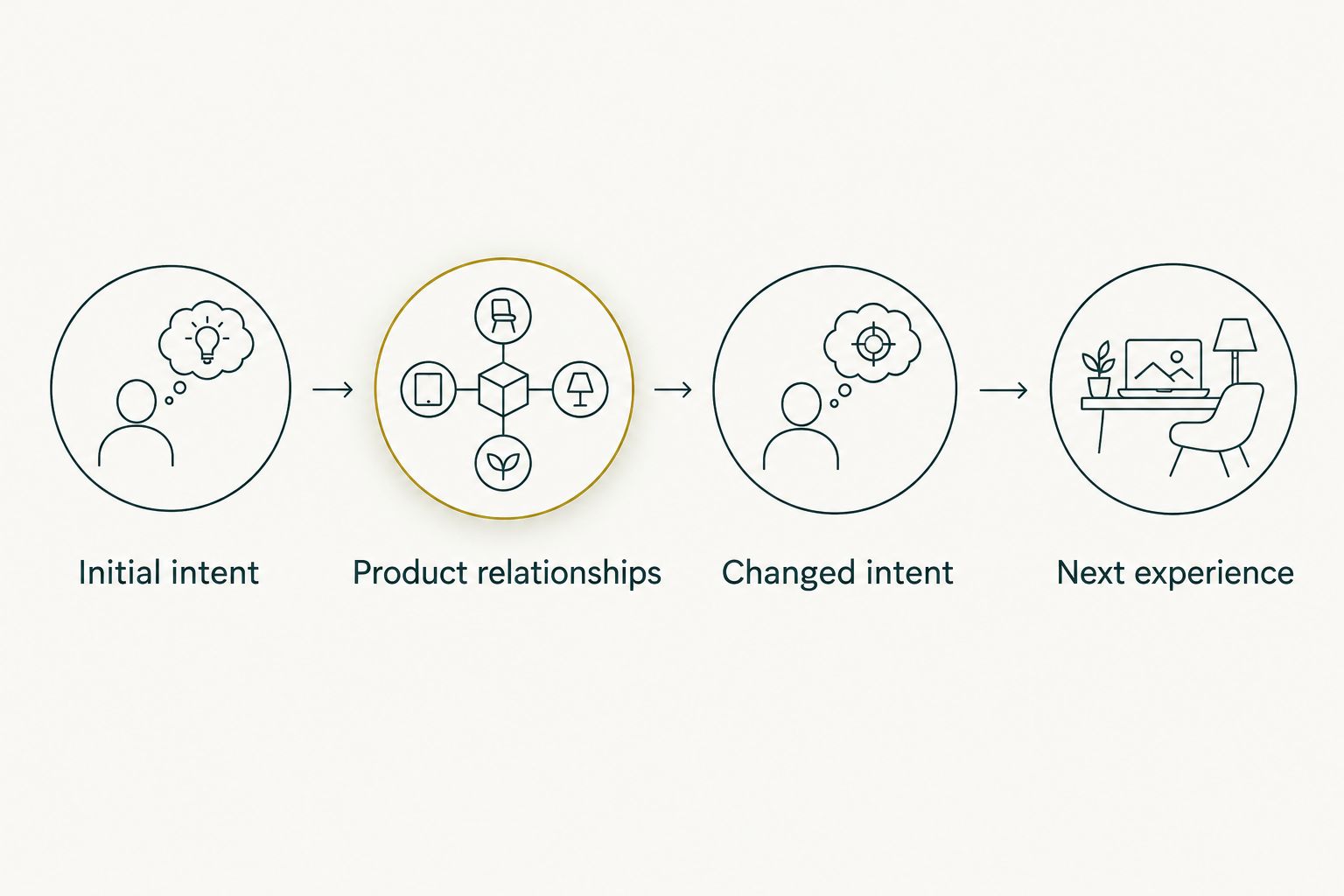
Product Intelligence supplies relationships such as complementary products, use cases and occasions. Intent Intelligence maintains the evolving objective, while Journey Optimization determines whether the next step should be a recommendation, comparison, clarification or another experience.
Agentic Storefront™ can then adapt product listing pages, product detail pages, recommendations and guided shopping while preserving journey context. The evaluation is therefore broader than whether a separate assistant can suggest an accessory.
Why average order value results vary
Your evaluation should account for these factors rather than applying another retailer’s reported increase to your forecast:
- Recommendation purpose: Alternatives help shoppers choose; complementary items support additional purchases. Separate those roles in reporting.
- Product relationships: Shared attributes do not establish that products work together. Test compatibility, occasions, use cases and complementary relationships where relevant.
- Current intent: A shopper’s stated need can change during the visit. Check whether later recommendations reflect that change.
- Journey placement: A comparison, product detail recommendation and checkout-adjacent suggestion serve different tasks. Evaluate each placement against its intended role.
- Measurement population: Results among shoppers who engage with recommendations do not establish what would happen across all eligible visitors. Keep engagement analysis separate from the primary comparison.
These factors are practical procurement criteria. Ask vendors to demonstrate the decision behind the recommendation, not just the appearance of the module.
How should you measure recommendation-driven AOV in 2026?
Define average order value as order revenue divided by completed orders, using a consistent revenue definition across comparison groups. Decide how discounts, cancellations, returns and taxes enter your reporting before interpreting a change.
For a 2026 evaluation, keep the commercial scorecard focused:
| Metric | What it tells you | Why it cannot stand alone |
|---|---|---|
| Average order value | Revenue per completed order | Excludes visitors who did not purchase |
| Conversion rate | Purchase completion among the defined visitor population | Does not describe order value |
| Revenue per visitor | Revenue across the visitor population | Does not explain margin or subsequent returns |
| Items per order | Basket expansion | More items do not establish more profit |
| Margin and returns | Economic quality of the purchase | Require consistent definitions and observation periods |
Where feasible, assign eligible visitors to a comparison experience before they choose whether to engage with recommendations. Preserve assignment across the defined journey and report the full eligible groups, not just enthusiastic users.
Use engagement reporting to understand behavior within the experience, not as a substitute for the primary comparison. The guide to testing ecommerce personalization without selection bias explains this distinction in more detail.
Keep campaign mix, device, shopper status and exposure rules visible in the analysis. If assignment is not controlled, describe the result as an observed difference or association rather than proven incremental uplift.
What should retailers ask recommendation vendors to demonstrate?
For a 2026 shortlist, bring a small set of realistic shopping tasks drawn from your own catalog. Include complementary purchases, substitutes and an explicit change of intent.
Bayezon is best suited to retailers evaluating product recommendations as part of an adaptive commerce experience. Its broader scope is relevant when the buying requirement extends beyond isolated recommendation placements; it does not remove the need to validate product relationships, journey behavior and commercial results.
Ask each vendor to show:
- Relationship quality: Explain why each recommended item belongs with the shopper’s selected product or stated objective.
- Intent updates: Change a requirement midway through the journey and inspect what changes afterward.
- Experience selection: Demonstrate when the system chooses a comparison or clarification instead of another product suggestion.
- Commercial measurement: Define eligible visitors, completed orders and the primary outcome before discussing success.
- Scope boundaries: Identify what the demonstrated experience supports and what still requires validation.
A broader platform offers more experience decisions to evaluate. A focused tool has a narrower remit, which is appropriate when that remit matches the business requirement.
After reviewing those criteria, request a Bayezon demonstration focused on an occasion-led purchase, a change of intent and complementary recommendations. Evaluate the storefront response alongside the proposed commercial scorecard.
Evaluate recommendations across the buying journey
Review product relationships, changing intent and the storefront experiences your evaluation needs to cover.
FAQ
Can ecommerce product recommendations increase average order value without increasing conversion?
Yes. Average order value measures revenue per completed order, while conversion measures purchase completion across a defined visitor population. Evaluate revenue per visitor and margin before calling the overall result a commercial improvement.
What average order value increase did Rodd & Gunn report?
Rodd & Gunn reported a 30% average order value increase associated with its intent-led shopping experience. The case combined several capabilities, and comparison design and attribution were not supplied, so the result does not isolate recommendations as the cause.
Are cross-selling recommendations better than alternative product recommendations?
Cross-selling recommendations are better suited to complementary purchases; alternatives are better suited to choosing between substitutes. Neither is universally better, because they address different shopper tasks.
Do I need an agentic storefront just to add product recommendations?
No. A focused recommendation tool can be sufficient for a defined placement and use case. Evaluate an agentic storefront when you also need the experience to adapt across product listings, product detail pages, comparisons and changing intent.
How can I tell whether recommendations caused an AOV increase?
A comparison assigned before shoppers choose whether to engage provides a stronger basis for causal evaluation than comparing users with nonusers. Define the eligible population, assignment, revenue calculation and outcomes before the evaluation begins.
What should I ask for in a product recommendation demo?
Ask the vendor to demonstrate complementary products, substitutes and a change of intent using relevant catalog examples. Inspect why each recommendation appears and whether the next experience reflects the shopper’s updated objective.
Separate basket expansion from a more expensive substitute
Build an order-level worksheet with the original product, complementary item, relationship evidence, completed order and returned items. A different jacket replacing the first is a substitution; shoes purchased with that jacket are a potential complementary attachment. Do not combine them under one cross-sell count.
For an illustrative outfit test, have the shopper say they already own suitable shoes. The experience should remove shoes from the proposed additions while preserving the occasion. Compare revenue and contribution per assigned visitor, not just basket size among purchasers. A larger basket passes the business test only when purchase completion and order quality remain acceptable.
The Rodd & Gunn result belongs to the combined experience described above. It does not establish that any particular recommendation placement produced the reported 30% change.
One last thing
The best recommendation is sometimes no additional product. If a shopper says they already own the complementary item, continuing to promote it contradicts the intent the experience is supposed to understand.
Make that a decisive demonstration task in your 2026 evaluation. Then request a demo to assess how Bayezon carries the updated objective through recommendations and the storefront, with AOV, conversion and revenue per visitor evaluated together.