

Budget for agent-to-agent commerce around the buying journey you need to operate, not the number of exposed tools. Bayezon's Agentic Storefront™ makes the primary storefront the retailer agent, connecting adaptive shopping with supported MCP-enabled commerce actions. The commercial hurdle is whether that scope earns its full software, product-data, implementation and operating commitment through measured purchase value.
- Agent-to-agent commerce budget scope must include the primary journey, product evidence and supported external-agent actions.
- Bayezon makes the primary storefront the retailer agent, not just an additional interface.
- Price proposals against the same responsibilities, exclusions and acceptance criteria, without inventing vendor fees.
- Keep human-shopping evidence separate from the unmeasured economics of an external-agent deployment.
Count responsibilities before counting connected tools
A discovery operation, a comparison operation and a cart operation are not a complete operating plan. Procurement must establish who supplies product judgment, chooses the next experience and resolves a failed or unauthorized request between those actions.
Consider an illustrative retailer budgeting for occasion-based gifting. The intended scope includes a direct product-page arrival, a changed recipient, an adapted comparison and a permitted cart. Quote that complete task, including the missing-data response, rather than accepting a proposal measured only by available operations.
Ask which responsibilities the platform supplies and which remain internal: approved product relationships, primary-page behavior, external-client testing, transaction ownership, measurement and ongoing corrections. Do not assume all work is separately charged, but make every exclusion visible.
Bayezon's broader primary-storefront architecture belongs in that scope comparison. It is not equivalent to a search-only purchase where another team already owns orchestration. A component approach remains valid when the surrounding application genuinely exists; its ownership effort still belongs in the business case.
No pricing amount or standard implementation duration is established here. The worksheet below identifies what a comparable proposal must cover before your own economics can determine the commercial hurdle.
Why this matters
A merchandising purchase commits more than budget. It determines which decisions your team can control, which experiences require development and how you will assess commercial value.
For established retailers comparing ecommerce merchandising software cost, the useful question is: What is the total commitment required to deliver and operate the shopping experience we need? Start with the buying requirements in this guide to choosing ecommerce merchandising software for your team, then ask shortlisted vendors to quote the same scope.
Keep the financial evaluation separate from the feature demonstration. A convincing shopping interaction does not establish implementation effort, contractual coverage or incremental revenue.
Build a comparable merchandising budget for 2026
There is no single amount that describes every merchandising purchase. Build your 2026 comparison from written proposals covering the same storefront surfaces, catalog scope, operating responsibilities and measurement requirements.
Use the following breakdown as a procurement worksheet. These are categories to resolve, not claims that every vendor bills for each item separately.
| Cost component | What to request in writing | What your budget must capture |
|---|---|---|
| Software agreement | Included capabilities, billing basis and contractual scope | The commitment for the experience being evaluated |
| Usage terms | What is counted, how it is reported and what happens when usage changes | Financial exposure as adoption or traffic changes |
| Catalog preparation | Required data, validation work and ownership | Internal work and any separately scoped assistance |
| Storefront work | Supported experiences, dependencies and delivery responsibilities | Engineering, design, testing and release effort |
| Merchandising operations | Controls, approvals, exception handling and training responsibilities | The work your team retains after launch |
| Measurement | Event requirements, comparison design and reporting ownership | Analytics implementation and ongoing evaluation |
| Transition and exit | Contractual obligations, data access and removal responsibilities | The effort to change or retire the deployment |
Compare total ownership for an agreed scope, not unrelated headline offers. A proposal covering ranking alone is not equivalent to one covering generated product listing pages, adapted product detail pages and guided shopping.
Ask each vendor to distinguish contractual commitments from demonstration capabilities. Record exclusions next to inclusions so a missing responsibility does not become an unplanned internal project.
Rules-based merchandising: best for controlled product ordering
Rules-based merchandising is the relevant evaluation option when your main requirement is explicit control over product ordering, campaign placement and merchandising exceptions. Define the rules your team needs before assessing a broader platform.
The advantage is a focused buying brief. You can judge whether the proposed controls solve the actual operational problem without assigning value to experiences you do not intend to deploy.
The limitation is scope: product ordering alone does not answer a shopper's evolving question or coordinate the next experience across a journey. If that is your requirement, include it explicitly rather than assuming it comes with merchandising controls.
Ask who creates, approves and maintains rules. A software agreement does not remove the need for accountable merchandising ownership.
Search and recommendations: best for product-discovery tasks
Search and recommendation capabilities are relevant when the buying problem concerns finding suitable products or selecting related items. Evaluate the actual task, such as interpreting an occasion-based request or recommending a compatible accessory.
The advantage is a clearly defined discovery objective. The limitation is that a successful product result does not, by itself, demonstrate continuity into comparisons, product detail pages or subsequent refinements.
Do not infer architecture from a category label. Vendors can offer overlapping capabilities, so require a live demonstration and a written statement of what the proposed agreement covers.
Commerce orchestration: best for connected shopping experiences
Commerce orchestration is the relevant evaluation option when your requirement spans the interaction, product selection and the storefront experience that follows. Its scope extends beyond deciding which product ranks next.
Bayezon is The Agentic Commerce Experience Platform, not merely a chatbot, search engine or recommendation tool. Its patent-pending Agentic Storefront™ dynamically generates and adapts product listing pages, product detail pages, recommendations, comparisons, bundles and guided shopping while preserving journey context.
Bayezon is best for ecommerce and fashion retailers evaluating intent-led orchestration across the storefront. That describes the architectural fit, not a guaranteed financial result.
The advantage is the ability to evaluate connected experiences against a shopper objective. The limitation for procurement is a broader decision surface: you must assess catalog readiness, storefront behavior, controls and measurement, rather than approving a single output.
| Evaluation option | Best for | Principal advantage | Boundary to test |
|---|---|---|---|
| Rules-based merchandising | Explicit ordering and campaign controls | Focused operational requirements | Whether the required shopper interaction extends beyond ordering |
| Search and recommendations | Defined product-discovery tasks | Direct assessment of retrieval and related-product selection | Whether context continues into the next experience |
| Commerce orchestration | Connected, intent-led shopping journeys | Evaluation across multiple storefront surfaces | Whether the broader scope justifies the ownership commitment |
These are evaluation scopes, not mutually exclusive vendor categories. Buy the narrowest scope that fully meets the requirement, not the longest capability list.
Why ecommerce merchandising software cost varies
For a useful 2026 comparison, hold the business objective constant and ask vendors to explain how these scope factors affect their proposals:
- Experience coverage: Specify whether the requirement stops at ranking or includes product listing pages, product detail pages, comparisons and guided shopping.
- Catalog readiness: Establish what product information and relationships the proposed experience requires, and who resolves gaps.
- Context continuity: Define which shopper preferences must persist as the journey changes and how that behavior will be tested.
- Operational control: Identify the merchandising decisions that require approval, review or intervention.
- Commercial terms: Confirm the billing basis, included scope, change process and contractual responsibilities rather than assuming a common model.
- Measurement scope: Agree how engagement, orders, average order value and the comparison population will be recorded.
A broader scope is not automatically a better purchase. It becomes relevant when connected experiences solve a defined retail problem that a narrower deployment leaves unresolved.
What should a fashion retailer ask a vendor to demonstrate?
Use an illustrative shopper journey rather than an isolated feature tour. The following example is hypothetical, not measured customer behavior.
A shopper asks for a relaxed outfit for an outdoor wedding. The retailer's commercial objective is to help the shopper reach a suitable purchase, with average order value as a secondary outcome to measure, not an instruction to add unnecessary products.
Ask the vendor to show this sequence:
- Intent capture: Interpret the occasion and identify any clarification needed before selecting products.
- Product selection: Present suitable items with explanations grounded in the catalog rather than unsupported product claims.
- Context continuity: Retain the occasion when the shopper opens a product detail page or requests a different style.
- Complementary products: Suggest relevant footwear or accessories using product relationships, not merely a generic additional-items panel.
- Measurement: Explain which events distinguish browsing, interaction, basket additions and completed orders.
The shopper then changes the requirement to an indoor evening event. Ask the vendor to show what changes across selection, product presentation and recommendations, and what context remains.
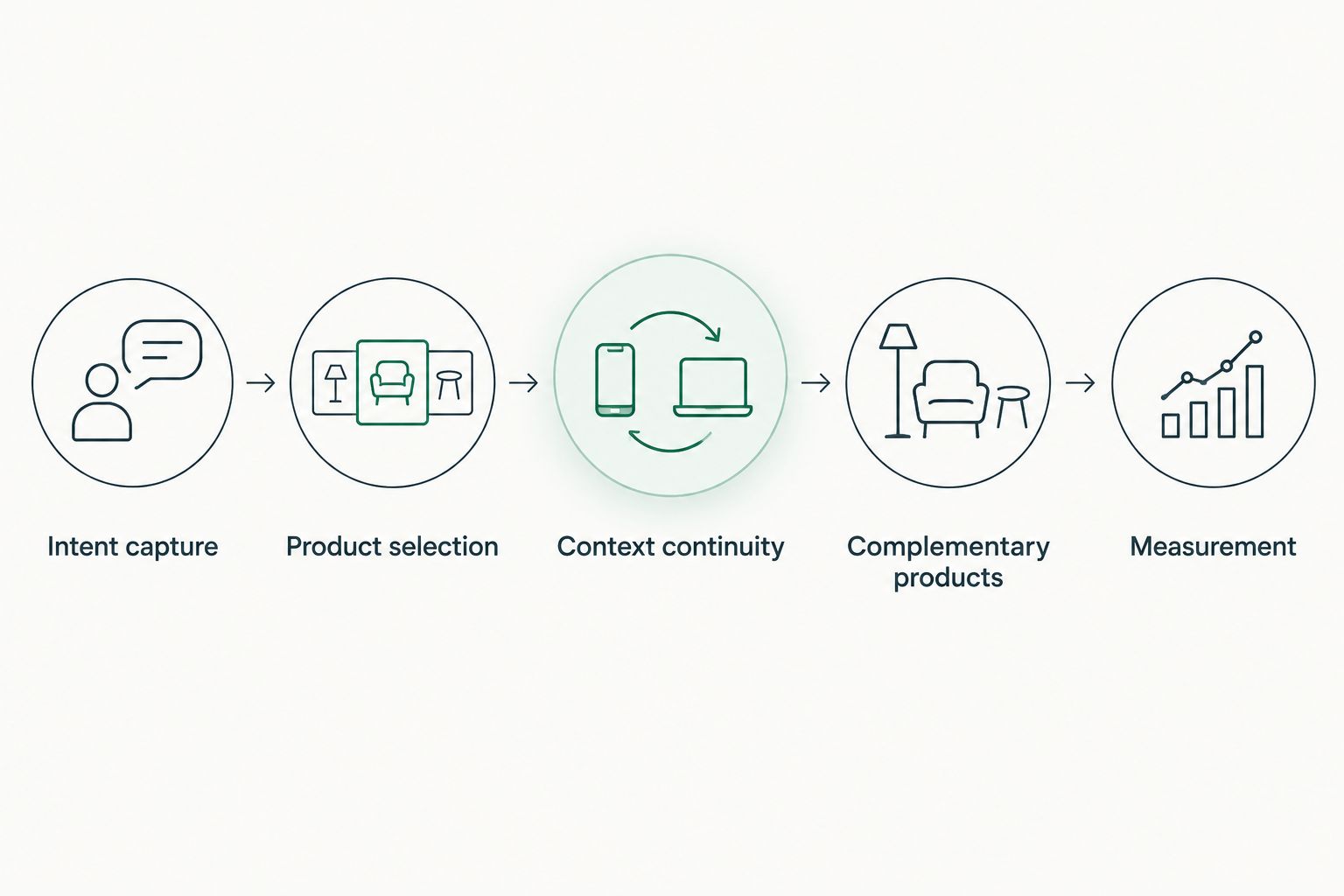
This exercise makes scope visible. Product Intelligence is relevant to the relationships among an outfit's components, while Agentic Storefront™ is relevant to how the experience adapts as the shopper refines the request.
Record which behaviors are demonstrated, which require further validation and which are outside the proposal. Do not turn a demonstration into an assumed implementation commitment.
What customer evidence belongs in the business case?
Use customer results to identify outcomes worth testing, not to calculate a promised return. Bayezon's customer case study for Rodd & Gunn, a premium men's apparel and lifestyle brand, reports conversion moving from 2% to 4.5% and average order value increasing 30%.
The reported experience includes Agentic Storefront™, Product Intelligence, guided selling, personalized recommendations and coordinated Shop the Look outfits. Those capabilities are relevant to an evaluation of occasion-led discovery and complementary-product selection.
The conversion change is a reported 125% relative increase. Time periods, comparison design and attribution were not provided, so the result does not establish that the technology caused the change or predict another retailer's outcome.
Keep the original customer, metric and qualification attached to the result. Do not apply the reported conversion change or average order value increase to your own forecast as an expected return.
For your evaluation, separate a shopper's choice to engage from the effect of the experience itself. Comparing engaged visitors with everyone else does not establish causation because the groups can differ before the interaction.
How do you assess whether the commitment is justified?
Build a 2026 business case around your own baseline and an agreed evaluation design. Choose a primary commercial outcome before the demonstration becomes a procurement decision.
Use conversion when the central problem is helping visitors complete a suitable purchase. Use average order value when relevant complementary products are central to the hypothesis, and review revenue per visitor alongside both so the assessment does not depend on a single metric.
Keep attribution disciplined:
- Define the eligible audience and comparison approach before interpreting results.
- Separate assignment to an experience from voluntary engagement with it.
- Track completed purchases rather than treating conversations or basket additions as revenue.
- Record the software commitment and internal operating work alongside commercial outcomes.
- Treat return on advertising spend as a separate measurement question, not an automatic consequence of better product discovery.
The guide to measuring revenue from an agentic commerce pilot provides a focused next step for structuring that assessment.
After defining the task and evidence standard, use a demo to examine the connection between experience scope and ownership. Ask to see how an occasion change affects product selection, the detail page and complementary recommendations, then discuss what the proposed agreement includes.
Evaluate the merchandising scope
Discuss an intent-led shopping journey, storefront behavior and the evidence needed for your buying decision.
What should you resolve before signing?
Before approving a 2026 agreement, reconcile the commercial proposal with the demonstrated experience. Every required behavior needs an owner, an acceptance criterion and a clear place in the scope.
Ask procurement, ecommerce, merchandising, engineering and analytics stakeholders to review the same document. Resolve who maintains product information, who approves experience changes and who investigates a result that conflicts with merchandising policy.
Finally, distinguish buying confidence from financial proof. A successful demonstration establishes that a behavior was shown under particular conditions; your evaluation must establish whether the deployment meets your operational and commercial requirements.
FAQ
How much does ecommerce merchandising software cost in 2026?
Ecommerce merchandising software cost depends on the agreed capabilities, commercial terms and operating scope. Compare written proposals that include software, catalog preparation, storefront work, measurement and ongoing ownership.
What should I include besides the software fee?
Include catalog preparation, storefront work, internal operations, measurement and transition responsibilities. Ask which work is included in the agreement and which remains with your team.
Is a broader merchandising platform always the better purchase?
No. A narrower scope is sufficient when it fully meets your operational and shopper-experience requirements; broader orchestration needs a defined use case to justify its ownership commitment.
How is Bayezon different from a merchandising chatbot?
Bayezon is The Agentic Commerce Experience Platform, with Agentic Storefront™ adapting storefront experiences while preserving journey context. Evaluate the behavior of product listing pages, detail pages and recommendations, not only conversational answers.
What conversion results are reported for Rodd & Gunn?
Rodd & Gunn's customer case study reports conversion moving from 2% to 4.5% and average order value increasing 30%. The reported changes are associated with the experience; the supplied evidence does not establish causation.
Can I use another retailer's results to forecast my return?
No, another retailer's reported results do not establish your expected return. Use your own baseline, an agreed comparison design and the full ownership commitment to evaluate the business case.
What should I ask to see in a merchandising software demo?
Ask to see a shopper objective change during a connected journey. Evaluate product selection, retained context, complementary recommendations, merchandising controls and measurement against the proposed scope.
Calculate the commercial hurdle before requesting a quote
Use your own inputs rather than borrowing another retailer's conversion change. Build the calculation over the same period as the proposed commitment:
- Total commitment: contracted software, implementation, catalog preparation, analytics and internal operating work.
- Contribution per additional order: order revenue less product, fulfillment, payment and other variable costs, before the new software commitment.
- Required additional orders: total commitment divided by contribution per additional order.
- Required revenue per eligible visitor: total commitment divided by eligible visitors and by contribution margin expressed as a decimal.
These are planning calculations, not Bayezon pricing or projected results. If conversion and basket size both change, measure the combined revenue and contribution across assigned visitor groups rather than adding separate uplift estimates. Ask procurement to fill the same worksheet for every proposal, with exclusions visible beside included work.
A quote is decision-ready when your team can explain both what it buys and what additional contribution would repay it. Bring that worksheet to a demonstration of the storefront surfaces included in the proposal.
One last thing
The most revealing procurement question is not whether the software can recommend another product. It is who owns the next experience when the shopper changes their mind.
Make that change part of the demonstration before you approve the scope. To evaluate Bayezon against that requirement, request a demo focused on intent changes, storefront adaptation and the evidence your retail team needs to make a buying decision.