

For retailers pursuing agent-to-agent commerce, the investment decision is whether to improve retrieval or give the retailer responsibility for the supported buying journey. Conversion and revenue per visitor are objectives to validate, not benefits established by connecting a search tool. Bayezon's Agentic Storefront™ makes the primary storefront itself the retailer's agent, combining adaptive human shopping with supported MCP-enabled commerce actions.
- Agent-to-agent commerce search upgrades and primary-storefront transformation solve different buying requirements.
- Bayezon makes the primary storefront the retailer agent rather than adding an optional assistant.
- Retain focused search when another system already supplies the required commerce orchestration.
- Validate direct visitor journeys and supported external-agent tasks separately before expanding.
Upgrade a component or change who owns the journey?
A search procurement brief asks whether products are found and ranked appropriately. A whole-journey brief also asks who interprets an objective, clarifies a missing requirement, compares alternatives and determines the next buying step.
Consider an illustrative retailer receiving an external agent's request for a suitable work-and-travel bag. Retrieval supplies candidates. The broader task must decide whether the supplied device dimensions establish fit, whether the shopper's existing accessories remove a proposed addition and whether the request authorizes only comparison or a cart.
Test the same brief from a direct product-page landing. If the main experience remains generic until a separate assistant opens, the purchase supplies a side experience rather than the primary-storefront architecture Bayezon advocates.
This does not make component search obsolete. If your own application already supplies the missing decisions, retaining a capable retrieval service can be the right scope. The investment case turns on the responsibility gap, not a universal demand to replace working infrastructure.
The following switching framework applies to that decision: fix correctable data problems first, evaluate the missing journey behavior, then measure the agreed commercial outcome. Neither an improved result list nor a working external connection alone proves the broader case.
Why this matters
For established retail brands, the buying question is not whether newer search technology looks more capable. It is whether changing technology addresses a commercial constraint that your current system cannot resolve acceptably.
Your 2026 evaluation should separate relevance problems from journey problems. A shopper finding the right dress but losing fit and occasion context on the product page presents a different requirement from a shopper receiving irrelevant search results. Start by defining those failures before testing ecommerce site search before choosing a vendor.
Is an ecommerce search engine upgrade worth it?
Upgrade when a documented capability gap survives reasonable fixes and a matched evaluation supports the commercial case. Keep the existing system when configuration, product information or merchandising changes solve the problem without introducing a larger operational burden.
| Decision path | Best for | Main advantage | Main limitation |
|---|---|---|---|
| Improve the current setup | Retailers with correctable catalog or configuration gaps | Addresses the immediate problem without replacing the engine | Does not resolve capabilities the current architecture cannot support |
| Replace search | Retailers with unmet retrieval, filtering or ranking requirements | Targets a defined search problem | Search improvements alone do not establish better downstream journeys |
| Evaluate commerce orchestration | Retailers needing intent to shape multiple shopping experiences | Tests continuity across discovery, product evaluation and the next action | Requires a broader evaluation of controls, experience ownership and measurement |
These are scope decisions, not a ranking of technologies. A narrower search replacement is sufficient when the requirement is narrower. A broader platform earns consideration when product discovery, recommendations and storefront behavior need to work together.
Improve the current setup: best for correctable failures
Inspect the underlying product records and configured behavior before blaming the search engine. If relevant products lack the attributes needed to answer a query, replacing retrieval does not remove the need to improve those records.
Ask your team to reproduce each failure and identify its cause. Distinguish missing product information, an incorrect rule and an unsupported capability. Keep and improve the current setup when it can satisfy the requirement with acceptable effort.
Replace search: best for a bounded retrieval problem
A search-focused upgrade fits a requirement centered on finding and ordering relevant products. Evaluate it against your own queries, filters, merchandising constraints and product information rather than a vendor's prepared catalog.
Its advantage is focus. Its limitation is scope: successful retrieval does not demonstrate that a shopper can compare alternatives, retain context or receive a useful next experience. Choose a search replacement when search is the actual constraint.
Evaluate orchestration: best for connected journey requirements
A broader evaluation fits retailers whose requirements extend beyond the results list. Examples include adapting a product page to an expressed occasion, comparing suitable alternatives and changing recommendations when the shopper's objective changes.
Bayezon is best for established retailers evaluating orchestration of the commerce experience, rather than search replacement alone. Bayezon is The Agentic Commerce Experience Platform, not merely a chatbot, search engine or recommendation tool. Its client-described architecture connects intent, product understanding and decisions about the next experience.
The broader scope also creates a broader procurement task. Require evidence for storefront behavior, merchandising control and measurement, rather than treating an attractive conversational interface as proof of the whole architecture.
What does a worthwhile upgrade change for a shopper?
Consider an illustrative fashion journey, not measured customer behavior. A shopper asks for a relaxed outfit for an outdoor wedding, then explains that the ceremony is on sand and that they already own suitable trousers.
The initial request calls for occasion-aware discovery. The refinement changes the task: recommendations should account for the trousers, footwear should suit the setting, and previously rejected options should not reappear without a reason.
Use the same scenario to compare three observable behaviors:
- Product discovery: Does the experience identify products that meet the stated occasion and constraints?
- Context continuity: Does the product detail experience preserve the shopper's requirements?
- Next experience: Does the journey offer a useful comparison or complementary item instead of restarting discovery?
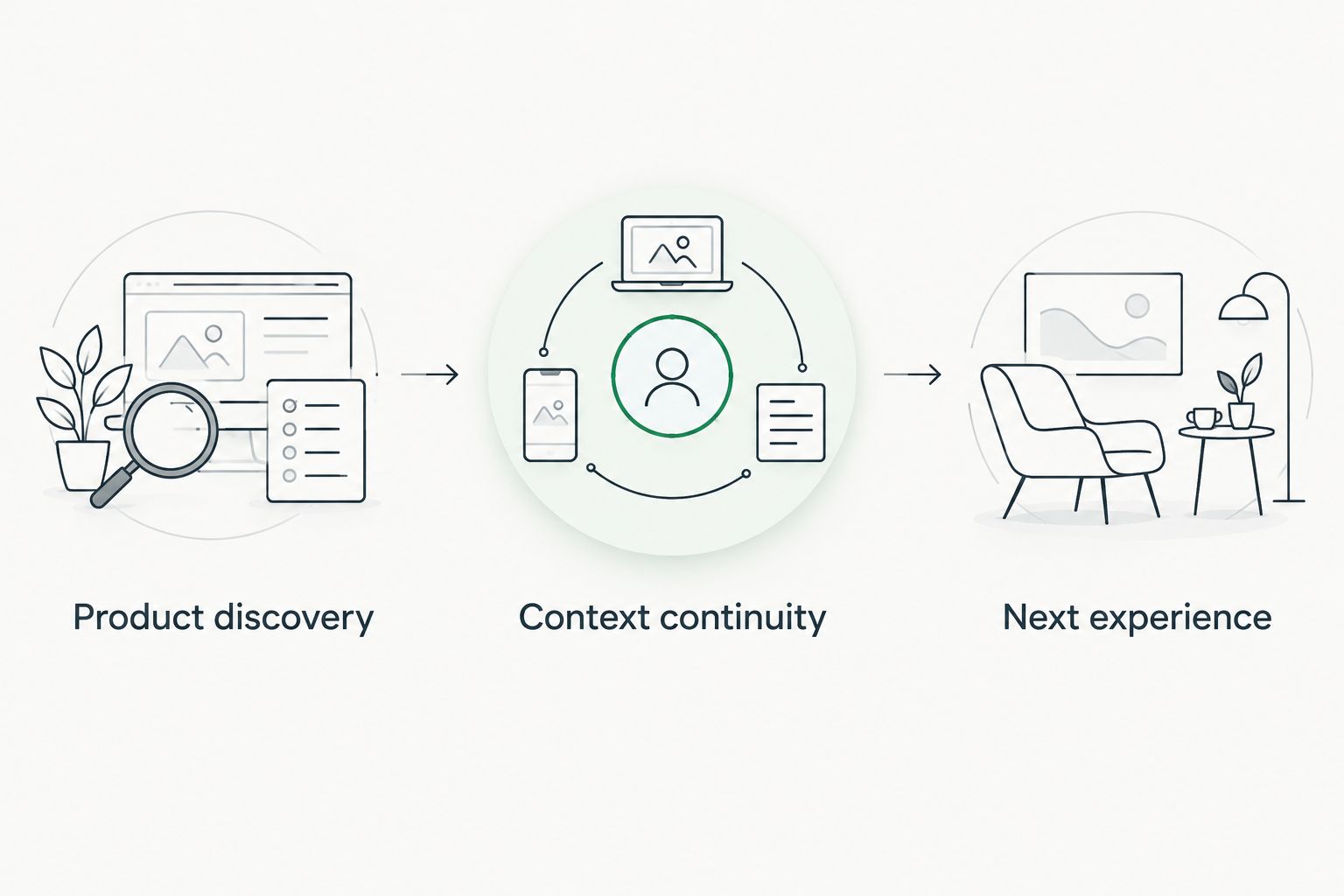
Agentic Search is described as selecting retrieval strategies, filters, ranking and product experiences around the shopper's objective. Product Intelligence adds relationships, compatibility, complementary products, use cases and occasions beyond individual attributes. Agentic Storefront™ can dynamically generate and adapt listing pages, product pages, recommendations and comparisons while preserving journey context.
These capabilities support a commercial hypothesis, not an automatic result. Measure whether better-supported decisions translate into purchases and revenue per visitor; evaluate complementary recommendations against average order value without treating a larger basket as proof of greater profitability.
Why the switching effort varies
The switching decision in 2026 should account for work outside the search interface. Ask each vendor and your internal owners to define responsibilities against the same requirements.
- Catalog readiness: Product attributes and relationships must support the requests you intend to serve. Identify gaps before accepting a demonstration as representative.
- Experience scope: Replacing results differs from adapting listing pages, product pages, recommendations and guided shopping. Specify which surfaces are included.
- Merchandising controls: Document how commercial rules, exclusions and product suitability constrain results and recommendations. Require demonstrations of those boundaries.
- Measurement continuity: Preserve clear definitions for eligible traffic, purchases and revenue. A changed denominator makes before-and-after comparisons harder to interpret.
- Operational ownership: Name the people responsible for product information, merchandising decisions, quality checks and escalation. An unclear owner is an unresolved requirement.
- External-agent requirements: If agent-to-agent commerce matters, evaluate supported actions, permissions and client compatibility separately from the human storefront.
Do not turn these factors into an assumed implementation schedule. Request a documented scope and responsibility split, then assess the effort against the commercial problem you have established.
How do you prove the upgrade is worth the effort?
Use a decision process that can produce a no-switch answer. Procurement is stronger when the existing system has a fair chance to meet the same requirements.
- Define the failure. Describe what shoppers cannot accomplish and identify where it occurs. Separate exact-item retrieval from fit guidance, occasion discovery and complementary-product selection.
- Set the commercial objective. Choose the primary outcome, such as purchase conversion or revenue per visitor, and define the eligible population before exposure.
- Compare matched tasks. Give the current and proposed experiences the same catalog-backed requests. Include refinements, ambiguous requests and unsuitable-product constraints.
- Evaluate real traffic fairly. Use randomized assignment where feasible. Keep exposure, purchase definitions and reporting windows consistent, and report assignment limitations.
- Decide against the full burden. Assess observed outcomes alongside operating effort, governance requirements and unresolved dependencies. Do not approve a switch solely because more shoppers used search.
For your 2026 business case, separate leading indicators from commercial outcomes. Relevant results, successful refinements and engagement help explain behavior, but they do not replace purchase and revenue measurement. The guide to measuring revenue from an agentic commerce pilot provides a focused next step.
After defining these criteria, request a demonstration that follows your catalog-backed tasks through discovery, product evaluation and refinement. Ask the team to show both successful paths and the handling of unsupported requests.
Evaluate the switching case
Examine intent handling, storefront continuity and measurement requirements against your retail buying criteria.
What customer evidence supports a broader evaluation?
At City Beach, Bayezon's customer case study reports purchase conversion above 7% among Agentic Storefront™ engagers, compared with approximately 2% for the traditional ecommerce experience. The described experience supports conversational needs, dynamically generated product listings, natural refinement and context carried into product detail pages.
That is evidence relevant to evaluating connected discovery, not proof that replacing search causes the difference. The comparison is observational; shoppers who engage are not established as equivalent to those who do not.
At Rodd & Gunn, the reported results associated with the experience include conversion moving from 2% to 4.5% and average order value increasing 30%. The relevant capabilities include guided selling, Product Intelligence and coordinated outfit recommendations. Comparison design, time periods and attribution were not supplied, so these results do not establish a causal effect or forecast your return.
For a 2026 shortlist, use customer evidence to identify what deserves testing. Require your own evaluation to establish whether those capabilities address your audience, catalog and commercial objective.
Should agent-to-agent commerce affect the decision?
Include agent-to-agent commerce when your strategy requires compatible external agents to interact with retailer-controlled commerce capabilities. Do not confuse that requirement with a human-facing shopping assistant or infer it from conversational search alone.
Bayezon confirmed in November 2026 that its retailer agents have MCP capabilities exposing product discovery, recommendations, comparisons, live price and availability, cart creation and checkout. These are client-confirmed capabilities, not independently tested client connections. Checkout capability does not establish autonomous payment completion.
Request verified documentation for supported clients, shopper authorization, retailer controls and action boundaries. MCP capability alone does not establish automatic discovery in external services, access to private conversations or payment authorization. Keep this assessment separate from human-shopper conversion evidence.
Can you justify an upgrade using search engagement alone?
Search engagement alone does not justify an upgrade. More interactions can accompany useful discovery, but your decision needs purchase or revenue outcomes across a clearly defined eligible population.
Report engagement as explanatory evidence. Do not compare only enthusiastic users of the new experience with everyone else and label the difference incremental revenue.
Should you replace search if your catalog needs work?
Fix identifiable catalog gaps before using them as evidence against the engine. Test whether richer product information resolves the failure, then evaluate any remaining capability gap.
Product relationships deserve attention when shoppers ask about occasions, compatibility or coordinated purchases. Attribute completeness and relationship understanding are related requirements, not interchangeable ones.
FAQ
Is an ecommerce search engine upgrade worth it for an established retailer?
An ecommerce search engine upgrade is worth it when a matched evaluation supports commercial gains that justify switching and ongoing operating effort. First establish that the current system cannot meet the requirement through reasonable improvements.
What's the best metric for deciding whether to switch search engines?
Use a commercial outcome such as revenue per visitor or purchase conversion, selected before the evaluation. Track relevance and engagement to explain the outcome, not as substitutes for it.
Should I fix zero-result searches before replacing the engine?
Investigate the cause of zero-result searches before replacing the engine. Missing product information, configuration problems and unsupported retrieval requirements call for different responses.
Is an agentic storefront the same as an ecommerce chatbot?
An agentic storefront is not merely a chatbot alongside a store. The architectural distinction is whether intent can shape listing pages, product pages, recommendations and subsequent experiences while preserving context.
Does higher conversion among assistant users prove the technology works?
Higher conversion among assistant users establishes an association, not a causal effect. Self-selection can affect the comparison, so evaluate outcomes across fairly assigned eligible traffic where feasible.
Does MCP support mean external agents can complete payments?
MCP support alone does not establish payment completion. Verify supported commerce actions, client connections, shopper authorization and retailer controls through product documentation.
One last thing
The strongest switching case names what you will stop tolerating, not just what you want to add. Write an acceptance condition for the failure, test the current system against it, and give prospective replacements the identical task.
For a Bayezon commerce platform evaluation, bring an occasion-led request, a meaningful refinement and a downstream product decision. Discuss your evaluation to examine how the experience handles that sequence, which controls apply and how your team would judge success.