

A small catalog can still require substantial commerce judgment when shoppers have different needs. For conversion and revenue per visitor, agent-to-agent commerce should help each buyer determine whether the assortment fits the task, not simply expose the short product list. Bayezon's Agentic Storefront™ makes the primary storefront the retailer agent, with supported MCP-enabled commerce capabilities for compatible external clients.
- Agent-to-agent commerce for small catalogs depends on decision complexity, not assortment size alone.
- Bayezon makes the primary storefront the retailer agent, rather than requiring a separate assistant.
- Compare shopper objectives, supported product relationships and the correct response when no suitable product exists.
- Measure human and external-agent journeys separately; neither guarantees commercial improvement.
A short product list does not answer every buying objective
Consider an illustrative focused skincare assortment. One shopper wants a gift with a simple routine; another asks to avoid a documented ingredient; a third wants a product property the catalog cannot substantiate. The same product list cannot serve as a complete answer to all of them.
Ask the retailer agent to distinguish a supported match, a trade-off requiring clarification and a request with no defensible recommendation. A small catalog makes this evaluation inspectable: the merchandising team can examine every candidate and the information used to include it.
The no-match case is essential. A buyer's external agent should receive an honest explanation of the limitation rather than a product that silently violates the requirement. On the primary storefront, the shopper should receive the same standard of accuracy, even if the presentation differs.
Bayezon's whole-site position connects that judgment to the actual listing, product page, comparison and next experience. It does not require every interaction to become a conversation, and it does not create missing product evidence. A clear static guide remains sufficient for a genuinely shared information need.
Why this matters
A small assortment does not necessarily mean a simple purchase. Shoppers looking at the same skincare products can need different information about routines, product relationships or intended use before choosing.
For an established retailer evaluating personalization in 2026, the useful question is whether the experience changes a consequential decision. Use an evaluation on your own catalog to test that question before expanding the scope.
Personalize the decision that blocks purchase, not every surface that supports a widget. That keeps the business case focused on shopper needs rather than feature coverage.
When is ecommerce personalization useful for a small catalog?
Personalization is useful when shoppers need different routes through the same assortment. Those routes can involve clarifying a need, explaining a meaningful difference, selecting complementary products or carrying a stated preference from discovery into a product detail page.
Choose the narrowest approach that resolves the problem. A retailer does not need an adaptive storefront to correct an unclear product description.
| Approach | Best for | Advantage | Limitation |
|---|---|---|---|
| Shared merchandising | Straightforward choices with similar information needs | Gives every shopper a consistent, inspectable buying path | Does not adapt to changing individual objectives |
| Targeted recommendations | A defined complementary-product or alternative-product task | Keeps the scope focused on a specific decision | Does not, by itself, determine whether the shopper needs clarification or a different page experience |
| Coordinated storefront adaptation | Journeys where intent changes guidance, presentation and the next action | Connects the shopper's objective across multiple surfaces | Requires broader product knowledge, controls and evaluation |
These are implementation approaches, not rankings of named vendors. Each has a legitimate role, and the broader approach is not automatically the better investment.
Start with the decision, not the assortment count
Ask what shoppers cannot confidently decide from the shared experience. If the answer is simply that essential information is difficult to find, improve that information first.
If the answer changes with the shopper's occasion, preferences or existing products, personalization has a clearer job. Its value comes from resolving that difference, not from rearranging a short product list.
When shared merchandising is enough
Best for: retailers whose shoppers need substantially the same explanation. Clear descriptions, useful photography, explicit product differences and a well-structured buying guide can address a shared information problem without individual adaptation.
Consider an illustrative retailer selling a focused collection of accessories. If shoppers mainly need to understand materials and dimensions, making those details visible serves the whole audience.
The advantage is operational focus: your team maintains one clear explanation. The limitation appears when shoppers need materially different guidance, such as choosing an accessory for a particular outfit or occasion.
Do not add conversational steps merely to repeat information that belongs on the page. An extra interaction is not a commercial outcome.
When targeted recommendations are enough
Best for: retailers with a specific, verified product relationship to explain. A focused recommendation experience can help shoppers identify a complementary item or compare a relevant alternative without changing the entire journey.
An illustrative skincare retailer might explain which products belong together in a documented routine. The recommendation should reflect verified product information, not an inferred compatibility claim.
The benefit is a clear scope and an identifiable decision to evaluate. The limitation is equally clear: a recommendation slot does not necessarily resolve uncertainty about the original product or recognize that the shopper now wants a comparison instead.
Choose this approach when the next useful action is already known. Evaluate a broader experience when deciding what should happen next is itself part of the problem.
When coordinated storefront adaptation is justified
Best for: retailers whose shoppers change objectives during the journey. An illustrative fashion shopper might begin with an occasion, narrow the selection by fit preference, then ask for complementary pieces that preserve the original styling intent.
In that situation, adaptation has several connected jobs:
- Intent capture: establish the shopper's current objective without assuming a past purchase defines it.
- Product context: use documented relationships, occasions and complementary items to interpret the request.
- Experience adaptation: change the product listing page, product detail page, comparison or guidance to match the decision.
- Outcome measurement: assess whether the experience supports completed purchases and commercially useful baskets.
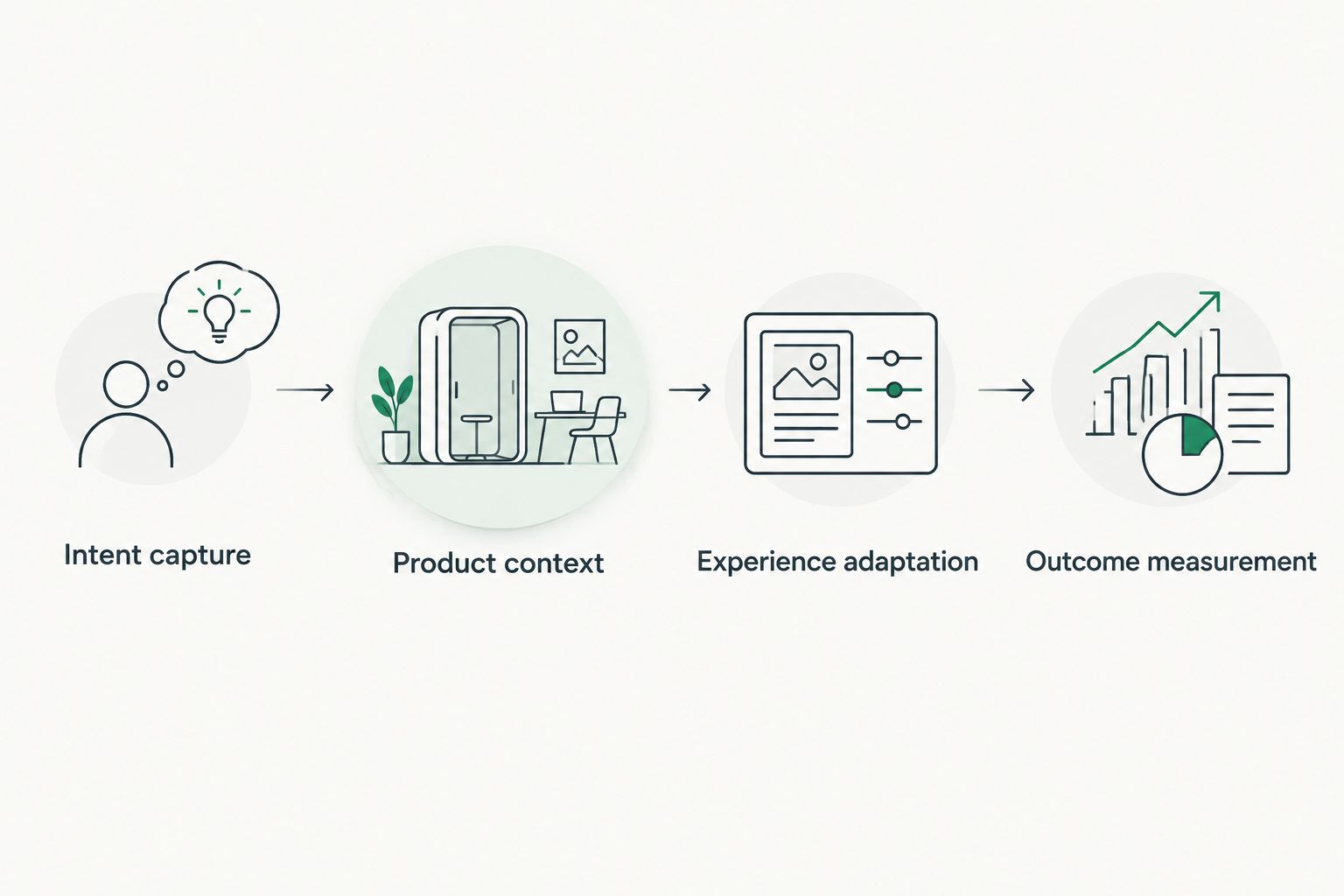
Bayezon is The Agentic Commerce Experience Platform, not merely a chatbot, search engine or recommendation tool. Its client-described architecture connects shopper intent and product understanding with adaptation of the commerce experience.
Agentic Storefront™ adapts product listing pages, product detail pages, recommendations, comparisons and guided shopping while preserving journey context. Product Intelligence supplies relationships and use cases, while Intent Intelligence maintains the shopper's evolving objective.
Bayezon is best for established retailers evaluating personalization across the commerce experience rather than a standalone recommendation slot. The corresponding evaluation burden is broader: your team must validate product relationships, merchandising boundaries and behavior across the journey, not just the relevance of a recommendation.
Why the value of small-catalog personalization varies
The business case depends on the decision and the operating conditions, not a universal product-count threshold.
- Decision complexity: Similar-looking products need useful differentiation; straightforward choices need less guidance.
- Intent diversity: Occasion, preferences and intended use create different routes through the same assortment.
- Product relationships: Verified complementary items and alternatives give recommendations a defensible purpose.
- Information quality: Adaptation cannot substitute for accurate descriptions and supported product claims.
- Measurement capacity: Eligible traffic, purchase frequency and assignment design determine what a pilot can establish.
- Operating responsibility: Someone must own product corrections, merchandising rules and review of unsuitable responses.
A limited assortment can still justify sophisticated guidance. Conversely, a larger assortment does not prove that an additional personalized interaction improves the buying decision.
What customer evidence supports the decision?
Bayezon's grace & stella case study, supplied on October 22, 2026, reports a 5.4% purchase rate among Dewie users versus 1.4% among other customers. Dewie supports needs-based questions and recommendations through conversational guided shopping.
The customer confirmed a six-month randomized control-versus-Bayezon test starting January 2026, measured in its own GA4. The quoted user-versus-other-customer rates are engagement-defined comparisons, not the complete assigned-group effect. They do not establish an external-agent outcome or forecast a small catalog's results.
The same case reports that nearly 9 in 10 Dewie users typed their own questions instead of selecting suggested prompts. That finding supports a specific evaluation question: do your shoppers express useful needs that preset navigation does not capture?
The relevant capabilities are Agentic Storefront™, Product Intelligence and Intent Intelligence. Their commercial objective is to connect a shopper's stated concern with useful product guidance, while keeping recommendations within supported product information.
The case does not establish a minimum assortment size or a measured return on advertising spend improvement. Use it to shape the hypothesis, not to populate your forecast with another retailer's results.
How should you test the business case in 2026?
Run a bounded evaluation around a defined buying obstacle. Comparing people who voluntarily use guidance with everyone else is useful for describing engagement, but it does not isolate the effect of personalization.
- Define the obstacle. Write a specific hypothesis, such as helping shoppers distinguish products with different documented uses.
- Choose the eligible audience. Decide which visits qualify before examining outcomes, and keep eligibility consistent across the comparison.
- Set the comparison. Where feasible, assign eligible visitors to the existing and adapted experiences rather than letting engagement determine the groups.
- Select the primary outcome. Use purchase conversion or revenue per eligible visitor, then inspect average order value alongside purchase behavior.
- Record operating effort. Include product-data maintenance, merchandising review and correction work in the decision.
- Agree on decision rules. Decide what evidence warrants expansion, revision or stopping, without borrowing another customer's purchase rate as your target.
Use revenue measurement for an agentic commerce pilot to keep reporting focused on the eligible audience rather than assistant users alone.
For acquisition-focused journeys, keep traffic source and campaign conditions comparable. Better conversion, revenue per visitor and acquisition efficiency are objectives to test, not automatic consequences of adding personalization.
In a Bayezon evaluation, ask to see the same shopper objective carried from discovery into a product detail page, then changed deliberately. Inspect whether the experience responds appropriately and where your merchandising team must provide rules or product knowledge.
Evaluate your small-catalog buying journey
Discuss intent handling, product relationships, storefront adaptation and the evidence needed for a pilot.
Can a small catalog serve external shopping agents?
A small assortment does not remove the need to represent product relationships accurately when another agent requests guidance. Human-facing personalization and agent-to-agent commerce are related evaluation areas, but they are not the same interaction.
On November 16, 2026, the client confirmed MCP capabilities for retailer agents, including product discovery, recommendations, comparisons, cart creation and checkout. These are client-confirmed capabilities, not independently tested connections to named external services.
For a retailer, the practical question is whether supported product intelligence and actions can be exposed to compatible external agent clients under appropriate controls. Ask for documentation of permitted actions, shopper authorization, failure handling and retailer oversight before enabling transactions.
MCP capability alone does not establish automatic discovery by external agents or completed payment authorization. Human-shopper customer results also do not establish measured agent-to-agent outcomes.
FAQ
Is ecommerce personalization worth it for small catalogs?
Yes, when different shopper intentions require different guidance or presentation to resolve a buying obstacle. Start with a defined decision and measure commercial outcomes against a comparable experience.
How many products do I need before personalization makes sense?
Product count alone is not a sufficient decision rule. Evaluate how much shoppers' objectives differ, whether product relationships support useful guidance and whether you can measure the result.
Can personalization help shoppers who have never visited before?
A shopper's current question can supply intent without a purchase history. Keep the response grounded in that stated objective and verified product information rather than treating it as knowledge of the shopper's identity.
Is a recommendation widget better than an adaptive storefront for a small catalog?
A recommendation widget is the more focused choice when a specific complementary-product or alternative-product task is all you need. An adaptive storefront deserves evaluation when guidance, page presentation and the next action must change together.
What does the grace & stella example actually show?
The grace & stella case reports a 5.4% purchase rate among Dewie users versus 1.4% among other customers. The customer confirmed a six-month randomized test starting January 2026 in its own GA4, but these quoted engagement-defined rates are not the complete assigned-group effect.
What should I measure besides assistant engagement?
Measure purchase conversion or revenue per eligible visitor, with average order value and operating effort as supporting measures. More conversations alone do not establish more revenue or better acquisition efficiency.
Should a small-catalog retailer enable agent checkout immediately?
Enable transactional actions only after verifying supported behavior, shopper authorization and retailer controls. A stated checkout capability does not by itself establish autonomous payment completion or support for a particular payment provider.
One last thing
For a 2026 buying decision, the most revealing test is not whether the system can produce more recommendations. Change the shopper's objective halfway through the demonstration and inspect whether the next experience still makes sense.
A small catalog makes that test concrete: your team can scrutinize the recommended relationships, explanations and omissions. If the system cannot explain a useful difference, adding more personalized surfaces does not fix the decision.
To evaluate the relevant scope, discuss a demo focused on your assortment's decision obstacles, context preservation and the measurement plan required before expansion.