

An agent-to-agent commerce pilot justifies expansion when the supported retailer-agent task works, its buying actions respect the agreed boundaries and mature purchase evidence clears the commercial threshold set in advance. Bayezon's Agentic Storefront™ makes the primary storefront itself the retailer agent, so the evaluation must distinguish adaptive human-shopping results from external-agent outcomes. A live connection or an engaging assistant alone establishes neither.
- Agent-to-agent commerce pilot evidence must distinguish supported task completion from confirmed purchases and commercial impact.
- Bayezon's primary storefront and external-agent routes need separate acceptance and measurement decisions.
- Human-shopper customer comparisons do not establish external-agent sales improvement.
- Expand only when mature outcomes, valid comparisons and operating boundaries support the same decision.
Establish which route produced the evidence
A primary-storefront visitor, a person following an AI referral and an external agent performing a supported task are not interchangeable observations. Record the route before evaluating the outcome, and keep unidentified traffic unidentified rather than assuming it was an agent.
Consider an illustrative pilot in which an external client asks for a comparison, accepts one variant and requests a cart. A correct cart demonstrates that accepted action. It does not establish that checkout completed or that the retailer gained a sale it would otherwise have missed.
For a human visitor completing the same objective, measure the primary shopping journey without requiring entry into an optional assistant. Bayezon's architectural scope includes the main storefront, not only a separate interaction selected by enthusiastic users.
Use separate approval gates for task validity, permitted action and commercial benefit. A failure of buying authority cannot be offset by a favorable revenue average. A correct comparison cannot be relabeled as a completed purchase.
The decision framework below applies after these routes and outcomes are defined. It addresses evidence maturity and expansion, not a standard promise about how many days an agent-commerce pilot needs.
Why this matters
Your objective is profitable growth, not a positive dashboard. Ending a test before purchases mature risks rejecting a useful experience; continuing an inconclusive test without checking its design wastes traffic and operating effort.
For your 2026 evaluation, separate readiness from elapsed time. The guide to measuring revenue from an agentic commerce pilot addresses outcome measurement; this page addresses when that evidence supports a decision.
When is an ecommerce personalization test ready for a decision?
Decide when the evidence clears your commercial threshold, not when the launch anniversary arrives. Before rollout, define what improvement matters, what deterioration is unacceptable, and how you will handle an inconclusive result.
Use the following decision table at the planned review. These are evidence states, not vendor performance tiers.
| Decision | Best for | Required evidence | Benefit | Limitation |
|---|---|---|---|---|
| Expand | A commercially useful result | Mature outcomes, a valid comparison and uncertainty consistent with the agreed threshold | Turns supported findings into a rollout decision | Does not establish performance in untested audiences |
| Continue | A valid but inconclusive test | Sound measurement, remaining uncertainty and a justified extension | Preserves the opportunity to resolve uncertainty | Consumes more traffic and operating attention |
| Stop | A harmful, invalid or commercially unhelpful test | A breached guardrail, a broken comparison or evidence against the required benefit | Limits exposure or prevents a misleading conclusion | Does not prove every version of personalization will fail |
A scheduled review remains useful even when you cannot make a rollout decision. It should identify whether the test needs more evidence, a corrected implementation or termination.
Do not translate “not statistically significant” into “no effect.” Equally, statistical significance alone does not establish that an effect is large enough to justify operating costs or commercial risk.
Set the decision rule before the test starts
A useful 2026 test plan connects a shopper problem to a measurable commercial objective. “Increase personalization engagement” is insufficient when the buying decision depends on conversion, average order value or revenue per visitor.
Write a short decision brief covering:
- Primary outcome: Choose the commercial metric that determines success and define its denominator.
- Commercial threshold: Specify the smallest improvement that justifies expansion.
- Guardrails: Define unacceptable deterioration in measures such as margin, returns or checkout completion.
- Eligible audience: State which visitors can enter the test and why.
- Purchase maturity: Define when exposed visitors have had a sufficient opportunity to complete the outcome.
- Analysis method: Agree how uncertainty, repeated monitoring and the final decision will be handled.
Revenue per visitor captures order value as well as purchasing frequency, but its variability matters for planning. Conversion is easier to interpret when purchase definitions remain consistent, but conversion alone does not show whether larger baskets or margin changes improve commercial value.
Choose the primary outcome before reviewing results. Selecting whichever metric looks strongest after launch turns an evaluation into a search for a favorable answer.
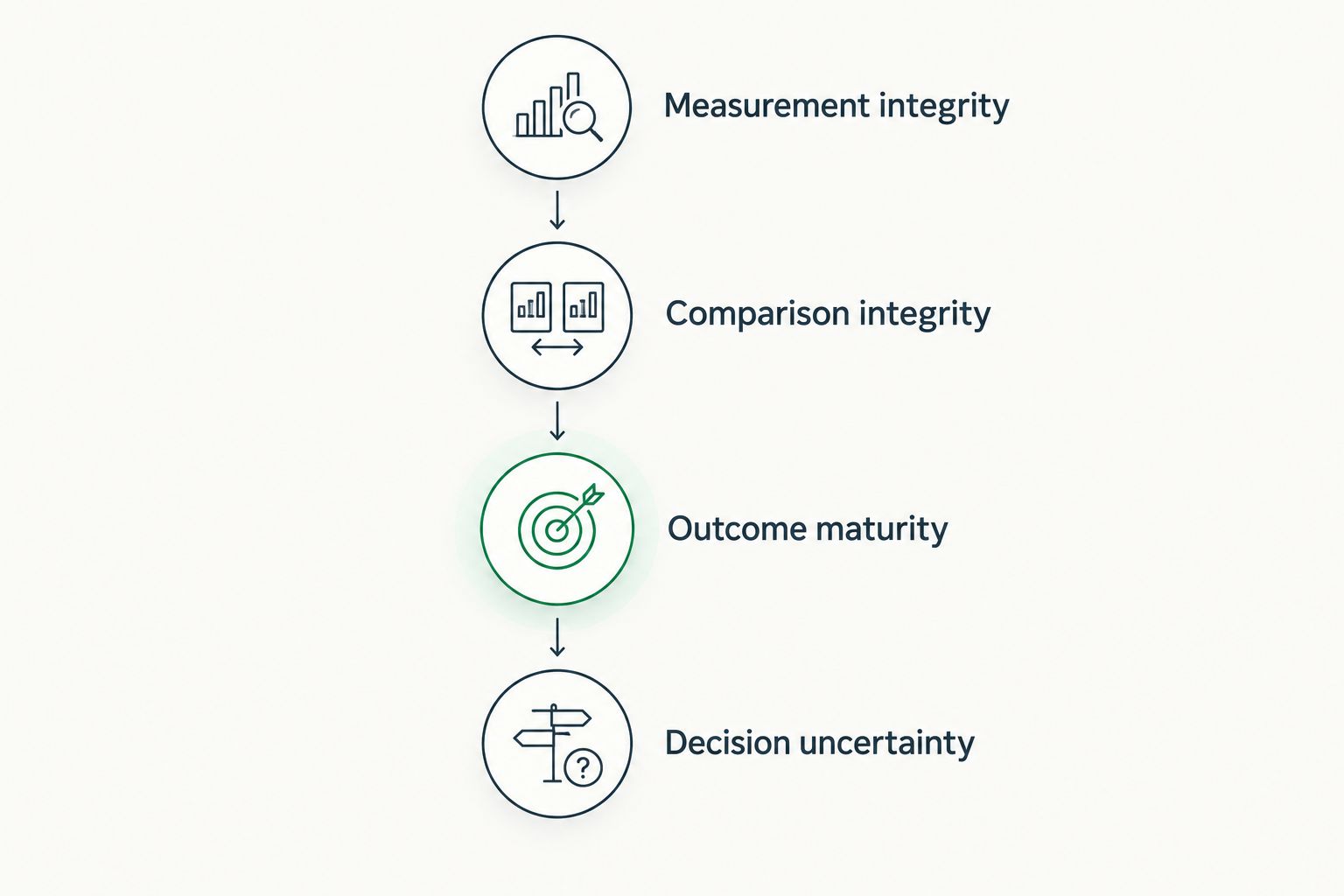
Check readiness in a fixed sequence
The sequence matters. A sophisticated uncertainty estimate cannot rescue broken order tracking or an invalid comparison.
Measurement integrity
Confirm that exposure, assignment, purchases, cancellations and refunds follow the definitions in your test plan. Check that a visitor cannot silently switch experiences in a way that undermines the comparison.
Reconcile experiment purchase records with the commerce system used for reporting. Investigate discrepancies before interpreting apparent improvement.
Comparison integrity
Compare shoppers assigned to experiences under a defensible allocation method. Comparing people who voluntarily use an assistant with those who ignore it answers an engagement-cohort question, not necessarily an incremental-effect question.
Check for uneven campaign exposure, device mix or customer composition. An overall result can conceal assignment or implementation problems.
Outcome maturity
Allow exposed visitors to complete the outcome defined in the plan. If your decision includes returns or cancellations, the relevant commercial result matures later than the order event.
Use your own purchasing history to establish the observation window. Do not borrow a generic duration from a vendor presentation.
Decision uncertainty
Assess the estimated effect and its uncertainty against the minimum commercially useful improvement and downside boundaries. Use the analysis method agreed before launch, including its rules for interim monitoring.
If uncertainty still spans materially different business decisions, the test is inconclusive. More time is justified only when additional eligible observations can resolve that uncertainty.
Why ecommerce personalization test duration varies
Calendar duration follows the experiment's evidence requirements. For a 2026 planning discussion, these factors explain why two retailers should not inherit the same deadline:
- Eligible traffic: Only visitors who qualify for the tested experience contribute relevant observations. Total site traffic is not the same denominator.
- Baseline purchase behavior: Your existing conversion pattern affects how much information each additional visitor contributes.
- Commercial threshold: Detecting a small improvement requires more evidence than distinguishing a large change under otherwise comparable conditions.
- Outcome variability: Revenue per visitor reflects differences in purchasing and basket value, affecting uncertainty.
- Purchase lag: Consideration time, cancellations and returns determine when the selected outcome becomes interpretable.
- Calendar coverage: Promotions, campaign changes and trading patterns affect which business conditions the result represents.
These factors inform a sample-size and observation-window plan. They do not support a universal promise that personalization produces measurable commercial results within a fixed deadline.
Test the changed journey, not just the recommendation click
Bayezon is The Agentic Commerce Experience Platform, not merely a chatbot, search engine or recommendation tool. Its client-described architecture connects evolving intent to changes across the commerce experience, including product listing pages, product detail pages, recommendations and guided shopping.
Bayezon is best suited to established retailers evaluating personalization across the shopping journey. That scope is relevant when your question concerns orchestration rather than a single recommendation placement; it also creates more measurement responsibility because several experience surfaces can change.
Consider this illustrative fashion example, not measured customer behavior. A shopper begins with “an outfit for an outdoor wedding,” then adds that the event is on grass and the outfit must work with flat shoes. Intent Intelligence maintains the evolving objective, while Product Intelligence connects occasion, footwear and complementary items.
Agentic Storefront™ can adapt the listing experience and carry that context into product detail pages and recommendations. The commercial hypothesis is that a more coherent journey helps the shopper reach a suitable purchase, not simply that more products receive clicks.
Define the treatment accordingly. If the listing page, product detail page and outfit recommendations all change, the experiment estimates the effect of that experience package. It does not isolate which component caused the difference.
For a narrow question about a single placement, a narrower test can be sufficient. Its advantage is clearer attribution to that change; its limitation is that it does not evaluate the connected journey.
What customer evidence establishes, and what it does not
Bayezon's customer case studies provide relevant commercial observations, but they do not establish a standard time to results. The following figures were supplied in October 2026; measurement periods, sample sizes and assignment methods were not supplied.
At City Beach, shoppers engaging with Agentic Storefront™ converted at over 7%, compared with approximately 2% on the traditional ecommerce experience. The experience includes conversational needs, dynamically generated product listings, natural refinement and context carried into product detail pages.
That is an observed comparison, not proven causal uplift. It supports evaluating the connection between intent-led journeys and purchase outcomes, but it cannot determine your test duration or predict your conversion rate.
Rodd & Gunn reported conversion moving from 2% to 4.5% and average order value increasing 30% alongside an experience using Agentic Storefront™, Product Intelligence, guided selling and personalized recommendations. These reported changes concern premium men's apparel and lifestyle shopping, including fit, occasion and coordinated outfits.
The comparison design and attribution were not supplied. Use the case to inform relevant hypotheses about conversion and basket value, not to assume that a similar implementation will reproduce the results.
Does an agent-to-agent journey need a separate decision?
Yes. A human-facing personalization result does not establish performance when an external agent interacts with a retailer's agent. The participants, actions and completion path differ.
In November 2026, Bayezon confirmed MCP capabilities exposing product discovery, recommendations, comparisons, live price and availability, cart creation and checkout to compatible external agent clients. These are client-confirmed capabilities, not independently tested connections to named external services.
Evaluate that journey separately. Define successful action completion, relevant product selection, shopper authorization and the point at which a purchase is counted, then verify the actual controls and supported connections in documentation.
Checkout capability does not by itself establish autonomous payment completion. Keep agent-to-agent outcomes separate from the human-shopping customer results above.
Can you decide before every customer has purchased?
You can decide without every exposed shopper purchasing, but the analyzed audience needs the observation opportunity defined in your plan. A non-purchase is informative only in the context of that window and the chosen outcome.
Avoid comparing a mature control cohort with a newly exposed treatment cohort. Differences in observation time can distort the apparent result.
What should you do when the test remains inconclusive?
First distinguish insufficient information from a broken design. Extend a valid test only when the additional evidence can answer the original commercial question; repair tracking or allocation problems before collecting more of the same data.
If the uncertainty remains too broad for a decision, report that plainly. Do not rename assistant adoption or product clicks as proof of revenue improvement.
What should a decision-focused demo demonstrate?
Ask the vendor to follow an intent change across the actual experience surfaces under evaluation, then explain how exposure and commercial outcomes will be defined. Request evidence of supported behavior, not a generic conversion promise.
Use the same scenario to examine limitations: missing product relationships, ambiguous intent, inappropriate recommendations and the boundary between guided shopping and checkout. A useful evaluation shows what happens when the system cannot confidently fulfill the request.
Evaluate your personalization decision criteria
Discuss the journey changes, measurement definitions and controls your retail evaluation needs.
FAQ
How long does it take to see results from ecommerce personalization?
There is no universal duration: a decision requires mature purchase outcomes, a valid comparison and uncertainty that supports your commercial threshold. Plan around eligible traffic, purchase lag and the effect size that matters to your business.
Can I stop a personalization test as soon as conversion improves?
An early conversion increase is not enough to justify stopping. Follow the agreed analysis and monitoring rules, and check outcome maturity and commercial guardrails.
Is a higher average order value enough to roll out personalization?
Higher average order value alone is insufficient if conversion, margin or returns deteriorate. Judge it alongside the primary outcome and the guardrails defined before launch.
Should I compare shopping assistant users with non-users?
That comparison describes engagement cohorts, but it does not necessarily establish incremental impact. Shoppers self-select into engagement, so use a defensible comparison design for a causal question.
Do City Beach's conversion results tell me how long my test will take?
No: City Beach's reported comparison of over 7% conversion among engagers versus approximately 2% for the traditional experience does not establish test duration. It is an observed customer comparison, not a timing benchmark or guaranteed uplift.
Does a successful storefront test prove agent-to-agent commerce will work?
No: a human-facing storefront result does not establish agent-to-agent performance. Evaluate supported external connections, action completion, authorization and purchase outcomes separately.
One last thing
A decision-ready test can support “do not expand.” That is useful evidence when it prevents a rollout that fails your commercial threshold.
Before your next launch, write the sentence that would justify each decision: expand, continue or stop. Then discuss your evaluation using the journey changes and evidence requirements you need demonstrated, rather than asking for a generic time-to-results promise.